Doctrine and Questions
Grace You Can Receive: The Quiet Power of the Sacraments
A Catholic look at how Christ meets us through visible signs and gives real help for the Christian life.
Site Admin | July 19, 2025 | 80 views
In Catholic life, grace is never meant to remain a theory. It is the very gift of God by which we are brought into communion with Him, healed from sin, and strengthened to live as His children. When Catholics speak of sacramental grace explained in simple terms, they mean this: Christ uses the sacraments to give real, holy help for the life of faith.
This is one of the Church's most beautiful and practical teachings. The Lord does not save us from a distance. He comes near through words, water, oil, bread, wine, laying on of hands, and the ministry of His Church. He touches the ordinary and makes it a place of divine action.
Grace is God's life shared with us
Before speaking about sacramental grace, it helps to remember what grace is. Grace is God's free gift, His own life and favor given to us. It is not something we earn. It is not a spiritual reward for good behavior. It is the mercy of God at work in the human person, drawing us toward holiness and friendship with Him.
The New Testament speaks constantly of this gift. Saint Paul says, For by grace you have been saved, and he reminds the Church that salvation is rooted in God's mercy, not human boasting. Grace begins the Christian life, sustains it, and perfects it.
Catholic teaching also distinguishes between sanctifying grace and the graces God gives for particular needs. Sanctifying grace is the stable gift that makes us pleasing to God and shares His divine life with us. Actual graces are helps God gives in moments of temptation, decision, suffering, prayer, and duty. Sacramental grace belongs to this larger world of God's gifts, but in a special and sacramental way.
What sacramental grace means
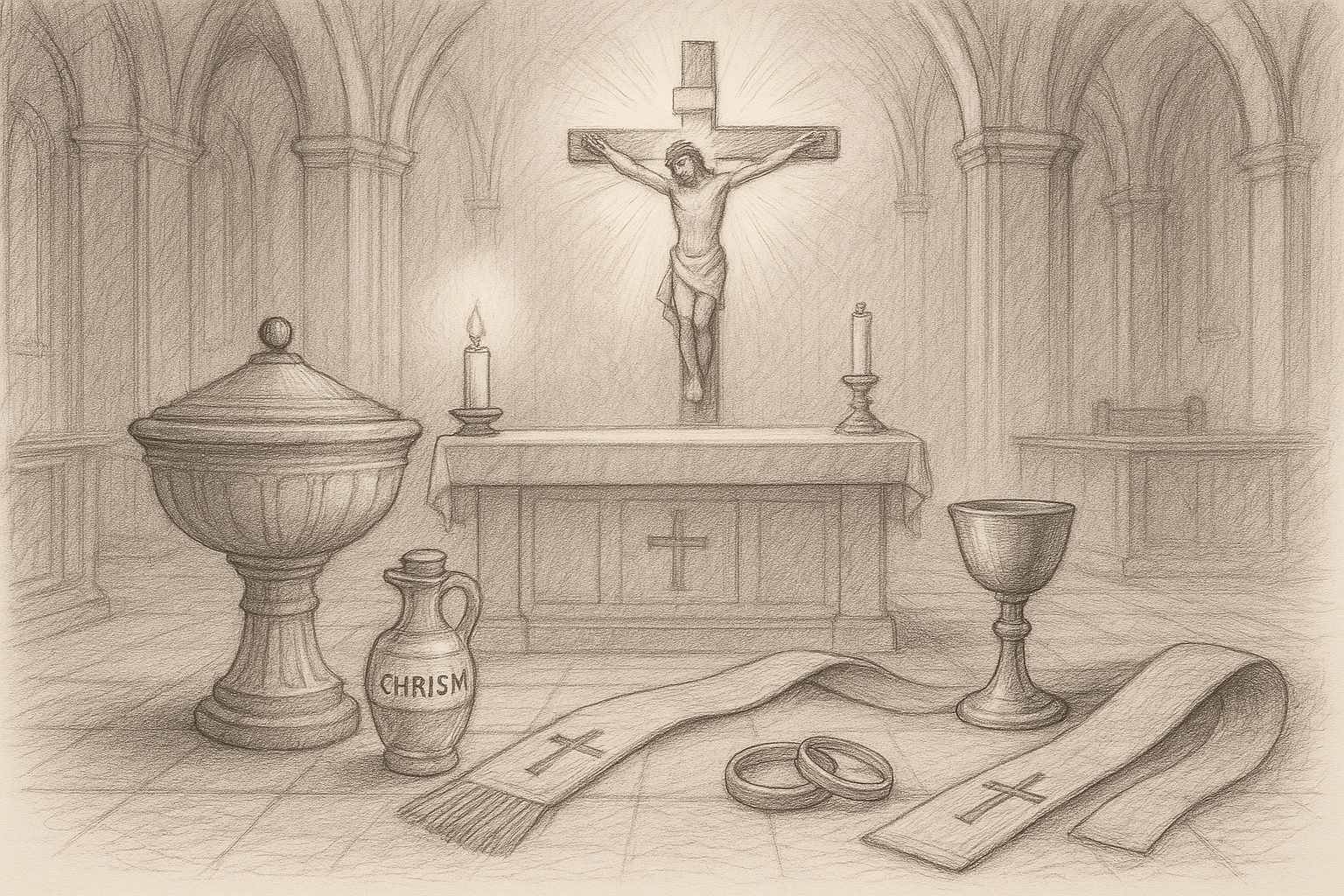
Sacramental grace is the grace given by Christ through the sacraments. Each sacrament confers a grace proper to itself. Baptism gives new birth and cleanses from sin. Confirmation strengthens the baptized with the Holy Spirit. The Eucharist nourishes and deepens union with Christ. Penance reconciles the sinner to God and the Church. Anointing of the Sick brings healing, peace, and strength. Holy Orders configures a man to Christ for service in the priesthood. Matrimony sanctifies the bond of husband and wife and supports their vocation of faithful love.
In other words, sacramental grace is not vague religious encouragement. It is real divine assistance given in a sacramental encounter. The Church teaches that the sacraments confer grace because Christ Himself acts in them.
When the Church baptizes, absolves, anoints, consecrates, or joins spouses in sacramental marriage, it is not merely performing a rite. It is the risen Lord acting through visible signs to give invisible gifts.
This is why the Church has always treated the sacraments with reverence. Their power does not come from human personality or devotion alone. It comes from Christ, who instituted them and remains faithful to His promise.
Scripture shows a God who gives grace through signs
The Catholic understanding of sacramental grace is deeply biblical. From the beginning, God uses material signs to carry His action. He creates through His word, seals covenants with visible signs, and heals through touch, water, bread, and oil.
Jesus' own ministry is full of sacramental patterns. He does not simply speak forgiveness from afar. He touches lepers, breathes the Spirit upon the apostles, and sends disciples to baptize. He says, Unless one is born of water and the Spirit. He also commands, Go therefore and make disciples of all nations, baptizing them.
At the Last Supper, He gives bread and wine and says, This is my body, which is given for you. Saint Paul passes on the apostolic faith when he writes, For I received from the Lord what I also delivered to you. The apostles then continue to minister in ways that show sacramental life at work, laying hands, forgiving sins, praying over the sick, and appointing ministers for the Church.
James gives the Church a direct glimpse of sacramental healing when he writes, Is any among you sick? Let him call for the elders of the church. The passage points to prayer, anointing, and the ministry of the Church as instruments of God's care.
None of this reduces grace to magic. Sacraments are not mechanical. They are covenant signs through which Christ acts. God is not trapped inside the sign, but He truly works through the sign He Himself has given.
The sacraments do not replace faith, but they nourish it
Some people imagine that sacramental grace and personal faith compete with one another. Catholic teaching says the opposite. The sacraments are gifts for believers, and they deepen the very faith by which we receive them. They are not substitutes for conversion, prayer, repentance, or trust. They are means by which all of these are strengthened.
This is one reason the Church insists that the disposition of the recipient matters. A sacrament is truly given by Christ, but the fruit borne in the soul depends on openness to grace. A person who receives the Eucharist in a state of grace is nourished in a way that is very different from a person who receives unworthily. A penitent who comes with contrition and honesty receives the healing power of absolution with greater fruitfulness than someone who resists repentance.
Still, the goodness of the sacraments does not depend on the holiness of the minister. Christ remains the principal giver. This brings great comfort to ordinary Catholics. Our access to grace does not depend on finding a perfect priest, a perfect parish, or a perfect moment. It depends on the fidelity of Christ.
Each sacrament gives a grace suited to a real human need
One of the richest aspects of sacramental grace is how closely it meets human life. God does not give us one generic blessing and leave us to sort it out. He addresses us in the concrete places where we need help.
Baptism
Baptism gives rebirth, washes away sin, and makes a person a new creation in Christ. It is the doorway into the Christian life. A baptized Catholic is not merely informed about God. He or she is adopted into God's family.
Confirmation
Confirmation strengthens the gifts received in baptism, sealing the baptized with the Holy Spirit for witness and perseverance. It is a grace for courage, maturity, and mission.
The Eucharist
The Eucharist nourishes charity and unites us more closely to Christ. It is not only a reminder of Him. It is communion with Him. The faithful are fed by the Lord's own self-giving love and are strengthened for daily holiness.
Penance and Reconciliation
In confession, sacramental grace restores the soul to friendship with God after sin. The penitent receives forgiveness, peace, and strength to begin again. This sacrament is one of the clearest signs that grace is mercy, not mere moral achievement.
Anointing of the Sick
Anointing offers consolation, courage, and healing according to God's will. Sometimes physical recovery comes. Sometimes the deeper gift is peace, endurance, and readiness to entrust oneself to the Lord.
Holy Orders and Matrimony
Holy Orders gives ministers the grace to serve in Christ's name. Matrimony gives spouses the grace to love faithfully, forgive repeatedly, and endure the demands of family life. These sacraments sanctify vocations, not just private devotion.
Why sacramental grace matters in ordinary Catholic life
This teaching matters because most Catholic life is ordinary. It is made of schedules, meals, work, fatigue, children, illness, responsibilities, and repeated beginnings. If grace were only a distant ideal, many would lose heart. But sacramental grace says that Christ meets us in the ordinary.
A parent goes to Mass exhausted and receives the Eucharist as strength for the week ahead. A sinner returns to confession after a long absence and hears words of absolution that re-open the way home. An elderly person receives anointing and discovers that suffering need not be abandoned to meaninglessness. A young couple marries and is not left to build fidelity on sentiment alone. A teenager is confirmed and sent into the world with the promise of the Spirit.
This is not an escape from reality. It is grace entering reality.
Many Catholics experience their faith most deeply in the sacraments precisely because the sacraments are dependable. Feelings rise and fall. Disciplines weaken and strengthen. But Christ remains faithful in the Church. The sacramental life teaches us that holiness is not reserved for extraordinary people. It is given to ordinary believers who keep coming to Jesus where He has promised to be.
A life shaped by sacramental grace
When Catholics live from sacramental grace, several habits begin to grow. First, there is reverence. The sacraments are not casual religious add-ons. They are encounters with the living God.
Second, there is gratitude. If grace is gift, then every sacrament is a reason to thank God. Baptism, confession, communion, marriage, anointing, ordination, and confirmation all remind us that God takes the initiative in our salvation.
Third, there is dependence. Catholics learn that holiness is not self-made. We need the Church's prayers, the sacraments, and the steady help of God.
Fourth, there is confidence. The sacraments are not signs of divine reluctance. They are signs of divine generosity. Christ wants to heal, feed, forgive, and strengthen His people.
That confidence matters in prayer as well. A Catholic who understands sacramental grace does not approach the altar or the confessional as though nothing is happening. He or she comes expecting the Lord to act, while remaining humble and receptive.
And so the sacramental life becomes a school of hope. In the water of baptism, the oil of anointing, the bread of life, the words of absolution, and the vows of marriage, the Lord keeps meeting His people. He is forming a holy people, one grace at a time.
That is why sacramental grace is not an abstraction for theologians alone. It is the quiet power by which Christ carries His Church through the everyday path of salvation, until the sacraments give way to the face-to-face vision for which they have always prepared us.
Keep Reading on Lets Read The Bible
Frequently Asked Questions
What is sacramental grace in Catholic teaching?
Sacramental grace is the grace Christ gives through the sacraments. Each sacrament confers a specific help suited to its purpose, such as forgiveness, strengthening, healing, or deeper union with God.
Do the sacraments work automatically?
The sacraments truly act by Christ's power, not by human merit, but the fruit they bear in a person depends on proper disposition. Faith, repentance, and openness to grace matter.
Which sacrament gives the most grace?
The Church does not teach a simple ranking that applies to every situation. Each sacrament gives real grace according to its purpose, and the Eucharist is especially central because it is the sacrament of Christ's Body and Blood.