Sacraments and Liturgy
Lent, Fasting, and the Quiet Work of Conversion
A practical Catholic look at prayer, fasting, and almsgiving in the season that teaches the heart to return to God.
Site Admin | September 12, 2025 | 64 views
What Lent asks of us
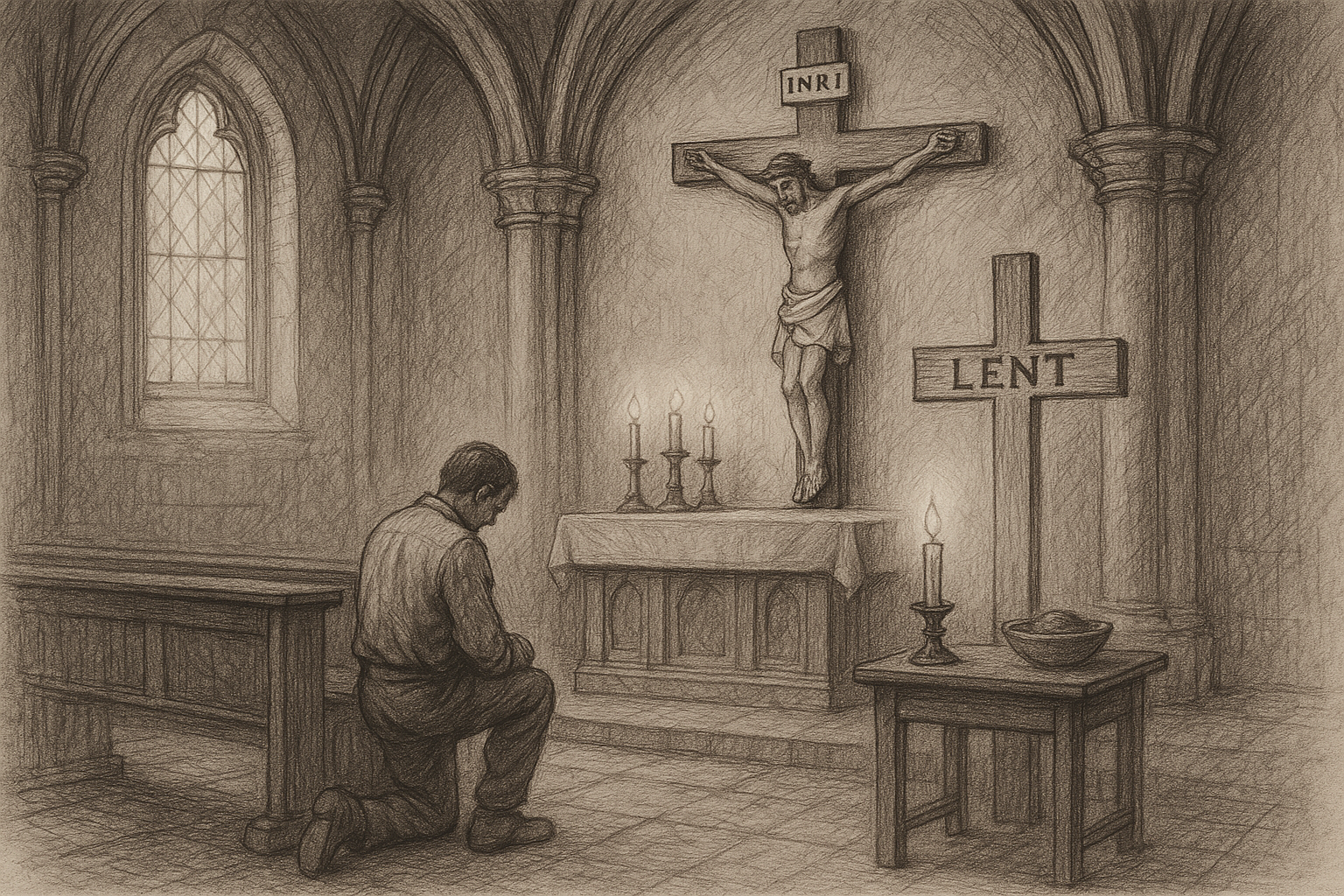
Lent arrives each year with a sober grace. The Church does not treat it as a vague season of self-improvement, but as a liturgical time set apart for conversion. From Ash Wednesday to Holy Thursday, Catholics are invited to pray more deliberately, fast more faithfully, and give alms more generously. These practices are not isolated habits. They belong together, and they are meant to turn the whole person back toward God.
The phrase Lent and fasting Catholic guide may sound practical, but the reality it names is spiritual and deeply human. Lent is not about proving that we can endure discomfort. It is about learning again that we are dependent creatures, redeemed by Christ, in need of mercy. The season creates room for repentance by reminding us that the heart can be trained, and that desire itself can be purified.
Where Lenten fasting comes from
The Church did not invent fasting as an arbitrary rule. Scripture shows fasting woven into the life of God s people from the beginning. Moses fasted on the mountain before receiving the Law. Israel fasted in moments of mourning and repentance. The prophet Joel called the people to return to the Lord with fasting, weeping, and mourning, not merely with outward signs but with torn hearts. Jesus Himself fasted in the wilderness before beginning His public ministry, and He taught that some struggles are met only with prayer and fasting Matthew 4:2 [[VERSE|matthew|6|16-18|Matthew 6:16-18]] [[VERSE|joel|2|12-13|Joel 2:12-13]].
From the earliest centuries, Christians continued this pattern. The Church understood that fasting was not a rejection of creation, but a disciplined use of creation for the sake of love. By forgoing some food and comforts, the believer makes space to remember what truly nourishes the soul. Lent developed as the Church's chief annual time for preparing catechumens for baptism and for renewing the baptized in repentance. Its fast became a shared sign that the whole Church was walking with Christ toward the Cross and the Resurrection.
That history matters because it shows Lent is not a private spiritual project. It is ecclesial. The Church fasts together, prays together, and seeks conversion together. Even when the practice is carried out in hidden ways, it belongs to the common life of the Body of Christ.
Why fasting has a place in Catholic life
Catholic fasting is not meant to earn grace. Grace is always a gift. Rather, fasting disposes us to receive what God wants to give. It loosens the grip of habits that can become tyrannical. It teaches humility by letting us feel, even in a small way, that we are not self-sufficient. And it joins us to Christ, who accepted hunger, thirst, fatigue, and suffering for our salvation.
Fasting also has a sacramental quality in the broad Catholic sense of the word. It is an outward act that bears inward meaning. The stomach is not holy in itself, but what we do with it can either reinforce self-indulgence or open us to gratitude and self-mastery. When fasting is done with faith, it can become a school of charity. We begin to see more clearly that our abundance is not ours alone, and that the poor are not abstractions but neighbors for whom Christ died.
The Church insists on this connection between fasting and love. Isaiah rebukes fasting that leaves injustice untouched. The true fast is one that loosens the bonds of wickedness, lets the oppressed go free, and shares bread with the hungry [[VERSE|isaiah|58|6-7|Isaiah 58:6-7]]. Lent echoes that prophetic demand. If our fasting makes us irritable, proud, or harsh, then something has gone wrong. But if it opens our hands, softens our speech, and deepens our patience, then it is doing its work.
What the Church actually asks
Many Catholics carry uncertainty about what fasting in Lent really requires. The Church's minimum disciplines are simple, but they are not meant to exhaust the season. On Ash Wednesday and Good Friday, Catholics who are of age and in good health are asked to fast. On those same days, and on the Fridays of Lent, Catholics are also called to abstain from meat. Outside these obligations, the Church encourages each person to practice additional acts of penance in a way suited to health, state in life, and pastoral circumstance.
It helps to remember that the law sets a floor, not a ceiling. A Catholic can fulfill the obligation and still miss the heart of Lent. Conversely, someone who cannot observe every form of fasting because of illness, pregnancy, demanding work, age, or another serious reason is not excluded from the season. The Church is a mother. She asks for sacrifice, but she does not ask for what would be unreasonable or harmful. What she seeks is a sincere turning of the heart.
That is why it is wise to keep Lent with steadiness rather than theatrical intensity. A modest but faithful fast, kept with prayer and charity, is often better than an ambitious plan that collapses after a week. The point is not spectacle. The point is conversion.
Prayer, fasting, and almsgiving belong together
Jesus places prayer, fasting, and almsgiving side by side in the Sermon on the Mount [[VERSE|matthew|6|1-6|Matthew 6:1-6]] [[VERSE|matthew|6|16-18|Matthew 6:16-18]]. This is not an accidental grouping. Prayer turns the soul toward God. Fasting disciplines desire. Almsgiving turns us outward in mercy. Together they form a kind of spiritual balance, keeping Lent from becoming either inward navel-gazing or merely social activism.
Prayer reminds us why we fast. Fasting reminds us that prayer is not a theory. Almsgiving reminds us that repentance has consequences in the real world. A person might choose to skip dessert, but if that choice does not lead to more attention to God and more generosity toward others, it remains thin. The classic Lenten pattern is beautiful because it resists that thinness. It gathers the whole person into a single movement of return.
Repent, and believe in the gospel. That is the sound at the center of Lent, and every discipline in the season serves that call.
How an ordinary Catholic can live Lent more deeply
The best Lenten practices are usually the ones that can be kept with fidelity. Start with the Church's obligations, then add one or two concrete practices that are realistic in your state of life. A parent with small children may not be able to take on long devotional plans, but may be able to begin the day with a short prayer, accept inconvenience without complaint, and fast from unnecessary spending. A student may not be able to give many hours, but may be able to limit distractions, attend daily Mass when possible, and set aside a portion of savings for almsgiving. A retiree may be able to pray a decade of the Rosary each day and visit the Blessed Sacrament more often.
What matters is not the size of the practice but its intention and persistence. Lent asks for honesty. What is pulling your attention away from God? What habit dulls gratitude? What attachment makes prayer difficult? Fasting can be directed toward those very points. If social media feeds restlessness, fast from it for part of the day. If overeating has become a way of self-soothing, simplify meals. If constant noise is making silence unfamiliar, create one quiet space each day for the Lord.
It can also help to connect fasting with a specific prayer intention. Fasting for a loved one, for the conversion of sinners, or for peace in the Church gives the sacrifice a sharper edge of love. The tradition of the Church has always understood penance as something offered, not merely endured. When united to Christ, even small sacrifices become fruitful.
Practical ways to keep a faithful Lent
- Attend Mass more intentionally, especially on weekdays when possible.
- Choose a modest fast beyond the minimum, and keep it consistently.
- Set aside a fixed amount for almsgiving and give it quietly.
- Read a Gospel passage each day and sit with one phrase in prayer.
- Make a good confession during Lent if you are able.
- Limit one distraction that tends to rule your attention.
Confession deserves special mention. Lent has always been a season of repentance, and the sacrament of Reconciliation gives that repentance a concrete and healing shape. In confession, the mercy of Christ meets the truth of our lives without illusion. That encounter is one of the most powerful ways to live Lent honestly, because it brings the season into the sacraments rather than leaving it at the level of personal resolve.
Fasting that leads toward Easter
Christian fasting is never an end in itself. It points forward. The Church fasts because she is a people on pilgrimage, and pilgrims travel light. Lent teaches us to renounce lesser things not because they are evil in themselves, but because they are not ultimate. The Resurrection is coming. Easter is not a reward for surviving Lent, but the fulfillment toward which all this purification tends.
That is why Lent can be experienced as hope rather than gloom. The ashes on our foreheads are a sign of mortality, yes, but they are also a sign that God meets mortal sinners with mercy. The fast makes room for desire, and desire makes room for joy. When Easter arrives, the feast does not feel trivial if we have prepared for it with sobriety. It feels like arrival.
For that reason, the most fruitful Lenten discipline is often the one that quietly changes the way we live after Lent ends. A better order in eating, a steadier habit of prayer, a more generous relationship to money, a greater readiness to confess sin, and a deeper love for the liturgy are all signs that the season has done its work. Lent passes quickly, but its gifts can last if we let them.
The Church gives us this season every year because she knows our hearts need training. We forget, drift, and become attached to what cannot satisfy. Lent calls us back. If we receive it with patience, the fast becomes less about deprivation and more about freedom, and the road to Easter becomes a road where Christ Himself walks with us.
Keep Reading on Lets Read The Bible
Frequently Asked Questions
What is the difference between fasting and abstinence in Lent?
Fasting usually means reducing the amount of food taken at a meal and limiting meals on designated days, while abstinence means refraining from meat. In the Latin Church, Catholics fast on Ash Wednesday and Good Friday and abstain from meat on those days and on the Fridays of Lent.
Can Catholics choose their own Lenten fast beyond the required days?
Yes. The Church encourages additional penance suited to a person's age, health, duties, and circumstances. Many Catholics choose a modest fast that can be kept faithfully, such as simplifying meals, giving up snacks, or limiting distractions.
What should I do if I cannot fast because of health or other serious reasons?
If fasting would be harmful or seriously imprudent, a person is not bound to that form of penance. The spirit of Lent can still be lived through prayer, almsgiving, works of mercy, and another suitable sacrifice chosen with prudence.