Sacraments and Liturgy
Making Room for the Lord: Living Advent with a More Intentional Heart
Advent is not a pause before Christmas so much as a spiritual way of clearing space for Christ, one prayer, one sacrament, and one small act of readiness at a time.
Site Admin | September 14, 2025 | 59 views
Advent arrives each year with a quiet but urgent invitation: prepare. The Church does not begin this season by telling us to rush toward Christmas, but to watch, to wait, and to make room. In a world that often treats December as a blur of noise and pressure, Advent gently restores a different rhythm. It asks the heart to slow down enough to notice that the Lord is near.
For Catholics, Advent is more than a nostalgic countdown to Christmas. It is a liturgical season shaped by Scripture, prayer, and hope. It remembers Israel's longing for the Messiah, it prepares the Church to celebrate the Nativity of Christ, and it turns our minds toward His coming again in glory. In that sense, Advent is both deeply ancient and intensely practical. It teaches us how to live in expectation without anxiety, and how to wait without becoming passive.
What Advent is, and why the Church gives it to us
The word Advent comes from the Latin adventus, meaning coming or arrival. The season is a period of preparation before Christmas, but it is not merely decorative. The Church places it at the start of the liturgical year because it sets the tone for all that follows. Before we celebrate the joy of the Incarnation, we first learn how to desire the Savior properly.
Scripture gives Advent its spiritual shape. We hear the voice of the prophets, especially Isaiah, speaking to a people who long for deliverance. We hear John the Baptist crying out in the wilderness, calling hearts to repentance. We hear Jesus urging vigilance, as in the words, Watch therefore, for you do not know on what day your Lord is coming. Advent gathers all of this into a season of holy readiness.
This readiness is not fear. It is hope purified by truth. Catholics do not prepare for Christ as though He were absent and unknowable. We prepare because He has come, He comes to us sacramentally, and He will come again. Advent holds these three movements together. The past, present, and future are all touched by His saving presence.
Advent in the life of the Church
The Church's liturgy teaches the soul before the soul fully notices it. In Advent, vestments are violet, the prayers are marked by expectation, and the Alleluia is held back until Christmas. These details are not empty symbols. They form us. They remind us that joy is richest when it has been awaited, and that celebration is deeper when it has been prepared for.
Advent also gives a healthy tension between penance and gladness. It is not as severe as Lent, but it carries its own discipline. The Church asks us to awaken our consciences, to examine our lives, and to resist the temptation to let Christmas become only sentiment or consumption. A Catholic heart benefits from this ordered restraint. It learns that longing itself can be sanctified.
The liturgy also widens Advent beyond the manger scene. When we pray the Mass during this season, we are not only moving toward Bethlehem. We are also looking toward the fulfillment of all history in Christ. That wider horizon is one reason Advent can feel sobering at times. It reminds us that the Incarnation is not sentimental closeness alone. It is the beginning of salvation, which includes conversion, judgment, mercy, and glory.
How an ordinary Catholic can live Advent more deeply
The most effective Advent preparation is often simple. Ordinary Catholics do not need to invent a new spiritual program each year. They need concrete, faithful practices that open space for grace. The goal is not to create spiritual performance, but to become more available to Christ.
1. Begin with prayer that makes room
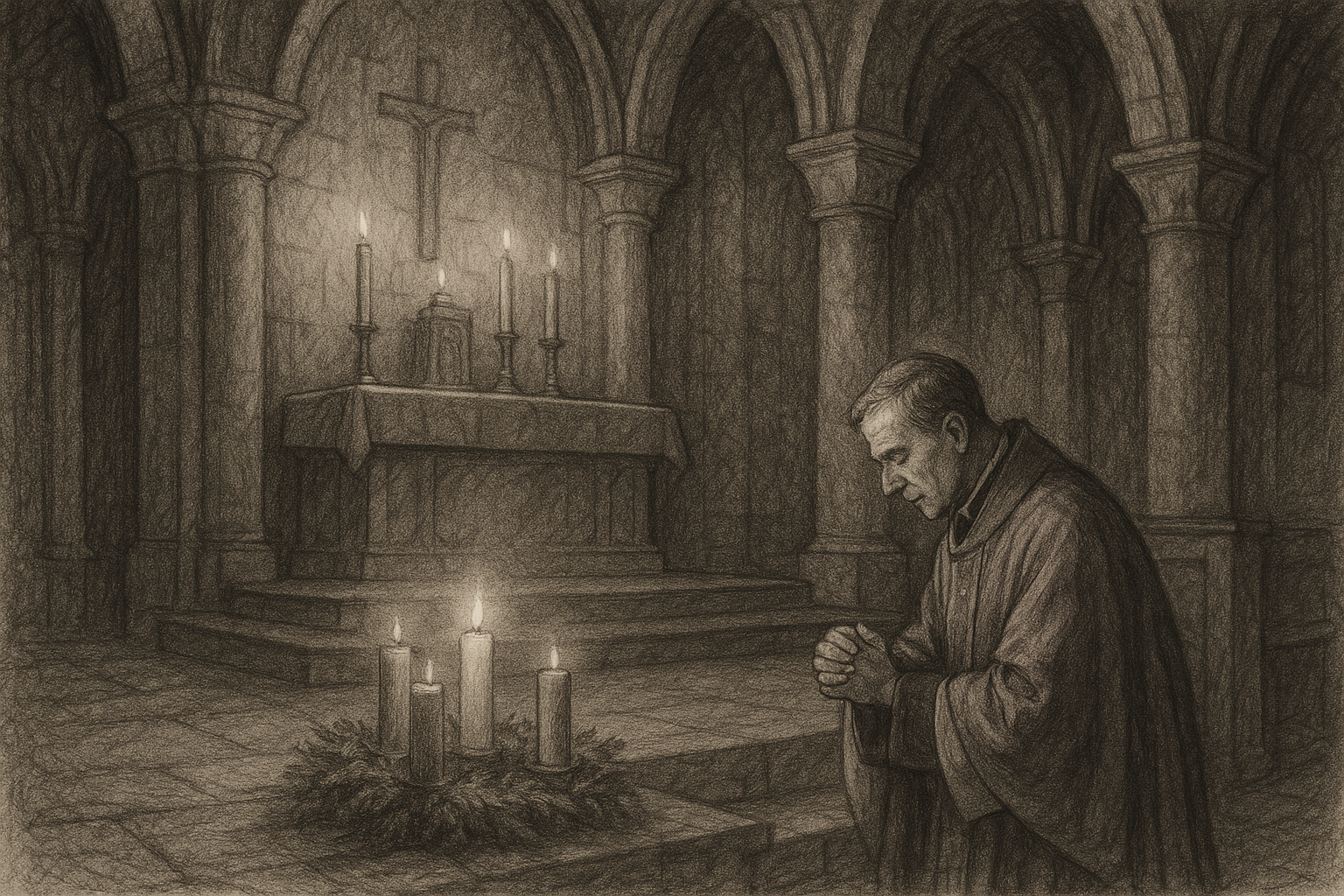
A short daily prayer can shape the whole season. Many Catholics pray with the Advent wreath, the Scriptures of the day, or a simple morning offering. The point is not quantity but attentiveness. Even ten quiet minutes can become a true preparation if they are given honestly to God.
It can help to pray with the Church's longing. The Psalms are full of this kind of waiting: I wait for the Lord, my soul waits, and in his word I hope. Such prayer reminds us that Christian hope is not shallow optimism. It is trust in the fidelity of God.
2. Receive the sacraments with deliberate devotion
Advent is an especially good time to receive the Sacrament of Reconciliation. Confession helps clear the inner clutter that keeps us from welcoming Christ more fully. If Christmas is about God entering human poverty, then sacramental confession is one of the places where that poverty is named honestly and met with mercy.
Sunday Mass should also be approached with special care in Advent. Arriving a little early, listening attentively, and making a more deliberate thanksgiving afterward can help the liturgy shape the soul. The Eucharist is not simply part of Advent preparation. It is the center of it. Christ comes to us in His Word and Body, and that encounter reorders our longing.
3. Practice restraint that serves love
In a season of excess, restraint can be a gift. Catholics may choose to simplify a few habits: spending less on unnecessary items, reducing some entertainment, or limiting the kind of busyness that leaves no room for prayer. This is not about joyless self-denial. It is about making space for what matters.
Restraint can also be family-oriented. A household might keep a quieter evening once or twice a week, dim unnecessary distractions, and use the time for Scripture, a Rosary decade, or simple conversation. Children often remember these small patterns more than elaborate activities. They learn, by habit, that Advent is a season of expectation.
4. Keep charity close to the center
Preparation for Christ is never only interior. The Lord comes to us in the poor, the lonely, the sick, and the overlooked. Advent gives a fitting opportunity to make charity more concrete. A donation, a visit, a meal, a handwritten note, or a hidden act of service can become an offering of readiness.
This is not a moral accessory. It belongs to the season. John the Baptist does not merely tell people to feel inspired. He tells them to bear fruit worthy of repentance. Advent charity is one way of bearing that fruit. It lets repentance become visible in love.
5. Reclaim silence and attentiveness
Many Catholics discover that Advent becomes richer when they allow more silence. This may mean turning off background noise, avoiding constant scrolling, or spending a few minutes in stillness before the day begins. Silence is not empty when it is given to God. It becomes a kind of readiness.
In silence, the Church can hear again the ancient promise: A voice cries: In the wilderness prepare the way of the Lord, make straight in the desert a highway for our God. That wilderness can be external, but it is often interior. Advent invites us to clear a path within ourselves where Christ can come without resistance.
Where Advent preparation comes from
Advent developed gradually in the life of the Church. Its roots reach into ancient Christian practice, especially in the West, where the season came to be observed as a time of preparation before Christmas. Over time, the liturgy gave it a clearer structure, and the Church came to see its value as a distinct season of anticipation.
Its deeper roots, however, are biblical and theological. Advent grows out of salvation history itself. Israel lived in expectation of the Messiah. The Church inherits that expectation and transforms it into prayer. Christians do not wait in uncertainty, but in fulfillment that is not yet complete. Christ has already come, yet the world still needs His healing and His peace.
This is why Advent speaks so powerfully to the human condition. Every person knows what it means to wait for what is good, to hope for what is not yet visible, and to desire a deliverance that cannot be manufactured. Advent dignifies that longing. It teaches that waiting can be holy when it is directed toward God.
What to avoid in Advent
One of the great temptations of the season is to confuse preparation with distraction. A full calendar can create the illusion of readiness while the soul remains untouched. Another temptation is to make Christmas arrive emotionally too early, leaving no space for Advent's quiet expectancy.
It can also be easy to reduce Advent to self-improvement. While self-discipline has a place, the Christian season is not mainly about becoming efficient or perfectly organized. It is about being receptive to grace. The question is not simply whether we are managing December well. The question is whether we are becoming more available to the Lord.
Finally, Catholics should avoid forgetting the poor in the middle of festive planning. If the season becomes only family tradition, aesthetic beauty, or private devotion, it can lose contact with the Gospel. Christ comes humbly. Advent should make us humble too.
Let Advent shape the way Christmas is received
When Advent is lived well, Christmas is not diminished. It shines more brightly. The joy of the Nativity is deeper when it is the fruit of longing, repentance, and prayer. A soul that has watched for the Lord is better able to recognize Him when He comes.
That is the heart of Advent preparation Catholic guide articles should recover in plain language: the Church is teaching us how to welcome Christ with our whole lives. Not only with decorations and music, but with confession, Mass, charity, silence, and hope. The season asks for simplicity, but it gives abundance in return.
If we let Advent do its work, we may discover that readiness is itself a grace. The heart becomes less crowded. Prayer becomes more sincere. Love becomes more concrete. And when Christmas finally arrives, it is not a sudden interruption to an already full life. It is the arrival of the One for whom we have been making room all along.
Keep Reading on Lets Read The Bible
Frequently Asked Questions
What is the main purpose of Advent for Catholics?
Advent prepares Catholics to celebrate the Nativity of Christ at Christmas while also recalling the Church's hope for His coming again. It is a season of watchfulness, repentance, and joyful expectation.
What are the best Catholic practices for Advent preparation?
Prayer, frequent attendance at Mass, confession, Scripture reading, silence, and concrete acts of charity are among the best ways to live Advent well. These practices help a Catholic make room for Christ in both heart and home.
Is Advent supposed to be penitential?
Yes, but in a moderate way. Advent has a penitential character, especially in the use of violet and in its call to conversion, yet it remains a hopeful and joyful season ordered toward Christmas.