Jesus and the Gospels
Mercy on the Road: Reading the Good Samaritan with Catholic Eyes
Christ's parable moves from roadside pity to a demanding vision of neighbor-love, mercy, and daily discipleship.
Site Admin | February 18, 2026 | 88 views
The parable of the Good Samaritan is so familiar that it can be easy to miss how unsettling it is. Jesus tells it in response to a legal scholar who asks, "And who is my neighbor?" The question sounds reasonable, even careful. It asks for limits. It asks for a definition. Christ answers by telling a story that does the opposite. He does not narrow neighbor-love. He widens it until it reaches the person in need, even when that person is inconvenient, unknown, or socially unexpected.
For Catholics, the Good Samaritan explanation is not only about being kind. It is about the shape of Christian charity, the demands of mercy, and the way Christ Himself reorders our view of human life. The parable is not a moral slogan. It is a lesson about the heart of the Gospel.
The setting of the parable
Luke places this teaching in a dialogue between Jesus and a scholar of the law. The man asks what he must do to inherit eternal life, and Jesus brings him back to the law itself: love God with all your heart, soul, strength, and mind, and love your neighbor as yourself love God and neighbor. The scholar then seeks a further clarification, asking who counts as neighbor Who is my neighbor?.
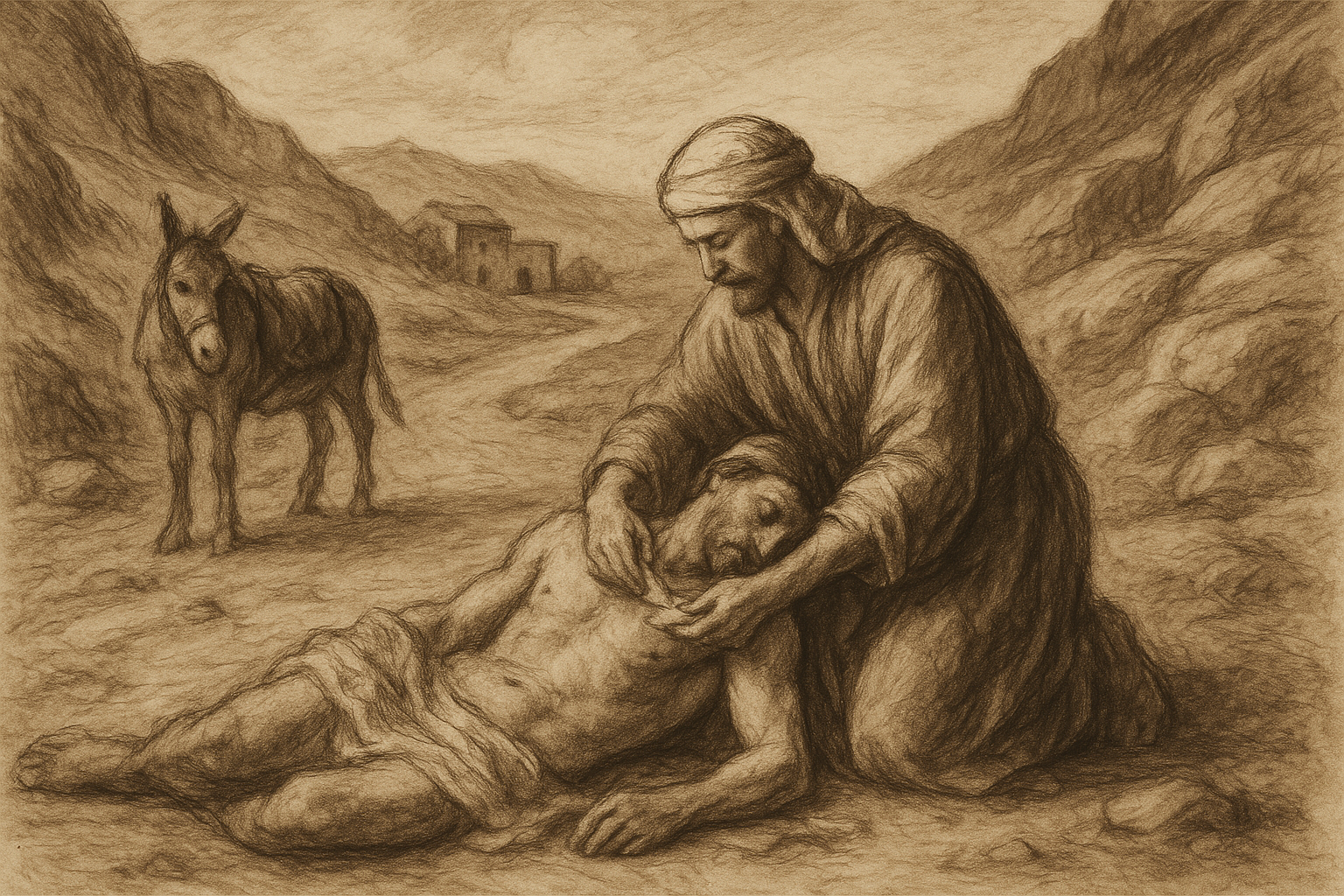
That question mattered in the world of Israel because the law of God was not vague. The command to love the neighbor was real, but people naturally wanted boundaries. Which people are included? Which obligations are binding? How far does mercy go? Jesus answers with a story set on the road from Jerusalem to Jericho, a place known for danger. A man is stripped, beaten, and left half dead. A priest sees him and passes by. A Levite does the same. Then a Samaritan, a figure despised by many Jews of the time, stops, tends the wounds, brings the man to an inn, and pays for his care.
The shock of the parable lies in the reversal. Those expected to know the law do not act with mercy. The outsider does. Jesus turns the scholar's question inside out. The issue is not, first, who qualifies as my neighbor. The issue is, will I become a neighbor to the one in need?
What Jesus is teaching
The parable reveals that mercy is not an abstraction. It is concrete, costly, and personal. The Samaritan sees the wounded man and is moved with compassion. He does not merely approve of helping. He helps. He binds the man's wounds, pours on oil and wine, lifts him onto his animal, and brings him to care. Mercy becomes action.
Jesus is also teaching that religious office alone does not guarantee love of God. The priest and the Levite, both associated with sacred service, fail at the point where charity is most needed. This does not mean the priesthood or temple service is condemned. Rather, Christ shows that worship detached from mercy is incomplete. The law of love cannot be fulfilled by outward observance alone if a suffering brother is ignored at the roadside.
At the end of the parable, Jesus asks a question that the scholar can hardly evade: "Which of these three, in your opinion, was neighbor to the robbers' victim?" Which was neighbor? The answer is obvious. It is the one who showed mercy. Jesus then says, "Go and do likewise" Go and do likewise.
That final command matters. Christ does not merely invite admiration for the Samaritan. He commands imitation. The parable becomes a mirror. It asks whether I am willing to cross the distance between myself and another person's suffering.
A Catholic reading of mercy
In Catholic tradition, mercy is not sentimental. It is one of the clearest forms of love because it responds to misery with help. The Lord's own life reveals this pattern. He does not stand far off from human suffering. He enters it. He heals, forgives, teaches, feeds, and finally lays down His life.
The Good Samaritan can be read as a figure of Christ without forcing the text. The injured man represents our wounded human condition. Sin has left humanity battered and unable to save itself. The Samaritan comes near, just as Christ comes near to us in the Incarnation. Oil and wine can recall the healing and strengthening grace God gives. The inn suggests a place of care, which many Christians have long seen as an image of the Church, where the wounded are tended while they continue their journey.
Still, it is important not to flatten the parable into a single allegory. Jesus gives a moral command, not only a hidden symbol. The story calls believers to act. Catholic interpretation holds both truths together. Christ is the true merciful one, and His mercy becomes the pattern for our own.
Mercy is love kneeling beside misery.
That simple idea echoes throughout Catholic life. It appears in the corporal works of mercy, such as feeding the hungry, sheltering the homeless, and visiting the sick. It also appears in the spiritual works of mercy, such as instructing the ignorant, counseling the doubtful, and bearing wrongs patiently. The parable does not list these works, but it breathes their spirit.
Why the priest and Levite matter
Readers sometimes rush past the priest and the Levite, but they are essential to the force of the parable. Their silence raises uncomfortable questions. Did they fear ritual impurity? Were they in a hurry? Did they assume someone else would help? Jesus does not explain their motives, and that is part of the point. Many excuses can sound reasonable when we are trying to avoid love.
Catholic life includes duties, schedules, devotions, and responsibilities. These are good and necessary. Yet the parable warns us not to let order become hardness. A prayer book in hand does not excuse a closed heart. A busy calendar does not erase the command to love. The Lord will not be impressed if we have maintained the appearance of religion while stepping around human need.
This warning is especially sharp because the road between Jerusalem and Jericho is not a theoretical place. It is a place of real vulnerability. The man is not merely troubled in a spiritual sense. He is injured and helpless. The Samaritan notices what others pass over. Love begins with attention.
How the parable touches daily Catholic life
The Good Samaritan explanation becomes practical when we stop asking only what the parable meant and begin asking what it asks of us now. In everyday Catholic life, the story challenges several habits.
- It challenges selective compassion. It is easy to care about people who resemble us, agree with us, or repay kindness. Christ calls us beyond that comfort.
- It challenges delay. The Samaritan does not postpone help until the man is easier to love.
- It challenges distance. Mercy usually requires getting close enough to be inconvenienced.
- It challenges superiority. We are not asked to judge whether the suffering person deserves aid. We are asked to love.
In family life, this can mean responding patiently to need rather than only to efficiency. In parish life, it can mean remembering the lonely, the elderly, the grieving, and the overlooked. In the workplace, it can mean refusing gossip and choosing fairness. In public life, it can mean defending human dignity without partiality or cruelty. None of this is glamorous. It is simply the road of discipleship.
The parable also invites self-examination during confession. Have I passed by when someone needed help? Have I excused indifference with good intentions? Have I limited my concern to the people easiest to love? The sacrament of Reconciliation is a grace-filled place to face such questions honestly. Christ does not accuse in order to crush. He reveals in order to heal.
The neighbor we are called to become
One of the most beautiful turns in Jesus' teaching is that neighbor is not only a noun. It is also a vocation. The question is not merely, Who belongs in my circle? It is, How can I become a neighbor? That change of perspective matters because Christian love is active. It moves outward.
For Catholics, this fits the whole logic of grace. We do not manufacture mercy on our own. We receive it from God and then pass it along. The more deeply we know Christ's tenderness toward our own wounds, the more readily we should notice the wounds of others. The Eucharist forms this kind of people, because at the altar we receive the one who gives Himself for the life of the world. A heart fed by Christ should not remain closed to Christ in the suffering person.
That does not mean we can solve every problem. The Samaritan cannot undo the violence that happened on the road. But he can do what is in front of him. He can bind wounds, provide transport, and pay for ongoing care. Much of Christian mercy is like that: small enough to be possible, real enough to matter.
The Good Samaritan remains unforgettable because it strips away excuses and leaves love standing in plain sight. Jesus teaches that eternal life is bound to love of God and neighbor, and that neighbor-love becomes visible in mercy. The road is still before us, and so are people who need to be seen, approached, and helped. The command of Christ has not changed: Go and do likewise.
Keep Reading on Lets Read The Bible
Frequently Asked Questions
Who is the Good Samaritan in Catholic interpretation?
In the plain sense of the parable, the Good Samaritan is the compassionate outsider who helps the wounded man. Catholics also often see him as an image of Christ, who comes near to heal wounded humanity, while still keeping the moral command to show mercy to others.
Why does Jesus choose a Samaritan as the hero of the parable?
Jesus uses a Samaritan because Samaritans were viewed with suspicion or hostility by many Jews of the time. The choice makes the lesson sharper: true neighbor-love is not limited by social boundaries, prejudice, or religious status.
How can Catholics apply the Good Samaritan to daily life?
Catholics can apply the parable by practicing the works of mercy, paying attention to people in need, and refusing to pass by when help is possible. It also invites examination of conscience about indifference, prejudice, and excuses.