Jesus and the Gospels
When Faith Reaches for the Hem: The Woman in the Crowd
A close reading of the Gospel healing that reveals Christ's mercy, the courage of hidden faith, and the dignity of the suffering soul.
Site Admin | February 11, 2026 | 71 views
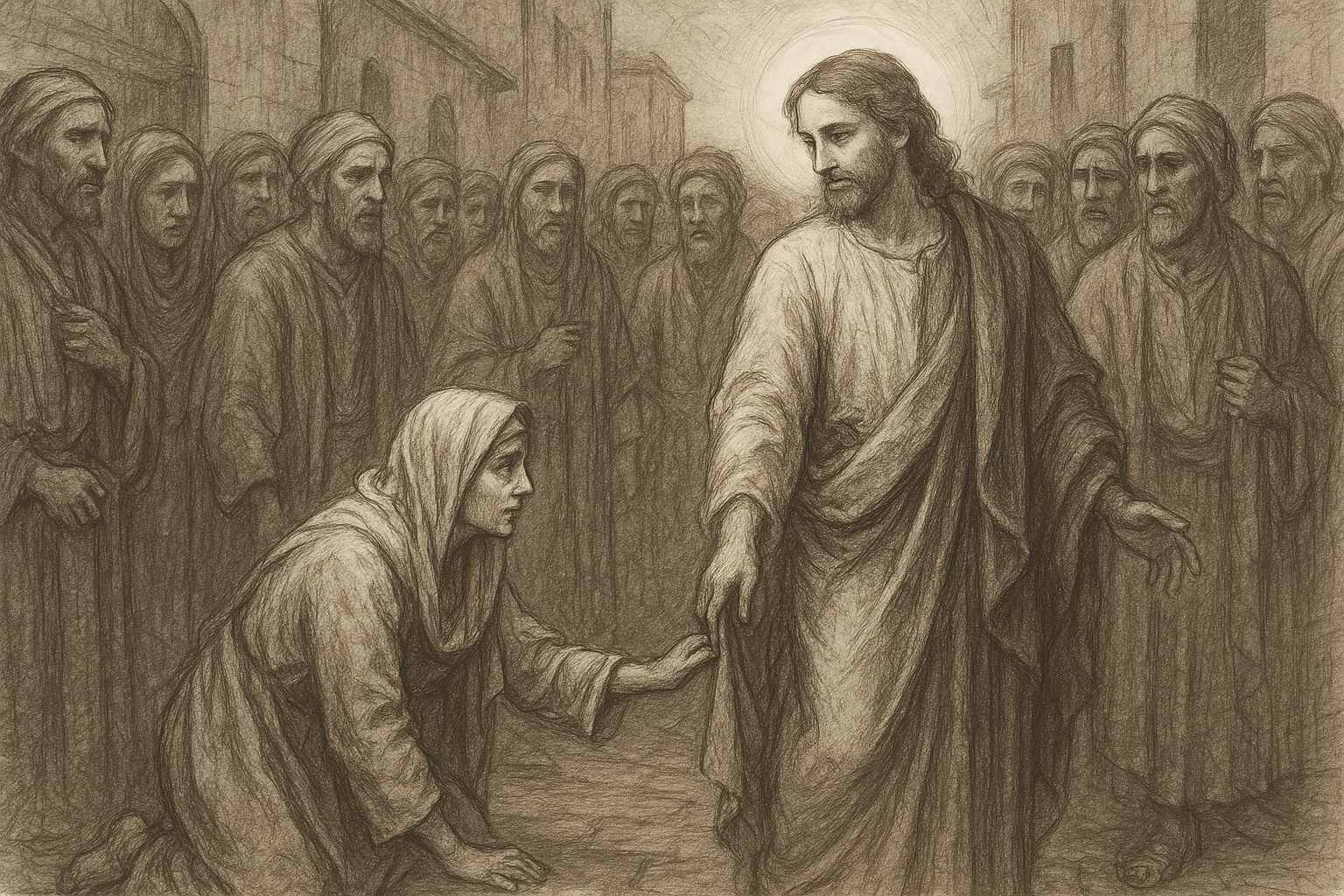
Among the many healing scenes in the Gospels, few are as intimate as the woman with the hemorrhage. She does not call out to Jesus by name. She does not speak a long prayer. She does not ask to be seen. Instead, she comes from behind the crowd and touches the fringe of His garment, trusting that even this small contact is enough for mercy to flow into her life.
The account appears in the Synoptic Gospels, especially in Mark 5:25 to 34 and Luke 8:43 to 48, with a parallel in Matthew 9:20 to 22. It is a story of suffering, faith, and restoration. For Catholics, the woman with the hemorrhage Catholic meaning is not only about physical healing. It also speaks of the Lord who sees the afflicted, honors faith, and draws the wounded person back into communion.
The Gospel scene in its plain beauty
The woman had been suffering for twelve years. The Gospels tell us that she had spent all she had on physicians and only grew worse. In the language of Scripture, her condition was not treated as a minor discomfort. It was long, exhausting, and isolating. Chronic illness in the world of the Gospels often meant more than bodily pain. It could also mean social shame, ritual uncleanness, and exclusion from ordinary life.
Then Jesus enters the scene as He is surrounded by a pressing crowd. Jairus, a synagogue official, has begged Him to come heal his dying daughter. The urgency of the moment is already high when the woman reaches out. Her action is quiet, but it is anything but trivial. She believes that if she can touch even His cloak, she will be made well.
Jesus stops. That detail matters. The crowd presses, but He perceives that power has gone forth from Him. He turns and asks who touched Him. His question is not because He lacks information. Rather, He brings the hidden act of faith into the light. The woman comes forward trembling and tells Him the whole truth. Jesus then addresses her tenderly:
"Daughter, your faith has made you well; go in peace."
In Matthew's account, He also says, "Take heart, daughter." The healing is complete, but the Lord does even more than restore her body. He restores her to peace, to voice, and to filial dignity.
Why the crowd does not obscure the individual soul
One of the most striking features of the story is the contrast between the crowd and the person. The crowd is large, noisy, and urgent. Yet Jesus is never too occupied to receive the one who comes in need. This is deeply consoling for Catholics, because it reveals something essential about divine mercy: Christ does not save humanity only in the abstract. He saves persons.
The woman had likely become used to being overlooked. Illness can make a person feel invisible. Long suffering can make the heart shrink. She may have expected resistance, embarrassment, or rejection. Instead, she meets a Lord who pauses in the middle of public movement to attend to one hidden act of trust.
That moment also reveals something about prayer. Not every prayer is loud. Not every prayer comes with polished language. Sometimes faith is expressed by reaching, waiting, and daring to believe that contact with Christ is enough. The woman does not control the outcome. She only comes. In that sense, her gesture is a figure of humble prayer itself.
The meaning of her touch
The woman reaches for the hem or fringe of Jesus' garment. For Catholics, this detail is rich with resonance, though we should be careful not to force the text beyond what it says. Her touch is simple and bodily, and that matters. The Incarnation means that the Son of God entered our material world and chose to heal through visible, tangible signs. Christ is not distant from fleshly human life. He enters it.
Her act also reminds us that faith is not merely an idea. It is a movement of the whole person toward the Lord. She believes, she acts, and she receives. The healing is not magic. It is not superstition. It is an encounter with the living Christ.
Catholic readers often see in this scene a gentle echo of sacramental life. The Church teaches that God uses outward signs to convey inward grace. The woman touches Jesus' garment and is made whole. In the sacraments, Christ continues to meet us through visible signs, not because matter is holy in itself apart from Him, but because He has chosen to make use of it as an instrument of grace. The story is not a proof text for sacramental theology, but it is beautifully consonant with it.
Faith, fear, and the courage to come forward
When Jesus asks who touched Him, the woman could have remained silent. Instead, she comes forward "in fear and trembling," according to Mark. That detail is psychologically true to life. Healing can be joyful, but it can also be frightening. When a person has lived for years with sickness, disappointment, or shame, being noticed can feel overwhelming.
Yet Jesus does not shame her. He does not rebuke her for touching Him. He does not insist that she did something wrong. He draws her out because He wants her healing to be personal and complete. Hidden faith becomes spoken faith. Private trust becomes public peace.
For Catholics today, this is a lesson in honesty before God. Many people carry wounds they would rather keep concealed. Some have physical illness. Others carry grief, anxiety, addiction, broken family relationships, or the quiet burden of years of discouragement. The Gospel does not say we must be polished before approaching Christ. It says we must come. Even trembling faith is real faith when it reaches toward Him.
What Jesus restores besides the body
The woman's cure is immediate, but her restoration is broader than bodily health. Her condition, in the Jewish context, likely involved ritual uncleanness, which would have affected worship and ordinary contact with others. Her healing therefore represents reintegration. She is not only less sick. She is returned to life among the people of God.
That is one reason this passage speaks so deeply to Catholic life. Sin and suffering both isolate. Christ heals in a way that restores communion. He does not merely patch up a broken person and send her away. He speaks peace. He calls her daughter. He gives back her place in the family of faith.
This is why Catholics naturally hear sacramental overtones in the scene, especially in relation to Reconciliation and the Anointing of the Sick. In Confession, the Lord does not simply pardon privately in the abstract. He restores the sinner to communion with God and the Church. In Anointing, Christ offers comfort, grace, and healing according to His will, whether by bodily recovery or by strengthening the soul for whatever lies ahead. The woman with the hemorrhage stands as a luminous image of the God who heals and gathers.
The connection with Jairus' daughter
In Mark and Luke, the healing of the woman unfolds within another miracle story, the raising of Jairus' daughter. The two accounts are intertwined. A dying child and a suffering woman are both drawn into the same dramatic movement of mercy. One is in a house, the other in a crowd. One is publicly urgent, the other privately hidden. Jesus attends to both.
This structure matters. The Gospel is not only about extraordinary miracles, but about the authority and compassion of Christ over every human condition. Delay does not defeat Him. Interruption does not derail Him. While others may see competing needs, Jesus sees persons. He can stop for one wounded soul and still arrive at the house where death seems to have already won.
For believers, that is not merely a narrative detail. It is a sign of the Lord's sovereignty over time itself. He is never late in the way we fear He is late. He works according to mercy.
Lessons for Catholic prayer today
The woman with the hemorrhage offers several practical lessons for prayer and discipleship:
- Come as you are. She did not wait until she was stronger, cleaner, or more deserving.
- Touch Christ with confidence. Her faith was directed toward a real Person, not a vague idea.
- Do not despise small acts of trust. A quiet gesture can carry great faith.
- Accept being known by Jesus. He does not only heal anonymously. He calls us into relationship.
- Receive peace as part of healing. Christ's gift is not only cure but communion.
Catholics may also find here a helpful pattern for prayer in times of illness. It is good to ask for healing. It is also good to ask for the grace to trust Christ's care even when the body does not immediately improve. The Lord who heals bodily affliction is the same Lord who strengthens the soul to suffer faithfully when healing does not come at once.
A word about hope and patience
The story is especially moving because it begins in disappointment. Twelve years is a long time to hope and be disappointed. Many people know that kind of waiting. Some pray faithfully and still feel that they are touching the edge of the crowd, not the center of God's attention. This Gospel says otherwise. Christ sees the one who touches Him in faith.
That does not mean every request is answered exactly as expected. The Church does not teach that prayer is a technique for controlling outcomes. Rather, prayer is an act of trust before a loving Father. The woman receives what she seeks, but even more importantly, she receives the Lord Himself in a way that confirms her worth.
That is the deeper consolation of the passage. The healing is real. The peace is real. But the true treasure is the encounter with Jesus, who is not too holy to be touched and not too busy to stop.
A final glance at the woman in the crowd
The woman disappears from the Gospel scene as quietly as she entered it. She is not named. She does not become a public figure. Yet her faith has been remembered by the Church for centuries because it reveals something enduring about Christ. He welcomes the needy. He notices the hidden. He honors the courage it takes to come near.
When Catholics reflect on the woman with the hemorrhage Catholic meaning, we do not only admire her perseverance. We also learn to trust the Lord who let Himself be interrupted for her sake. In every age, He is still worthy of that trust.
Keep Reading on Lets Read The Bible
Frequently Asked Questions
What is the main Catholic meaning of the woman with the hemorrhage?
Her story shows that Christ responds to humble, persevering faith with mercy, healing, and restored dignity. Catholics also see in it a sign that Jesus meets people personally and can use outward signs to bring inward grace.
Why did Jesus ask who touched Him if He already knew?
Jesus asked to bring the woman's hidden faith into the open, not because He lacked knowledge. He wanted to heal her publicly, give her peace, and show the crowd that her touch was received with compassion, not shame.
How can Catholics pray with this Gospel passage today?
Catholics can pray by coming honestly to Christ with their needs, asking for healing, and trusting His mercy even in long suffering. The woman's quiet reach is a model of simple, confident prayer before Jesus.