Jesus and the Gospels
The Woman Who Stayed Near the Tomb
Mary Magdalene meets the risen Jesus in a moment that reveals grief, faith, and the mercy of Christ.
Site Admin | January 26, 2026 | 99 views
Among the Easter accounts, few scenes are as moving as Mary Magdalene at the empty tomb. She comes in grief, remains in confusion, and leaves in joy. The Gospel writers do not soften her sorrow, and that is part of the beauty of the scene. The risen Jesus does not meet her in triumphal display but in a garden, at dawn, when her heart is still heavy with loss.
For Catholics, this moment is far more than a touching detail after the Resurrection. It reveals how Christ meets the faithful soul, how love persists when understanding is incomplete, and how the first Easter witness is given to a woman who stayed close to the Lord when others had gone home. Mary Magdalene becomes a sign of faithful discipleship, the kind that waits, weeps, listens, and then runs to announce what has been seen.
The Gospel scene at dawn
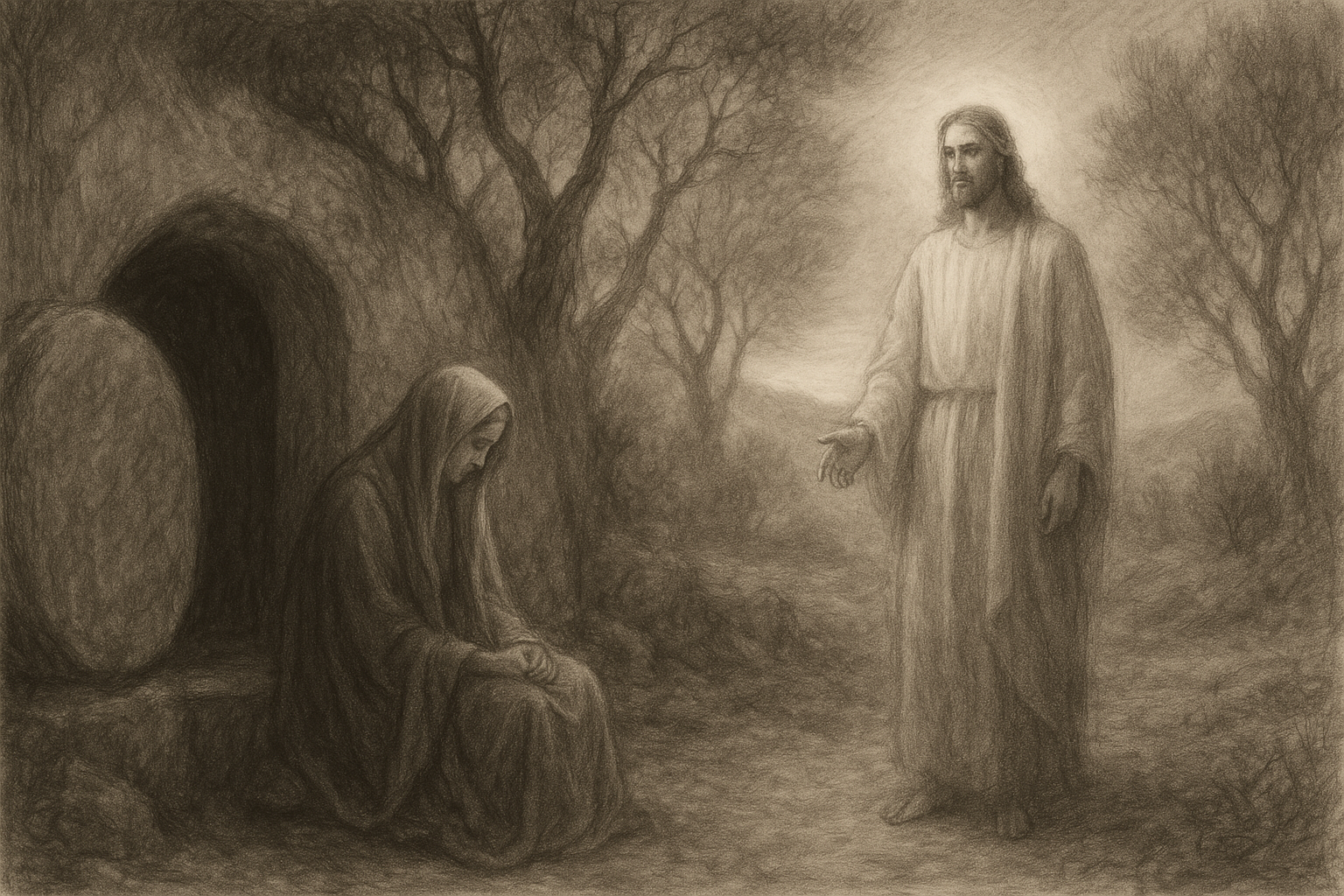
John tells us that Mary Magdalene came to the tomb early, while it was still dark John 20:1. She sees the stone removed and runs to tell Peter and the beloved disciple. After they leave, she remains there weeping. This detail matters. Mary does not treat the tomb like a mystery to solve and move past. She stays. Her grief is not yet ready to rest.
Then the angels speak to her, and shortly afterward she turns and sees Jesus, though she does not yet recognize him [[VERSE|john|20|11-16|John 20:11-16]]. He asks a question that reaches the center of her pain: Woman, why are you weeping? Whom are you seeking? The Lord is not merely asking for information. He is drawing her heart into the truth of what she most desires. She had come seeking the body of Jesus. In fact, she was seeking the One her soul loved, though she did not yet know how near he already was.
When Jesus calls her by name, everything changes John 20:16. Recognition comes through relationship. The Good Shepherd is known by the voice, and the disciple is gathered by name. Mary answers, Rabbouni, which means Teacher. Her tears are not dismissed. They are transformed by presence.
What Mary Magdalene teaches about love that stays
Mary Magdalene at the empty tomb Catholic meaning begins with her steadfastness. The Gospel presents her as one who does not abandon the place of loss. Even when she does not understand what has happened, she remains close to the Lord's presence. In Catholic life, this has a deep resonance. Faith is not always a matter of immediate clarity. Sometimes faith is the willingness to stay near Christ when the way forward is not yet visible.
Mary's love is not polished or theoretical. It is concrete and personal. She comes to tend the tomb, to honor Jesus, and to mourn. That love, though wounded, is still directed toward him. Such fidelity is precious. Many souls know what it means to keep praying, keep returning to Mass, keep showing up in sorrow, even when prayer feels dry and answers seem delayed. Mary shows that this kind of love is not wasted. It is often the very place where Christ makes himself known.
There is also a quiet humility in her search. She does not assume she has the full story. She asks, seeks, and weeps. That posture is important for Catholics. The Lord often reveals himself to those who are receptive, not to those who imagine they already possess the whole truth. Mary's heart is open, and because it is open, it can be filled.
The empty tomb is not absence without meaning
At first, the empty tomb looks like loss. Mary thinks someone has taken the body away John 20:13. Yet the empty tomb is one of the Church's great signs of hope. It does not erase the reality of death, but it declares that death has not conquered Jesus. The body that entered the tomb is no longer there because the Crucified One is alive.
Catholic faith never treats the Resurrection as a vague spiritual idea. The tomb is empty because Christ truly rose in the body. This matters because salvation is not escape from creation. It is the healing and fulfillment of creation. The same Jesus who was buried is now risen in glory, still bearing the marks of his Passion, yet no longer subject to death. The empty tomb is not a denial of the Cross but its victory.
Mary Magdalene stands at that threshold between sorrow and joy. She does not yet know what the tomb means, but she is present when the meaning is revealed. In this, she becomes an image of the Church herself, which receives the news of Resurrection as gift before it can fully explain it. Faith begins in encounter, then unfolds into understanding.
Why Jesus chooses to speak her name
One of the most tender lines in the Gospel is simply this: Jesus said to her, Mary John 20:16. Her name spoken by the risen Lord turns confusion into recognition. The moment is intimate and personal. It is not only that Jesus is alive. It is that he knows her, and she knows him.
This is deeply Catholic in spirit because it reflects the personal character of grace. God does not save mankind in the abstract. He calls persons. He calls by name. In baptism, each Christian is claimed by Christ. In prayer, the believer is not addressing an idea but a living Lord. Mary Magdalene's encounter reminds us that the risen Jesus is not distant from human sorrow. He enters it and speaks into it.
Her response, Rabbouni, also shows reverence. She does not claim the Lord on her own terms. She receives him as Teacher, as the One who interprets her life. This is a good Easter lesson for Catholics. We often want God to explain everything immediately. Instead, Christ often first gives himself, and only afterward grants deeper understanding. The sequence matters. Presence comes before explanation.
A witness entrusted with an announcement
Mary Magdalene does not merely receive consolation. She is sent. Jesus tells her, Go to my brethren and say to them... John 20:17. She becomes the messenger of Easter morning. The Church has long treasured this commission because it shows that the risen Lord entrusts a woman who had been weeping with the proclamation of joy.
This does not diminish the apostolic office of the Twelve. Rather, it highlights the generosity of Christ, who shares the news of his Resurrection through those who have truly encountered him. Mary is not given a secondhand report. She is a witness. And witnesses speak from what they have seen and heard.
There is a pattern here that Catholics can carry into daily life. The Lord often comforts us not only for our own sake, but so that we may bear witness to others. A person who has known mercy can speak of mercy. A person who has been consoled in grief can stand with those who grieve. Mary Magdalene moves from tears to mission in a single morning. That movement remains a beautiful model for Christian discipleship.
Mary Magdalene and the Easter shape of discipleship
Mary Magdalene's place at the tomb also reveals something about the shape of discipleship after the Passion. True discipleship is not only found in moments of bold confession. It is also found in loyalty, waiting, and loving presence. Mary is there when others are not. She does not understand the Resurrection in advance, but she does not leave before it is revealed.
Catholics can learn from this in several ways:
- Stay close to Christ in prayer even when feelings are uncertain.
- Bring grief honestly to God instead of hiding it.
- Allow the Scriptures to name what the heart longs for.
- Be ready to receive joy in the form God chooses, not the one expected.
- Let encounters with Christ lead naturally to witness.
Her example also speaks to the place of women in the Gospel narrative. Jesus receives women as real disciples, real believers, and real witnesses. Mary Magdalene is not a marginal figure in the Easter story. She is central to it. The Lord who rose from the dead chose to make his first appearance to a sorrowing woman who remained near the tomb.
Living the scene in Catholic prayer
It can be fruitful to meditate on this passage slowly in prayer. Imagine the garden before sunrise. Imagine the cold stone, the confusion, the tears, and the moment when Jesus speaks a single name. The scene invites a kind of prayer that is both simple and profound. Many Catholics find that lectio divina opens the heart to this passage, because the text itself moves gently from loss to recognition.
One may also pray with the desire to become more like Mary Magdalene: attentive, faithful, and ready to listen. When life feels like an empty tomb, the temptation is to assume that God has abandoned the scene. Mary teaches otherwise. The Lord may be nearer than we realize, and his timing may be hidden until the exact moment his voice is heard.
The Resurrection does not cancel tears. It gives them an answer. Mary Magdalene at the empty tomb Catholic meaning is not that sorrow is foolish, but that sorrow is not the final word. Christ receives the tears of his friend and turns them into the first proclamation of Easter. For the Christian, that is not only a story to remember. It is a mystery to enter, again and again, until the day when every hidden garden of grief is flooded with the light of his presence.
Keep Reading on Lets Read The Bible
Frequently Asked Questions
Why does Mary Magdalene not recognize Jesus at first?
The Gospel suggests that the risen Christ is truly present yet not immediately recognized in the ordinary way. Her recognition comes when Jesus speaks her name, showing that Easter faith is rooted in personal encounter and grace rather than sight alone.
What is the Catholic significance of Mary Magdalene being the first witness of the Resurrection?
Catholics see this as a sign of Christ's generosity and of the dignity of personal witness. Mary receives the first news of the Resurrection and is sent to announce it, which highlights her fidelity and the Lord's freedom in choosing witnesses.
How can Catholics pray with Mary Magdalene at the empty tomb?
A Catholic can pray with the passage by imagining the scene slowly, bringing personal grief to Christ, and listening for the Lord who calls by name. The story invites trust that Jesus meets people in sorrow and leads them toward hope.