Jesus and the Gospels
Bethany's Two Sisters and the Prayerful Shape of Discipleship
Martha and Mary show two real forms of love, both needed in the life of faith.
Site Admin | January 29, 2026 | 86 views
Two sisters, one house, and the presence of Christ
The Gospel account of Martha and Mary of Bethany in the Gospel is small in length but rich in meaning. Jesus enters a home in Bethany, and the two sisters respond in different ways. Martha busies herself with serving. Mary sits at the Lord's feet and listens to his word. The scene is brief, but it touches one of the deepest questions in Christian life: how do we love Christ with both action and contemplation?
In Luke's Gospel, the sisters are not given as abstract symbols. They are real women in a real house, receiving a real guest. That ordinary setting matters. Christ does not appear only in sanctuaries or among the learned. He enters family life, shared labor, domestic concern, and conversation. The home at Bethany becomes a place of revelation because Jesus is there. The Catholic imagination has always treasured such moments, where grace meets daily duties and transforms them.
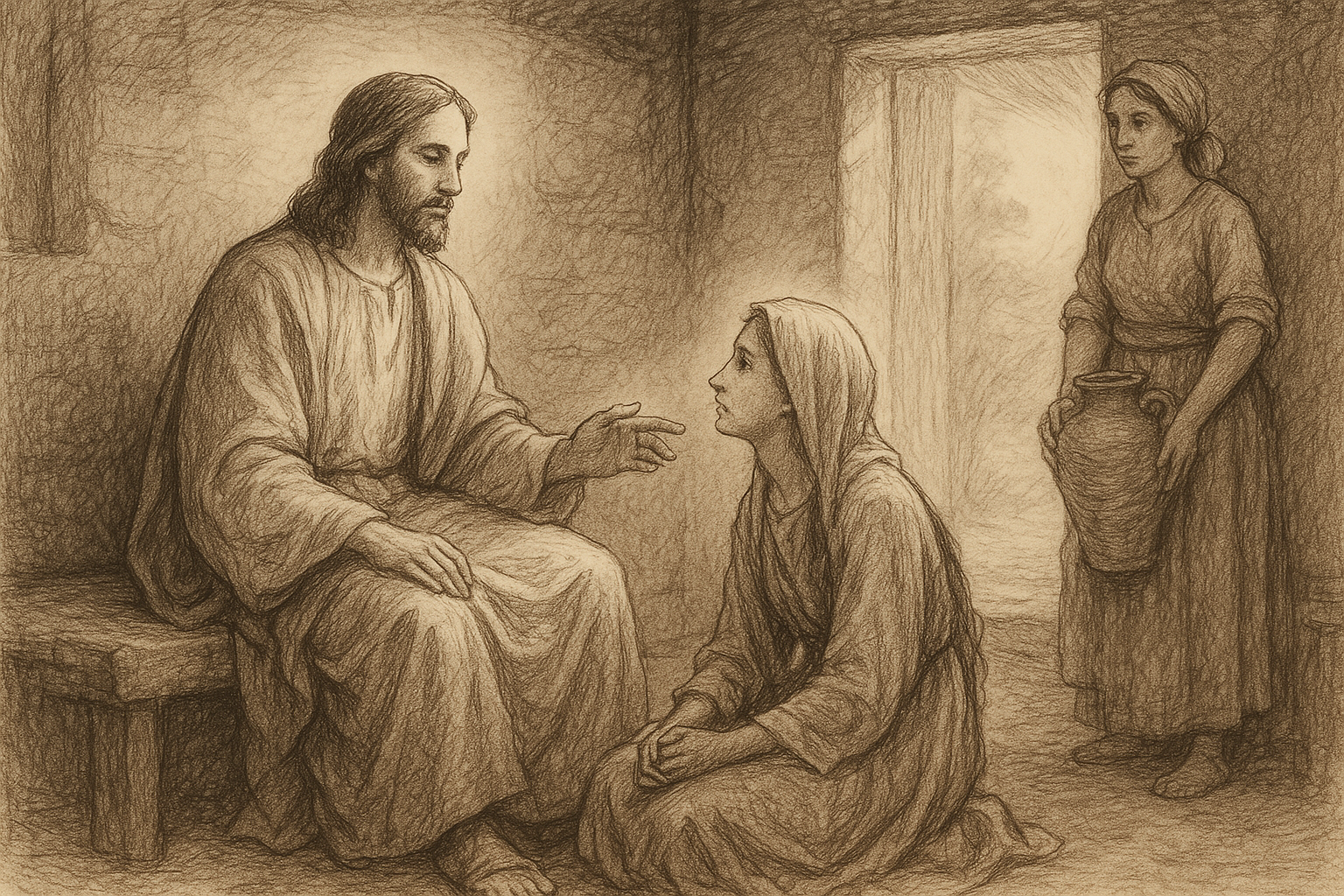
The first impression of Martha is easy to understand. She welcomes Jesus into her home and works to serve him well. Her concern is not selfishness but hospitality. Mary, meanwhile, is still. She sits at the feet of the Lord, the posture of a disciple. The contrast is not between good and bad, but between two goods that must be rightly ordered. The Lord's gentle correction helps reveal that order.
The Lord's word to Martha
When Martha complains that Mary has left her to serve alone, Jesus answers with tenderness: Martha, Martha, you are anxious and worried about many things. He does not deny her work or belittle hospitality. Instead, he names the deeper problem beneath her busyness. Martha's service has become tangled with anxiety. Her heart is divided. She wants to honor the guest, but her concern has begun to disturb her peace.
Jesus then says, There is need of only one thing. Mary has chosen the better part and it will not be taken from her. These words have been read in many ways, but the Church has consistently understood them as a defense of the primacy of listening to Christ. Martha's activity is not condemned, yet Mary's quiet attention is held up as the better portion because it places the soul directly before the Lord.
This is not a rejection of work. Catholic faith never teaches that labor, care for others, or practical service are spiritually inferior in themselves. Rather, the Gospel warns that activity can become spiritually empty when it loses contact with prayer. If we serve without listening, we may become resentful, distracted, or proud. If we listen without ever serving, we may risk a faith that remains unreal. The Lord's word restores the proper order: first receive him, then serve from communion with him.
Mary at the feet of Jesus
Mary's posture is striking. In the ancient world, to sit at the feet of a teacher was the position of a disciple. Mary is not merely being restful. She is learning. She receives the Word as one who knows that the true center of life is not self-management but the voice of Christ. Her silence is active. Her attention is love.
For Catholics, Mary of Bethany has long been a figure of contemplative discipleship. She is not the Blessed Virgin Mary, but she echoes something of that same receptive faith. Like her name sake, she receives the Lord in humble openness. The Church does not ask every Christian to withdraw from ordinary tasks, but she does call every Christian to this interior posture: to sit before Christ in trust and let his word shape everything else.
This is one reason the scene has remained so enduring in Christian memory. It shows that holiness begins not with performance, but with receptivity. Before the apostolic mission, before visible works of mercy, before the noise of Christian activity, there must be a moment of listening. In prayer, the disciple learns that Christ is not only the one to be served. He is the one who speaks, teaches, comforts, corrects, and sanctifies.
Martha's faith is deeper than impatience
Martha is often remembered only for distraction, but the Gospels present her as a woman of strong faith. In another episode at Bethany, after the death of Lazarus, Martha meets Jesus and makes a profound profession of belief: I have come to believe that you are the Christ, the Son of God, the one who is coming into the world. This is one of the great confessions in the Gospel of John.
That moment changes how we read her earlier appearance. Martha is not merely a frantic householder. She is a disciple whose love is sincere, direct, and brave. Her fault in Luke is not laziness or lack of belief. It is that her service, though real, has become detached from the quiet center where faith listens. Her later confession shows that she is capable of profound spiritual insight. The Lord who gently rebukes her in Luke also receives her faith in John.
This matters pastorally. Many Catholics know what it is to resemble Martha. We want the house ready, the work completed, the ministry done well, the family cared for, the obligations met. These concerns are not trivial. Yet when they become a source of agitation, they can conceal a deeper spiritual need. Martha's story invites us to bring our good works back under the lordship of Christ, where they can be purified by peace.
The Catholic meaning of the better portion
In Catholic tradition, the better portion is not a code word for escaping ordinary life. It is the primacy of communion with God. Prayer is not a break from discipleship. It is the heart of discipleship. The disciple who listens learns what to do, how to do it, and when to stop. Without prayer, service can become anxious activism. Without service, prayer can become inwardly closed. The Gospel asks for both, but in the right order.
The saints have often meditated on this passage because it names a tension every Christian must face. Some are called to outward service in public, in family life, in works of mercy, or in parish ministry. Others are drawn more strongly to silence and contemplation. Yet the Church does not divide believers into separate classes of Martha and Mary. Instead, she teaches that every Christian life must contain both dimensions. Even the busiest parent, worker, or caregiver can cultivate the Mary-like habit of attention to Christ. Even the most contemplative soul must eventually bear fruit in charity.
There is also a Eucharistic resonance in the Bethany scene. Jesus is welcomed into the home, and his presence becomes the center around which all else turns. Catholics recognize in this a pattern that reaches its fullness in the Mass, where Christ feeds his people with his word and his Body. We come to receive before we go to serve. The liturgy reminds us that the first task of the Church is not to produce spiritual results, but to adore, listen, and be fed.
Lessons for prayer in ordinary life
The story of Martha and Mary of Bethany in the Gospel becomes especially practical when we ask what it says about our own habits. Most Catholics do not struggle because they have too little to do. They struggle because so much must be done. The danger is not work itself, but work without interior recollection. This Gospel gives a few simple but demanding lessons.
- Begin with Christ. Before answering messages, starting chores, or entering a meeting, make a brief act of recollection. Offer the moment to Jesus.
- Protect time for listening. A few quiet minutes with Scripture or prayer can reshape the entire day.
- Notice when service becomes resentment. Martha's complaint reveals how quickly ministry can become burden if it is not rooted in love.
- Do not despise practical work. Christian discipleship includes cooking, cleaning, caregiving, administration, and hidden labor done for the Lord.
- Let prayer correct your pace. Interior peace often tells us when to slow down, simplify, or release control.
These lessons are not complicated, but they are not easy either. The modern world rewards constant motion. The Gospel forms a different rhythm. It teaches that the soul becomes fruitful when it is first receptive. This is why silence is not wasted time. It is the place where the Word is heard clearly enough to bear fruit later in action.
How Bethany speaks to family life and ministry
Many readers meet Martha and Mary in the middle of their own domestic pressures. Family life can make everyone feel like Martha. Meals need preparing, schedules need coordinating, and a hundred hidden tasks fill the day. In that setting, the story of Bethany is not a rebuke to generous hosts. It is a reminder that the home itself can become a place of prayer when Christ is welcomed at the center.
It also speaks to ministry. People who serve in catechesis, parish work, music, hospitality, or works of mercy can grow weary if they forget Mary's listening heart. The Church is not sustained by effort alone. She is sustained by grace. Any ministry that does not spring from prayer gradually loses its joy. The soul then begins to confuse activity with faithfulness.
At the same time, those drawn to prayer should hear the quiet challenge to become concrete in love. Mary is not portrayed as indifferent. The better portion is not a private retreat from charity. It is the interior rooting of charity in Christ. A prayerful person becomes more available, more patient, and less possessive of time and attention. In that sense, true contemplation enlarges love.
Christ visits the house, and the house is changed
One of the most beautiful things about Bethany is that Jesus accepts the sisters exactly where they are. He comes into a home where one sister serves and the other listens. He corrects, but he does not reject. He teaches, but he does not shame. That is how the Lord often works in the Gospels. He enters the confusion of ordinary life and brings it toward peace.
This scene is a quiet invitation to let Christ enter our own homes, schedules, and habits. If we are Martha, he asks us to serve without agitation. If we are Mary, he asks us to listen without apathy. If we are both, as most of us are, he calls us to the harmony of a heart that can work and worship, labor and rest, provide and pray.
To read Martha and Mary of Bethany in the Gospel is to discover that discipleship is not a matter of choosing between action and contemplation as if one must cancel the other. The Lord himself creates the balance. He welcomes the service of Martha, praises the listening of Mary, and calls both sisters into fuller communion with him. That same Christ still enters the homes of his people, and when he does, even the busiest room can become a place of peace.
Keep Reading on Lets Read The Bible
Frequently Asked Questions
Was Martha wrong to serve Jesus in Luke 10?
No. Martha's service was good, but Jesus gently corrected the anxiety and distraction that had come with it. The problem was not hospitality itself, but a heart pulled apart by worry.
Why is Mary said to have chosen the better part?
Mary chose to sit at the feet of Jesus and listen to his word. The better part is the primacy of prayerful attention to Christ, which gives meaning and order to all Christian action.
How can Catholics live out both Martha and Mary in daily life?
By beginning work with prayer, making time for silence and Scripture, and serving others from a heart that has first listened to Christ. Prayer and action belong together when prayer remains at the center.