Jesus and the Gospels
At Cana, Mary Notices First: The Marriage Feast That Reveals Christ
A close look at the first sign in John and the quiet faith of the Mother of Jesus
Site Admin | January 30, 2026 | 94 views
The first sign is a wedding
The Gospel of John begins Jesus' public ministry not with a sermon in a synagogue, nor with a dramatic healing, but with a wedding feast. That choice matters. At Cana, the Lord enters an ordinary human celebration, one marked by joy, guests, family ties, and the quiet pressure that comes when something goes wrong. The setting is simple, but the sign is not. When the wine runs short, Jesus performs his first recorded miracle and reveals something essential about who he is and how he acts among his people.
For Catholics, the Wedding at Cana is not only a charming Gospel story. It opens a window into the wedding feast between Christ and his Church, into the honor due to Mary, and into the way grace works in hidden, practical ways. The scene invites us to see that divine glory is not reserved for mountaintops and thunder. Sometimes it appears at a table, in a household, in the concern of a mother, and in the response of servants who simply do what they are told.
What happens in John 2
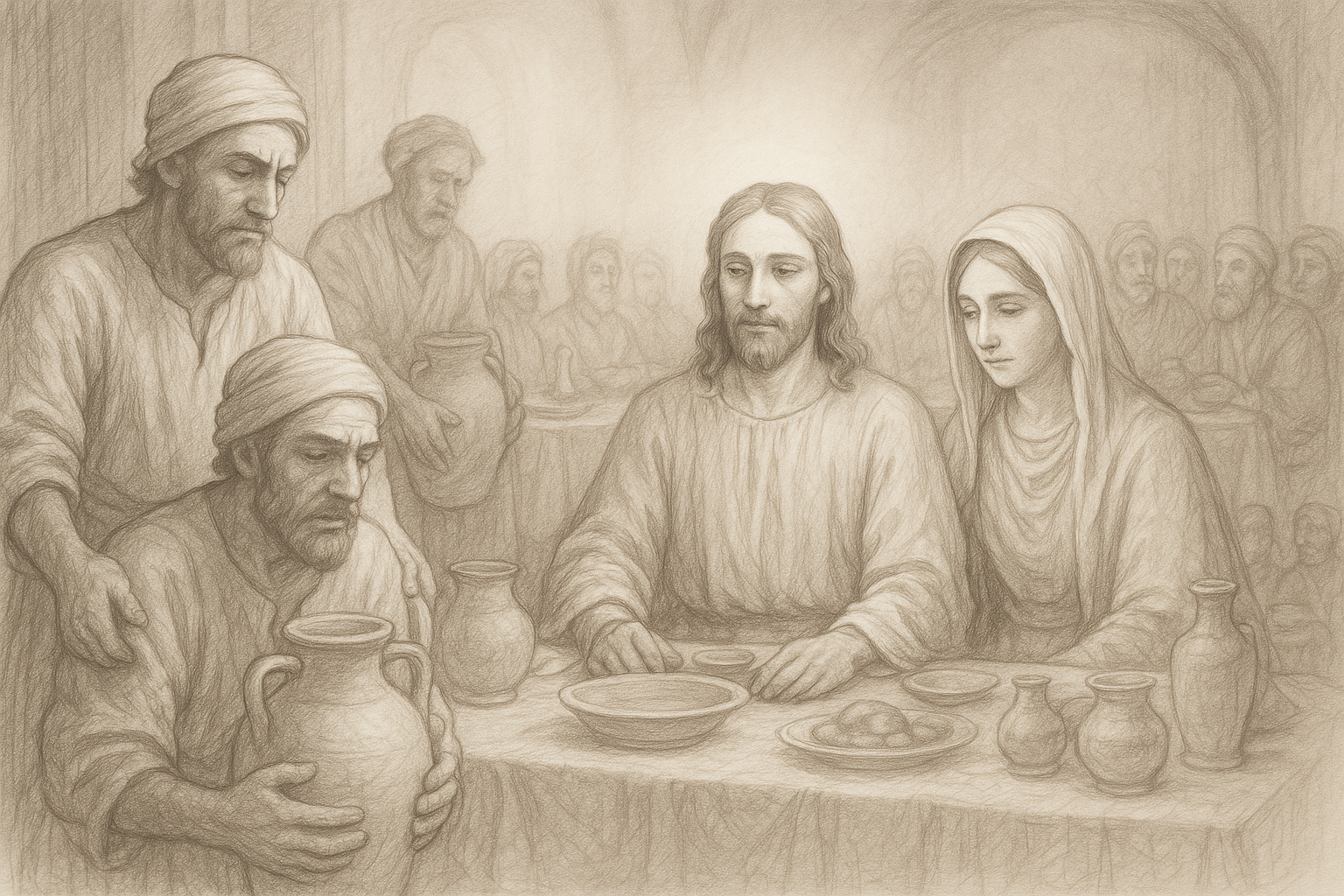
John tells us that the marriage feast took place in Cana of Galilee and that Jesus, his mother, and his disciples were invited. When the wine gives out, Mary brings the need to Jesus:
Her words are brief, but they carry trust. She does not dictate the method. She does not lecture the servants. She simply places the lack before her Son and leaves the matter in his hands.
Jesus replies,
and then, in a phrase that can sound abrupt if we read it without the larger Gospel context, he adds that his hour has not yet come. Catholics have long understood that his response is not a rejection of his mother, but a revelation that the timing and manner of his saving work belong to the Father's plan. Mary is not rebuked into silence. Instead, she turns to the servants with words that remain among the most important Marian instructions in Scripture:
Six stone water jars stand nearby, used for Jewish ceremonial washings. Jesus tells the servants to fill them with water, and then to draw some out and bring it to the steward. The water has become wine, and not just any wine. The steward marvels that the good wine has been kept until now. John concludes that Jesus did this as the first of his signs, manifesting his glory, and his disciples believed in him.
The meaning of the sign in John's Gospel
John does not call the miracle a spectacle. He calls it a sign. That distinction is important. A sign points beyond itself. The changing of water into wine is not only an act of kindness to an embarrassed wedding host, though it is that. It also points to the deeper identity of Jesus as the one in whom God's generosity arrives in overflowing measure.
In the Old Testament, wine often appears as a sign of joy, blessing, and covenant abundance. When the prophets speak of the messianic age, they often picture it in terms of rich harvests, feasting, and overflowing consolation. At Cana, the Bridegroom has arrived, and the feast begins to show what his presence means. The shortage is real, but the abundance of Christ is greater. What was lacking is not merely repaired. It is transformed.
John places this event at the beginning of the ministry because it helps us read everything that follows. The miracles, the teaching, the Cross, and the Resurrection all belong together. Cana is the first bright indication that Jesus comes not only to instruct but to renew. He does not merely point toward joy. He makes joy possible in a deeper way than human planning can manage.
Mary's faith and the quiet power of intercession
Mary is at the center of the scene without trying to be the center of attention. She notices the lack before others seem to have named it. She brings the need to Jesus. Then she trusts him. This is one reason Catholics return so often to Cana when thinking about Mary's role in the life of the Church. She does not replace Christ. She leads to him.
Her intercession is concrete and maternal. She sees a real need. She does not present a theory. She presents a circumstance. In doing so, she models a very Catholic instinct: bring the need to Jesus. The Gospel does not suggest that the servants first must understand every detail. Faith begins with obedience. Mary's final words are the clearest summary of her posture before God and the attitude she invites in others: do whatever he tells you.
That instruction is as practical now as it was then. Catholics do not honor Mary by treating her as a substitute for Christ. We honor her by receiving her Son's words with confidence, the way she did. At Cana, her presence gives shape to Christian discipleship because she knows where help comes from and she points others toward it without hesitation.
The jars, the water, and the grace of transformation
The six stone jars are not incidental details. John tells us they were used for ceremonial washing, and this detail has invited reflection from the earliest centuries of the Church. The old water of purification is now associated with the new wine of the Kingdom. In a spiritual sense, the sign suggests a movement from old expectations to fulfilled promise, from preparation to fulfillment, from outward washing to the gift Christ brings in abundance.
The servants obey before they can see the result. They fill the jars with water to the brim. They draw out what has become wine. There is a lesson here for every Christian life. Grace often asks for our cooperation before it grants clarity. We are not always shown the full picture first. We are told to carry water, to fill jars, to wait, to trust, to bring the cup to the steward. The miracle occurs in the space between obedience and revelation.
Catholics also hear in Cana a foreshadowing of sacramental life. Christ takes ordinary matter and makes it bear extraordinary meaning. Water becomes wine. In the sacraments, earthly signs are taken up into divine action. The Church does not invent grace, but she receives it through visible signs established by Christ. Cana reminds us that God is not opposed to matter. He is free to use it as the instrument of his saving work.
The Bridegroom has arrived
The wedding setting matters because Scripture often speaks of God's covenant in marital language. The Lord is not a distant observer of human history. He is the faithful Bridegroom who comes to claim, heal, and sanctify his people. Cana is therefore more than a family event in Galilee. It is a revelation that the long waiting of Israel is reaching its fulfillment.
This helps explain why the miracle unfolds in a context of festivity. The Gospel is not a grim announcement that life must become less human in order to become holy. Rather, holiness enters human life and deepens it. Christ does not despise the wedding feast. He blesses it. He does not cancel joy. He intensifies it. The Church sees in this a promise that the Lord is not only concerned with grave crises, but also with the ordinary goods of human life, including marriage, hospitality, and celebration.
Yet Cana also points beyond earthly marriage. Every Christian marriage is meant to witness to a greater covenant. Husbands and wives are called to fidelity that mirrors, however imperfectly, the steadfast love of Christ for his Church. When Jesus blesses the wedding at Cana, he is not only helping a couple and their guests. He is revealing that all true human love finds its meaning in him.
What Catholics can learn from Cana today
Cana is a school of discipleship because it teaches several lessons at once.
- Notice need honestly. The wine ran out. Faith does not pretend that lacks are not real.
- Bring the need to Jesus. Mary models prayer that is direct, simple, and confident.
- Trust Christ's timing. His hour is not ours, and his wisdom is never less than merciful.
- Obey promptly. The servants did not argue with the jars. They filled them.
- Expect abundance. Christ does not answer halfway when he chooses to give.
These lessons matter in family life, in parish life, and in personal prayer. Many Catholics know what it is to experience a shortage of some kind: patience, peace, clarity, health, reconciliation, or hope. Cana does not promise that every earthly shortage will vanish on our preferred schedule. It does promise that Jesus sees the need, enters the scene, and is able to transform what seems lacking into a place where glory can be shown.
For married couples, Cana offers a beautiful pattern. Invite Christ into the household. Keep Mary near. Let obedience be practical and humble. Let joy be received as a gift rather than treated as a possession. A Christian home is not one where nothing runs short, but one where shortage is brought to the Lord before panic has the last word.
Why the disciples believed
John ends the account by saying that the disciples believed in Jesus. That result should not be overlooked. The first sign is not only about wine or marriage or Mary. It is about faith. The disciples see something that reveals the glory of Christ, and belief begins to grow in them.
This is often how the Gospel works. Jesus reveals himself through events that seem local and even hidden. A meal. A need. A mother's concern. A command to fill jars. A steward's surprise. And then belief. Christian faith is nourished not only by arguments, though reason has its place, but by recognition. We begin to see who Jesus is by watching what he does, and by letting his actions interpret our lives.
That is the enduring power of the Wedding at Cana. It is not only a miracle story. It is a revelation of the heart of Christ. He comes where life is real. He honors the gifts of creation. He responds to trust. He transforms lack into abundance. And he draws his disciples into faith. For Catholics, the Wedding at Cana Catholic meaning is never merely symbolic. It is pastoral, sacramental, Marian, and deeply personal. It tells us that the Lord of glory is near, and that when Mary says, Do whatever he tells you, she is teaching the Church how to live.
Keep Reading on Lets Read The Bible
Frequently Asked Questions
Why is the Wedding at Cana important in Catholic teaching?
Cana is important because it is Jesus' first sign in John's Gospel. It reveals his glory, shows Mary's maternal intercession, and points to the abundance of grace Christ brings to the Church.
What does Mary's role at Cana teach Catholics?
Mary notices the need, brings it to Jesus, and directs the servants to obey him. Catholics see in this a model of intercession and discipleship that always leads to Christ.
How does Cana connect to marriage and sacramental life?
The wedding setting highlights Christ's blessing on marriage and the covenant love he has for his Church. The transformation of water into wine also points to the way God uses visible signs to give grace, a pattern fulfilled in the sacraments.