Sacraments and Liturgy
Nine First Fridays and the Quiet Work of the Sacred Heart
A practical Catholic look at a devotion that joins monthly Communion, repentance, and trust in Christ's merciful Heart
Site Admin | September 21, 2025 | 74 views
First Friday devotion explained begins with a simple Catholic instinct: love responds to love. The devotion asks the faithful to honor the Sacred Heart of Jesus by receiving Holy Communion on the first Friday of nine consecutive months, with the right disposition of faith and the desire to make reparation for sin. It is not a private spiritual trick and it is not a substitute for the sacraments. It is a disciplined way of entering more deeply into the mercy already offered by Christ in the Eucharist.
Many Catholics first meet this devotion as a family practice, a parish habit, or an encouragement from a priest or teacher. At its heart, the devotion points to a truth that is already central to the Gospel: Jesus gives Himself completely, and the believer is invited to answer with trust, repentance, and love. The First Friday observance keeps that answer concrete. It places devotion on the calendar, joins it to Mass, and teaches perseverance one month at a time.
Where the devotion comes from
First Friday devotion is linked to the Sacred Heart of Jesus and to the private revelations given to St. Margaret Mary Alacoque in the 17th century. In those revelations, Christ invited believers to honor His Heart, a sign of His love for humanity and His sorrow over indifference and sin. The Church has long permitted and encouraged devotion to the Sacred Heart, while distinguishing private revelation from public Revelation, which ended with the Apostles. Catholics are never required to believe private revelations as a matter of faith, but they may receive them as a fruitful help to devotion when they are consistent with the faith.
The devotion grew in a culture that often forgot the personal love of Christ. The Sacred Heart corrected that forgetfulness. It made visible what the Gospels already show: the Son of God is not distant from human sorrow. He weeps over sin, feeds the hungry, heals the sick, and gives His life for the salvation of the world. The First Friday practice is a monthly way of saying that this love deserves a response that is steady, not occasional.
To see the biblical shape of the devotion, one might think of the Lord's own invitation: Come to me, all who labor and are heavy laden, and I will give you rest Matthew 11:28. The Sacred Heart devotion is not meant to distract from Christ's words. It helps the believer hear them more personally.
What makes First Friday different
At the center of First Friday devotion is Holy Communion. The faithful attend Mass and receive the Eucharist on the first Friday of the month for nine consecutive months. The value of the devotion lies not in a magical counting of days, but in the spiritual formation that comes through repeated, faithful acts of love. In other words, the Church asks for a habit, not a one-time gesture.
That emphasis on repetition matters. Many Catholics know what it is to begin well and then drift. First Friday devotion resists that drift. It asks a person to return again and again to the altar, to confession when needed, and to a sincere intention to love Christ more deeply. Month after month, the soul is reminded that grace is not a momentary inspiration but a life to be received and lived.
The devotion is also tied to reparation. Catholics do not think of reparation as paying God back in a strict sense, as though divine mercy were a debt that humans could settle. Rather, reparation is a loving response to sin, both one's own and the sins of the world. It is an act of sorrow and consolation, offered to the Heart of Jesus that is wounded by human refusal. Scripture gives language for this response in the mystery of Christ who loved us to the end John 13:1 and who, from the Cross, reveals the depth of divine mercy.
How the devotion fits Catholic life
First Friday devotion only makes sense inside the larger life of the Church. It does not replace Sunday Mass, the sacrament of Penance, or daily conversion. It supports them. A Catholic who keeps First Fridays well will usually find the devotion drawing him or her more faithfully into ordinary sacramental life. That is one of its greatest strengths.
There is also a beautiful realism in the devotion. It assumes that love needs practice. Catholics know this in marriage, in family life, in prayer, and in worship. The soul rarely becomes attentive by accident. It becomes attentive through repeated acts of return. The first Friday of each month becomes a checkpoint of grace, a day to ask: Have I gone to Confession? Have I approached the Eucharist with reverence? Have I made room for silence, gratitude, and amendment of life?
In this way the devotion complements the liturgy without competing with it. The Mass remains the source and summit of Catholic life. First Friday devotion simply helps the faithful approach that center with greater desire. It is a school of Eucharistic hunger.
The spiritual meaning of nine months
The nine-month pattern is often understood as a sign of perseverance and completion. Catholics should be careful not to impose meanings that the Church herself has not defined, yet it is fair to say that the number invites patient fidelity. Nine months is long enough to require commitment and short enough to measure. It becomes a structured path for someone who wants to grow beyond scattered devotion.
That structure also teaches hope. Many people want immediate results in prayer. First Friday devotion is more modest and, in a sense, more mature. It says that grace often works slowly. The believer shows up, month after month, trusting that Christ sees the hidden offering. The Sacred Heart receives what the world overlooks: the quiet yes of a Catholic trying to be faithful in ordinary circumstances.
For some, the devotion begins in weakness. They may be seeking spiritual renewal after a period of indifference. They may want to reenter the sacramental life after a long absence. They may simply be longing for a more stable pattern of prayer. First Friday devotion is generous in that sense. It welcomes beginners, provided they approach it honestly and in communion with the Church.
He who eats my flesh and drinks my blood abides in me, and I in him John 6:56.
That verse captures something essential here. First Friday devotion is not about sentiment alone. It is about abiding. The Eucharist draws the believer into Christ's own life, and the devotion keeps that truth before the eyes of the heart.
How to practice First Friday devotion well
For a Catholic who wants to begin, the steps are not complicated, but they should be taken seriously.
- Attend Mass on the first Friday of the month.
- Receive Holy Communion reverently, in the state of grace.
- If needed, go to Confession beforehand, especially if one is conscious of mortal sin.
- Offer the Communion with the intention of honoring the Sacred Heart and making reparation for sin.
- Keep the practice for nine consecutive months without casually skipping and restarting.
It is worth saying plainly that the state of grace matters. Catholics should not receive Communion if they are conscious of mortal sin and have not yet been reconciled in Confession. The devotion is meant to deepen reverence, not to encourage careless reception of the Eucharist. If someone misses a month without a serious reason, it is prudent to ask a confessor or spiritual director how best to proceed. The point is not anxiety, but honesty.
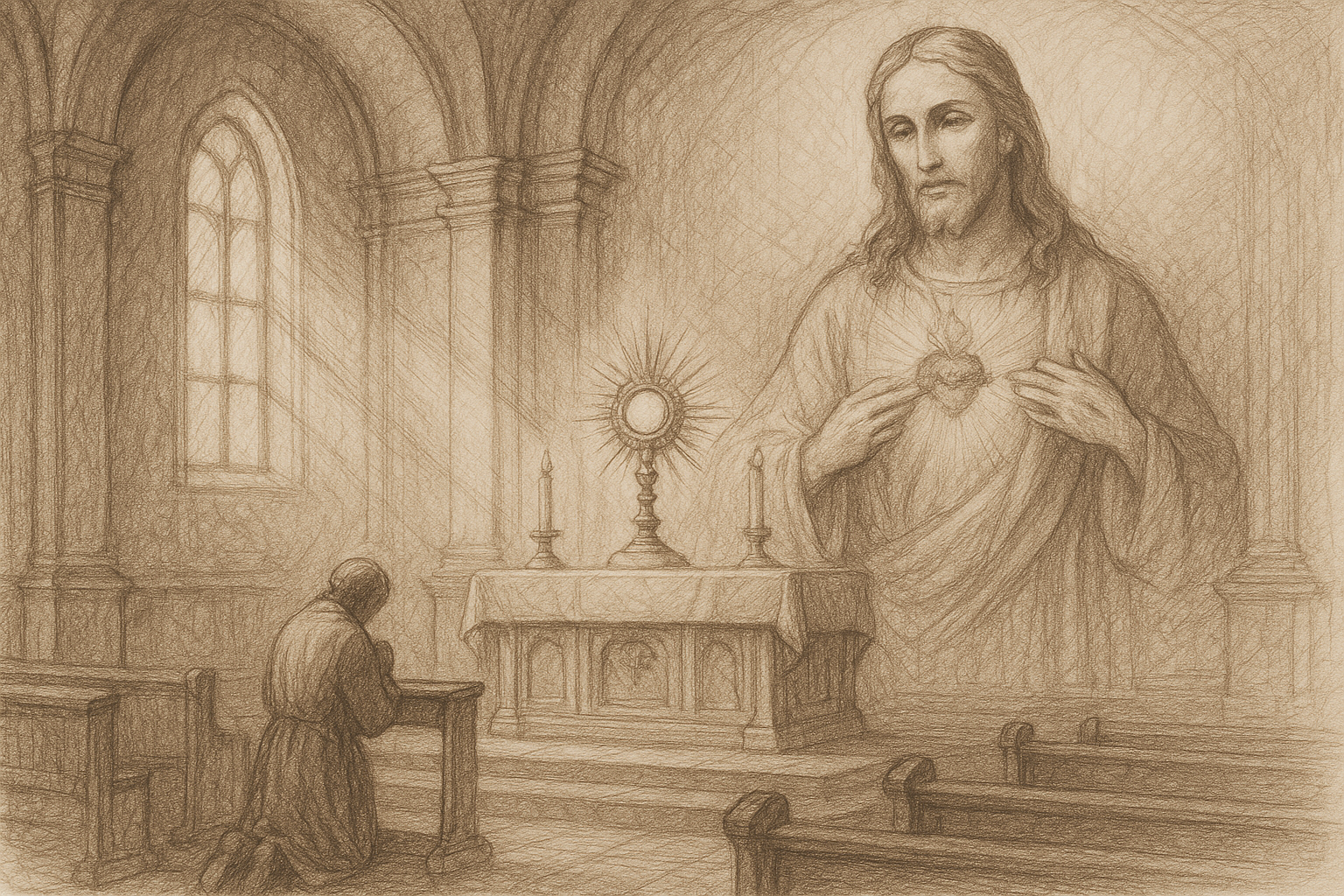
It can also help to prepare before Mass. A few minutes with the Sacred Heart, the Rosary, or a simple act of contrition may make the day more fruitful. Some Catholics keep the first Friday as a day of gentleness, reduced distractions, and quiet acts of charity. Others add a brief visit to the Blessed Sacrament after Mass. These are not required, but they can give the devotion a more prayerful shape.
Common misunderstandings
One misunderstanding is to treat First Friday devotion as if it guarantees a mechanical reward. Catholic devotion is never magic. The Church does teach that devotions can be associated with promises and graces, but always within the living action of God, who knows the heart. A person can keep nine First Fridays externally and still miss the point if the interior act of love is absent.
Another misunderstanding is to think the devotion is sentimental or outdated. In reality, it addresses a need that never goes away: the human heart must learn how to love Christ with steadiness. In a distracted age, scheduled devotion can be a safeguard. It keeps love from becoming vague. It says that the Eucharist is not an accessory to Catholic life. It is the center from which Catholic life receives its shape.
A third misunderstanding is to separate the Sacred Heart from the Cross. They belong together. The Heart of Jesus is not a soft symbol detached from sacrifice. It is the Heart that loved unto death, the Heart opened by the lance, the Heart from which blood and water flowed. The devotion leads the believer toward the mystery of redemptive love, not away from it.
Why this devotion still speaks to modern Catholics
Modern Catholics live amid speed, noise, and spiritual fragmentation. Many are tempted to measure everything by immediate payoff. First Friday devotion answers that mood with patience. It invites the believer to keep a promise, arrive at Mass, and receive Christ with gratitude. That simple structure can restore a sense of spiritual order.
The devotion also speaks to loneliness. The Sacred Heart is not an abstraction. It is the sign that Christ knows human sorrow from within. A Catholic who approaches First Friday with genuine faith is not bringing problems to a distant ruler. He or she is coming to the Lord whose love entered suffering and redeemed it from inside. That is why devotion to the Sacred Heart remains so enduring. It is tender, but never weak. It is consoling, but never sentimental. It asks for a response from the whole person.
For families, the practice can become a small rhythm of shared faith. For parish communities, it can renew Eucharistic reverence. For individuals, it can serve as a quiet rule of life. However it is lived, the devotion reminds Catholics that the heart of Christianity is not self-improvement. It is communion with Christ, who gives Himself and teaches us how to give ourselves in return.
To begin, then, is not complicated. Mark the first Friday, go to Mass, prepare for Communion, and offer the day to the Sacred Heart. Repeat that with humility for nine months. The discipline may seem small, but grace often works through what looks small. The Heart of Jesus is patient with those who return to Him, and the faithful who keep this devotion usually discover that the repetition has been praying them into deeper trust all along.
Keep Reading on Lets Read The Bible
Frequently Asked Questions
What is First Friday devotion in the Catholic Church?
First Friday devotion is the practice of attending Mass and receiving Holy Communion on the first Friday of nine consecutive months in honor of the Sacred Heart of Jesus, with a sincere spirit of love and reparation.
Do I need to go to Confession before First Friday Communion?
Yes, if you are conscious of mortal sin or if you are not in a state of grace, you should go to Confession before receiving Holy Communion. The devotion should always be practiced reverently and in harmony with the sacramental life of the Church.
What if I miss a First Friday during the nine months?
If you miss a month, it is wise to speak with a priest or confessor about how to proceed. Because local practice can vary, a confessor can help you resume the devotion in a way that is faithful and peaceful.