Doctrine and Questions
The Crucifix at the Center: Why Catholics Keep Christ on the Cross
A close look at the crucifix, Catholic worship, and the meaning of Christ's saving sacrifice
Site Admin | June 15, 2026 | 48 views
Catholics often hear the question in one form or another: why do you keep a crucifix, instead of only an empty cross? The question is fair, and it touches something central to Catholic faith. The crucifix is not kept because Catholics enjoy sorrow or want to dwell on suffering for its own sake. It is kept because the crucifix speaks plainly about who Jesus is and what He has done for the world.
In Catholic life, the crucifix stands at the meeting point of Scripture, worship, memory, and love. It does not compete with the Resurrection. It points to the sacrifice by which the Resurrection came to us. The cross is not merely a tragic instrument from the past. In Christ, it becomes the sign of redemption, obedience, mercy, and victory.
The cross is not hidden in the New Testament
Christian faith begins with the proclamation that Jesus died for our sins and rose again. Saint Paul wrote, we preach Christ crucified. That is a striking statement. Paul does not say Christians preach Christ as a teacher only, or Christ as an example only, or Christ as a miracle worker only. He says the preaching centers on Christ crucified.
Paul also says, I decided to know nothing among you except Jesus Christ and him crucified. This is not an accident of language. The earliest Christian preaching refused to separate Jesus' glory from His Passion. The cross belongs at the center because the cross is where God's love was revealed in a human way that no one could miss.
The Gospels do not treat the crucifixion as a shameful detail to move past quickly. They devote great attention to it. They show the obedience of the Son, the injustice of His condemnation, the mockery He endured, and the mercy He offered even while suffering. On the cross Jesus prays, Father, forgive them. He gives the beloved disciple a new relationship with His Mother. He entrusts His spirit to the Father. The cross is not merely an ending. It is the hour in which love reaches its fullness.
Why Catholics keep the crucifix rather than only an empty cross
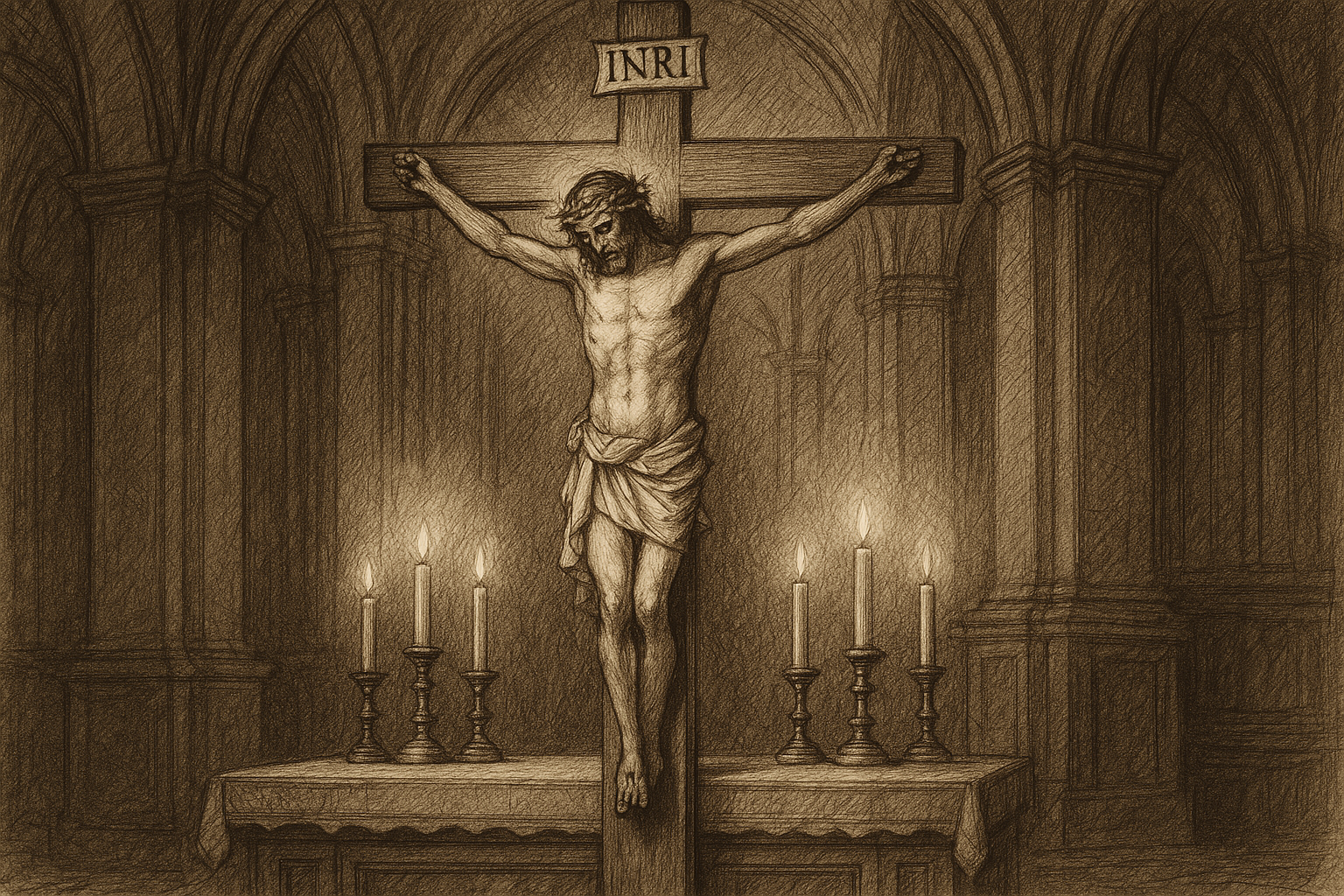
Catholics also keep the empty cross, and many do. But the crucifix adds a specific truth that the empty cross does not communicate as directly. It says that the One who conquered death did so by entering into it. It shows the price of our salvation in a visible and unmistakable way.
This does not mean Catholics think Jesus is still suffering on the cross in a physical sense. The Church teaches that Christ died once for all and now lives in glory. The crucifix is a sacred image that recalls the saving event of Calvary. It presents, in a concentrated form, the mystery of the Passion. When Catholics kneel before a crucifix, they are not worshiping wood or metal. They are honoring Christ Himself, whose love the image proclaims.
In Catholic teaching, sacred images help the faithful remember and contemplate divine realities. The crucifix is especially powerful because it keeps the essential Christian claim before the eyes: salvation is not abstract. It came through the self-giving body of the Son of God. The sign of the cross is therefore not a vague symbol of spirituality. It is the sign of an historical sacrifice and a present grace.
The crucifix teaches that love is costly
The crucifix also corrects a modern tendency to imagine love as pure feeling without sacrifice. Jesus teaches otherwise. He says, No one has greater love than this, to lay down one's life for one's friends. On the cross, He does exactly that.
For Catholics, the crucifix remains in homes, classrooms, churches, and on altars because it reminds us what real love looks like. It is patient, obedient, self-giving, and faithful unto death. Parents who look at the crucifix are reminded of the sacrifice involved in raising children. Priests are reminded of the sacrifice involved in service. Married couples are reminded that love is not sustained by comfort alone, but by daily offering. Every Christian is reminded that discipleship includes the cross.
Jesus Himself says, Whoever wishes to come after me must deny himself, take up his cross, and follow me. The crucifix is therefore not a decorative extra. It is a disciple's sign. It tells the Christian life story in a single glance: trust, surrender, suffering, love, and hope.
The crucifix and the Eucharist belong together
Catholics do not think of the crucifix in isolation. It is deeply connected to the Mass and the Eucharist. At the Last Supper, Jesus said, This is my body, which will be given for you. That promise is fulfilled on Calvary. The offering of the Eucharist and the sacrifice of the cross are inseparable mysteries in Catholic faith.
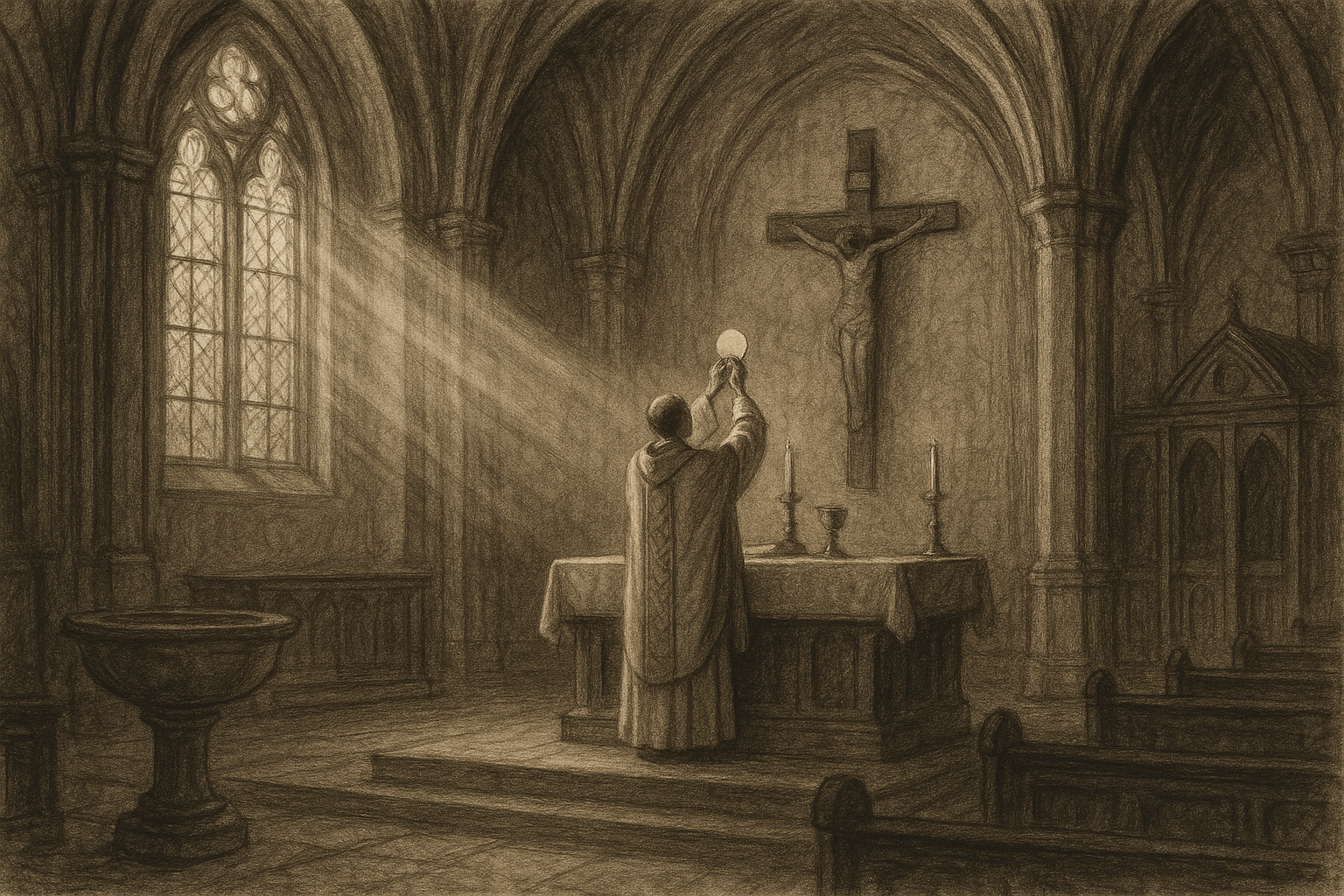
When Catholics see a crucifix near the altar, they are reminded that the Mass is not a new sacrifice added to Christ's saving work. Rather, it is the sacramental making-present of the one sacrifice of Christ. The cross therefore shapes Catholic worship. It reminds the faithful that the liturgy is not self-expression or communal nostalgia. It is an encounter with the Lamb who was slain and who lives forever.
That is one reason the crucifix appears so often in Catholic churches. It directs attention to the heart of the liturgy. The Church does not gather around an idea. She gathers around a Person who gave His body and blood for the life of the world.
The cross in Scripture is a sign of victory
Some people assume that to keep a crucifix is to focus only on defeat or pain. But Scripture presents the cross as a paradoxical victory. Saint Paul writes that Christ canceled the bond against us and nailed it to the cross. He then says that God disarmed the principalities and powers through the cross. The place of apparent defeat becomes the place of triumph.
This is why Catholics do not see the crucifix as a symbol of hopelessness. The body of Christ on the cross is not there because death won. He is there because love went all the way into death and broke its power from within. The resurrection does not erase the cross. It reveals what the cross accomplished.
When Catholics place the crucifix in a bedroom, classroom, hospital room, or above a doorway, they are not announcing despair. They are proclaiming a victory won through sacrificial love. The cross says that suffering is not the final word, and that sin and death are not ultimate.
For Catholics, the crucifix is a compact profession of faith: Christ truly suffered, truly died, and truly gave Himself for us. The image keeps before the heart what the mind can too easily forget.
Does keeping a crucifix mean Catholics worship the cross?
This is one of the most common misunderstandings, and it deserves a careful answer. No, Catholics do not worship the crucifix as an object. Worship belongs to God alone. The crucifix is a sacred sign that points beyond itself to Christ. It is honored because of the One it represents.
Catholic practice has always distinguished between adoration due to God and honor given to sacred things. A Bible is treated with reverence, but not worshiped. A wedding ring may be cherished, but it is not adored. In a deeper way, the crucifix is revered because it is bound to the saving act of Christ. The image helps the faithful turn their minds and hearts to Him.
It may help to think of the crucifix as a visual confession. It quietly says: Jesus is Lord. He is the Son of God. He was crucified for us. He is risen. He remains the Savior of the world. That is why Catholics keep it close.
The crucifix forms the Christian imagination
Human beings are shaped not only by arguments but by images, habits, and repeated signs. The Church knows this. That is why she fills her life with visible reminders that train the heart. The crucifix is one of the clearest of these reminders.
A child who grows up seeing a crucifix learns that Christianity is not a religion of comfort alone. A suffering adult who looks at a crucifix learns that Christ does not stand far off from pain. A sinner who contemplates the crucifix learns that mercy is costly and real. A dying person who grips a crucifix learns that death does not have the last word.
The crucifix also keeps the Christian from turning the faith into sentimentality. It tells the truth about sin, but it tells the truth about mercy too. It does not flatter human nature. It saves it. The crucifix stands at the center because the Christian story is not first about our effort, but about Christ's gift.
A sign Catholics keep close because Christ kept us close
In the end, Catholics keep crucifixes because Jesus Christ did not remain at a safe distance from human suffering. He entered it. He carried our sins. He bore our wounds. He opened paradise by His obedient love. The crucifix gives visible form to that mystery.
When Catholics look at the crucifix, they are not trying to remain in Good Friday forever. They are refusing to forget what Easter cost. The empty tomb is radiant precisely because the cross was real. The risen Lord still bears the wounds, now transfigured in glory. That is why the crucifix remains so dear: it holds together suffering and redemption, sorrow and hope, death and life.
The cross is not the last word, but it is the necessary one before the last word. And because Christ loved us there, Catholics keep Him there in memory, reverence, and gratitude.
Keep Reading on Lets Read The Bible
Frequently Asked Questions
Why do Catholics use a crucifix instead of an empty cross?
Catholics use a crucifix to emphasize Christ's Passion and the saving sacrifice by which He redeemed the world. The empty cross is also a Christian symbol, but the crucifix shows more directly that Jesus truly suffered and died for us before rising again.
Do Catholics worship the crucifix?
No. Catholics worship God alone. The crucifix is a sacred image that points to Christ and helps the faithful remember and meditate on His sacrifice.
What Scripture supports keeping a crucifix?
Key texts include [[VERSE|1-corinthians|1|23|we preach Christ crucified]], [[VERSE|1-corinthians|2|2|I decided to know nothing among you except Jesus Christ and him crucified]], and [[VERSE|john|15|13|No one has greater love than this, to lay down one's life for one's friends]].