Saints and Witnesses
The Parish Cure Who Learned to Burn Brightly
A close look at St. John Vianney life, from a hesitant seminarian to a shepherd who gave his parish everything for Christ.
Site Admin | May 28, 2026 | 92 views
St. John Vianney life is one of those Catholic stories that seems almost too simple at first glance. There are no grand treatises, no dramatic public campaigns, and no noble family name carrying the plot forward. Instead, there is a quiet French priest, a difficult path to ordination, a parish burdened by routine, and a man who believed with all his heart that souls were worth everything. That simplicity is part of his power. He reminds the Church that holiness is not measured by outward polish, but by fidelity to God in the place where He has put us.
John Vianney was born in 1786 in Dardilly, near Lyon, in France. His early years were marked by the turbulence of the French Revolution, when public worship was restricted and priests were often hunted or forced into secrecy. He grew up in a believing Catholic home, but like many children of his generation, he knew faith under pressure, not comfort. That background mattered. It formed in him an early sense that priesthood was not a career choice or a status to be won. It was a gift to be offered with reverence, in a Church that had already suffered much.
As a young man, Vianney wanted to become a priest, yet he was not naturally gifted in the ways that institutions often reward. He struggled with Latin and with academic study. By ordinary standards, he was an unlikely candidate for the seminary. Still, the Church saw something else in him: perseverance, sincerity, and a genuine desire to belong wholly to Christ. He was ordained in 1815 after repeated difficulty, and the fact that he arrived there at all already tells part of the story. His life is a witness to grace working through human weakness, not around it.
His first major assignment was as assistant priest in Ecully, where he came under the guidance of Abbé Balley. That period helped shape him, especially in prayer and pastoral discipline. After Balley died, Vianney was sent in 1818 to Ars, a tiny and spiritually lukewarm parish in the Diocese of Belley. Ars was not a prestigious posting. It was a small village with a modest church and a population shaped, as many rural parishes were, by habit more than zeal. This is where the drama of his priesthood truly began.
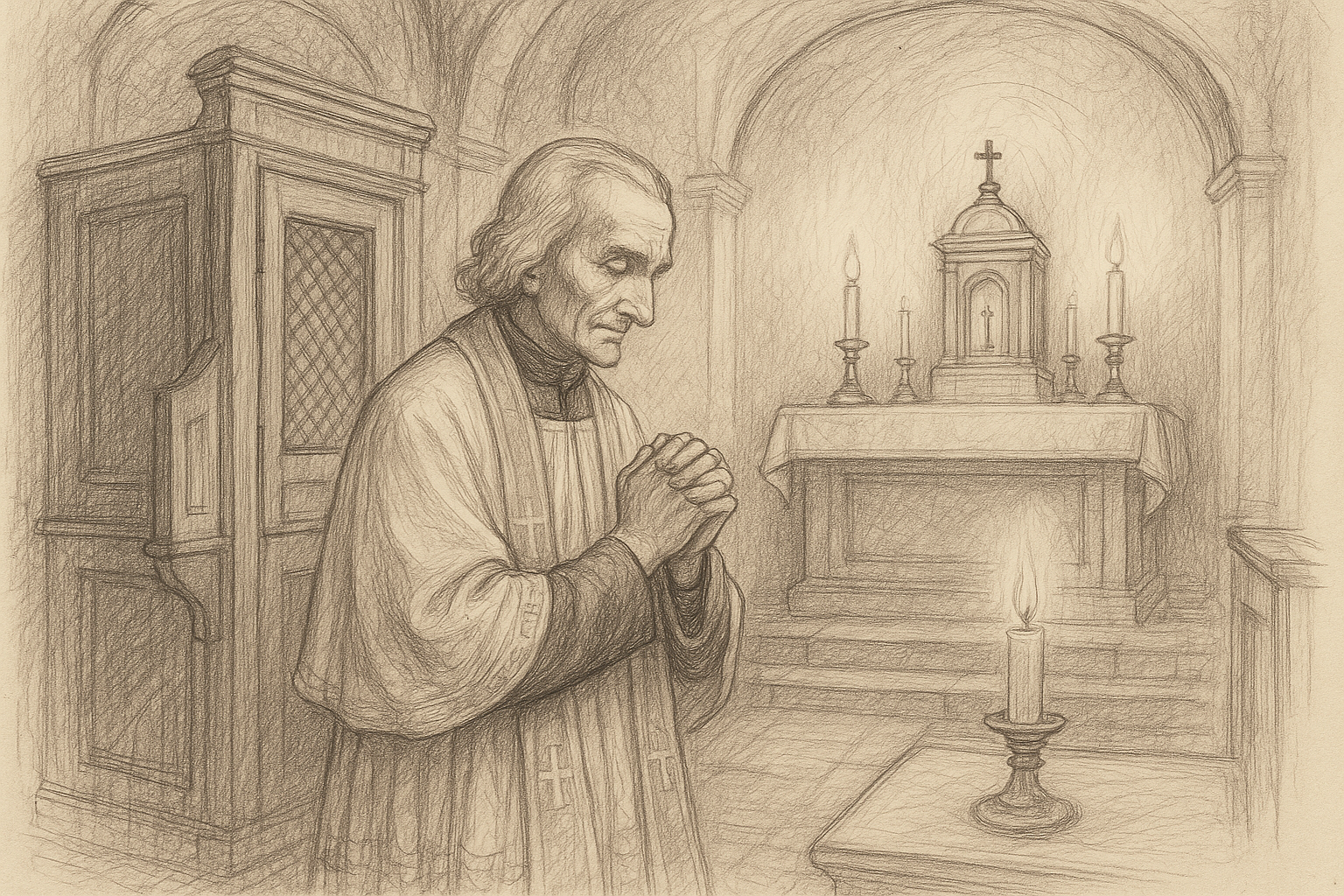
Vianney believed the priest was sent to save souls, not to be admired. He gave himself to the parish with astonishing intensity. He prayed long hours before the tabernacle, celebrated the sacraments carefully, and preached simply but directly. His words were not elaborate, but they went to the conscience. He spoke often about sin, repentance, heaven, hell, and the mercy of God. In an age when many had grown casual about faith, he refused to flatter. He called people back to confession and to real conversion, not because he wanted control, but because he wanted them to be free.
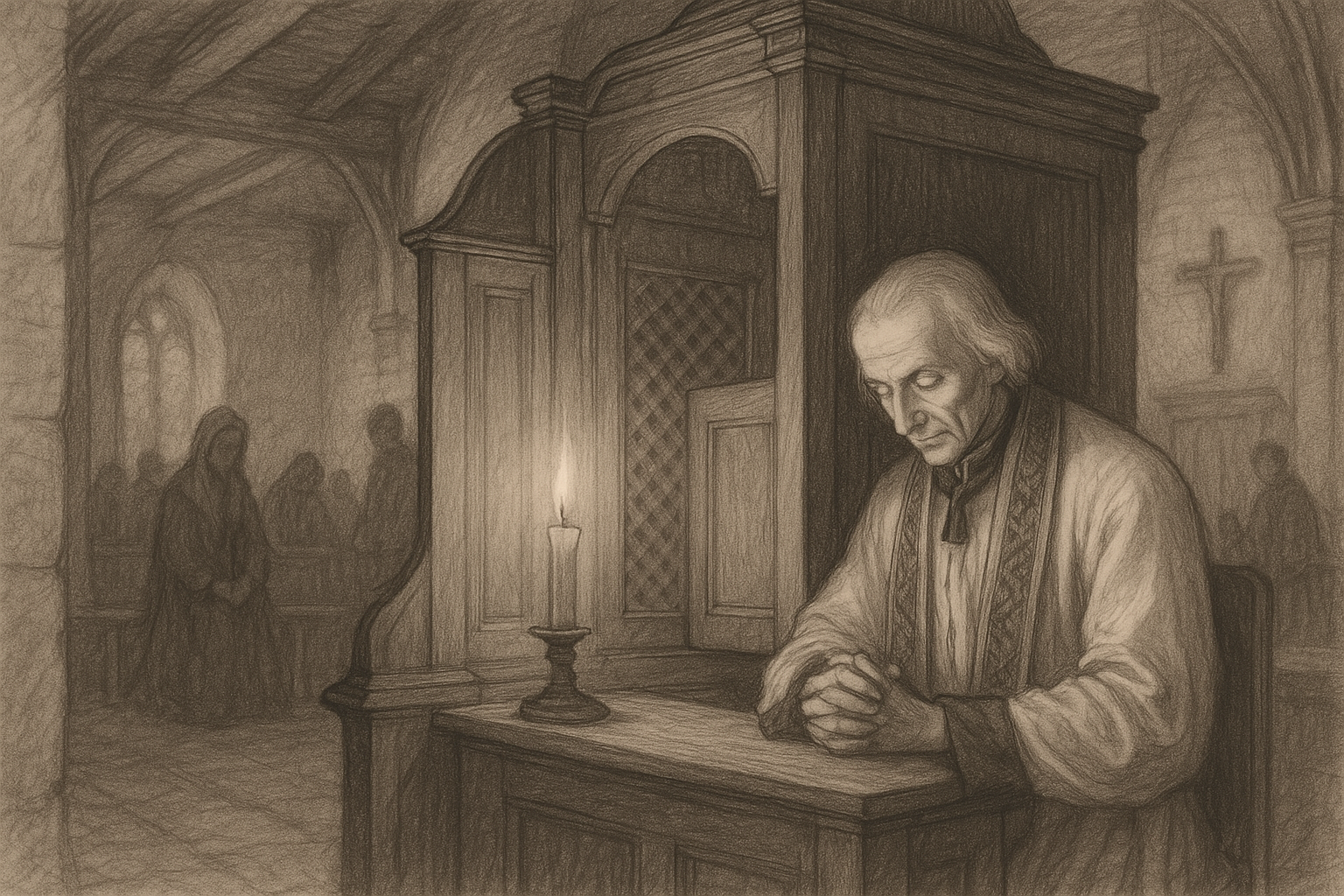
The confessional became the center of his priestly life. Over time, pilgrims began coming to Ars from far beyond the village. Some came because they had heard of his gift for spiritual guidance. Others came because they sensed that here was a priest who listened carefully and judged souls with the seriousness of eternity. He spent enormous portions of the day hearing confessions, often to the point of physical exhaustion. This was not efficiency in the modern sense. It was love. He understood that the mercy of Christ had to be made concrete through the ministry of the Church.
His own life of penance supported that work. Vianney lived austerely, slept little, ate sparingly, and offered sacrifices that seem severe by modern standards. Yet his austerity was not theatrical. It flowed from a priestly conviction that he belonged to God and to his people. He wanted nothing in himself to compete with the Gospel he preached. If he was relentless about holiness, it was because he believed grace was real and salvation mattered more than comfort.
One reason St. John Vianney life continues to attract Catholics is that it shows the harmony of mercy and truth. He was gentle with the penitent who was truly sorry, but he did not pretend sin was harmless. He did not reduce conversion to a feeling. For him, repentance meant turning back to God in fact, with concrete amendment of life. That is deeply biblical. Jesus begins His public ministry by proclaiming, Repent and believe in the gospel. Vianney took that command seriously, and he helped others do the same.
He also had a striking devotion to the Blessed Virgin Mary and to the saints. His faith was not abstract. It was relational, rooted in the communion of the Church. He loved the Mass, encouraged Eucharistic devotion, and spent hours in prayer before the Blessed Sacrament. In that sense, his priesthood was built on foundations that every Catholic can recognize: prayer, confession, Eucharist, and a steady desire to belong to Christ more fully. The ordinary means of grace became, in his hands, channels of extraordinary fruitfulness.
As his reputation spread, Ars changed. What had once been a sleepy parish became a center of pilgrimage. Visitors came for direction, healing, and repentance. Yet Vianney never tried to turn himself into a celebrity spiritual figure. He remained a parish priest, attached to his people and to his post. The growth of his ministry was not based on novelty. It was based on holiness lived consistently over time. That matters because it keeps us from imagining that fruitful ministry depends primarily on charisma. In Vianney's case, the power came from self-forgetting fidelity.
There were trials as well. Not everyone admired him. Some mocked his simplicity or doubted his abilities. He also endured spiritual warfare and interior suffering that he associated with his mission. But he did not let opposition make him bitter. If anything, hardship seemed to deepen his dependence on God. His patience under pressure is part of what makes him such a compelling witness for priests and laypeople alike. He shows that fruitfulness does not require a perfect setting. It requires steadfastness.
By the time of his death in 1859, John Vianney had become known far beyond Ars as the Cure of Ars, a parish priest whose life had transformed a community. The Church later canonized him and named him patron of parish priests. That title fits him well, because his greatness was thoroughly local. He did not build a movement from afar. He inhabited his parish completely and let grace work through repeated daily acts of service. In that, he echoes the shepherding heart described in Scripture: The good shepherd lays down his life for the sheep.
For Catholics today, his witness is especially useful because it resists sentimental ideas about holiness. St. John Vianney did not become a saint by being impressive. He became a saint by surrendering his limitations to God and remaining faithful in hidden labor. That has real implications for parents, priests, teachers, catechists, and anyone serving in a parish. Much of the Church's life is built not by those who attract attention, but by those who keep praying, keep listening, keep teaching, and keep returning souls to the sacraments.
His life also challenges the temptation to separate priestly ministry from prayer. Vianney understood that a priest cannot give what he does not first receive. He spent time with God because his people needed more than management or good intentions. They needed the sacramental presence of Christ. The same is true in every Christian vocation. If prayer becomes secondary, service slowly dries out. But when prayer is first, service becomes durable.
There is something consoling in the fact that his gifts were not obvious in worldly terms. Many Catholics today worry that they are too ordinary, too weak, too unlearned, or too limited to do anything meaningful for the Church. St. John Vianney life answers that concern without exaggeration. He was limited, and everyone knew it. Yet God made his weakness fruitful because he stayed available. The Lord's words to St. Paul fit him well: My grace is sufficient for you, for power is made perfect in weakness.
His example is not only for priests. Lay Catholics can learn from his discipline in prayer, his love for confession, his seriousness about conversion, and his refusal to waste time on self-importance. Parish renewal often begins when one person decides to take holiness seriously. A family that prays, a penitent who returns to confession, a catechist who teaches faithfully, a pastor who gives himself generously, a parish that learns to adore the Lord together: these are the kinds of hidden beginnings that change communities.
In the end, St. John Vianney did not leave behind a program so much as a pattern of life. He teaches that sanctity is possible in the ordinary, that the priesthood is meant for sacrifice, and that souls are still won by prayer, penance, and sacramental mercy. His life is small in outward scale and immense in spiritual reach. That is often how God works. He plants grace in a hidden place, and if someone stays faithful long enough, an entire village can begin to burn with a new and steady light.
Keep Reading on Lets Read The Bible
Frequently Asked Questions
Why is St. John Vianney important to Catholics?
He is important because he shows what priestly holiness looks like in a very direct way: prayer, confession, sacrifice, and pastoral charity. He also reminds Catholics that God can use a person who appears ordinary or even inadequate by worldly standards.
What made the Cur of Ars so well known?
His long hours in the confessional, his simple but powerful preaching, and his intense devotion to the sacraments drew pilgrims to Ars. Over time, people came from far away to seek his guidance and receive the mercy of God through his ministry.
What can lay Catholics learn from St. John Vianney life?
Lay Catholics can learn the value of prayer, confession, perseverance, and faithful service in daily responsibilities. His life shows that holiness is not reserved for dramatic settings. It grows where people stay close to Christ and keep saying yes to grace.