Family and Vocation
The Quiet Work of Handing On the Faith at Home
Raising children in the faith is less about perfect technique than about daily witness, patient repetition, and trust in God's grace.
Site Admin | November 12, 2025 | 60 views
The vocation hidden in ordinary family life
Parents often hear that they should be the first teachers of their children, but the phrase can sound intimidating when the day is already full of meals, homework, errands, and fatigue. In practice, raising children in the faith does not begin with a perfect program. It begins with a household that keeps turning toward God, even when the steps are small.
The Church has long taught that parents have a serious and beautiful responsibility to hand on the faith. Yet this is not a burden meant to crush family life. It is part of marriage itself, woven into the vocation of husband, wife, mother, and father. A home becomes a place of discipleship when children see that prayer is not an optional extra, that Mass is not a weekly interruption, and that God is present in ordinary speech, work, forgiveness, and rest.
The Bible does not present faith formation as a technical project. It presents it as covenant life. God speaks to families, forms them, and calls them to remember. That pattern still holds. The work of raising children in the faith reflection is not mainly about controlling outcomes. It is about remaining faithful to the Lord who already loves the child more than any parent can.
Scripture places faith on the lips of the home
One of the clearest biblical images of family faith comes from Israel's call to remember the Lord's commandments every day: 6 and 7. These verses are striking because they do not imagine religious formation as something reserved for synagogue or feast day alone. The words of God are to be spoken at home, on the road, at waking, and at rest. Faith is to be carried into the full rhythm of life.
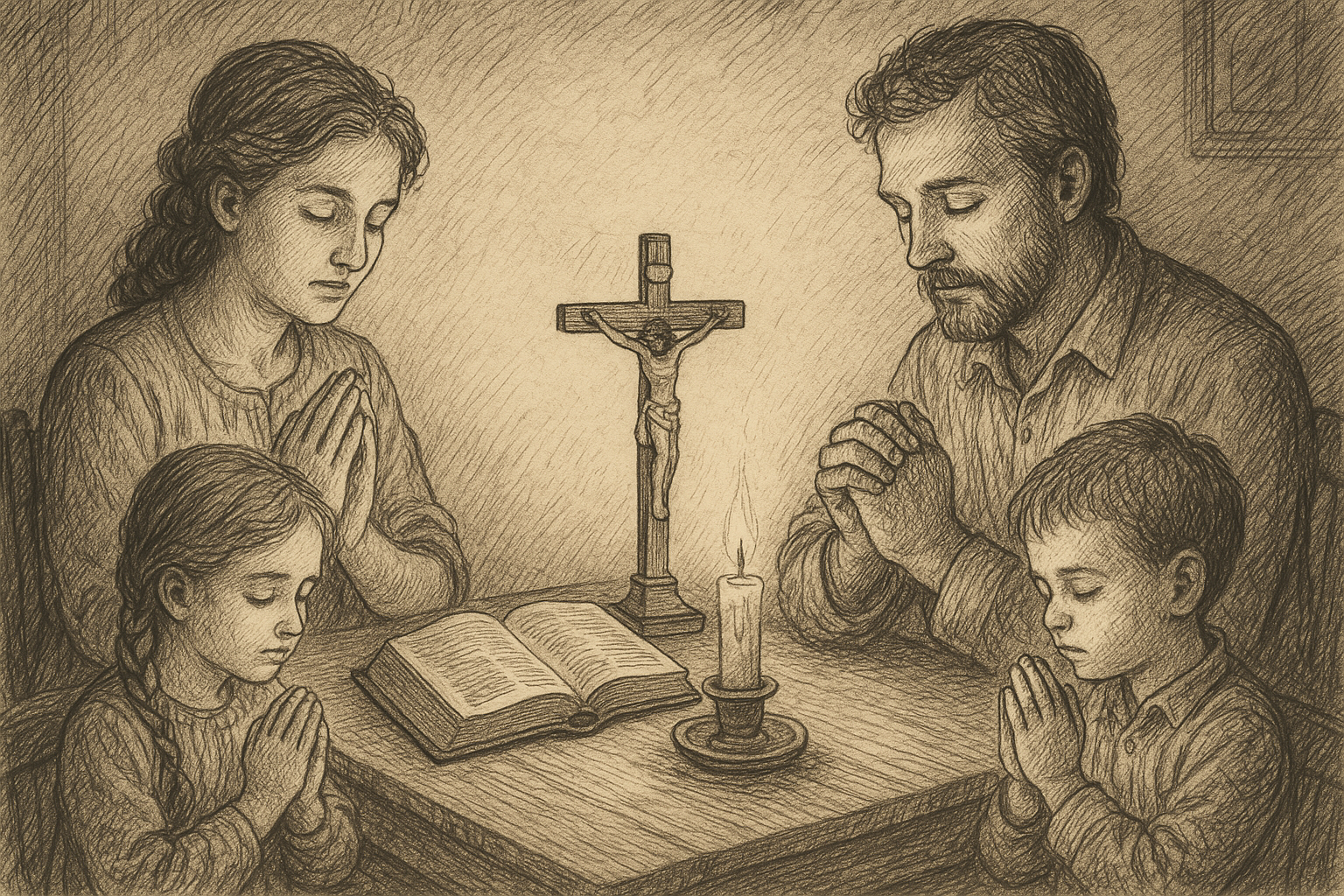
That does not mean every conversation must sound formal or religious. It means children learn by repeated contact with a living faith. They hear a parent bless the table. They watch someone apologize after losing patience. They see Sunday worship treated as sacred. They notice that a crucifix belongs in the center of the home because Christ belongs in the center of life.
The same biblical instinct appears in the Psalms: 4. The people of God are told not to hide the works of the Lord from the next generation, but to tell them. This is an act of gratitude as much as instruction. Parents hand on the faith best when they speak about what God has done, not merely what children should do.
Faith is not handed on only by lessons. It is handed on by memory, witness, and love made visible in daily life.
The home teaches before words do
Children are quick readers of the atmosphere in a house. They sense whether prayer is cherished or merely scheduled. They notice whether Scripture is honored, whether saints are spoken of naturally, and whether the Lord is called upon in times of stress. Long before children can explain doctrine, they absorb the tone of a family's faith.
That is why example matters so much. A parent who prays, even briefly and imperfectly, teaches more than a parent who gives long lectures but never kneels. A mother or father who goes to confession and speaks of mercy without shame teaches that God's forgiveness is real. A household that keeps holy days, fasts with moderation, and rejoices at Easter teaches that the liturgical year is not decoration but a school of hope.
St. Paul reminds Timothy of the faith that lived first in his grandmother Lois and his mother Eunice 5. This is one of Scripture's gentlest affirmations of family formation. Faith is not passed on by force. It is received through a chain of witness. Often the most lasting influence is quiet, steady, and long remembered.
Small practices form deep habits
Practical habits do not replace grace, but they make space for it. Catholic families often find help in a few simple rhythms:
- Praying a short blessing before meals and at bedtime
- Keeping a Bible or children's Bible in a visible place
- Teaching children the Sign of the Cross with care
- Going to Mass every Sunday and on holy days
- Speaking about the saints as real friends and examples
- Making room for silence, not only noise, in the home
These practices may look small, but over time they shape a child's sense of what matters. A child who learns to say grace also learns to recognize gift. A child who learns to ask for forgiveness also learns humility. A child who sees parents attend Mass faithfully learns that worship is not about convenience but about allegiance.
Formation includes patience, not panic
Many Catholic parents fear they are not doing enough. They compare themselves to other families, worry about distractions, and wonder whether their efforts will bear fruit. Such concern is understandable, but fear is a poor master in the spiritual life. The Lord does not ask parents to guarantee outcomes. He asks them to be faithful.
Jesus Himself welcomed children and placed them before the disciples as an example of trust 14. That scene is often remembered for its tenderness, but it also reveals something important about God's kingdom. Children are not obstacles to discipleship. They are recipients of blessing. Parents therefore do not need to treat spiritual formation as a battle to be won through pressure. They can approach it as a work of patient invitation.
There will be days when a child resists prayer, shrugs at Sunday Mass, or asks difficult questions. These moments are not signs of failure. They are part of growth. Faith matures over time, often in ways no parent can see. A seed buried in the soil does not appear impressive before it begins to grow.
Here the words of St. Paul are useful: 6 and 7. One plants, another waters, but God gives the growth. Parents need this reminder because it frees them from trying to play the role of savior. They are not the source of grace. They are its servants.
Children need truth, beauty, and mercy
To raise a child in the faith is not merely to prevent bad behavior. It is to present the fullness of Catholic life in a way a child can receive. Children need truth, because they need to know who God is. They need beauty, because beauty draws the soul toward worship. They need mercy, because every child sooner or later discovers weakness and failure.
This is why Catholic homes benefit from simple signs of reverence. An image of Our Lady, a prayer corner, a blessing before travel, a candle lit in Advent, or a family rosary can all help children recognize that God is not distant. They teach that holy things belong in ordinary rooms.
At the same time, mercy must remain visible. A parent who admits fault and seeks reconciliation shows children that holiness is not the same as pretending to be flawless. The sacramental life of the Church, especially Confession and the Eucharist, reminds families that grace meets people where they are and leads them onward.
Psalm 127 offers a salutary correction to parental anxiety: 1. Unless the Lord builds the house, those who build it labor in vain. This is not a command to do nothing. It is a call to build with humility. Parents work, but they do not replace God. They serve the building the Lord alone can complete.
The parish and the home belong together
Raising children in the faith cannot rest on the family alone. The parish matters. The sacraments matter. Good priests, catechists, godparents, and other Catholic families help children see that the Church is larger than one household. Children need to know they belong to a people, not simply to private religious preference.
When a child sees families kneeling together at Mass, hears the prayers of the Church, and learns the liturgy's language of praise and petition, faith becomes communal. This is vital, because isolation can make religion seem like a private opinion. The liturgy reveals something better: we are gathered into Christ's own prayer.
Parents should not feel they must create everything alone. They are the first teachers, yes, but not the only ones. The Church surrounds children with a wider witness. A faithful parish, regular sacraments, and friendships grounded in virtue all strengthen what begins at home.
When parents feel behind
Some readers may carry regret. Perhaps prayer was irregular for years. Perhaps family life was marked by stress, inconsistency, or long periods of spiritual silence. It is never too late to begin again. The Lord is patient with families. He often restores through small acts offered now, not through perfect histories that no one actually has.
Start where you are. Begin with one bedtime prayer. Return to Sunday Mass with renewed attention. Read a Gospel passage together once a week. Teach one child one prayer at a time. The Lord can do much with humble beginnings.
Children do not need parents who have mastered every answer. They need adults who are willing to seek Christ honestly and continue seeking Him. In that sense, the most powerful lesson a child may receive is not polished certainty, but persevering trust. A home that keeps turning back to God becomes a place where faith can take root, even slowly, and that quiet perseverance is often the truest form of raising children in the faith reflection.
In the end, Catholic parenting is not a performance. It is a daily yes to grace. Parents plant, pray, correct, encourage, and begin again. God sees the work, receives it, and gives growth in His time.
Keep Reading on Lets Read The Bible
Frequently Asked Questions
What is the most important part of raising children in the faith as a Catholic parent?
The most important part is living a visible, faithful Catholic life at home and in the parish. Children learn prayer, reverence, and trust in God from what they see every day, not only from formal lessons.
How can busy parents teach the faith without doing everything perfectly?
Busy parents can begin with small, consistent habits such as grace before meals, bedtime prayer, Sunday Mass, and brief Scripture reading. Consistency matters more than perfection.
What should parents do if a child seems uninterested in the faith?
Parents should stay calm, keep praying, keep the sacraments central, and continue inviting the child gently. Faith often grows over time, and patient witness is more fruitful than pressure.