Jesus and the Gospels
Lazarus at the Tomb: Faith, Delay, and the Voice of Christ
The raising of Lazarus reveals not only Christ's power over death, but also his patient love for those who wait in sorrow.
Site Admin | February 10, 2026 | 77 views
The scene at Bethany
The raising of Lazarus in the Gospel is one of the most moving moments in the ministry of Jesus. It appears in John 11, where a family in Bethany sends word that their brother Lazarus is ill. Mary and Martha know Jesus as a trusted friend, and they expect his help. Yet Jesus does not come at once. He remains where he is for two more days, and by the time he reaches Bethany, Lazarus has already been in the tomb for four days.
For readers, that delay can be difficult to understand. In ordinary human terms, it feels like an absence. In the logic of the Gospel, however, the delay becomes part of the revelation. Jesus is not indifferent to suffering. He is preparing to show that his power is not limited to healing at the edge of death, but extends even into death itself.
When Martha hears that Jesus is near, she goes out to meet him. Her words are full of faith and sorrow at once: if Jesus had been there, her brother would not have died. Mary later falls at his feet and weeps. The whole scene is shaped by grief, but also by hope, because both sisters still come to Christ.
Jesus enters human sorrow
Two short verses in John 11 are among the most beloved in the entire New Testament: Jesus wept. The Son of God, who will soon command Lazarus to come out of the tomb, also enters into the sorrow of the mourners. He does not remain above their pain. He allows himself to be moved by it.
This matters deeply for Catholic readers. It tells us that divine power is never cold. Christ is not a distant miracle worker performing signs without compassion. His tears show that God's saving work is personal. He meets us in grief, not just in triumph. The Church has always treasured this passage because it reveals both the humanity and divinity of Christ in a single, unforgettable moment.
Jesus also is troubled in spirit. He stands before death not as one who merely observes it, but as one who is about to confront it. Death is an enemy in the biblical story, one that entered the human family through sin. Here, in Bethany, the Lord of life faces that enemy openly.
What Jesus says to Martha
Martha's conversation with Jesus contains one of the clearest confessions of faith in the Gospel: I am the resurrection and the life. Jesus does not merely promise resurrection as a future event. He identifies himself with resurrection and life. In him, the power of the age to come has already entered the present.
At first, Martha speaks with confidence in the future resurrection at the last day, a belief firmly rooted in Jewish faith and fully affirmed by the Church. Jesus does not correct her hope. Instead, he deepens it. He asks her to believe not only in a future restoration, but in his own person. This is a pattern throughout the Gospel of John. Jesus constantly draws people from partial understanding to deeper trust.
For Catholics, this moment is especially precious because it helps us see that eternal life is not only a doctrine. It is communion with Christ himself. Resurrection is not simply a return to biological existence. It is the life that flows from the Son of God, who shares his own life with those who believe.
The miracle as a sign
The Church reads the raising of Lazarus in the Gospel as a sign, and John clearly intends it that way. Signs in the Fourth Gospel point beyond themselves. They reveal who Jesus is. Here the sign is plain: Christ has authority over death. He speaks, and the grave cannot resist him.
When Jesus arrives at the tomb, he commands that the stone be taken away. Martha objects, noting the odor. Her reaction is very human. It reminds us that miracles do not erase the reality of death, decay, and sorrow. Jesus then prays aloud, not because the Father needs to be informed, but so that the crowd may believe. His prayer is a revelation of communion between Father and Son.
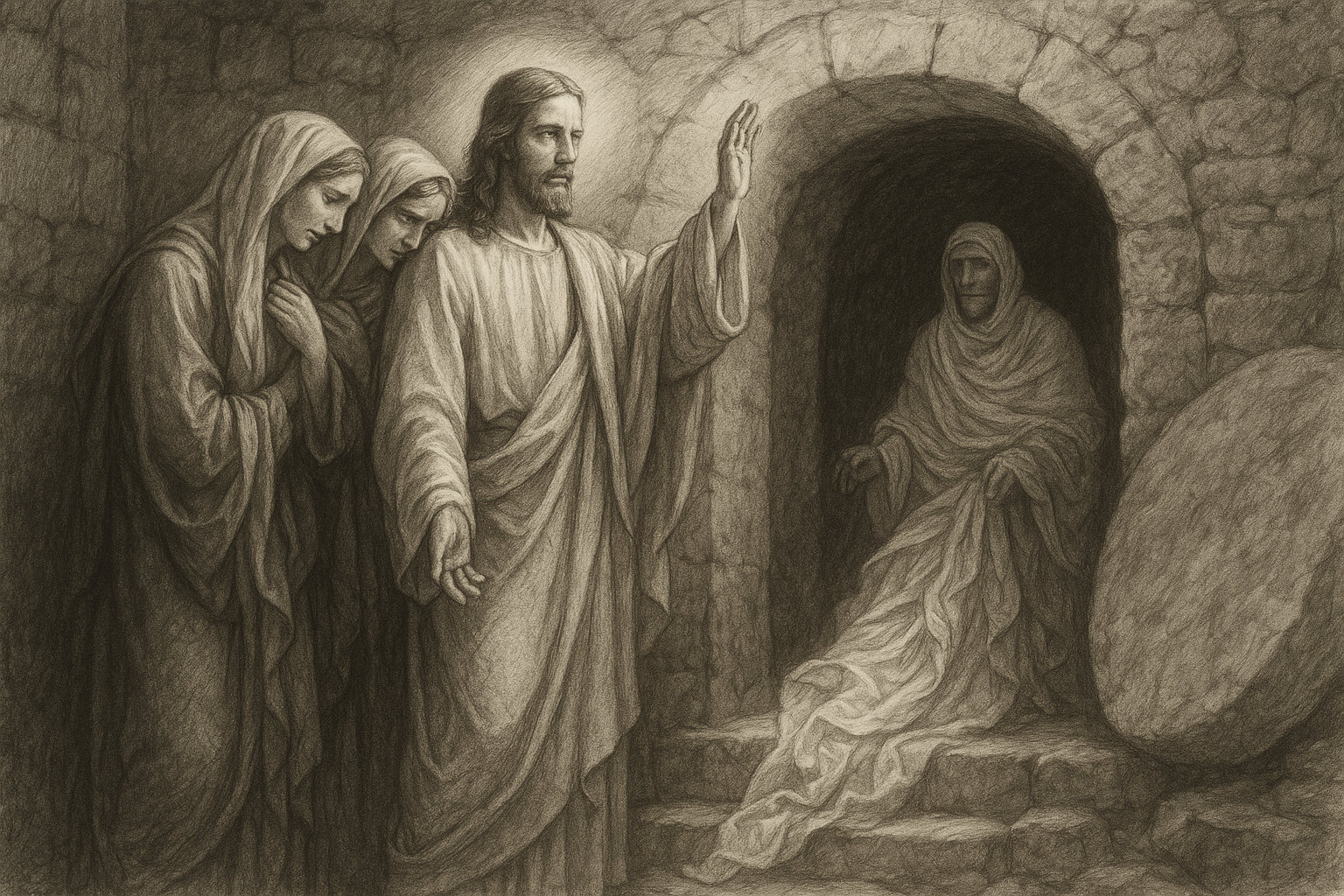
Then comes the command that stands at the center of the whole episode: Lazarus, come out. The dead man emerges, still wrapped in burial cloths. Jesus then tells the bystanders to untie him and let him go. The details matter. The command is personal, direct, and sovereign. Life returns by the word of Christ.
What the Church sees in Lazarus
In Catholic tradition, the raising of Lazarus has often been read as a sign of Christ's victory over death and a foreshadowing of his own Resurrection. Lazarus is brought back to mortal life, which means he will die again someday. Christ, by rising, enters a new and glorified life that death can never touch again. Even so, Lazarus points toward Easter morning. What Jesus does for his friend anticipates what he will do for the whole world through his Cross and Resurrection.
The Church also sees in this Gospel a spiritual image of conversion. Sin, in its spiritual effects, can make a person like one bound in grave clothes: alive in body, yet confined, hidden, and unable to move freely toward God. Christ calls the sinner out of darkness and into life, and then the community helps remove what still binds him. This is not a forced allegory detached from the text. It follows naturally from the way John presents the sign: the Lord gives life, and others help with the untangling that follows.
There is also a sacramental resonance here. Catholics hear in this passage an echo of the grace given in Baptism, when a person passes from death to life in Christ. The Church does not claim that Lazarus is a sacrament, but the story beautifully mirrors the pattern of grace. Christ speaks, life begins, and the old bindings no longer have the final word.
Jesus does not wait at a safe distance from grief. He comes near, weeps, prays, and speaks life into the tomb.
Why the delay matters
One of the hardest parts of the story is Jesus' delay. Mary and Martha both express the same thought in different ways: if Jesus had been there earlier, Lazarus would not have died. That is often how suffering feels in prayer. We ask, wait, and wonder why help did not come sooner.
The Gospel does not mock that pain. Instead, it shows that delay is not the same thing as abandonment. Jesus knew exactly what he was doing. His timing led not only to a healing, but to a revelation of glory. This does not mean every unanswered prayer ends in a visible miracle. It does mean that God's silence is never empty. He may be preparing a grace we cannot yet imagine.
For Catholics, this is a sobering and consoling lesson. Faith does not require pretending that grief is painless. It means bringing sorrow into the presence of Christ and trusting that he remains Lord even when his hour does not match ours.
Practical lessons for prayer and discipleship
The raising of Lazarus in the Gospel gives several concrete lessons for daily Christian life:
- Bring your honest grief to Jesus. Mary, Martha, and the mourners do not hide their sorrow. Neither should we.
- Believe that Christ is present even when he seems delayed. His timing belongs to him, not to our impatience.
- Hold fast to the confession that Jesus is the resurrection and the life. This is not poetry alone. It is the center of Christian hope.
- Let Christ command the parts of life that feel sealed shut. Prayer can become a way of standing before the tomb and asking for divine intervention where we have no strength left.
- Accept help from the community. The command to untie Lazarus reminds us that Christian life is communal. God often uses others to help us live freely.
These lessons are especially useful in seasons of bereavement, fear, or spiritual dryness. The Gospel does not promise that every pain will vanish at once. It does promise that Christ can enter any place, even the place that seems most final.
A sign that points beyond itself
The raising of Lazarus is one of the great turning points in John. It strengthens faith in some and hardens opposition in others. After this sign, the conflict around Jesus intensifies. In that sense, the miracle is not only a display of power. It is also a preview of the Cross.
That is an important Catholic insight. Christ's glory is never separated from his suffering. The one who calls Lazarus out of the tomb will himself be laid in a tomb. The one who weeps at Bethany will later give his life for the world. The raising of Lazarus is therefore not a detached wonder story. It is part of the road to Calvary and, beyond it, to Easter.
When Catholics meditate on this Gospel, they can pray for the grace to trust Jesus in the places where life feels sealed off. We can ask him to speak into our own darkness, to call forth what has grown silent, and to teach us to wait with faith when his response comes differently than we expected. The Lord who stood before Lazarus' tomb still speaks, and his word still gives life.
Keep Reading on Lets Read The Bible
Frequently Asked Questions
Why did Jesus wait before going to Lazarus?
John 11 presents the delay as part of the sign. Jesus says the illness will not end in death, but will reveal God's glory. His waiting shows that he is not absent, only acting according to a greater purpose.
Is the raising of Lazarus the same as Jesus' Resurrection?
No. Lazarus was restored to ordinary mortal life and would die again. Jesus rose in a glorified body and entered a new life that death can never end.
How can Catholics pray with the story of Lazarus today?
Catholics can pray with this passage by bringing grief, fear, and spiritual deadness to Christ with honesty. The story invites trust in Jesus' timing, confidence in his power, and hope that he can bring life where we can no longer see a way forward.