Jesus and the Gospels
When the Sea Refused to Be the Limit
The storm on the lake reveals not only Christ's power, but the shape of faith in every fearful heart.
Site Admin | February 7, 2026 | 74 views
The night the disciples learned who was in the boat
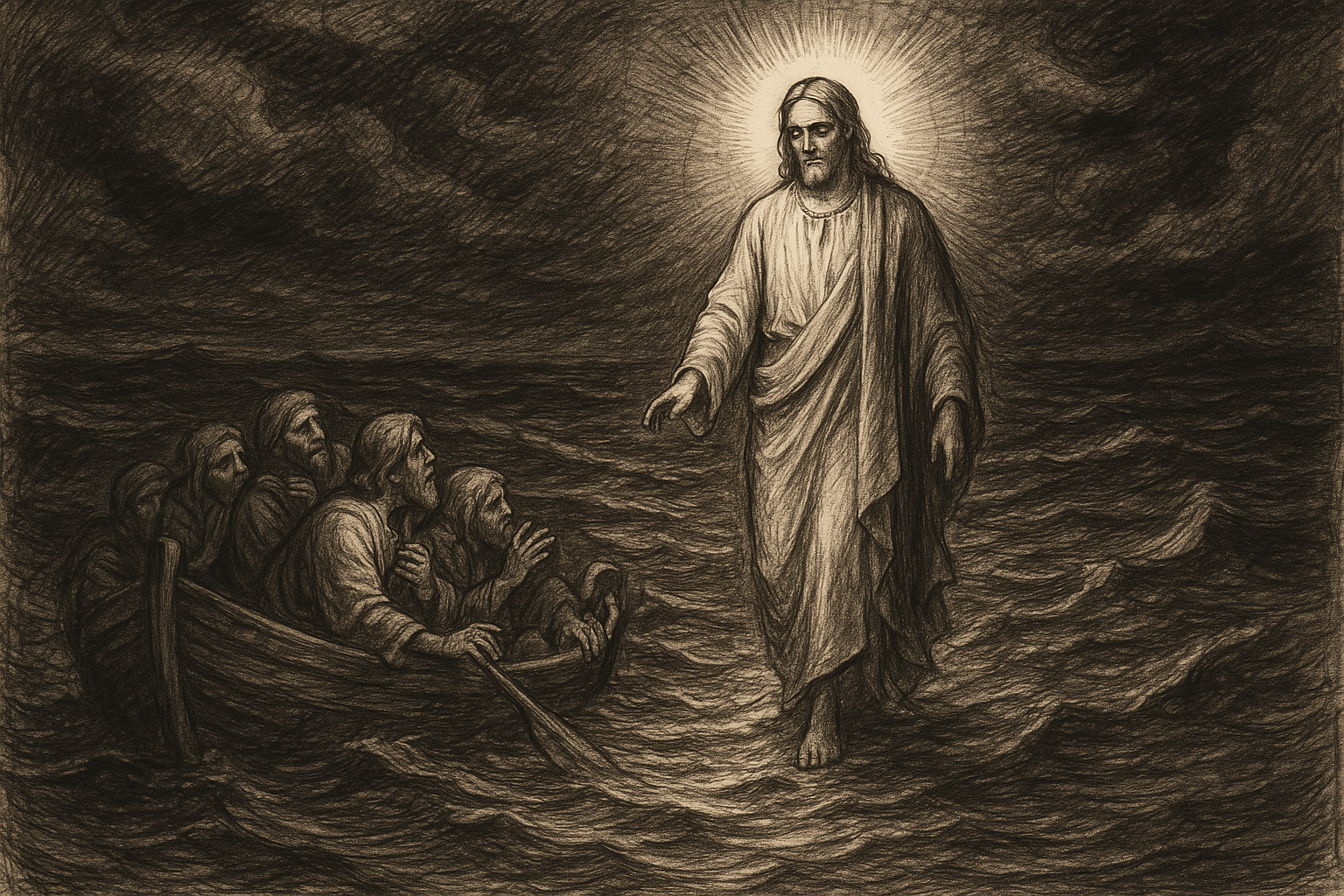
The scene is brief, but it carries the weight of revelation. After the feeding of the multitude, Jesus sends the disciples ahead by boat while he goes up the mountain to pray. Night falls. The wind becomes contrary. The water turns dangerous. Then, in the fourth watch of the night, Jesus comes to them walking on the sea, and the frightened disciples think they are seeing a ghost. But he speaks at once: "Take heart; it is I. Have no fear" Take heart; it is I. Have no fear.
That line is one of the center points of the whole account. Jesus does not merely rescue the disciples from a difficult night. He reveals his identity in a way that belongs to God alone. In the Old Testament, the sea often symbolizes chaos, danger, and powers beyond human control. The Lord who rules the depths is the Lord who is greater than fear itself. So when Christ walks upon the waters, he is not performing a trick. He is showing divine authority in a form that the disciples can see with their own eyes.
The Gospel accounts place this moment in the life of real men who were tired, frightened, and unable to manage the storm by their own skill. That matters. The miracle is not only about Jesus overpowering nature. It is also about the disciples learning that they are never abandoned when obedience has led them into rough water.
What Matthew wants us to notice
Of the Gospel writers, Matthew gives the fullest account of Peter stepping out of the boat. After Jesus identifies himself, Peter answers, "Lord, if it is you, bid me come to you on the water" Lord, if it is you, bid me come to you on the water. Jesus says, "Come." Peter climbs out and walks toward him. Then he notices the wind, becomes afraid, begins to sink, and cries out, "Lord, save me" Lord, save me.
That prayer is one of the most human lines in the Gospels. It is short, direct, and honest. Peter does not offer an argument. He does not promise to do better. He calls on the Lord. Jesus immediately reaches out his hand and catches him, saying, "O man of little faith, why did you doubt?" O man of little faith, why did you doubt?
Catholics often recognize in Peter both courage and weakness, which is fitting. Peter is not a symbol of perfect spiritual performance. He is a disciple who trusts enough to step out, then falters when he lets the storm become larger in his mind than the Lord standing before him. That tension makes him so relatable. Many believers know what it is to begin well, then look away, then sink, then cry out for mercy. The Gospel does not shame that cry. It places Jesus' hand beside it.
The miracle points beyond the miracle
Signs in the Gospels are never meant to remain isolated wonders. They point to the identity of Jesus and to the life he gives. Here, the sign reveals several truths at once.
First, Christ is Lord over creation. The sea obeys him because all things are made through him. He does not struggle against the waters as one who is equal to them. He passes over them with sovereign freedom. The storm remains real, but it is not ultimate.
Second, Christ comes to his disciples in the dark. The boat is far from shore. The wind is harsh. The night is long. Yet Jesus is not absent. That detail is deeply consoling. Catholic faith does not promise a life without storms. It promises the nearness of the Savior within them.
Third, faith is learned in relationship, not in theory alone. Peter learns what trust means not by reading about it, but by moving toward Jesus at his word. Faith is always personal. It is a response to the Lord who speaks. This is why Christian discipleship is never just about ideas, however true those ideas are. It is about following Christ when his voice is the only steady thing in the wind.
Fourth, Jesus saves in an instant when the disciple cries out. There is no delay in his hand. The one who permits the test also provides the rescue. That pattern appears again and again in the Bible. God allows his people to discover their need, but he is never slow to answer the humble plea for help.
The Catholic meaning of trusting Christ in the storm
The phrase Jesus walking on the water Catholic meaning points us to more than emotional encouragement. The Church reads events like this as revelation of Christ and instruction for the Christian life. The disciples in the boat can resemble the Church herself, carried through troubled waters across history. The world may be restless, but Christ remains Lord.
There is also a sacramental resonance in the scene, even if we should not force the passage into a neat allegory. The Lord comes to his own. He speaks. He saves. He raises the one who sinks. Catholic life is built around that same movement of grace. We are not left to manage the flood by our own strength. We receive what Christ gives.
That is especially important because modern hearts often want control before trust. We want calm before surrender. We want the water to settle before we believe we can step. But in the Gospel, faith often means acting before the storm has passed. Peter does not wait for perfect weather. He trusts the word of Christ and moves. The point is not that fearless people walk on water. The point is that the Lord is faithful when fearful people obey him.
The Church's spiritual tradition often returns to this same pattern. The saints do not deny fear. They learn to place fear beneath obedience. The life of prayer slowly changes the center of gravity in the soul. Instead of letting waves command attention, the believer begins to look first to Christ. That is one reason this miracle remains so relevant. It names the human condition with unusual clarity. We are always tempted to let what we see determine what we believe. Jesus teaches us to let his word determine how we see what we see.
Peter's sinking and the mercy that meets him
Peter often receives sharp attention because he steps out, falters, and is corrected. But the more important detail is not his failure. It is the mercy that meets him in the failure.
Peter sinks because he takes his eyes off Jesus. That is not merely a story about distraction. It is a spiritual diagnosis. Fear grows when Christ recedes from the center of attention. The wind is real, but it becomes overwhelming when it is interpreted without reference to the Lord. Many Catholics recognize that dynamic in prayer, in family life, in suffering, or in the burdens of conscience. The more we stare at the storm, the less room there is in the mind for trust.
Still, the Gospel does not say Peter was rejected for sinking. Jesus catches him. He does correct him, but the correction is within rescue, not apart from it. That is exactly how divine mercy often works. The Lord does not wait until we become stable before he saves us. He reaches down while we are still struggling.
Peter's words, "Lord, save me" Lord, save me, can serve as a simple Christian prayer. They are especially useful when the soul feels too agitated for elaborate speech. In such moments, the heart may not be able to draft a long meditation, but it can still cry out. The brief prayer of need is not a lesser prayer. It is often the truest one.
Other Gospel notes that deepen the scene
Mark also recounts the event, emphasizing that Jesus saw the disciples straining at the oars and came to them, because the wind was against them He saw that they were making headway painfully, for the wind was against them. That detail adds tenderness to the account. Christ is not detached from the labor of his own people. He sees the effort. He sees the resistance. He comes.
John's Gospel does not narrate the walking on the water in the same way, but it often presents signs that reveal Jesus' glory to those who recognize him. Taken together, the Gospels show the same Lord: one who feeds the hungry, masters the storm, and draws faith out of frightened hearts.
For Catholics, Scripture is always read within the living faith of the Church. That means we do not isolate a passage simply to marvel at its drama. We ask what it reveals about Christ, what it teaches about discipleship, and how it orders our prayer. This miracle tells us that divine power is never far from divine care. The same Lord who commands the sea bends toward the one who sinks.
How to pray with this Gospel scene
It can help to sit with the passage slowly and let it expose our own habits of heart. A few questions may open the text in prayer:
- Where in my life am I rowing against a contrary wind?
- What storm most easily steals my attention from Christ?
- Do I believe that Jesus sees me before I see him?
- Have I learned to pray, Lord, save me, without embarrassment?
One can also meditate on the contrast between the boat and the sea. The boat is small, the water immense, and yet the Lord is nearer than the waves. In prayer, that is often how grace feels. The danger may not disappear immediately, but the presence of Christ changes the meaning of the danger. The soul begins to learn that nearness to Jesus is not the absence of difficulty. It is the presence of salvation within it.
Many Catholics will find this passage especially rich before or after receiving the sacraments, since the life of grace strengthens what fear weakens. To approach Christ in the Eucharist is not to escape the world. It is to be given the strength to meet it without surrendering to panic. The Savior who came across the water still comes to his people, and he still speaks words that steady the heart.
In the end, the miracle leaves us with a simple but demanding truth: the sea is not the final horizon, and fear is not the final master. Christ is present, Christ speaks, Christ saves, and the disciple who keeps looking toward him will find that even the roughest waters cannot keep the Lord away.
Keep Reading on Lets Read The Bible
Frequently Asked Questions
What is the main Catholic meaning of Jesus walking on the water?
It reveals Jesus as Lord over creation and teaches that faith means trusting his word in the midst of fear and uncertainty. The miracle also shows that Christ comes to his disciples in distress and saves them when they call on him.
Why did Peter sink while walking on the water?
Peter began to sink when he took his eyes off Jesus and focused on the wind. The passage shows that faith weakens when fear becomes larger than trust, but it also shows that Jesus immediately saves the one who cries out.
How can Catholics pray with this passage today?
Catholics can use Peter's short prayer, 'Lord, save me,' as a simple act of trust in moments of fear. The scene also invites reflection on where we are called to obey Christ even before the storm has fully passed.