Jesus and the Gospels
When Christ Reproaches the Wind, He Also Reproaches Our Fear
The Gospel storm scene shows not only the power of Jesus, but the schooling of disciples who must learn to trust him in the middle of danger.
Site Admin | February 6, 2026 | 82 views
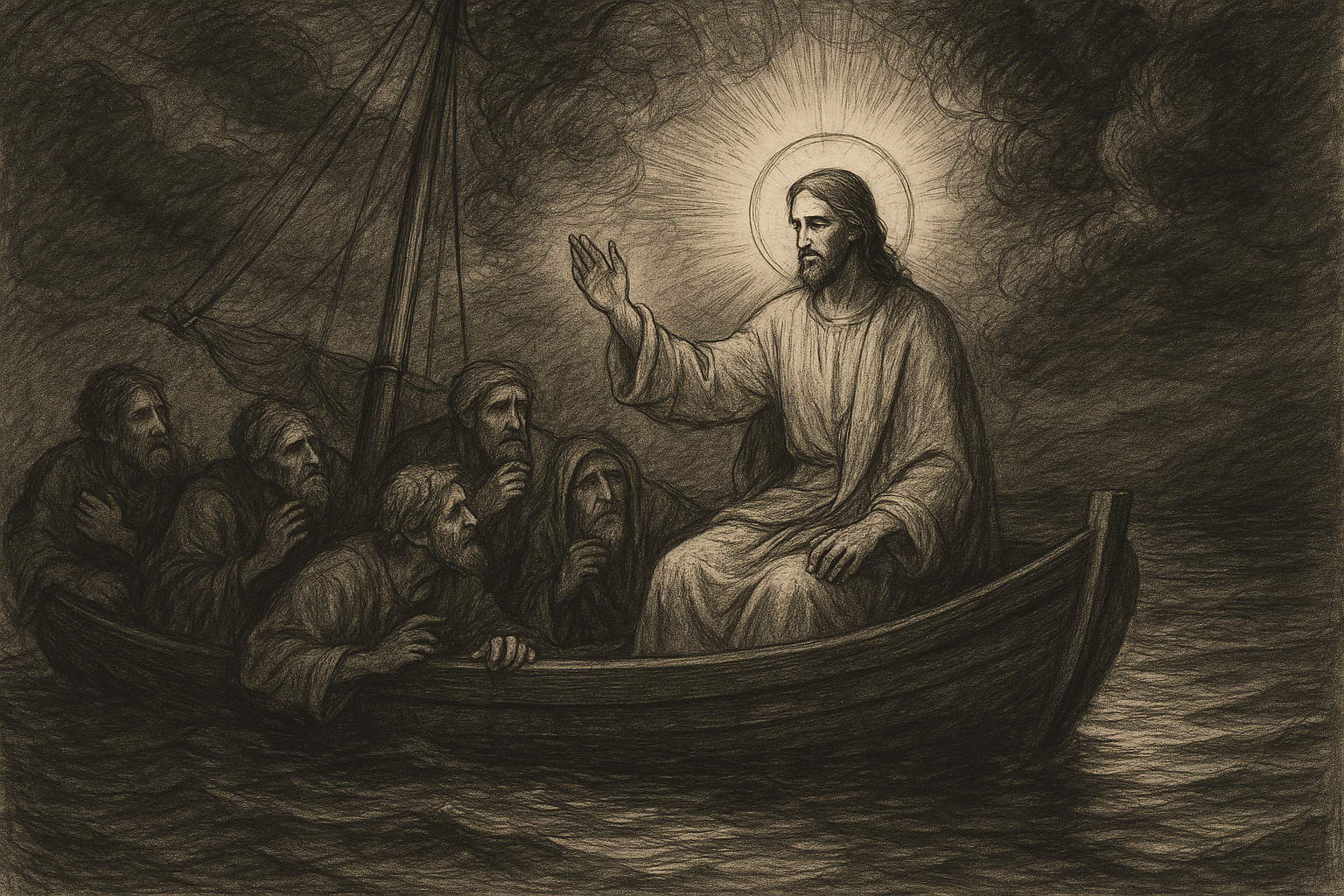
The scene of Jesus calming the storm is one of the most memorable moments in the Gospels. A boat is battered by waves, the disciples are afraid, and Christ is present yet apparently asleep. Then, with a word, the wind ceases and the sea becomes calm. The story is brief, but it opens into the heart of Christian discipleship.
In Matthew, Mark, and Luke, this miracle is not told as a decorative wonder story. It is a revelation. The One who rebukes the sea is not merely a prophet with unusual power. He is the Lord who speaks with divine authority, the One through whom all things were made. The disciples, who have seen him heal the sick and drive out demons, now face a question that reaches deeper than fear of weather: Who is this that even wind and sea obey him?
The storm in the Gospels
The Synoptic Gospels each place the storm at a crucial moment in the disciples' journey. In Matthew 8:23-27, Jesus enters the boat and the tempest rises. In Mark 4:35-41, the scene is especially vivid, with the boat filling with water while Jesus sleeps on a cushion. In Luke 8:22-25, the disciples cry out in terror, and the rebuke that follows leaves them in awe.
These accounts are not competing versions so much as complementary witnesses. Each emphasizes a different aspect of the same reality. The disciples are not simply caught in bad weather. They are being led into a moment that will disclose their own fear and Christ's sovereign peace.
It matters that Jesus himself commands the boat to cross the lake. The storm is not outside the scope of his will. The disciples are not in a place he did not send them. That detail gives the story a lasting force for Christian life. Faith does not mean the absence of storms. It means learning to trust the Lord when obedience leads into rough water.
Why the sleeping Christ matters
One of the most striking details in Mark's account is that Jesus is asleep. To frightened fishermen, his sleep can seem like indifference. They wake him with what sounds like a reproach: Teacher, do you not care that we are perishing? It is a human cry, honest and urgent. Many believers have prayed with that same feeling in one form or another.
Yet the sleeping Christ is not absent. His rest reveals more than fatigue. It shows his true humanity, real enough to sleep, and his divine peace, deep enough to remain untroubled in the midst of danger. The Lord is not panicked by what panics us. He is not manipulated by the chaos that surrounds us.
This is a comfort Catholics should not miss. The Lord's silence in trial is not the same as his absence. There are moments in prayer when heaven seems quiet and the soul feels small against the size of the trouble. The Gospel scene invites us to remember that Christ's nearness is not measured by our emotions. He is in the boat.
When the disciples cannot awaken peace in the world around them, they discover that peace is a person, not a technique.
What Jesus reveals by rebuking the sea
After the disciples cry out, Jesus rises and speaks: Peace! Be still! The sea obeys. This is not only a display of power over nature. It is a sign of who Jesus is in relation to creation itself. In the Old Testament, the Lord alone rules the waters and brings order out of chaos. When Christ calms the storm, he acts with that same divine authority.
The reaction of the disciples is therefore part of the point. They are astonished not simply that the storm ended, but that Jesus ended it with a word. The question, Who then is this? presses the reader to confess what the Church has always professed: Jesus Christ is truly Lord.
Catholic faith receives this scene with reverence because it reveals the identity of Christ without dissolving his humanity. He is fully man and fully God. He can sleep in the boat and command the sea. He can share our weakness and rule over creation. The miracle is not a contradiction of the Incarnation. It is one of its luminous disclosures.
The disciples' fear and our own
The disciples in the boat are not caricatures of unbelief. They are men learning faith in real time. Their fear is understandable. The water is rising. The boat is vulnerable. Human strength is not enough.
That is why the storm speaks so directly to Christian experience. Many faithful people know what it is to feel overwhelmed by illness, family conflict, financial strain, grief, uncertainty, or temptation. In those moments, we may assume that fear is a sign of failure. The Gospel suggests something more subtle. Fear is often the place where discipleship is tested and purified.
Jesus does not shame the disciples for being afraid of the storm alone. He asks, Why are you afraid, O you of little faith? The issue is not that they felt the danger, but that they had not yet learned to interpret danger in the light of his presence. Faith does not deny the storm. It remembers the Lord in the storm.
This distinction matters in Catholic prayer. We do not come to God only when we are calm. We come to him precisely when we are not. The Psalms give us language for this honesty, and the Gospels give us Christ himself as the answer to it. Prayer becomes mature when it can say both, Lord, we are afraid and Lord, you are here.
Lessons for Catholic prayer
The storm on the sea can become a guide for prayer in several practical ways.
1. Bring the fear to Jesus without dressing it up
The disciples do not deliver a polished speech. They cry out. That simplicity is a grace. In prayer, Catholics should not feel forced to sound composed before the Lord. Honest prayer is better than formal words that conceal distress. A frightened heart can still be a praying heart.
2. Remember that Christ is not distant from suffering
Jesus enters the boat with the disciples. He does not issue instructions from the shore. Christian prayer is grounded in a Savior who comes near, shares the journey, and enters our vulnerability. This is why Catholics find so much comfort in the sacraments, especially the Eucharist, where the Lord remains truly present among his people.
3. Ask not only for relief, but for faith
It is natural to ask God to calm the storm. Yet the deeper request is often that he calm the heart. Sometimes the external trouble remains for a time, but the soul becomes steadier through grace. That steadiness is not resignation. It is the fruit of trust.
4. Let the miracle question you
The disciples end with wonder. Good prayer does that. It does not merely seek an outcome. It also allows itself to be changed. When Jesus reveals his power, he also reveals our need to know him better. A Catholic reading of the story does not stop with comfort. It moves toward adoration.
The storm as a sign of the Church's journey
Many Christians have seen in this Gospel scene an image of the Church sailing through history. The boat can suggest the community of disciples, fragile and tested, yet never abandoned by Christ. That reading is not forced. It fits the way the Gospels consistently show Jesus forming a people who must learn to trust him together.
The Church has never been promised a life without storms. Persecution, misunderstanding, scandal, internal weakness, and the ordinary trials of every age have pressed against her from the beginning. And yet the risen Lord has not left his people alone. He remains with the Church, teaching her to pray and to endure.
For individual believers, this means that storms are not always signs that God has forgotten us. Sometimes they are the very setting in which trust is refined. The waves may be real, but so is the presence of Christ. That presence does not always remove difficulty instantly, but it does keep difficulty from having the final word.
Trust that grows in the dark
The Gospel does not suggest that the disciples understood everything at once. In fact, their amazement shows that they were still being taught. That is encouraging. Saints are not people who never tremble. They are people who keep returning to Christ until trust becomes more reliable than panic.
There is a hidden mercy in the storm: it reveals what the heart leans on. When the weather is fair, self-confidence can be mistaken for faith. When the sea rises, we learn where we actually place our hope. That discovery can be painful, but it can also be purifying.
For Catholics, the answer is not stoic self-reliance. It is surrender to the Lord who speaks peace. The same Jesus who calmed the waters also calms the heart through grace, the Word, the sacraments, and the quiet work of the Holy Spirit. He still forms disciples by bringing them through fear into trust.
The boat may rock. The night may be long. The prayer may begin in anxiety. But Christ is not less Lord because the waves are high. He is Lord over the storm, Lord over the heart, and Lord over every crossing that leads his people toward the far shore.
Keep Reading on Lets Read The Bible
Frequently Asked Questions
Which Gospel passages tell the story of Jesus calming the storm?
The miracle is found in [[VERSE|matthew|8|23|Matthew 8:23-27]], [[VERSE|mark|4|35|Mark 4:35-41]], and [[VERSE|luke|8|22|Luke 8:22-25]]. Each account highlights the disciples' fear, Jesus' authority, and the sudden calm that follows his word.
What does Jesus calming the storm teach Catholics about faith?
It teaches that faith is not the absence of fear, but trust in Christ's presence during fear. The disciples were frightened, yet Jesus was with them in the boat. Catholics can see in this a call to bring honest prayer, deeper trust, and surrender to the Lord in times of trial.
Why is Jesus sleeping in the boat such an important detail?
His sleep shows both his real humanity and his divine peace. He is truly man, able to sleep, and truly God, not ruled by the storm. For believers, this detail reassures us that Christ is never absent, even when he seems quiet in moments of distress.