Jesus and the Gospels
At the Tax Booth: The Quiet Power of Christ's Call to Matthew
The Gospel scene is brief, but its mercy reaches to the heart of Catholic discipleship.
Site Admin | January 21, 2026 | 86 views
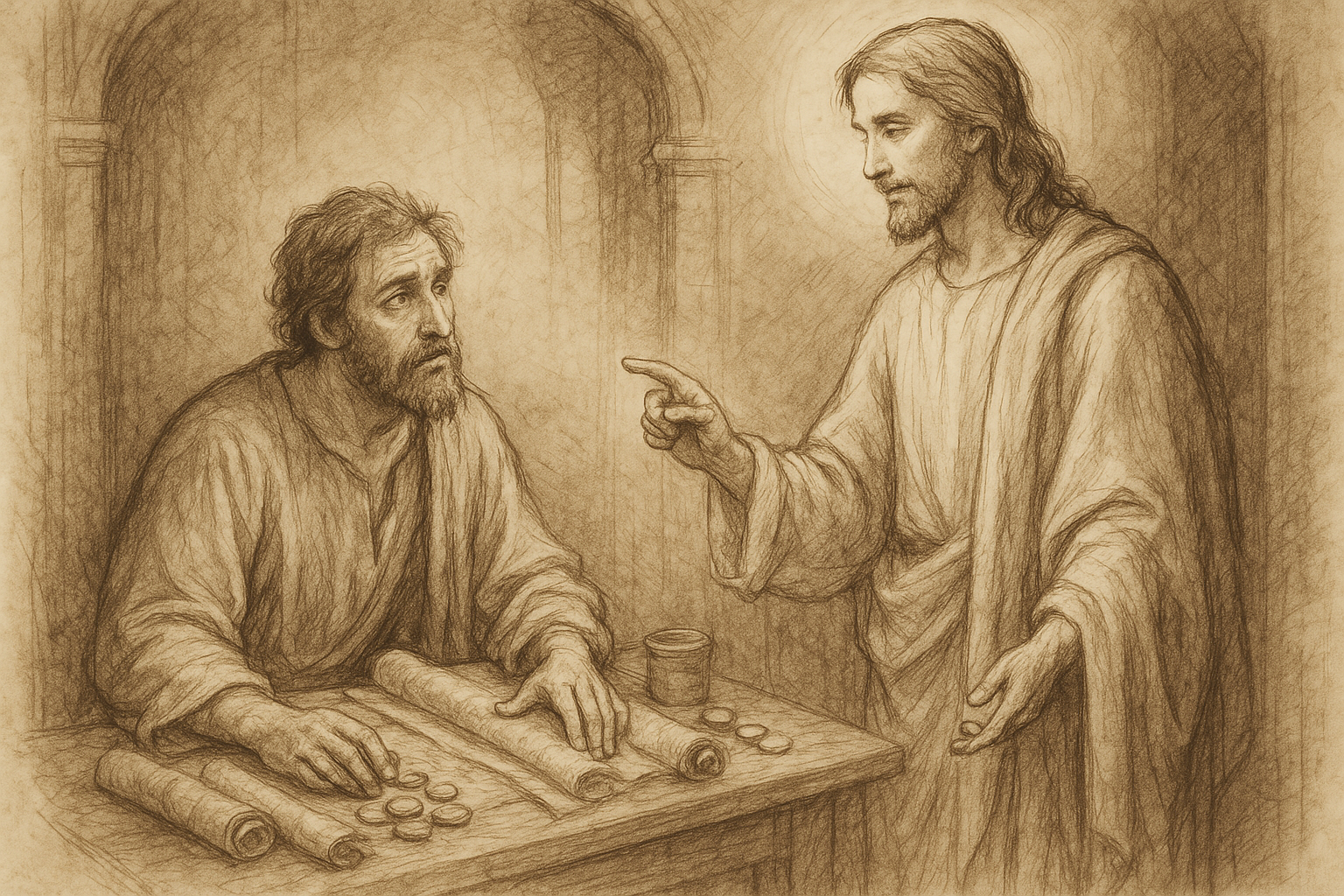
The calling of St. Matthew in the Gospel is one of those brief scenes that carries more spiritual weight the longer one sits with it. A single sentence from Jesus changes the course of a life: Matthew is sitting at the tax booth, and Christ says, Follow me. The next words are just as striking: And he rose and followed him Mt 9:9.
That is the heart of the scene. Jesus does not give Matthew a long interview. He does not ask him to prove himself first or to clean up his reputation before speaking. The call itself becomes the beginning of conversion. In the Catholic life, this is never a small detail. Grace does not merely reward the already worthy. Grace awakens the heart, turns it toward Christ, and makes a new path possible.
To appreciate this Gospel moment, it helps to remember who Matthew was and what his booth meant. Tax collectors in the first century were often viewed with suspicion or outright contempt. They were associated with collaboration, greed, and dishonesty. Even if a particular tax collector tried to act fairly, the office itself carried a social stain. Matthew was not standing at the edge of religious respectability. He was seated at a place of profit and public shame. And it is there, not in the temple precincts or among the scribes, that Jesus calls him.
The Gospel scene and its startling simplicity
Saint Matthew tells the story with remarkable restraint. There is no dramatic argument, no visible sign, no extended conversion speech. Jesus passes by and says, Follow me Mt 9:9. Matthew rises and follows. That simplicity matters, because it keeps the emphasis where the Gospel places it: on the authority of Christ and the freedom that grace creates in the soul.
Matthew's response is immediate because the call of Christ is not merely information. It is an event. The Lord's word reaches into the deepest place of a person and summons him into communion. This is one reason the Church reads such passages not only as history but as living revelation. Christ still speaks with that same authority. He still calls people in the middle of ordinary work, ordinary fatigue, ordinary compromise, and ordinary fear.
The next detail in the Gospel is also important. Matthew gives a banquet in his house, and many tax collectors and sinners come to eat with Jesus and his disciples Mt 9:10. The Pharisees object, asking why Jesus would associate with people of such poor standing. Jesus answers with a sentence that remains central to Catholic devotion and pastoral life: Those who are well have no need of a physician, but those who are sick Mt 9:12. Then he adds, I desire mercy, and not sacrifice Mt 9:13.
Here the calling of Matthew opens into the logic of the entire Gospel. Christ does not deny sin. He enters it to heal. He does not praise the wound. He applies mercy to it. In Catholic terms, this is not sentimental kindness. It is saving charity, the mercy of God that seeks conversion, reconciliation, and communion.
Mercy meets a man at work
Matthew is not pictured in prayer, fasting, or study when Jesus calls him. He is at work. That detail is spiritually rich. It reminds us that God does not wait for a perfect setting before initiating grace. He addresses people in the middle of their real lives. The tax booth is the place of income, obligation, routine, and perhaps inner compromise. It is also the place where Matthew is found by Christ.
For Catholics, this should correct a common temptation: the idea that holiness begins only once life is tidied up. The Gospel says otherwise. The Lord meets people where they are, but He never leaves them where they are. Mercy is not permission to remain unchanged. Mercy is power for change. Matthew's leaving the booth is a visible sign that a deeper leaving has begun inside him. He is walking away from a former identity and entering a new one.
This is why the scene speaks so clearly to the sacramental life of the Church. In Confession, the Lord continues His merciful work by calling sinners to conversion and healing. The sacrament does not erase the seriousness of sin. It reveals even more clearly the greatness of divine mercy. Matthew's story helps us see that the first movement belongs to Jesus. He comes near, speaks, and invites. The sinner responds in faith.
It is also worth noticing that Matthew does not negotiate. He does not ask for time to settle accounts or to satisfy every demand. The Gospels present him as one who hears and follows. That response does not mean he understood everything at once. It means he trusted the One who called him. Christian discipleship begins there. The believer does not master Christ. The believer yields to Christ.
The banquet that reveals the heart of the Gospel
Matthew's feast is more than a social event. It is an image of the mercy Christ came to bring. The table becomes a sign of fellowship, restoration, and unexpected welcome. Jesus is not afraid to be seen with people who need healing. In fact, their need is precisely the reason He is present.
This matters in a Catholic reading of the Gospels because it reveals both the tenderness and the realism of divine mercy. Jesus does not pretend that sin does not exist. He names the sick, the lost, and the sinner. Yet He does so in order to save, not to humiliate. His presence at the table is already a kind of judgment, because it exposes the narrowness of those who imagine holiness as separation from the unclean rather than as the power to restore them.
The Lord's words, I desire mercy, and not sacrifice Mt 9:13, should not be read as a rejection of worship or ritual. In Catholic faith, sacrifice and mercy belong together when rightly understood. The problem is not sacrifice itself, but sacrifice detached from a merciful heart. God desires a people whose worship is truthful, whose prayers are humble, and whose lives reflect the mercy they have received. Matthew's banquet shows what such mercy looks like in practice: Jesus shares the table with the very people others would avoid.
There is also a quiet apostolic lesson here. Matthew does not keep his encounter with Christ to himself. He opens his house. Something received becomes something offered. That pattern still shapes Christian witness. A convert who has encountered mercy often becomes a host of mercy. A forgiven person begins to make space for others. Matthew's table hints at the Church herself, where the Lord gathers sinners, feeds them, and forms them into a new people.
What the Church sees in Matthew's call
The Catholic tradition has long read Matthew's call as a portrait of vocation. A vocation is not first about a career or a task. It is about being called by Christ into a relationship that reorders everything else. Matthew becomes an apostle, a witness, and, by tradition, the author associated with one of the Gospels. But before all of that, he is a man summoned by mercy.
That sequence is important. The Church does not begin with achievement. She begins with grace. The apostles were not selected because they had already arrived at perfection. They were chosen, formed, corrected, and sent. Matthew fits that pattern exactly. His former life does not disqualify him from being called. Instead, his transformation displays what the call of Christ can accomplish in a human life.
For Catholics discerning their own path, this can be deeply consoling. Many people hesitate to respond to God because they think their past has made them unusable. Matthew stands against that lie. The Lord who called him knew his history and still chose him. This does not minimize repentance. It magnifies mercy. God does not call because a person is already holy. He calls in order to make a person holy.
The scene also reminds us that discipleship is a movement. Matthew rises. He leaves behind one manner of living and enters another. In Catholic terms, this is a fitting image of conversion, ongoing sanctification, and the repeated renunciation that Christian life requires. We do not answer Christ once and then remain unchanged. We continue to respond every day. The call may sound in a moment, but it shapes a lifetime.
Lessons for prayer and daily discipleship
The calling of St. Matthew in the Gospel offers several practical lessons that are easy to overlook if we read too quickly.
- Christ sees people in their real condition. He does not wait for an ideal version of us before speaking.
- Grace initiates. The Lord calls before Matthew proves anything.
- Discipleship requires a response. Matthew rose and followed. Hearing alone was not enough.
- Mercy creates mission. The forgiven person becomes a witness to mercy.
- Meals and fellowship matter. Table fellowship in the Gospel often reveals the shape of God's welcome.
For prayer, this scene invites a very simple practice: place yourself where Matthew sits, and listen for Christ's word. Not every prayer begins with many words. Sometimes the most fruitful prayer is a quiet readiness to hear the Lord say, Follow me. Then ask for the grace to rise. If there is sin to confess, confess it. If there is reluctance, name it. If there is fear, bring it to Christ. The One who called Matthew can also steady your own next step.
The scene can also sharpen our understanding of mercy in relationships. Catholics are called to be truthful about sin, but never cruel. The mercy of Christ does not flatter wrongdoing, yet it refuses to reduce a person to his failures. Matthew was more than a tax collector once Christ called him. So too every baptized person is more than a past wound, a bad habit, or a public label. The Gospel teaches us to see as Christ sees: with realism, compassion, and hope.
Finally, Matthew's call reminds us that the Church herself is a community of the called. We gather not because we are all finished but because we have heard the voice of the Shepherd. In every Mass, in every confession, in every act of repentance, the same pattern is renewed. Christ comes near. He speaks. The heart is invited to rise.
And when that happens, even the most ordinary place can become the beginning of a new life.
Keep Reading on Lets Read The Bible
Frequently Asked Questions
What is the main point of Matthew's call in the Gospel?
The main point is that Jesus calls Matthew with mercy and authority, and Matthew responds immediately by leaving his former life to follow Christ.
Why is Matthew's profession as a tax collector important?
Tax collectors were widely despised in Jesus' time, so Matthew's call shows that Christ seeks sinners where they are and brings them into conversion.
How does Matthew's call relate to Catholic discipleship?
It shows that discipleship begins with grace, requires a real response, and continues through a life of conversion, mercy, and trust in Christ.