Jesus and the Gospels
Five Loaves, Twelve Baskets, and the Logic of Christ's Heart
The feeding of the five thousand in the Gospel reveals more than abundance. It reveals how Jesus receives what we cannot make enough and turns it into communion.
Site Admin | February 4, 2026 | 75 views
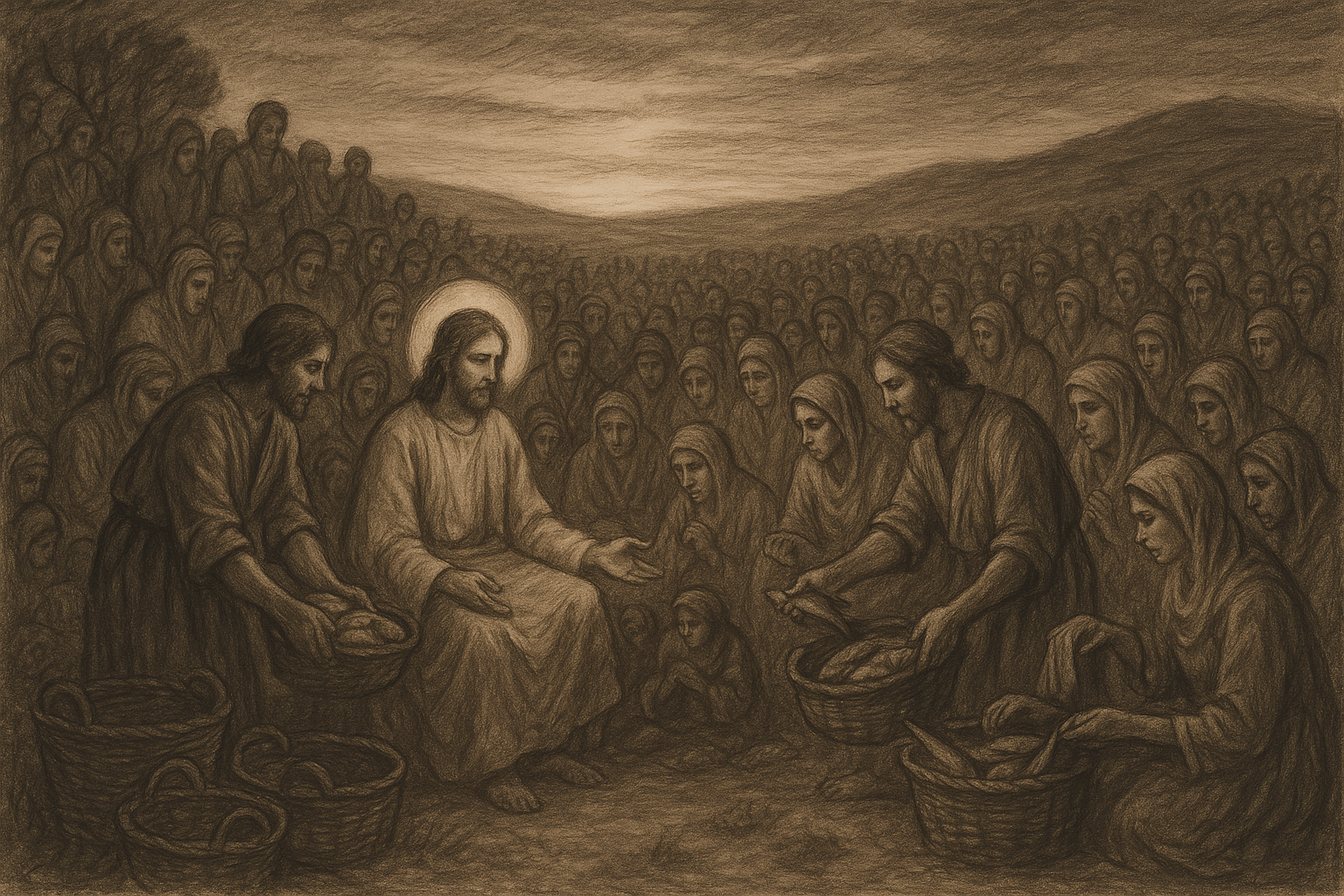
The feeding of the five thousand in the Gospel is one of those moments that seems simple at first glance and inexhaustible after prayer. A great crowd has followed Jesus into a lonely place. The hour grows late. The disciples see the problem plainly: too many people, too little food, too much need. Jesus, however, does not begin with scarcity. He begins with compassion, then blessing, and finally abundance.
In the Gospels, this miracle appears in all four accounts in some form, which already tells us that the Church has long regarded it as central. [[VERSE|matthew|14|13-21|Matthew 14:13-21]] [[VERSE|mark|6|30-44|Mark 6:30-44]] [[VERSE|luke|9|10-17|Luke 9:10-17]] [[VERSE|john|6|1-15|John 6:1-15]] Each Evangelist places the event in a slightly different light, but the core is the same: Jesus feeds a hungry multitude with five loaves and two fish, and the leftovers fill twelve baskets. The sign is practical, but it is also symbolic. It reveals who Jesus is and what kind of kingdom he brings.
The scene in the wilderness
The setting matters. The crowd is not gathered in a banquet hall but in a deserted place. They are tired, hungry, and dependent. This is not a setting of human control. It resembles Israel in the wilderness, where the Lord provided manna from heaven, and it also recalls the people of God learning to trust divine care one day at a time. The Gospel writers are not subtle about this. Jesus is presented not only as a wonder worker, but as the One who shepherds his people through barrenness.
Mark says that Jesus had compassion on the crowd because they were like sheep without a shepherd. Mark 6:34 That single line helps us read the miracle rightly. Christ does not feed people as if performing a display of power. He feeds them because they are his flock. He sees their hunger before they speak it. He sees their weakness and does not turn away from it. In Catholic life, that is a consoling truth. The Lord is never embarrassed by human need. He meets it with mercy.
The disciples, by contrast, are practical to the point of discouragement. Their suggestion makes sense. The crowd is large. The hour is late. The resources are small. Yet their realism is incomplete because it forgets who is standing in front of them. This is often where discipleship becomes hard. We can accurately describe the problem and still fail to imagine what Christ can do with it.
Jesus takes, blesses, breaks, and gives
In John, Jesus takes the loaves, gives thanks, and distributes them. John 6:11 The language is striking. It echoes the pattern of the Last Supper and, for Catholic readers, it naturally recalls the Eucharist. The verbs are not accidental. Jesus takes what is offered, blesses it, breaks it, and gives it. The Church hears in that rhythm a foreshadowing of the Mass, where ordinary bread and wine are offered to God and become, by the power of Christ, the sacramental food of his Body and Blood.
This does not mean the feeding of the five thousand is simply a coded version of the Eucharist. It is a real miracle in its own right, a sign of Jesus' compassion and divine authority. But signs in the Gospel are never only one thing. They point beyond themselves. The crowd receives physical food, and the reader is invited to wonder about a deeper hunger. Human beings need bread, but they also need communion with God. They need daily sustenance, but they also need eternal life.
John makes that deeper meaning explicit later in the chapter, when Jesus speaks of himself as the Bread of Life. John 6:35 The miracle prepares the heart for that teaching. It says, in effect, that the One who can feed a multitude from almost nothing is also the One who can give himself as true nourishment. In Catholic faith, this is not poetry detached from reality. It is the logic of the Incarnation continuing into sacramental life. Christ feeds us not only with ideas, but with himself.
What the leftovers tell us
The twelve baskets remaining after everyone has eaten are not an afterthought. They are part of the sign. God does not merely satisfy the crowd in a minimal way. He gives enough, and then more than enough. In Scripture, abundance often reveals divine generosity. The Lord is not a miser with grace.
The number twelve also invites reflection. Without forcing the symbolism, Catholics have long seen in it an image of Israel and the apostolic foundation of the Church. The food is not only for the moment. It is gathered and preserved. Nothing is wasted. The Lord's generosity has order, and his abundance is not chaotic. He provides in a way that leaves room for memory, gratitude, and mission.
There is a quiet lesson here for prayer. We often approach God as if his help will be barely sufficient, as if grace will run out before the need is met. But the Gospel shows a different pattern. Jesus does not ask the disciples to begin with what they lack. He asks what they have. Then he takes that small offering and makes it fruitful. Catholic disciples can live from that same logic. What seems insignificant in our hands can become fruitful when surrendered to Christ.
The apostles as learners
The disciples are not portrayed as heroes who immediately understand everything. They are bewildered, hesitant, and stretched beyond their own resources. That is encouraging, because most Christian growth looks like that. The apostles learn by being asked to do more than they can do on their own. They distribute what Jesus provides, and in that service they become instruments of his care.
This is one of the deepest patterns in discipleship. The Lord rarely removes his servants from need. More often, he places them where need is visible so that they can learn dependence. Apostolic ministry is not about self-sufficiency. It is about participation in Christ's own generosity. A priest at the altar, a parent at home, a teacher in the classroom, a volunteer at the parish pantry, a friend sitting quietly with someone in grief all share in that same basic movement: receive from Christ, then give to others.
There is also humility in the detail that Jesus tells the disciples to organize the crowd. [[VERSE|mark|6|39-40|Mark 6:39-40]] Grace is not opposed to order. The Lord feeds people through human cooperation, not because he needs help, but because he dignifies his servants by letting them take part. This is a beautiful pattern for Catholic life. God is sovereign, yet he truly involves us. He can work without us, but he usually chooses to work through us.
A sign of the Eucharist
Catholic readers naturally hear Eucharistic notes in this miracle, and rightly so. The same Christ who fed the crowd in the wilderness feeds his Church in the sacrament of the altar. The multiplication of bread anticipates the mystery in which the Lord gives himself without being diminished. In the Eucharist, Christ is not shared less because he is given to many. He is present wholly to each communicant, and the Church grows by receiving him together.
This is not a metaphor that stays safely in the abstract. It shapes worship. When Catholics come to Mass, they do not come to a religious lecture or a symbolic reminder alone. They come to the living Christ, who still says in effect,
Keep Reading on Lets Read The Bible
Frequently Asked Questions
How is the feeding of the five thousand connected to the Eucharist?
The miracle uses the pattern of taking, blessing, breaking, and giving, which anticipates the Last Supper and the Mass. It is not the Eucharist itself, but it strongly prefigures Christ's sacramental gift of himself as true bread for the life of the Church.
Why are there leftovers after everyone is fed?
The twelve baskets show God's abundance and order. Jesus does not provide only barely enough. He gives generously, and the leftovers also suggest a sign of fullness that reaches beyond the immediate crowd to the apostolic people of God.
What does this miracle teach Catholics about prayer and discipleship?
It teaches trust, surrender, and cooperation. The disciples bring a small offering, and Jesus multiplies it. Catholics can pray with the same spirit, offering what is limited and letting Christ use it for his purposes.