Jesus and the Gospels
Thomas and the Wounds: Faith After the Resurrection
St. Thomas's encounter with the risen Christ reveals how mercy answers doubt and how faith grows when it is touched by grace.
Site Admin | January 22, 2026 | 97 views
The scene of St. Thomas after the Resurrection is among the most familiar and most searching moments in the Gospels. Thomas was not present when the risen Jesus first appeared to the other disciples, and when they told him what they had seen, he refused to accept their witness without evidence he could grasp for himself. His words were stark: he would not believe unless he could see the wounds and place his hand where the soldiers had pierced the Lord.
At first glance, Thomas can seem like the disciple of doubt. Yet the Church has long seen more than skepticism in him. He is the man who wanted the truth, the man who would not settle for hearsay when the stakes were eternal, and the man who, by grace, moved from resistance to one of the greatest confessions of faith in Scripture: "My Lord and my God!" John 20:28
This is why the St. Thomas after the Resurrection Catholic meaning is so rich. The passage is not simply about one disciple's uncertainty. It is about how the risen Christ meets human weakness, how the Church is built on witness, and how faith becomes personal when a soul finally recognizes the living Lord.
The Gospel scene in its fullness
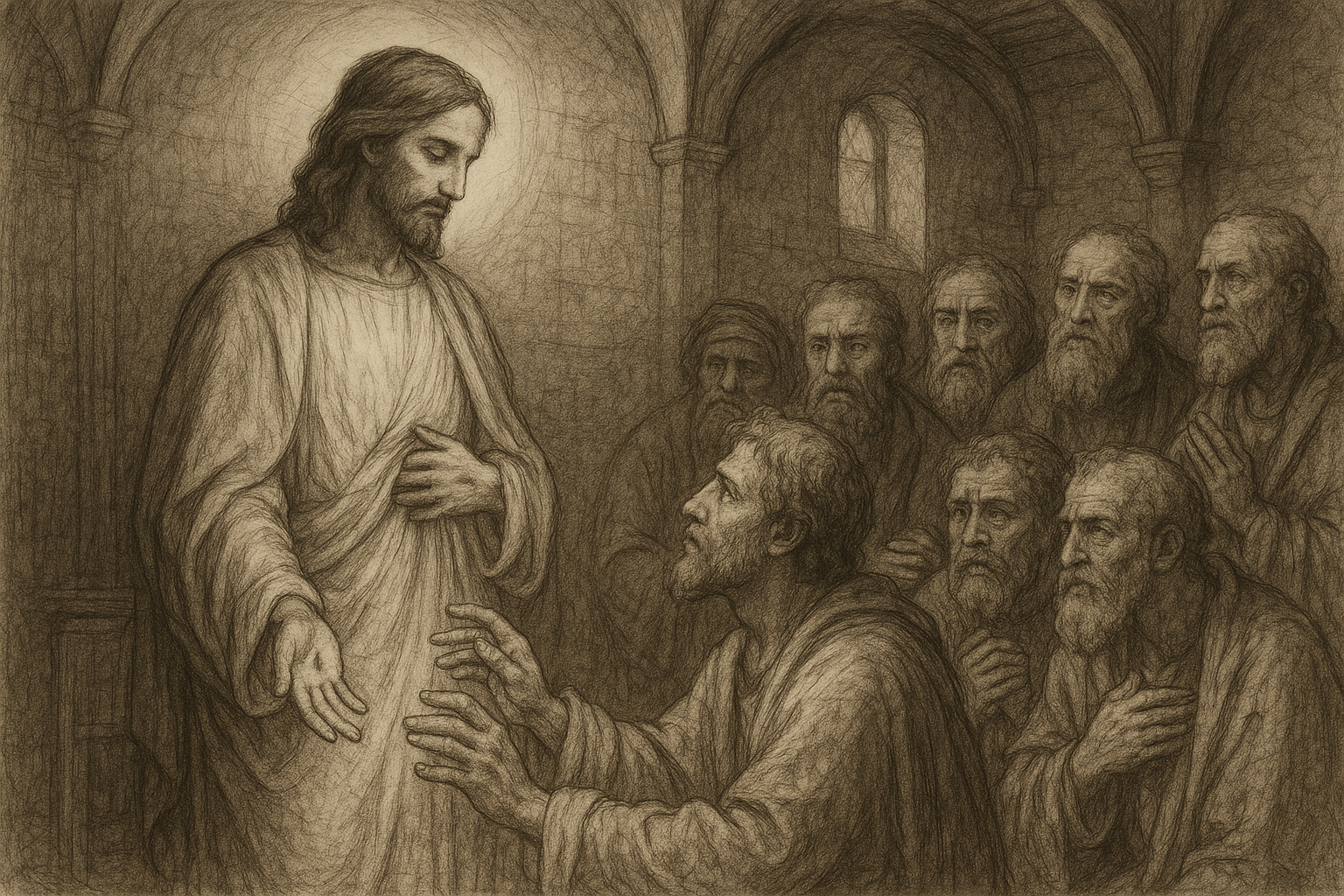
John tells us that the disciples were gathered behind locked doors out of fear, and Jesus came and stood among them. He gave them peace, showed them His hands and side, and breathed on them the Holy Spirit 22|John 20:19-22. Thomas, however, was not with them. When the others said, "We have seen the Lord," Thomas answered with a demand that sounds severe but also honest: unless he could see and touch the wounds, he would not believe 25|John 20:24-25.
Eight days later, Jesus came again while the disciples were together. He did not rebuke Thomas with contempt. He repeated Thomas's own conditions almost word for word: put your finger here, see my hands, put out your hand and place it in my side 27|John 20:26-27. The risen Christ answered the disciple's need with patience. Whether Thomas actually touched the wounds is not stated. What John does record is the confession that followed, a confession that rises to the heart of Christian faith.
Thomas had asked for proof, but what he received was an encounter. The Gospel does not present Jesus as offended by the disciple's struggle. Instead, the Lord enters the room, addresses him directly, and invites him beyond doubt into adoration.
Thomas as a witness to the reality of the Resurrection
One of the deepest reasons this scene matters is that it protects the Church from treating the Resurrection as a symbol. Thomas is not a poet searching for a metaphor. He is a disciple who knew the crucified Jesus and recognized that the same Jesus now stood alive before him. The marks in the hands and side matter because they show continuity between the suffering Christ and the risen Christ. The One who lives is the One who was nailed to the Cross.
That detail is profoundly Catholic. The Resurrection does not erase the Passion. It glorifies it. The wounds remain, not as signs of defeat, but as signs of victorious love. Christ's glorified body bears the memory of redemption. In that light, Thomas's insistence on the wounds becomes more than a request for verification. It becomes a strange and beautiful doorway into the mystery of salvation.
The risen Lord does not hide His scars. He reveals them. He lets Thomas see that the price of mercy has been paid in full. The wounds are no longer open to suffering, yet they remain visible as everlasting testimony to the love of God.
The mercy of Christ toward a hesitant disciple
Thomas is sometimes criticized too quickly. But the Gospel suggests that Jesus understood what Thomas needed. The Lord came back for him. He did not abandon the disciple who had missed the first appearance. He did not say, in effect, that Thomas had forfeited his place because he was slow to believe. Instead, He met him in the place of his difficulty.
This is one reason Catholics have so often found comfort in Thomas's story. Many believers know what it is to have a sincere heart and yet feel the strain of uncertainty. A person may believe, but still ask questions. A person may love Christ, but still long for reassurance. The Gospel does not mock that condition. It shows that the risen Jesus can answer it.
Jesus also gives Thomas a gentle but firm summons: "Do not be faithless, but believe." John 20:27 The words are both invitation and correction. Christ does not call Thomas to pretend, but to trust. Faith is not irrational. Yet it is more than what the eye can measure. It opens to what God reveals.
Faith and the witness of the Church
There is another important layer here. Thomas was not merely called to personal conviction. He was being drawn into the apostolic witness. The other disciples had seen the Lord, and their testimony mattered. In the life of the Church, faith is never just a private opinion. It is received through a community that has seen, heard, and handed on what Christ did.
That is why Thomas's doubt also illuminates the role of the apostles. They were not inventing an idea about Jesus. They were eyewitnesses to His Resurrection. Thomas's encounter confirms their proclamation and strengthens the credibility of their mission. When he finally believes, it is not because he has outgrown the Church's witness, but because he has come to rest within it.
Catholics recognize the same pattern in the life of faith today. We receive the Gospel through the Church. We hear it proclaimed in the liturgy. We are nourished by the sacraments. Even when personal feelings fluctuate, the apostolic witness remains steady. Thomas reminds us that the faith is not grounded in our mood, but in the living Christ who acts through His Church.
The blessedness of believing without seeing
After Thomas's confession, Jesus speaks a line that reaches beyond the Upper Room and into the entire age of the Church: "Have you believed because you have seen me? Blessed are those who have not seen and yet have believed." John 20:29
This is not a rebuke meant to shame Thomas into silence. It is a blessing for all who will come later, including every Christian who has not stood in that room. The first disciples saw with their eyes, but later believers would come to faith through testimony. That is not a lesser path. It is the ordinary path of discipleship in this age.
Catholics should hear this blessing as both encouragement and summons. Encouragement, because Jesus knows that most of His people will not receive visible appearances. Summons, because faith is meant to rest on trust in the Lord and in the witness He established. We do not see with bodily eyes, yet we are not left without signs. The Church gives us the Scriptures, the sacraments, the liturgy, and the lived witness of the saints.
Thomas stands at the turning point between sight and faith. He belongs to those who saw, and he speaks for those who will believe through hearing. In that sense, his story is every Catholic's story.
What Thomas teaches about wounds, hope, and conversion
There is a tender irony in this passage. Thomas wanted to see the wounds before he believed. In the end, the wounds became the very place where belief was born. That is how Christ often works. He does not wait for us to become polished and self-sufficient before drawing near. He meets us in the places where we are marked, questioned, or afraid.
The wounds of Christ also teach us something about our own wounds. Catholics do not pretend that suffering is good in itself. But in union with Christ, suffering can be transformed. The risen Lord does not erase the memory of the Cross. He redeems it. In a similar but far lesser way, God can redeem the pain of human life. He can make a place where there was fear into a place of grace.
Thomas also shows that conversion can happen in a single moment, but it is usually prepared by a longer journey. He had walked with Jesus. He had heard the Lord teach. He had seen Him die. Then, in one startling encounter, Thomas's scattered questions gave way to worship. The journey from uncertainty to adoration is not a failure. It is often the path by which grace deepens a soul.
How Catholics can receive this passage today
For Catholics today, St. Thomas after the Resurrection is not only a comforting story. It is a pattern for prayer, for trust, and for humility before God. A few lessons stand out.
- Bring your questions to Christ. Thomas did not leave the community in silence. His struggle remained within the circle of the disciples, where Jesus found him.
- Do not confuse doubt with unbelief. Honest questioning can become a doorway to deeper faith when it is offered to God rather than used to shut Him out.
- Value apostolic witness. The Gospel comes to us through the Church, and faith grows by listening to what Christ has already revealed.
- Remember that the Resurrection keeps the marks of the Cross. The Lord who lives is the Lord who suffered for us.
- Let worship be the goal of understanding. Thomas's final answer was not an argument but a prayerful confession of who Jesus is.
These lessons matter especially in a world that often rewards suspicion and treats belief as weakness. Thomas shows another way. He was not asked to suspend his mind. He was asked to let the risen Lord complete the search his mind had begun. In the end, the strongest statement in the passage is not Thomas's demand, but his surrender: "My Lord and my God!"
That confession remains the heart of Christian discipleship. It is brief, personal, and total. Jesus is not merely a teacher who returns from death. He is Lord and God. Thomas came to that recognition by seeing the wounds. Catholics come to it by grace through faith, hearing the Word, receiving the sacraments, and learning over time that the risen Christ still comes near to His people with peace.
When Thomas finally believed, he did not simply solve a puzzle. He entered a relationship. And that is where the Gospel always leads: not to detached certainty, but to living communion with the One who was dead and is alive forevermore.
Keep Reading on Lets Read The Bible
Frequently Asked Questions
Why is St. Thomas important after the Resurrection?
St. Thomas matters because his encounter with the risen Christ shows both the reality of Jesus' Resurrection and the patience of Christ with human weakness. His confession, 'My Lord and my God,' is one of the clearest declarations of Christ's divinity in the New Testament.
Did St. Thomas really touch Jesus' wounds?
The Gospel of John records Jesus inviting Thomas to touch His wounds, but it does not explicitly say that Thomas did so. What John does record is Thomas's immediate confession of faith after Jesus speaks to him.
What does St. Thomas teach Catholics about doubt?
Thomas teaches that honest doubt can be brought to Christ rather than hidden from Him. Faith is not the denial of questions, but trust in Jesus, who answers with mercy, truth, and the witness of the Church.