Jesus and the Gospels
When Mercy Crosses the Road: Reading the Good Samaritan in a Catholic Light
Jesus' parable is not only a moving story of kindness. It is a summons to see our neighbor, resist indifference, and practice mercy with real sacrifice.
Site Admin | February 17, 2026 | 77 views
The parable of the Good Samaritan is so familiar that it can become almost invisible. Many people hear it as a simple lesson: be nice, help others, do not pass by the wounded. That is true as far as it goes, but Jesus gives the story with greater force and deeper purpose. In its original setting, the parable cuts through religious excuses, exposes the limits of self-justifying holiness, and shows that mercy is not an optional ornament of discipleship. For Catholics, the Good Samaritan is not only a moral example. It is a window into the very heart of Christ.
The phrase the Good Samaritan Catholic meaning points to more than a practical ethic. It asks how the Church receives this parable in light of the Gospel, the commandment of love, and the sacramental life. When Jesus tells this story, he is not merely asking who deserves our help. He is teaching us how grace changes the way we see every person along the road.
Setting the scene in Luke's Gospel
The parable appears in Luke 10, in a conversation with a scholar of the law who asks Jesus what he must do to inherit eternal life. Jesus first draws the man to the commandment written in the law: love God with all your heart, soul, strength, and mind, and love your neighbor as yourself. When the scholar seeks to limit the command by asking, And who is my neighbor?, Jesus answers with a story that refuses narrow boundaries [[VERSE|luk|10|25-37|Luke 10:25-37]].
This is important. Jesus does not begin with a theory of ethics. He begins with a challenge to the heart. The question is not only, Who counts as my neighbor? It is also, What kind of person am I becoming when I decide in advance who matters? Luke presents the parable as an exchange about eternal life, which means the story reaches beyond social kindness into the shape of salvation itself.
The road from Jerusalem to Jericho
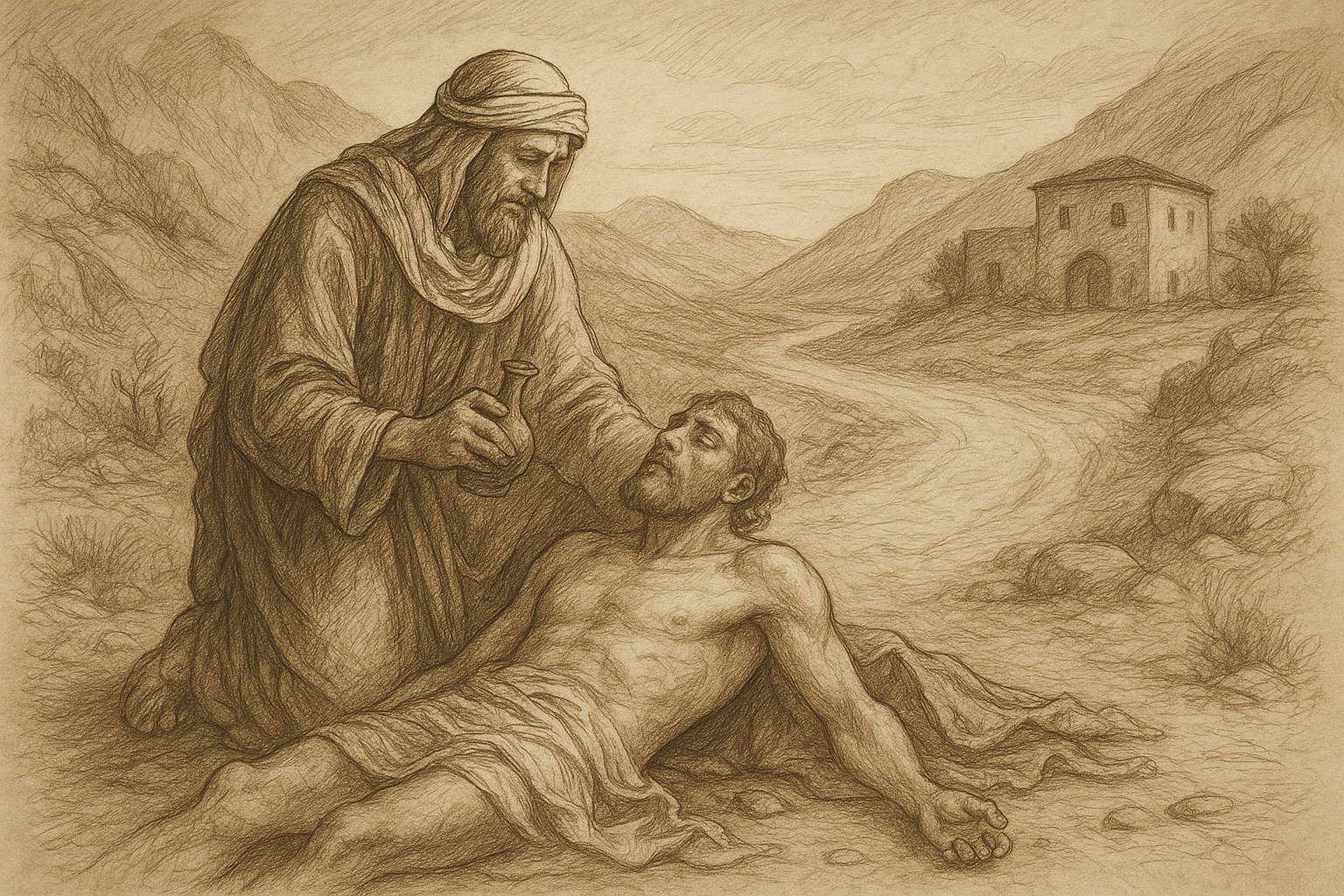
Jesus sets the scene on a dangerous road from Jerusalem to Jericho. A man is stripped, beaten, and left half dead. The detail matters because it removes abstraction. This is not a debate about ideas. It is a human being in real danger, with no power to repay anyone who stops. Mercy in the Gospel is always concrete.
Two religious figures pass by: a priest and a Levite. They both see the man, but neither helps. The text does not explain all their motives. They may have feared impurity, danger, delay, or inconvenience. Whatever the reason, they allow concern for themselves to outrank compassion. Jesus does not say they did evil in an obvious, dramatic way. He shows how moral failure can happen through indifference.
This is one reason the parable remains so piercing. Most people do not imagine themselves as villains. They imagine themselves as busy, respectable, and reasonable. The priest and Levite force us to ask whether respectability can become a shelter for a cold heart.
Why the Samaritan is so surprising
The shock of the parable lies in the fact that the helper is a Samaritan. In the world of Jesus' listeners, Samaritans were religious and ethnic outsiders, often despised by Jews. By choosing this figure as the one who acts mercifully, Jesus overturns assumptions about who is near to God and who is able to love rightly.
The Samaritan does not merely feel pity. He goes to the wounded man, binds his wounds, pours on oil and wine, places him on his own animal, brings him to an inn, and pays for his care [[VERSE|luk|10|33-35|Luke 10:33-35]]. The verbs accumulate. Mercy is shown as a sequence of costly acts, not a fleeting emotion. The Samaritan gives time, comfort, money, and continued responsibility.
That is one of the deepest insights into the Good Samaritan Catholic meaning. Mercy is not sentimental. It is active love that enters another person's pain and accepts burden for the sake of healing. Catholics recognize this pattern in the corporal works of mercy, where feeding, clothing, sheltering, visiting, and burying the dead are not symbolic gestures but real acts of love.
Jesus turns the question around
At the end of the story, Jesus asks which of the three proved to be a neighbor to the wounded man. The lawyer answers, The one who showed him mercy [[VERSE|luk|10|36-37|Luke 10:36-37]]. That shift is crucial. The original question tried to define the limits of obligation: Who counts as my neighbor? Jesus turns the focus to the kind of person one becomes through mercy: Who acts like a neighbor?
In other words, neighbor is not just a category to be identified. It is a vocation to be lived. The commandment is fulfilled not by drawing tight circles, but by crossing the road. Jesus tells the scholar, Go and do likewise Luke 10:37. He does not say this as a suggestion for the especially generous. He gives it as the shape of obedience.
A Catholic reading of mercy
Catholic tradition reads the parable in a sacramental and moral key. The wounded traveler can be seen as any person harmed by sin, suffering, or neglect. The Samaritan's care reveals mercy that is embodied, not merely spoken. In this light, Christians have often seen in the Samaritan a figure of Christ himself, who comes near to fallen humanity, binds our wounds, and carries us toward healing. The Church does not force a single allegorical meaning onto every detail, but this Christ-centered reading is deeply fitting because Jesus is the one who fully lives the mercy he teaches.
This does not remove the moral lesson. It deepens it. Catholics believe grace enables what Jesus commands. We are not saved by performing random acts of kindness on our own strength, but neither do we excuse ourselves from the demands of love. The parable calls us to cooperate with grace so that mercy becomes habitual. It also reminds us that love of neighbor cannot be separated from love of God. The man on the road is not an interruption to the religious life. He is part of it.
The story also fits well with the Church's teaching on the works of mercy. The corporal works are visible, practical ways of serving Christ in the suffering poor and vulnerable. Yet the parable also invites spiritual mercy: instructing the ignorant, counseling the doubtful, forgiving offenses, bearing wrongs patiently, and praying for the living and the dead. Mercy is broader than assistance. It is a way of seeing others through the eyes of Christ.
The temptation to pass by
Modern life makes the priest and Levite easy to understand. We are hurried, distracted, and often trained to protect our schedules. Many of us do not consciously reject mercy. We simply become too busy to notice the wounded lying in plain sight. The parable therefore speaks not only to dramatic crises but also to daily habits of attention.
There are many roads where people are left half dead: loneliness, poverty, family breakdown, addiction, fear, despair, and spiritual confusion. A Catholic response does not begin with grand plans. It begins with willingness to see. The Samaritan first saw, then drew near, then acted. Real mercy requires more than compassion at a distance.
At the same time, Catholics should be careful not to reduce the parable to activism alone. The Samaritan's mercy is strong because it is ordered toward the good of another person. It is not an exercise in self-display. It springs from love. A culture can praise helping behavior while remaining indifferent to truth, prayer, repentance, and the eternal destiny of the human person. The Gospel is broader and more demanding than that. The neighbor is not only a body to be cared for, but a soul loved by God.
What the parable asks of us now
The Good Samaritan asks whether we are willing to be interrupted for love. It asks whether we can recognize the dignity of people we might otherwise ignore. It asks whether our faith reaches the streets, the parish hall, the kitchen table, and the bedside. It asks whether mercy costs us anything.
Catholics can live this parable in many ordinary ways:
- by noticing the lonely parishioner who stands alone after Mass
- by helping a family in material need without humiliating them
- by visiting the sick, elderly, or imprisoned
- by speaking gently to someone in distress rather than turning away
- by forgiving where pride would prefer to keep score
- by giving alms with discretion and gratitude
These are not extra-credit gestures. They are part of a Christian life shaped by the command of love. In the Eucharist, Catholics receive the One who has already crossed the greater distance to reach us. The Lord who gives himself at the altar is the same Lord who sends us back to the road with eyes open and hearts ready.
In that light, the Good Samaritan is not only a story about a man who stopped to help. It is a story about the kind of mercy that makes disciples recognizably Christian. Christ still asks his followers to draw near, to tend wounds, and to become neighbors before asking who deserves the name. That is how the road begins to look different.
Keep Reading on Lets Read The Bible
Frequently Asked Questions
What is the main Catholic meaning of the Good Samaritan?
The Good Samaritan teaches that true love of neighbor is practical, costly, and universal. Catholics also see in the Samaritan a reflection of Christ, who comes near to heal wounded humanity.
Why is the Samaritan's identity important in the parable?
Jesus makes the helper an outsider to overturn prejudice and show that mercy is not limited by social, ethnic, or religious boundaries. The point is that mercy creates a neighbor, even where division once stood.
How can Catholics apply the Good Samaritan today?
By practicing the corporal and spiritual works of mercy in ordinary life: helping those in need, visiting the sick, forgiving offenses, praying for others, and refusing to pass by suffering when they can truly help.