Sacraments and Liturgy
A Confession Worth Making Well: Preparing the Heart for Mercy
A practical Catholic look at confession, contrition, and the grace God gives when we return to Him honestly.
Site Admin | September 9, 2025 | 60 views
Many Catholics know the relief of hearing the words of absolution after a difficult confession. The peace is real, but so is the work that leads up to it. Making a good confession is not merely a matter of remembering a list of sins. It is a prayerful return to the Father, a humble naming of what has broken charity, and a surrender to the mercy Christ gives through His Church.
The sacrament of Penance has always belonged to the Church's life of healing. After the Resurrection, Jesus breathed on the apostles and said, "Whose sins you forgive are forgiven them, and whose sins you retain are retained" John 20:23. The Church has never treated these words as symbolic only. She has understood them as Christ's own gift of reconciliation, entrusted to His ministers for the salvation of souls. Over the centuries, the forms of celebrating this sacrament have developed, but its heart has remained the same: God meets the sinner with truth, mercy, and conversion.
Confession begins before you enter the confessional
A good confession is prepared long before the priest says, In the name of the Father. The most important preparation is an honest examination of conscience. This is not an exercise in anxiety. It is a prayerful review of life in the light of God's commandments, the teachings of the Church, and the example of Christ. We ask not only, What did I do wrong? but also, Where did I fail to love?
To examine your conscience well, it helps to be specific. Instead of saying only, "I was impatient," try to recall what that impatience looked like. Was there sharp speech, contempt, laziness, dishonesty, envy, or neglect of prayer? The point is not to shame ourselves, but to speak truthfully. The Psalmist prays, "Create in me a clean heart, O God" Psalm 51:10. That prayer becomes practical when we let God show us what needs cleansing.
A simple pattern for examination
Some Catholics find it helpful to use the Ten Commandments, the Beatitudes, or the seven capital sins as a framework. Others examine their duties in particular states of life: as spouse, parent, child, worker, student, neighbor, or friend. Whatever method you choose, keep it steady and prayerful.
- Ask for the Holy Spirit's light.
- Recall your sins since your last valid confession.
- Consider both what you have done and what you have failed to do.
- Note any mortal sins clearly and without exaggeration or hiding.
- Bring lesser sins too, since Confession heals the whole soul.
A brief prayer before beginning can help: Lord, show me myself as You see me. Give me honesty, sorrow, and trust in Your mercy.
What the Church means by contrition
Contrition is sorrow for sin and a resolve to avoid it in the future. Without contrition, the act becomes hollow. Yet contrition does not mean we must already feel emotionally overwhelmed. Some people do. Others do not. What matters is the will turning away from sin and back toward God. In ordinary speech, Catholics often say they are "sorry." In the deeper sense, contrition is the heart's turning.
The Church distinguishes perfect contrition from imperfect contrition. Perfect contrition arises from love of God above all things, while imperfect contrition, or attrition, arises from the ugliness of sin or fear of punishment. Both can dispose a person to receive the sacrament fruitfully, provided the sinner is truly repentant and intends to amend his life. This is one reason the sacrament is so realistic: grace meets us where we actually are, not where we pretend to be.
True contrition also includes a firm purpose of amendment. That does not mean absolute certainty that we will never fall again. It means a real decision to avoid sin and the occasions that lead to it. If one is confessing frequent failures in anger, for example, a purpose of amendment might include a new habit of silence before speaking, or a more serious effort to avoid the environments and habits that feed that anger.
Confession is not a theater of self-improvement. It is a meeting with Christ, who tells the truth about sin without withdrawing His mercy.
How to speak your sins clearly
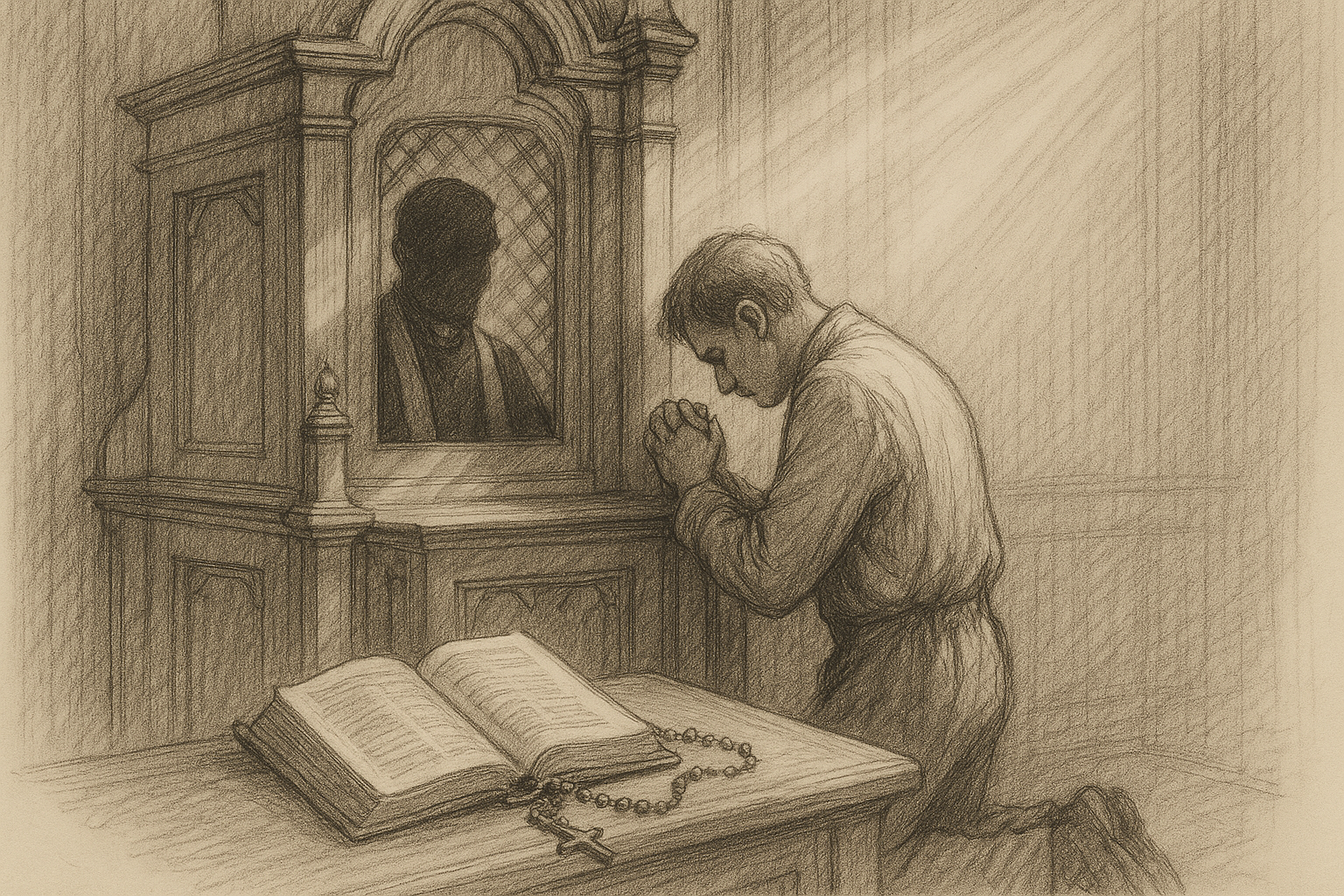
When you enter the confessional, speak plainly and briefly. There is no need for dramatic detail, self-defense, or long explanation unless it is needed for clarity. State the kind of sin and, when possible, how often it occurred. A confession might sound like this: I missed Mass on Sunday without a serious reason. I spoke harshly to my spouse several times. I was dishonest at work once. I have struggled with impure thoughts and have failed to resist them.
This straightforward manner is not cold. It is reverent. The sacrament is not a conversation about feelings alone, and it is not an interrogation. It is an honest naming of sin before the One who already knows it and still offers mercy. Proverbs says, "He who conceals his sins does not prosper, but he who confesses and forsakes them obtains mercy" Proverbs 28:13.
Some people worry about forgetting something. If you accidentally omit a sin you sincerely forgot, the confession is still valid if you were truly contrite. If you deliberately hide a mortal sin, however, the confession is invalid and the hidden sin must be confessed later. This is one reason a careful examination of conscience matters. It helps us come to the sacrament with completeness and peace.
The history of confession in the life of the Church
From the earliest centuries, Christians recognized that serious sin wounds communion with God and the Church. The precise outward forms varied. In some periods, public penance was common for grave offenses. Over time, the discipline became more private and repeatable, especially through the influence of monastic communities and the pastoral wisdom of confessors. What changed in practice did not change in meaning. The Church kept insisting that sin is real, repentance is necessary, and mercy is greater still.
This historical development matters because it shows that Confession is not a late human invention. It belongs to the Church's memory from the beginning. The Lord who healed the paralytic also gave His apostles authority to forgive sins. The same Lord who ate with sinners still meets sinners sacramentally. The sacrament therefore unites doctrine and mercy, justice and compassion, confession and absolution.
For many Catholics, this history also explains why the sacrament feels both ancient and personal. A person kneels alone, yet stands within a living tradition. The words are simple, but they carry centuries of prayer. In that sense, Confession is one of the clearest places where the Church's continuity becomes visible in ordinary life.
What to do after absolution
After the priest gives absolution, the sacrament is not finished until you complete the assigned penance. That penance is not a payment for sin. Christ alone pays that debt. Rather, penance is a small share in the healing work of grace, a concrete act of prayer, sacrifice, or charity that helps re-form the soul. If the priest asks for certain prayers, make them promptly. If he asks for a work of mercy or a devotional practice, receive it as a medicine for the spirit.
Then give thanks. Many Catholics leave the confessional relieved but rushed. It is worth lingering in prayer, even briefly, to praise God for mercy. The sacrament is not merely a reset. It is communion restored. The prodigal son does not merely avoid punishment; he returns to his father's house. So too, the penitent receives not only pardon but renewed friendship with God.
It is also wise to reflect gently on the confession afterward. Not to become scrupulous, but to notice whether a particular habit needs stronger support. Some sins require more than regret. They require new disciplines: regular prayer, fasting, accountability, better boundaries, more frequent reception of the Eucharist, and steadier use of Scripture. Grace does not replace effort. It makes real effort possible.
Common obstacles and how to answer them
People avoid Confession for many reasons. Shame is one. Another is the fear of being judged. Some assume their sins are too small to matter. Others think their sins are too great. Still others say they do not know how to begin. None of these obstacles is unusual, and none of them has the last word.
Shame loses much of its power when we remember the sacrament's purpose. The priest is not there to collect gossip. He stands there as minister of Christ's mercy and as guardian of the seal of confession. Fear of judgment is answered by faith in Jesus, who came not to condemn the world but to save it. The sense that sins are too small is corrected by love, since anything that turns us away from charity is worth naming. The sense that sins are too great is corrected by the Cross itself.
If you have been away from Confession for a long time, it is still worth returning. A priest can help you begin. You do not need perfect words. You need honesty and willingness. The sacrament is designed for sinners, not for the already flawless. As St. John writes, "If we confess our sins, he is faithful and just, and will forgive our sins and cleanse us from all unrighteousness" 1 John 1:9.
Making a habit of mercy
For Catholics who want to participate more faithfully, the best practice is often regular confession. Monthly confession has long been recommended by many saints and pastors because it keeps conscience alive, strengthens humility, and prevents spiritual drift. Regularity makes examination of conscience easier, because you begin to notice patterns. It also keeps mercy from becoming an emergency measure and helps it become a way of life.
A good confession is never just about avoiding punishment. It is about becoming honest before God. The soul that confesses well learns to say, without excuse or despair, Lord, I have sinned, and I need You. That sentence, spoken in faith, opens the door to grace. The Church does not ask this because God is reluctant to forgive. She asks it because the human heart is healed when it finally stops hiding.
When you next prepare for Confession, do so slowly and deliberately. Make your examination of conscience, ask for contrition, speak clearly, receive absolution with trust, and complete your penance with gratitude. In that humble rhythm, the sacrament becomes what it has always been: a meeting place between the sinner and the Savior, where truth is spoken and mercy is given.
Keep Reading on Lets Read The Bible
Frequently Asked Questions
How often should a Catholic go to Confession?
The Church requires Confession at least once a year for those conscious of mortal sin, but many Catholics benefit from monthly confession. Regular confession helps form conscience, strengthens repentance, and supports steady spiritual growth.
What if I forget a sin during Confession?
If you sincerely forgot a sin, the confession is still valid. You should mention it in your next confession if you remember it later. What matters is honest repentance and a real desire to confess all serious sins as best you can.
Do I need to confess venial sins too?
No, venial sins do not have to be confessed individually, but they may be confessed fruitfully. Many Catholics do so because the sacrament brings grace, healing, and better self-knowledge even for lesser faults.