Church History
Pope Leo XIII and the Catholic Wisdom of a Changing Age
How a 19th century pope helped the Church speak clearly about faith, work, reason, and social life.
Site Admin | January 3, 2026 | 78 views
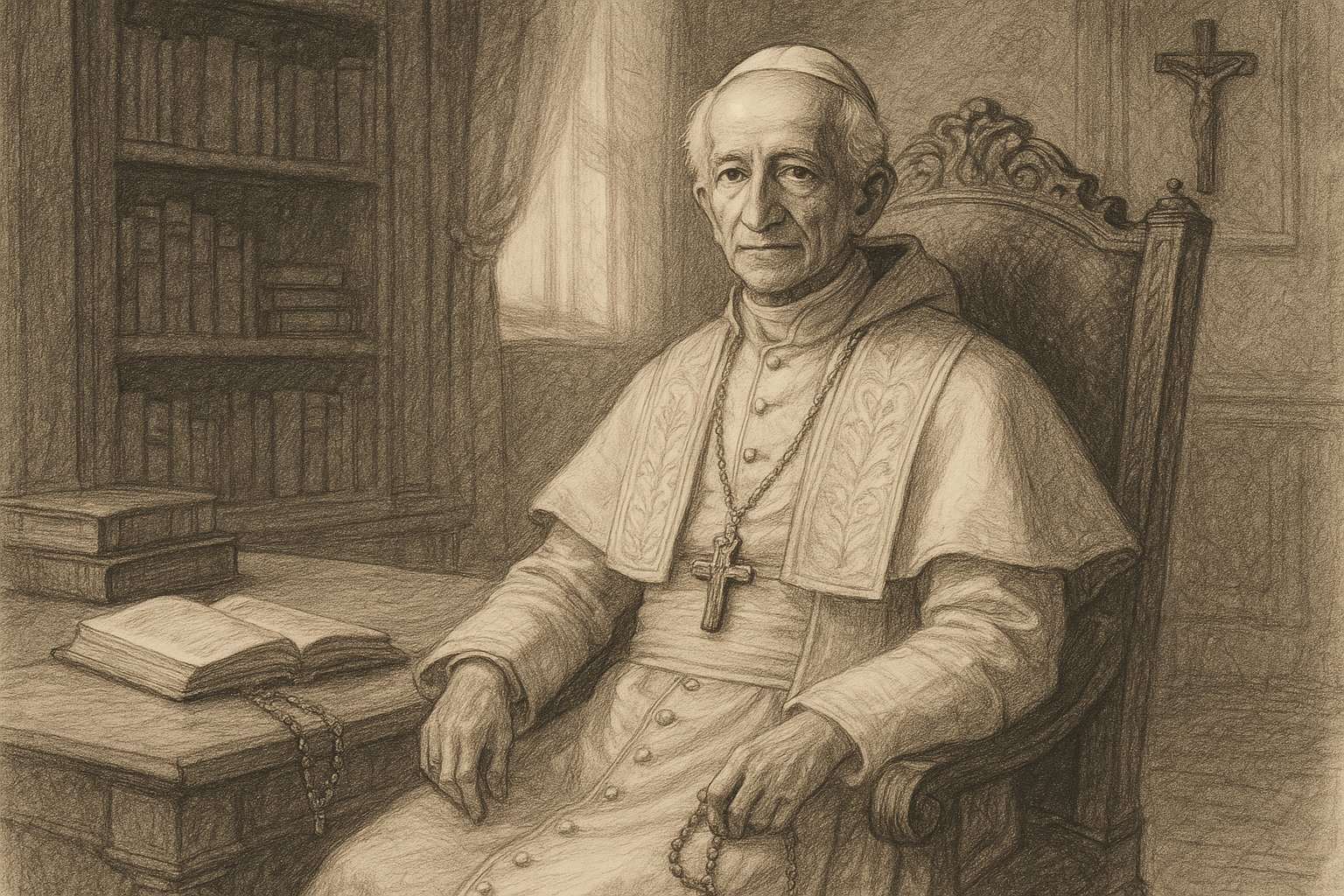
Pope Leo XIII remains one of the most significant figures in modern Catholic history because he showed how the Church can speak firmly without panic, thoughtfully without compromise, and pastorally without surrendering truth. In an age marked by political unrest, aggressive secularism, and the upheavals of industrial society, Leo XIII did not retreat into silence. He answered with doctrine, prudence, and a deep confidence that faith and reason belong together.
For Catholics today, that matters. The pressures are different now, but the underlying question is familiar: how does the Church remain faithful while the world changes around her? Leo XIII's long pontificate, which began in 1878, offers a remarkable answer. He was a pope of patience and vision, one who defended the Church's freedom, renewed Catholic thought, and gave lasting shape to Catholic social teaching.
The world Leo XIII inherited
Leo XIII was elected after a turbulent period in European history. The papal states had been lost, the Church was often treated as a relic of the past, and many influential voices assumed that modern progress required religion to fade into private life. New industrial systems were also changing the lives of ordinary workers, often for the worse. Rapid urbanization, harsh labor conditions, and growing class conflict created new moral and social questions.
Leo XIII did not approach these problems as a politician in a cassock. He approached them as the successor of Peter, entrusted first with the truth of the Gospel. That made his response distinctive. He recognized the real pain of the age, but he refused to accept the idea that the Church had no wisdom to offer. In that sense, Pope Leo XIII Catholic history is not just about one pontificate. It is about a Church that learns how to address a changing world without losing her center.
His style was marked by calm authority. He was not known for dramatic gestures, but for clear teaching and patient renewal. That restraint itself was a witness. At a time when many people equated loudness with strength, Leo XIII showed that steadiness can be more persuasive than spectacle.
Faith and reason belong together
One of Leo XIII's most enduring contributions was his insistence that Catholic faith is not threatened by honest reason. In his time, some thinkers treated modern science and philosophy as if they had already disproved Christian belief. Others reacted by separating faith from intellectual life altogether. Leo XIII rejected both errors.
He encouraged the study of St. Thomas Aquinas because he saw in Thomistic thought a disciplined way of bringing truth, logic, and theology into harmony. His encyclical Aeterni Patris promoted the revival of Scholastic philosophy, especially Aquinas, not as a museum piece but as a living intellectual resource. He believed Catholic thought should be rooted, coherent, and capable of speaking to modern questions.
This remains important because the temptation to separate faith from intellect still appears in many forms. Some Catholics feel pressure to treat belief as merely emotional. Others think the best defense of Christianity is to avoid serious reasoning altogether. Leo XIII reminds the Church that Catholicism welcomes truth wherever it is found. Faith does not fear reality. It clarifies it.
Truth cannot ultimately contradict truth, because all truth comes from God.
Rerum Novarum and the birth of modern Catholic social teaching
Leo XIII is perhaps best known for Rerum Novarum, published in 1891, which addressed the condition of workers and the moral demands of economic life. The document did not offer a political slogan or a technical economic plan. Instead, it laid down principles that remain central to Catholic social teaching.
He defended the dignity of labor and the right of workers to receive just wages. He affirmed the right to private property while insisting that property must serve the common good. He also defended the right of workers to form associations, an important point in an age when many laborers had little protection. At the same time, he rejected class warfare and warned against socialist schemes that denied human freedom or family life.
What made Rerum Novarum so important was not only its content but its method. Leo XIII looked at a concrete social crisis and asked what the Gospel required. He did not reduce morality to economics, and he did not reduce economics to ideology. He reminded Catholics that justice is not optional in public life, and that the Church has a real role in defending the vulnerable.
This teaching still resonates because work remains tied to human dignity. Catholics still face questions about fair pay, family stability, labor rights, and the responsibilities of business owners and public leaders. Leo XIII offers no easy formula, but he gives a durable moral framework. Human beings are not machines, workers are not disposable, and economic progress cannot be judged apart from justice.
The defense of the family and the moral order
Leo XIII repeatedly defended the family as a foundational social reality, not a private convenience. That emphasis is easy to overlook, but it was essential to his vision. If the family weakens, then both society and the Church suffer. Parents lose confidence, children lose formation, and public life becomes more fragile.
He understood that social reform is never only about institutions. It is also about moral habits, domestic life, and the formation of conscience. Catholic teaching on work, property, and rights depends on a larger moral order in which persons are accountable before God. Leo XIII believed this order is not invented by governments. It is received.
That conviction can help Catholics today resist two opposite mistakes. One is to treat the family as if it were only a sentimental ideal with no public importance. The other is to make the family a purely ideological symbol detached from the ordinary duties of sacrifice, fidelity, and prayer. Leo XIII's teaching is sober and practical: the home is where faith is handed on, virtue is learned, and social life begins.
Mary, the Rosary, and the life of prayer
Leo XIII was also a pope of prayer, especially Marian prayer. He wrote extensively on the Rosary and encouraged Catholics to pray it with confidence. In an age of intellectual upheaval and social uncertainty, he did not separate doctrine from devotion. He knew that the Church's public teaching must be sustained by the Church's interior life.
His appeals to the Rosary were not sentimental add-ons to serious theology. They reflected a deep Catholic instinct: the mysteries of Christ are contemplated best with Mary's help. Leo XIII saw that prayer forms the heart to endure confusion, temptation, and discouragement. A Christian people that prays well will think more clearly and act more faithfully.
This is one reason Leo XIII still speaks to Catholics now. It is easy to imagine that the Church's problems can be solved mainly by better strategy, sharper commentary, or more effective organization. Those things have their place. But Leo XIII reminds us that renewal begins in grace. Devotion, doctrine, and discipline belong together.
How he changed the Church's public voice
Leo XIII did not merely react to the modern world. He helped the Church speak in a more direct and comprehensive way to it. His pontificate opened paths for later Catholic teaching on labor, economics, philosophy, and the relationship between Church and state. He also modeled a papacy that could be both intellectually serious and spiritually accessible.
He was careful in tone. He argued rather than shouted. He taught without surrendering to the spirit of the age. For Catholics, that balance is instructive. It is possible to engage difficult questions without becoming captive to them. It is possible to respect genuine developments without calling every change progress. Leo XIII's example suggests that clarity is not hostility and that firmness need not become severity.
In a time when many people mistrusted the Church, he demonstrated that Catholic teaching could still address the modern world on its own terms. He did not ask permission to speak. He simply spoke as the Church must speak, with patience, intelligence, and confidence in Christ.
Lessons Catholics can still take from Leo XIII
Leo XIII's legacy is not only for historians. It offers practical lessons for Catholics now.
- Think with the Church. Catholic life is not built on slogans, but on formed judgment grounded in revelation and reason.
- Defend human dignity. Work, wages, family life, and social structures must be judged by their effect on real persons made in the image of God.
- Reject false choices. Catholics do not have to choose between faith and intellect, justice and charity, or doctrine and mercy.
- Pray before you act. Leo XIII's devotion to the Rosary shows that public renewal begins with interior conversion.
- Trust the Church's continuity. The problems of one century may change in form, but the Gospel remains capable of addressing them.
For all his importance as a teacher, Leo XIII was also a reminder that the papacy serves the Church by keeping her oriented toward Christ. He did not make himself the center. He pointed beyond himself to the truths that sustain Catholic life in every age.
That is why Pope Leo XIII Catholic history still matters. He is not simply a great name from the past. He is a witness to the kind of wisdom the Church needs whenever the world grows restless: clear doctrine, moral courage, reverent prayer, and a steady confidence that the Lord of history has not abandoned His people.
Keep Reading on Lets Read The Bible
Frequently Asked Questions
Why is Pope Leo XIII important in Catholic history?
Pope Leo XIII is important because he helped the Church respond to modern social and intellectual challenges with clear doctrine, especially through his teaching on faith and reason, his support for Thomistic philosophy, and his landmark encyclical Rerum Novarum on labor and social justice.
What is Rerum Novarum about?
Rerum Novarum is Leo XIII's 1891 encyclical on the rights and duties of workers, employers, and society. It defends just wages, private property, the dignity of labor, the right to form associations, and the rejection of class warfare and socialism that deny human freedom.
How did Pope Leo XIII encourage Catholic prayer?
Leo XIII strongly promoted devotion to the Rosary and wrote several encyclicals on it. He saw prayer as essential to Christian renewal, not separate from theology or social teaching but supportive of both.