Sacraments and Liturgy
A Saturday Kept with Mary: Entering the First Saturday Devotion
How confession, Holy Communion, the Rosary, and quiet meditation become a loving act of reparation
Site Admin | September 9, 2026 | 80 views
The First Saturday devotion is simple enough to fit into ordinary parish life, yet deep enough to reshape the way a Catholic approaches repentance, the Eucharist, and the Blessed Virgin Mary. Over five consecutive first Saturdays, the faithful are invited to receive the sacraments, pray the Rosary, meditate on its mysteries, and offer these acts in reparation to the Immaculate Heart of Mary.
This is not a spiritual formula or a way to purchase divine favor. It is a disciplined response of love. The devotion leads the faithful toward Jesus Christ, especially through sacramental confession and Holy Communion, while asking them to keep company with his Mother. Properly understood, it brings together repentance, intercession, contemplation, and fidelity.
What the First Saturday devotion asks of Catholics
The devotion is traditionally observed on the first Saturday of five consecutive months. On each of those Saturdays, a person undertakes four practices:
- Sacramental confession
- Reception of Holy Communion
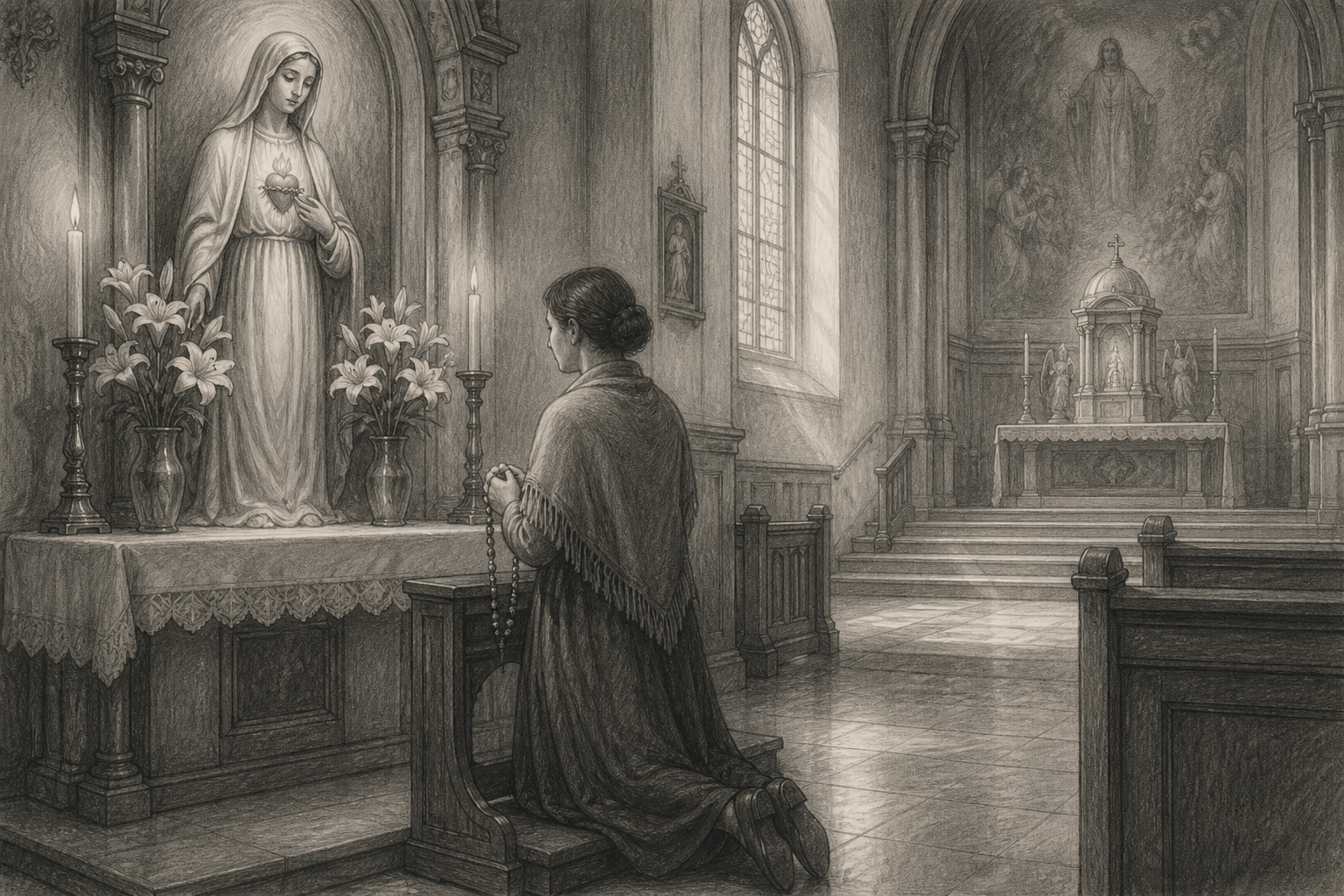
- Recitation of five decades of the Rosary
- Fifteen minutes of meditation on one or more mysteries of the Rosary
These acts are offered with the intention of making reparation to the Immaculate Heart of Mary. The intention is essential because it gives the practices their particular devotional character. A Catholic may already attend Saturday Mass, pray the Rosary, or go to confession regularly. For the First Saturday devotion, those good actions are consciously offered as a response of love to the sins, indifference, and contempt directed against God and against the Mother of Christ.
The fifteen minutes of meditation are distinct from praying the five decades. This does not require a complicated method. A person might slowly ponder the Annunciation, picture Mary standing beneath the Cross, or reflect on Christ's Resurrection. The goal is not to produce unusual feelings. It is to remain prayerfully present to a mystery of Christ's life in the company of Mary.
Where the devotion comes from
The First Saturday devotion is associated with the message of Fatima. In 1917, three shepherd children in Portugal, Lucia dos Santos and her cousins Francisco and Jacinta Marto, reported a series of apparitions of the Blessed Virgin Mary. The apparitions at Fatima were later judged worthy of belief by the local Church authority and became an important part of modern Catholic devotional life.
Lucia later entered religious life. In December 1925, while she was living in Pontevedra, Spain, she reported an apparition in which Mary requested the Communion of reparation on five consecutive first Saturdays. The requested observance included confession, Holy Communion, five decades of the Rosary, and fifteen minutes of meditation on the mysteries.
The devotion is therefore connected with a private revelation. This distinction matters. Public revelation, given in Scripture and Apostolic Tradition, was completed with the apostolic age. Private revelations do not add new doctrines to the faith or improve upon the Gospel. Even when the Church judges one worthy of belief, Catholics are not required to accept it with the assent owed to revealed doctrine.
The Church does, however, recognize that an authentic private revelation may help Christians live the Gospel more faithfully in a particular time and place. The First Saturday devotion should be measured by that standard. It calls Catholics to conversion, sacramental life, prayer, and deeper union with Christ. Nothing in its authentic practice replaces the Gospel or competes with the Church's public worship.
Why Saturday is associated with Mary
Catholic tradition has long honored the Blessed Virgin on Saturday. The day carries a quiet Marian character, recalling Mary's faith as Christ lay in the tomb. The Gospels do not give a detailed account of her experience on Holy Saturday, but the Church contemplates her as the faithful disciple who continued to trust in God's promise.
Mary's contemplative faith is visible throughout the Gospel. After the shepherds visited Bethlehem, she did not treat their words as a passing curiosity. She received and pondered them:
Mary kept all these things, pondering them in her heart. Luke 2:19
That disposition helps explain the shape of First Saturday prayer. The devotion does not ask for hurried activity alone. It asks the faithful to ponder the mysteries of Christ with Mary. Her role is never to draw attention away from her Son. At Cana, her instruction directs every disciple toward obedience to him:
His mother said to the servants, "Do whatever he tells you." John 2:5
A Marian devotion is sound when it follows that same direction. Mary teaches the Church to listen to Christ, receive his grace, and remain near him even at the Cross.
Reparation as a work of love
The word reparation can sound unfamiliar. It does not mean that Christ's sacrifice was incomplete. His offering upon the Cross is perfect and sufficient. Nor does reparation imply that human beings can balance a spiritual account through their own effort.
Reparation is a loving response to sin. When God is ignored, mocked, or rejected, the Christian responds with repentance, worship, and fidelity. When Mary is treated with contempt, Catholics honor her because God honored her and because she is the Mother of the incarnate Son. Jesus himself gave Mary to the beloved disciple at the Cross, a scene the Church has long contemplated in relation to her spiritual motherhood: John 19:27.
The First Saturday devotion gives this response a concrete form. Confession rejects sin. Communion unites the believer to Christ. The Rosary contemplates the Gospel. Meditation makes room for attentive love. Each practice turns the heart away from indifference and toward communion with God.
The traditional explanation for the number five connects it with five kinds of offenses against Mary, including attacks on her Immaculate Conception, her perpetual virginity, her divine motherhood, her spiritual motherhood of Christians, and dishonor shown toward her sacred images. This explanation comes from Lucia's later account within the Fatima tradition. The central purpose is not to dwell on offenses, but to answer them with faith, reverence, and love.
A practical First Saturday devotion Catholic guide
Plan for confession
Confession does not necessarily have to occur on the Saturday itself. In Lucia's account, it could take place within about eight days before or after the first Saturday, provided the person receives Communion worthily and has the reparative intention. Parish confession schedules often make confession on the exact day difficult, so it is wise to plan ahead.
If a person is conscious of mortal sin, confession should take place before receiving Holy Communion. This is not unique to the First Saturday devotion. It is the ordinary discipline of worthy reception of the Eucharist. The devotion should foster a sincere examination of conscience, not anxious scrupulosity. Confession is an encounter with Christ's mercy.
Find a Mass where you can pray attentively
Look at parish schedules before beginning the five months. Some parishes offer a Saturday morning Mass, while others may have only an evening anticipated Sunday Mass. If local circumstances are uncertain, a priest can provide practical guidance.
At Mass, remember that the Eucharist is not merely one item on a devotional checklist. It is the source and summit of Christian life. Prepare carefully, participate in the liturgy, and receive Christ with faith and thanksgiving.
Pray five decades of the Rosary
The Rosary may be prayed before or after Mass, at home, in church, or with a parish group. The essential point is to pray five decades with attention and the intention of reparation. A quiet, imperfect Rosary prayed faithfully is better than one abandoned because concentration was difficult.
Distractions do not automatically invalidate prayer. When the mind wanders, return gently to the words and the mystery. Mary's own prayer magnifies God rather than herself: Luke 1:46. The Rosary should cultivate the same God-centered spirit.
Set aside the fifteen minutes
Choose one mystery or several mysteries and remain with them for fifteen minutes. Reading the corresponding Gospel passage can help. Consider what Christ says or does, how Mary responds, and what grace you need in order to follow him.
For example, while meditating on the Nativity, consider the humility of the Son of God and Mary's receptive faith. During the Sorrowful Mysteries, remain with Mary near the suffering Christ. During the Glorious Mysteries, contemplate the hope promised to the Church. The meditation is best understood as keeping Mary company while contemplating her Son.
State the intention simply
No elaborate formula is required. Before beginning, a person might pray: Lord Jesus, I offer this confession, Holy Communion, Rosary, and meditation in reparation to the Immaculate Heart of Mary and for the conversion of sinners.
The words may vary. What matters is a sincere intention rooted in love of God and concern for souls.
Avoiding anxiety and spiritual bookkeeping
Because the devotion involves five consecutive months, someone may worry excessively about making a mistake. If a first Saturday is missed, the usual practice is simply to begin the sequence again. Missing the devotion is not itself a sin, and restarting should not be treated as a punishment.
Likewise, spiritual fruit should not be measured by emotion. One month may feel peaceful, while another may involve distraction, fatigue, or inconvenience. Fidelity offered without consolation can be a particularly honest act of love.
The devotion also should not be separated from ordinary Christian responsibility. It cannot substitute for Sunday Mass, daily prayer, forgiveness of neighbors, care for the poor, or obedience to one's vocation. Its purpose is to strengthen those commitments by drawing the believer more deeply into repentance and Eucharistic life.
After the five Saturdays are completed, there is no reason the pattern must disappear. A Catholic may continue to observe first Saturdays, make regular confession, pray the Rosary, and spend time meditating on Scripture. What begins as a five-month devotion can become a school of steadiness, teaching the heart to remain with Jesus and Mary through both consolation and sacrifice.
The deepest invitation of the First Saturday devotion is not complicated. Make room for mercy. Receive Christ reverently. Ponder his mysteries. Stand beside his Mother. In a distracted age, five Saturdays of faithful attention can help restore the heart to the quiet obedience heard at Cana: do whatever he tells you.
Keep Reading on Lets Read The Bible
Frequently Asked Questions
What must I do for the First Saturday devotion?
On the first Saturday of five consecutive months, go to sacramental confession, receive Holy Communion worthily, pray five decades of the Rosary, and spend fifteen minutes meditating on one or more mysteries of the Rosary. Offer these acts with the intention of reparation to the Immaculate Heart of Mary.
Does confession have to take place on the first Saturday itself?
Not necessarily. According to Lucia's account, confession may take place within about eight days before or after the first Saturday, provided Holy Communion is received worthily and the reparative intention is present. A priest can help if local schedules or unusual circumstances create difficulty.
What happens if I miss one of the five consecutive first Saturdays?
The customary approach is simply to begin the sequence again. Missing a first Saturday is not itself a sin. The devotion is an invitation to faithful love, not a reason for fear or scrupulosity.