Jesus and the Gospels
A Table at the Door and a Fire Beyond It: The Rich Man and Lazarus in Catholic View
Jesus places wealth, mercy, and eternity in direct conversation through one of the most searching parables in the Gospel of Luke.
Site Admin | February 23, 2026 | 80 views
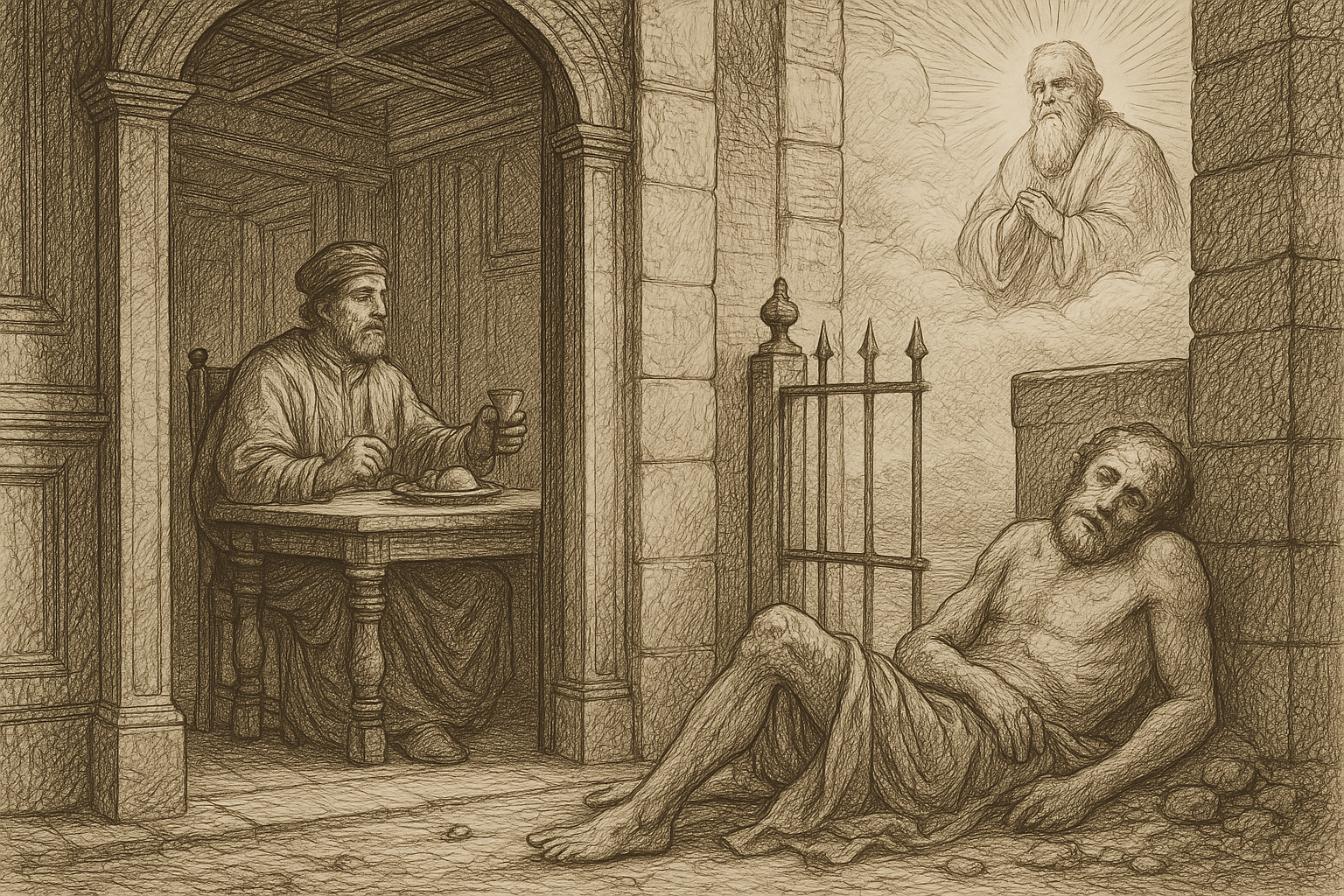
The parable of the rich man and Lazarus is among the starkest words Jesus speaks in the Gospel. A rich man lives in comfort. A poor beggar named Lazarus lies at his gate, covered with sores and longing for scraps from the table. When death comes, their fortunes are reversed in a way that reveals what each life was truly built upon. For Catholics, this passage is not only a lesson about heaven and hell. It is also a piercing examination of conscience about mercy, justice, and what we do with the gifts entrusted to us.
Jesus tells this account in Luke after speaking about money, fidelity, and the impossibility of serving two masters. The setting matters. He is not giving an abstract morality tale detached from ordinary life. He is exposing the spiritual danger of wealth when it becomes insulated from compassion. The rich man is not condemned because he owned much. He is condemned by his indifference. Lazarus is not saved because poverty itself is holy. He is received into consolation because God sees the one whom others ignored.
The scene Jesus paints in Luke
Luke describes the rich man in fine linen and purple, living in daily luxury, while Lazarus lies at his gate, hoping for leftovers Luke 16:19-21. The contrast is deliberate and severe. The gate is not a small detail. It is the threshold where charity could have begun. The poor man is not somewhere far away. He is close enough to be seen, heard, and reached.
After both men die, Lazarus is carried to Abraham's side, while the rich man finds himself in torment [[VERSE|luke|16|22-23|Luke 16:22-23]]. He asks for relief, then for a message to be sent to his brothers. Abraham answers that a great chasm has been fixed, and that Moses and the prophets already have spoken [[VERSE|luke|16|26-29|Luke 16:26-29]]. When the rich man pleads that someone risen from the dead might warn them, Abraham says that if they will not listen to Scripture, they will not be convinced even by that [[VERSE|luke|16|30-31|Luke 16:30-31]].
That ending is sobering. Jesus is telling us that revelation already given is enough to summon repentance. The problem is not usually lack of light. It is refusal to live by it.
What the parable reveals about sin
In Catholic teaching, sin is not only the breaking of a rule. It is a turning away from God and, by consequence, a turning away from our neighbor. The rich man's fault in this parable is not an outburst of cruelty. Jesus does not describe him kicking Lazarus or mocking him. The sin is quieter and perhaps more familiar: he noticed but did not act. He lived as if the beggar at his gate were part of the scenery.
This is one reason the parable remains so searching. It confronts the sin of omission. We tend to think of grave sin in dramatic terms, but the Gospel often shows that indifference can be spiritually deadly. The rich man had no interest in the suffering before him because his comfort had become a closed world. That is how the heart hardens. Not always through violence, but through habit, convenience, and self-protection.
Catholics hear in this passage a warning against the lie that private comfort can remain morally neutral. If our abundance never opens into mercy, it becomes a test we are failing. The Lord who gives bread also asks whether we have seen the hungry.
Lazarus and the dignity of the poor
It is striking that Jesus gives the beggar a name. The rich man remains unnamed, but the poor man is called Lazarus, meaning God has helped. That detail matters. In the eyes of the world, Lazarus has almost nothing. In the eyes of God, he is known personally. The Gospel quietly insists that the poor are not anonymous problems to solve. They are persons to love.
Catholic social teaching returns again and again to this truth. The dignity of the human person does not depend on wealth, usefulness, or public status. Every person bears the image of God. That is why care for the poor is not a decorative part of Christian life. It belongs to its center. Almsgiving, works of mercy, fair dealing, and concern for the vulnerable are not optional accessories. They are ways faith becomes flesh.
The parable also guards against an overly simple reading of suffering. Scripture does not teach that the poor are automatically righteous and the wealthy automatically wicked. What it does teach is that the poor are especially vulnerable to being overlooked, and God does not overlook them. Their cries rise before Him. The measure of a society, and of a soul, is often seen in how it treats those who cannot repay.
The meaning of the great chasm
When Abraham speaks of the fixed chasm, Jesus gives us one of the most forceful images of final judgment Luke 16:26. In Catholic faith, judgment is real, and eternity is real. The choices of this life matter because our lives are not endless moral experiments. We are moving toward an encounter with truth. At death, the soul is no longer on the road toward conversion in the same earthly way. The time for responding is now.
That does not mean the Church encourages fear without hope. Quite the opposite. The Gospel warns because it loves. Jesus does not speak of judgment to trap us, but to awaken us. The fixed chasm is frightening, yet it is also merciful in its honesty. It tells the living not to postpone repentance, not to imagine that tomorrow will automatically be available, and not to assume that a life of self-enclosed comfort can be repaired after death by sentiment alone.
Catholics also recognize in this passage a profound respect for the moral significance of earthly life. God does not dismiss our choices as temporary blunders. He takes them seriously. That seriousness is not meant to crush us. It is meant to summon us to conversion while mercy is still offered.
Moses, the prophets, and the call already given
Abraham's final answer points to Scripture itself: Moses and the prophets. In other words, the rich man's brothers do not lack enough revelation. They have already been taught how God wants His people to live. They know the command to love the Lord with all their heart and to care for the stranger, widow, and orphan. They know that justice and mercy belong together. They know that worship without charity is hollow.
This is a crucial Catholic insight. The moral life is not invented from scratch by private feeling. It is received. God has spoken. The commandments, the prophets, and finally Christ Himself give shape to a life that is both faithful and humane. When we ask for one more sign, one more proof, one more dramatic intervention, the Lord may be asking whether we have already listened to what He has said.
When the rich man asks for a messenger from the dead, Abraham answers that the Word of God has already been given. The issue is not only hearing more. It is obeying what has been heard.
That is why the parable speaks so sharply to modern habits of distraction. We can become experts in hearing without listening. We can move through news of suffering with the same indifference that kept the rich man at his table. The Gospel presses past that numbness and asks for a response.
Christ at the center of the parable
Although the parable does not directly describe the Cross, Catholics can hardly miss its shadow. Jesus Himself became poor for our sake. He was rejected, wounded, and laid among the dead. He did not remain above our misery. He entered it. In Him, God does not stand at a safe distance from human suffering. He comes near, and He gives Himself.
That is why the rich man and Lazarus can never be read as a mere social lesson. They belong inside the broader mystery of redemption. The Lord who tells this parable is the same Lord who will later feed the hungry, touch the leper, praise the widow's offering, and finally die outside the gate. If we want the Catholic meaning of the parable in its fullness, we must see that Christ is both the Judge who warns and the Savior who rescues.
He also reveals what true wealth is. It is not purple cloth or fine dining. It is communion with the Father. It is a heart made spacious enough to love. In that sense, the parable is not anti-material in a shallow way. It is anti-idolatrous. Earthly goods are meant to serve life, not replace God.
How Catholics can live the parable now
The most direct response is to practice mercy with eyes open. That begins close to home. Is there a person at the gate of our attention, our parish, our neighborhood, or our family whom we have quietly learned to ignore? The parable asks us to notice them. Seeing is often the first act of charity.
It also invites a disciplined approach to possessions. Catholics are not all called to the same level of poverty, but all are called to detachment. Goods are gifts, not masters. The Church's sacramental life trains us in this freedom. In the Eucharist, we receive Christ who gives Himself entirely. That gift should reshape how we hold our own resources, time, and comfort.
Practical charity can take many forms:
- Give alms regularly and intentionally, not only when it feels convenient.
- Support ministries that serve the poor, the sick, and the homeless.
- Learn the names and stories of people on the margins instead of speaking about them in generalities.
- Examine whether habits of consumption make us less attentive to those in need.
- Pray for the grace to see Christ in those whom the world overlooks.
The parable also strengthens the Catholic practice of repentance. If a person senses a hardened heart, the answer is not despair. It is confession, amendment of life, and renewed attention to the poor. Grace can reopen what selfishness has closed.
In the end, the rich man and Lazarus is not merely a story about two men after death. It is a revelation of what their lives meant before death. That is what makes it so urgent. We are all building a pattern of love or indifference, and each day offers another chance to choose differently. The gate is still there. So is the poor man. So is the Lord who sees both, and who calls His people to mercy while the hour remains.
Keep Reading on Lets Read The Bible
Frequently Asked Questions
Is the rich man condemned simply for being wealthy?
No. In Catholic reading, the parable does not teach that wealth itself is evil. The rich man is judged for his indifference to Lazarus, who lay at his gate in need. The warning is about a heart closed to mercy.
Why does Jesus give the poor man a name but not the rich man?
Lazarus is named because God knows and sees him personally. The unnamed rich man represents how worldly status can fade before God. The detail highlights the dignity of the poor and the emptiness of self-importance.
What is the main lesson Catholics should take from this parable?
The central lesson is that faith must become mercy. Catholics are called to notice the poor, practice charity, listen to God's word, and repent now rather than assume there will always be more time later.