Jesus and the Gospels
The Father Runs First: Reading the Parable of the Prodigal Son with Catholic Eyes
A close look at Jesus' parable of mercy, repentance, and the Father's generous welcome home.
Site Admin | February 19, 2026 | 94 views
Few Gospel scenes speak as directly to the human heart as the parable of the Prodigal Son. In a few verses, Jesus gives us a family wound, a reckless departure, a bitter famine, and a homecoming greater than shame. The story is familiar, but it is never shallow. It reveals both the misery of sin and the abundance of divine mercy.
For Catholics, the parable is more than a moral lesson about bad choices. It is a revelation of the Father revealed by Christ, a portrait of repentance, and a glimpse of the sacramental life of the Church. To read the prodigal son Catholic meaning well is to let the parable search us. It asks whether we know our need for mercy, whether we can receive it, and whether we can rejoice when mercy is given to others.
Jesus tells the parable in the setting of mercy and complaint
Luke introduces this parable in a charged moment. Tax collectors and sinners are coming near to hear Jesus, and the Pharisees and scribes are grumbling that he welcomes them and eats with them. In response, Jesus tells a series of parables about something lost being found: the lost sheep, the lost coin, and then the lost son. The parable is not an isolated moral tale. It is Jesus' answer to the accusation that divine mercy is too generous.
The younger son asks for his share of the inheritance before the father has died. In the world of the parable, this request is deeply offensive. It is as if he wants the father's gifts without the father himself. Jesus does not soften the offense. He shows us that sin is not merely a mistake. It is a rupture of communion, a refusal of order, and a desire to live apart from the giver of life.
The son leaves for a distant country and squanders everything in dissolute living. A famine then strips away the illusion of freedom. The parable does not glamorize rebellion. It exposes the false promise that life away from the father will be expansive and satisfying. In the end, the son is reduced to feeding swine, which would have carried a particular shame for Jesus' Jewish hearers. Hunger brings him back to honesty.
The turning point is repentance, not self-rescue
One of the most beautiful parts of the story is the moment when the son comes to himself. This is more than regret. It is the beginning of conversion. He remembers his father, recognizes his misery, and decides to return with words of humility: Father, I have sinned against heaven and before you Luke 15:18.
That confession matters. The son does not excuse himself. He does not claim he merely made a poor financial decision. He names sin for what it is. Catholic moral teaching has always taken sin seriously because sin wounds communion with God and neighbor. The parable is clear that healing begins when the sinner stops defending the self and begins to speak truth.
At the same time, the son does not presume he can restore himself by his own strength. He resolves to return as a servant, hoping only for mercy. This is an important distinction. Repentance is not a payment plan for salvation. It is a surrender to the goodness of the Father. The son prepares to ask for a place, but the Father gives him a sonship he cannot earn.
The Father runs, embraces, and restores
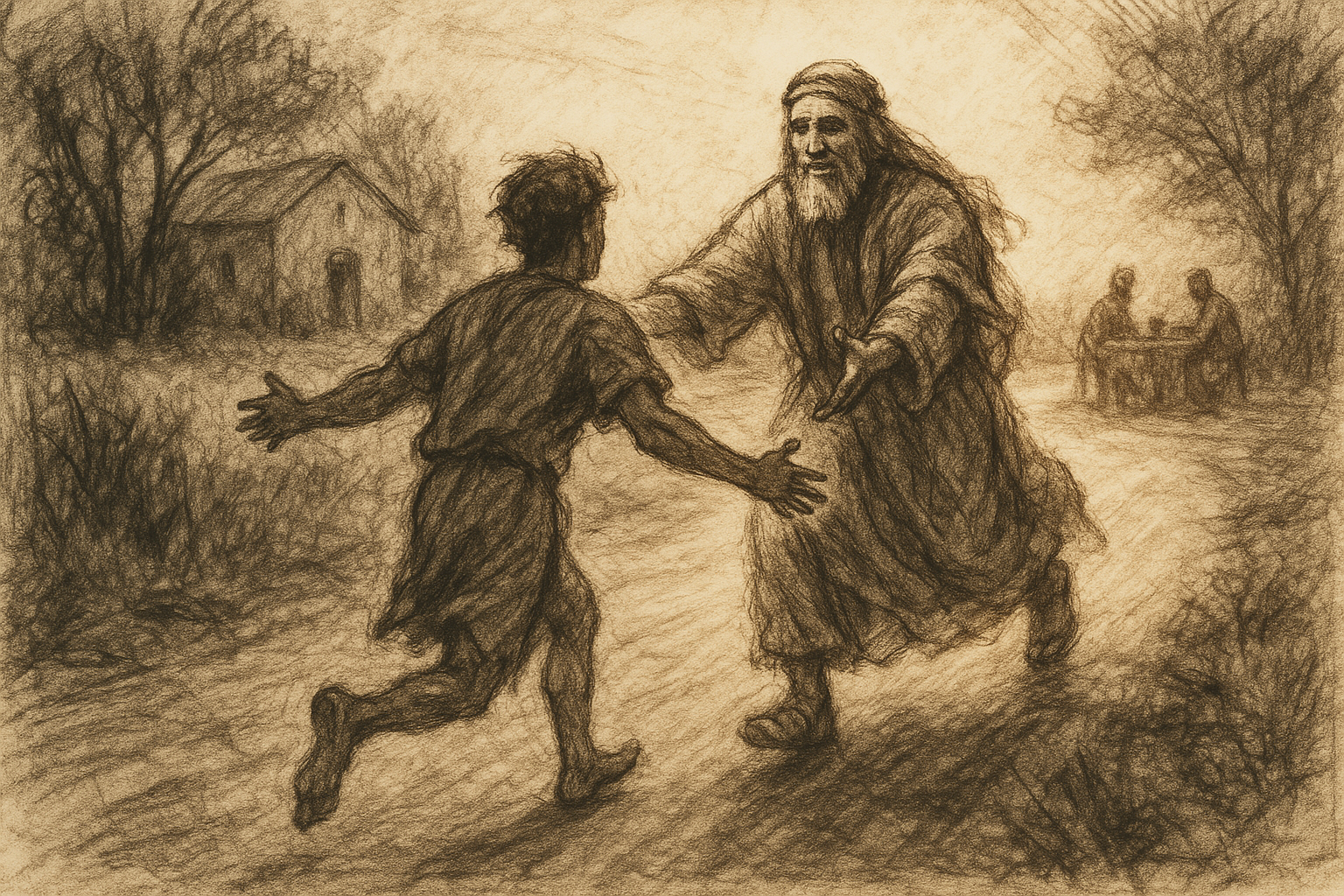
The most startling moment in the parable is the Father's response. While the son is still far off, the father sees him, has compassion, runs to him, embraces him, and kisses him Luke 15:20. For Jesus' first hearers, this would have sounded almost scandalous. A patriarch does not run. Yet the Father's action reveals the heart of God.
This is not sentimental indulgence. The father does not deny the truth of the son's sin. He does not say the famine was enough punishment. Instead, he receives the confession and restores the lost relationship. He orders the best robe, a ring, and sandals. He commands a feast. Each detail speaks of dignity returned. The son is not brought back on probation. He is welcomed as family.
Catholics can hear here an echo of the sacramental life, especially Reconciliation. The sacrament is not merely a private psychological relief. It is the Father's merciful restoration of the sinner to communion. We confess truthfully, and God acts with healing love. The parable does not describe the sacrament in technical terms, but it surely prepares the heart to understand it.
The Father's mercy in the parable is not weak. It is strong enough to restore what sin has damaged and generous enough to rejoice in the return of the lost.
The older son reveals another face of lostness
The parable would be incomplete if it ended with the younger son's return. Jesus also gives us the older son, who has remained near home but is far from the father's joy. When he hears music and dancing, he becomes angry and refuses to enter. His protest exposes resentment, self-righteousness, and a relationship with the father built on wages rather than love.
The older son's words are painful: Look, these many years I have served you, and I never disobeyed your command Luke 15:29. He speaks as though sonship were earned by labor. He cannot see that he has always been living in the father's house, surrounded by gift. His complaint is not only about his brother. It is about the kind of father he believes he has.
Here Jesus speaks directly to those who are outwardly obedient yet inwardly closed to mercy. The older son has not left physically, but his heart is narrowed by comparison and bitterness. Catholics should not miss the warning. It is possible to keep the forms of religion and still resist the Father's joy. Pride can appear in respectable clothing.
The father's response is tender and firm. He goes out to the older son too. He addresses him as child and reminds him, you are always with me, and all that is mine is yours Luke 15:31. Mercy is offered to both sons. One through repentance after open sin, the other through conversion from hidden hardness of heart.
The parable belongs inside the whole Gospel story
The Prodigal Son is not only about individual behavior. It sits within the larger Gospel announcement that God has come near in Christ to save sinners. Jesus himself is the one who eats with sinners, seeks the lost, and reveals the Father's heart. The parable is therefore both instruction and invitation. It shows who God is and how humans are meant to respond.
In the wider New Testament, the themes of repentance and mercy continue. The apostolic preaching calls people to turn from sin, believe in Christ, and receive forgiveness. The Church continues that mission through preaching, baptism, penance, Eucharist, and the whole life of grace. The parable fits naturally with Catholic faith because Catholic faith is built on the conviction that grace restores what sin destroys.
It also helps to notice that the story does not end with the older son's decision. Jesus leaves the question open. Will he enter the feast or remain outside? That open ending places the listener inside the parable. We are invited to decide whether we will accept the Father's mercy and share it.
Living the prodigal son Catholic meaning today
For Catholics today, the parable has direct and practical force. It teaches at least three habits of discipleship.
- Name sin honestly. The younger son begins to heal when he stops pretending. Catholics should cultivate examination of conscience, truthful confession, and humility before God.
- Return without fear. Many people delay repentance because they imagine God is reluctant. The parable teaches the opposite. The Father is already moving toward the sinner. Reconciliation is not a cold tribunal but a merciful encounter with truth.
- Reject resentment. The older brother's danger is real for religious people. We can resent mercy when it is given to those we dislike. The parable asks us to rejoice when God restores the lost.
There is also a pastoral tenderness in this story for those who feel spiritually exhausted. Some Catholics carry long histories of failure and assume they have gone too far. The father in the parable says otherwise. He welcomes the son who wasted everything. That does not make sin trivial. It means mercy is greater than sin.
At the same time, those who have remained close to the Church are not forgotten. The older son reminds us that nearness to holy things does not automatically produce holiness of heart. We are all invited deeper into communion, not just into correct behavior. The Father wants children, not employees.
Questions for prayer and self-examination
This parable becomes fruitful when prayed slowly. A Catholic reader might ask:
- Where have I tried to live as if the Father's gifts were enough without the Father himself?
- Have I been honest enough about my sin to return in humility?
- Do I rejoice when another person receives mercy, or do I measure myself against them?
These questions are not meant to discourage. They are meant to open the heart. The Father is not standing at a distance with crossed arms. He is the one who goes out, sees, embraces, and welcomes home.
That is why the parable remains so consoling and so demanding. It consoles because no one is beyond return. It demands because mercy asks us to become merciful. When Catholics read the story attentively, they see not only a wayward son but a God who is ready to restore, a Church that must rejoice, and a feast that still waits for the children to come in.
Keep Reading on Lets Read The Bible
Frequently Asked Questions
What is the main Catholic meaning of the Prodigal Son?
The Prodigal Son shows that God the Father receives repentant sinners with mercy, restores their dignity, and calls all his children to share in that mercy without resentment.
How does the Prodigal Son relate to Confession?
The parable strongly resembles the Sacrament of Reconciliation. The sinner admits the truth, returns in humility, and is restored by the Father's merciful love through God's grace.
Why is the older brother important in the parable?
The older brother warns religious people against pride, bitterness, and a spirit of comparison. He shows that someone can stay near the Father's house and still need conversion of heart.