Marian Devotion
At the Door of the Incarnation: The Annunciation and the Quiet Yes of Mary
Gabriel's message to Mary reveals how God enters human history through humility, freedom, and faith.
Site Admin | March 20, 2026 | 83 views
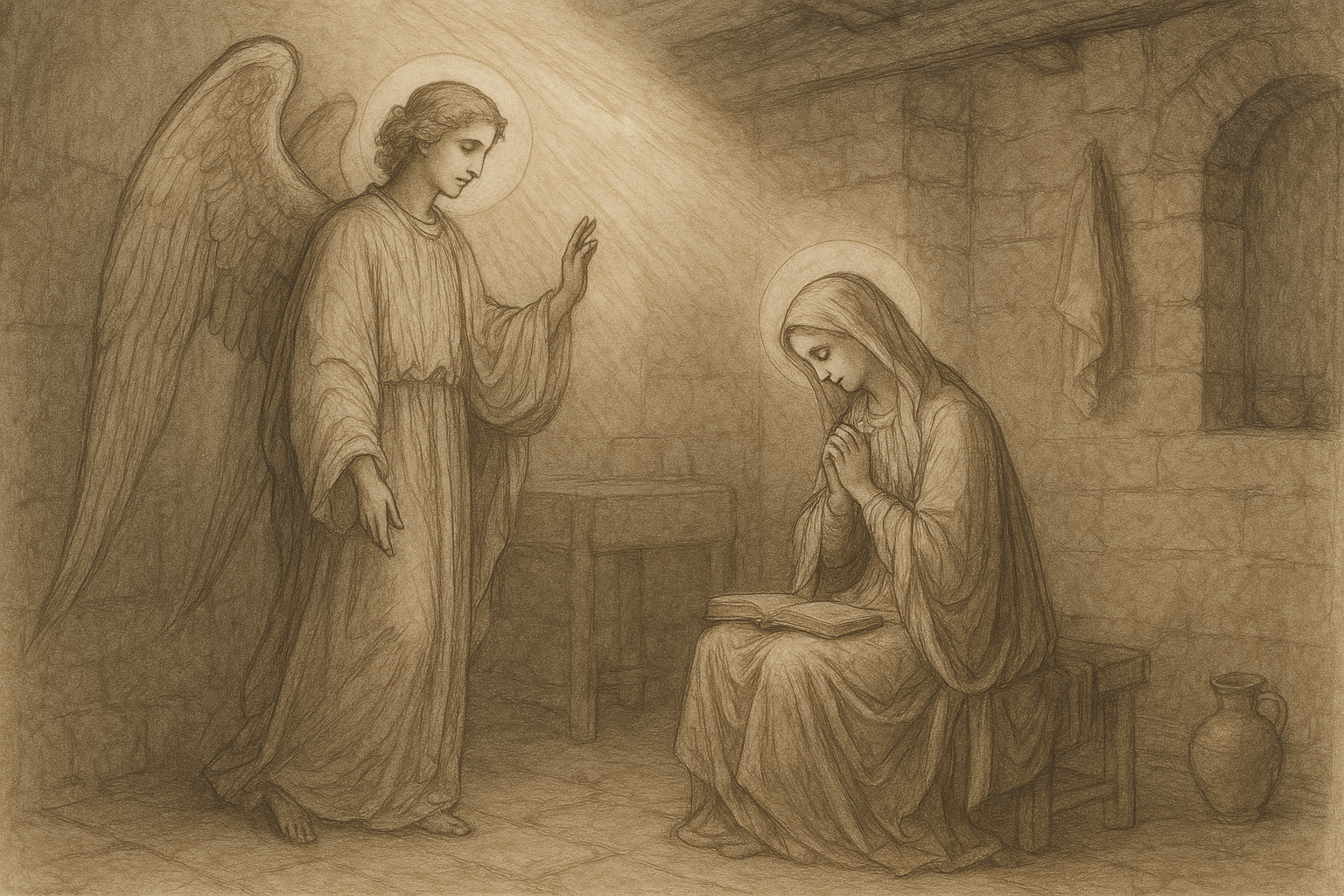
The Annunciation is one of the most beloved moments in the whole of salvation history. It is brief in the Gospel, yet it bears an immeasurable weight. In a quiet house in Nazareth, the angel Gabriel brings God's message to the Virgin Mary, and her free and trusting response becomes part of the mystery by which the Son of God takes flesh for our salvation. When Catholics speak of the Annunciation explained, we are not describing only a biblical episode. We are entering the doorway of the Incarnation itself.
Saint Luke tells the story with striking simplicity. Gabriel is sent by God to a virgin betrothed to Joseph, and the virgin's name is Mary. The angel greets her with reverence and announces that she has found favor with God. He tells her that she will conceive and bear a son, and that he will be called the Son of the Most High. Mary asks how this will come about, and the angel answers that the Holy Spirit will come upon her and that the power of the Most High will overshadow her. Then Mary gives her consent: let it be to me according to your word [[VERSE|luke|1|26-38|Luke 1:26-38]].
That exchange is short, but nothing about it is small. The Church has always seen in Mary's yes not mere passivity, but active faith. God does not force salvation upon the world as if human freedom were irrelevant. He seeks a human response, and Mary gives it perfectly. Her obedience is not mechanical. It is a response of mind, heart, and will to the living God who calls. That is why the Annunciation remains one of the clearest places in Scripture where grace and freedom are seen together.
The Gospel moment that changed history
It can be tempting to think of the Annunciation as a private devotion scene, almost isolated from the rest of the Bible. In truth, it belongs to the great arc of prophecy and promise. The angel's words echo the hope of Israel and the long expectation of a Redeemer. When Gabriel says that Mary's son will reign over the house of Jacob forever and that his kingdom will have no end, he is announcing the fulfillment of God's covenant love [[VERSE|luke|1|32-33|Luke 1:32-33]].
The mystery here is not only that Mary receives a message. It is that the eternal Son is coming into human flesh. The Creed confesses that Jesus Christ is consubstantial with the Father and that he was incarnate of the Virgin Mary. This is the heart of Christian faith. The Word did not merely appear to be human or take on a body for a time. He truly became man. At the Annunciation, the Son begins his earthly life in the womb of the Virgin by the power of the Holy Spirit.
This is why the feast is so closely tied to the Incarnation. The Annunciation is not only the moment when Mary receives news. It is the moment when God's promise becomes flesh. In the words of the Gospel of John, the Word became flesh and dwelt among us John 1:14. Catholics honor this not as a distant theological claim but as a living mystery that shapes prayer, worship, and daily discipleship.
Mary's freedom and Mary's faith
One of the deepest features of the Annunciation is Mary's freedom. God asks, he invites, and she answers. The Church has often reflected on how Mary stands as the new Eve, offering a faith-filled obedience where the first Eve had refused trust. This comparison does not diminish the uniqueness of Christ. Rather, it shows how God prepared a true human cooperation in the unfolding of redemption.
Mary's question, How can this be, since I have no husband? is not unbelief. It is a sincere desire to understand God's will Luke 1:34. The angel's response does not rebuke her. Instead, he reveals the divine initiative: the Holy Spirit will come upon her, and the child will be holy, the Son of God Luke 1:35. Mary then receives what she has been told in faith. She does not possess complete control. She possesses something better: trust.
For Catholics, this matters because Mary's yes is inseparable from the grace God gives her. The Church teaches that Mary was prepared by a singular grace of God to be a worthy dwelling place for the Incarnate Word. Her holiness is entirely God's gift, and yet it is truly hers. She is not a passive instrument in the modern sense of the word. She is a free person whose obedience is luminous because it is wholly aligned with grace.
That truth can help modern believers who struggle to say yes to God. We often want certainty before surrender. Mary receives enough light for the next step, not a map of the whole road. Her faith teaches us that obedience often begins before complete understanding. The Christian life is full of such moments, when God asks for trust before explanation.
What the Church sees in the Annunciation
Catholic devotion to the Annunciation is rooted in more than sentiment. It touches doctrine. The mystery confirms that Jesus is truly God and truly man. It affirms the virginal conception of Christ. It reveals the role of the Holy Spirit in the Incarnation. It also illuminates the dignity of human cooperation in God's plan.
In the Annunciation, the angel's greeting names Mary as full of grace Luke 1:28. Catholics have long pondered this phrase because it points to God's prior action in her life. Mary is not celebrated because she is independent of grace, but because grace has already taken root in her in a unique and beautiful way. This is one reason her person is so dear to Catholic devotion. She is what the redeemed person looks like when grace is welcomed without resistance.
The Fathers of the Church often marveled at the reversal that takes place in Mary's consent. By her yes, the Son enters the world in humility. The Lord of glory does not come through earthly power, wealth, or spectacle. He comes through obedience, hiddenness, and poverty. The child conceived in Mary's womb will be laid in a manger, and later will give himself on the Cross. The Annunciation already contains the pattern of the Gospel: divine glory clothed in humility.
Because of this, the feast of the Annunciation is never only about Mary in isolation. It is about Christ. Every authentic Marian devotion leads to him. The angel's message is about the Son. Mary's consent serves the mission of the Son. Her greatness lies in her transparent faith, which allows God's saving plan to unfold. Catholic devotion to Mary is at its healthiest when it remains centered on Jesus Christ, whom she bore, cherished, and followed.
Praying the mystery in ordinary life
The Annunciation speaks quietly to daily life because it occurs quietly. There is no public stage, no dramatic crowd, no earthly triumph. There is only a young woman, the word of God, and a decision of faith. For many believers, this is the most consoling part of the story. God often comes in silence. He asks for a response in the hidden places where ordinary life unfolds.
To pray with the Annunciation is to ask several simple but searching questions:
- Where is God asking for my trust before I understand everything?
- Am I willing to receive God's will even when it changes my plans?
- Do I believe that hidden obedience can bear fruit beyond what I can see?
The Annunciation also invites a deeper reverence for the body and for human life. The Son of God begins his earthly life in the womb. This means that the mystery of Christ's coming honors human life from its earliest beginning. Catholics see in this a sacred reminder that God works in ways the world often overlooks. What is hidden from human acclaim can be immense in divine purpose.
Many Christians pray the Angelus as a way of remembering this mystery throughout the day. Even for those who do not keep the devotion at fixed hours, the words of the prayer can still shape the heart: the Incarnation is not a distant event but the center of time. The eternal Son entered our history, and history will never be the same.
Behold, I am the handmaid of the Lord; let it be to me according to your word. These words remain among the clearest expressions of surrendered faith in all of Scripture. They are not the cry of someone who has all the answers. They are the prayer of someone who trusts the One who does.
Mary's yes and our own discipleship
There is a practical reason the Annunciation continues to matter for Catholics today. Mary shows us what it looks like to belong to God before understanding the full shape of his plan. Her yes is not a one-time event only. It is a posture of life. She will carry that consent forward through joy, confusion, sorrow, and the Cross.
Every Christian life includes moments when God asks for a response that costs something. It may be forgiveness, patience, chastity, a hidden sacrifice, a change in direction, or a quiet acceptance of circumstances we did not choose. Mary's example does not make these things easy, but it makes them intelligible. Faith is not the elimination of difficulty. Faith is the choice to trust God's word in the midst of it.
The Annunciation also teaches that holiness is fruitful. Mary's hidden consent became a source of blessing for the whole world. In a similar but lesser way, the acts of faith done in hiddenness still matter. A parent who prays faithfully, a person who serves quietly, a believer who endures suffering without bitterness, a soul that says yes to God's will in daily duty: these are not small things in the eyes of God. The Incarnation dignifies ordinary obedience.
For that reason, the Annunciation is a good mystery to return to when prayer feels dry or duty feels heavy. It reminds us that God often begins his greatest works in simplicity. He enters the world not by spectacle but by consent. He redeems not by force but by love. And he still asks hearts to make room for him.
When Catholics ponder the Annunciation, they are drawn into both humility and hope. Humility, because God chooses a lowly path and asks for our trust. Hope, because the promise given to Mary was fulfilled exactly as spoken. The Lord does what he says. The Word truly became flesh. And the quiet yes of a young woman in Nazareth became one of the most fruitful moments in the history of salvation.
Keep Reading on Lets Read The Bible
Frequently Asked Questions
Why is the Annunciation so important in Catholic teaching?
The Annunciation is the moment when the eternal Son of God takes flesh in the womb of the Virgin Mary by the power of the Holy Spirit. It marks the beginning of the Incarnation in time and reveals the union of divine grace and human freedom.
Did Mary fully understand everything when she said yes?
No. Mary did not possess complete knowledge of the future, but she trusted God's word. Her faith is remarkable precisely because she accepted the angel's message before seeing its full fulfillment.
How can Catholics pray with the Annunciation in daily life?
Catholics can pray with the Annunciation by asking for Mary's openness to God's will, reflecting on Luke 1:26-38, and using the scene as a guide for trust in ordinary decisions, hidden sacrifices, and moments of uncertainty.