Catholic Living
When Suffering Feels Close: Catholic Clarity on Euthanasia and the Dignity of the Dying
A sober look at euthanasia, human dignity, and the Church's call to care for the suffering with truth and mercy.
Site Admin | August 13, 2025 | 72 views
Questions about dying are never abstract for long. They arrive in hospital rooms, family meetings, hospice visits, and long nights of prayer when a loved one is in pain and everyone feels the weight of what cannot be fixed. In those moments, euthanasia can seem less like a theory and more like a plea for relief. The Church does not mock that plea. She listens to the anguish behind it. Yet she also insists that no act aimed at ending innocent human life can be made good by difficult circumstances.
That is the heart of euthanasia Catholic teaching: human life is a gift from God, and its value does not disappear when strength fades, independence ends, or suffering increases. The moral question is not whether pain is real. It is. The question is whether a person may deliberately bring about death as a means of ending pain. The Church answers no, because life remains sacred until natural death, and because love does not abandon the suffering person even when healing is no longer possible.
What the Church means by euthanasia
In ordinary speech, euthanasia usually means deliberately causing a person's death in order to relieve suffering. It may be described as mercy, dignity, or control, but the moral act remains the same when death is intended as the goal or as a means. Catholic moral teaching rejects this because it makes human life something we may choose to end when it appears burdensome.
The Catechism teaches that euthanasia is morally unacceptable. It also distinguishes it from allowing death to occur naturally when treatment is excessively burdensome or no longer beneficial. Catholics are not required to use every possible medical intervention at all times. There is a difference between killing and allowing natural death. That distinction matters deeply.
A person may refuse treatments that are disproportionate, overly burdensome, or unlikely to help. A patient may also receive strong pain relief, even if the medication has the unintended effect of shortening life, so long as the intention is to relieve suffering and not to cause death. Catholic teaching does not demand the prolongation of life by every available means. It asks for care that is wise, proportionate, and faithful to the dignity of the person.
Why the Church says human life cannot be intentionally ended
The Church's opposition to euthanasia rests on more than a rule. It flows from a vision of the human person. We are not owners of life in the absolute sense. We are stewards. Life is received, not manufactured. It belongs first to God, who alone gives and takes life in the fullness of His authority.
Scripture consistently presents life as a holy trust. The commandment, You shall not kill, guards innocent life from direct attack. The Psalms speak of God's care from the womb to old age. And St. Paul reminds believers that whether we live or die, we belong to the Lord. That does not erase human anguish, but it gives it a horizon: our value is not measured by usefulness, productivity, or visible strength.
There is also a moral danger in the logic of euthanasia. Once society accepts that some lives may be ended because they are judged too painful, too dependent, or too costly, the temptation grows to sort lives by their degree of convenience. The sick, the disabled, the elderly, and the lonely are placed under subtle pressure to believe they are a burden. Catholic teaching resists that pressure by affirming that every person has inviolable dignity, especially when he or she can no longer defend that dignity with speech, ability, or social influence.
Suffering, compassion, and the temptation to despair
It is important to say plainly that the Church does not romanticize suffering. Pain is a real evil. Illness can strip away privacy, mobility, memory, and the ability to recognize familiar faces. Families can feel helpless as they watch a loved one decline. In such moments, the temptation toward euthanasia often comes wrapped in compassion. People do not always ask for death because they hate life. Sometimes they ask because they are tired, afraid, or convinced they are losing their meaning.
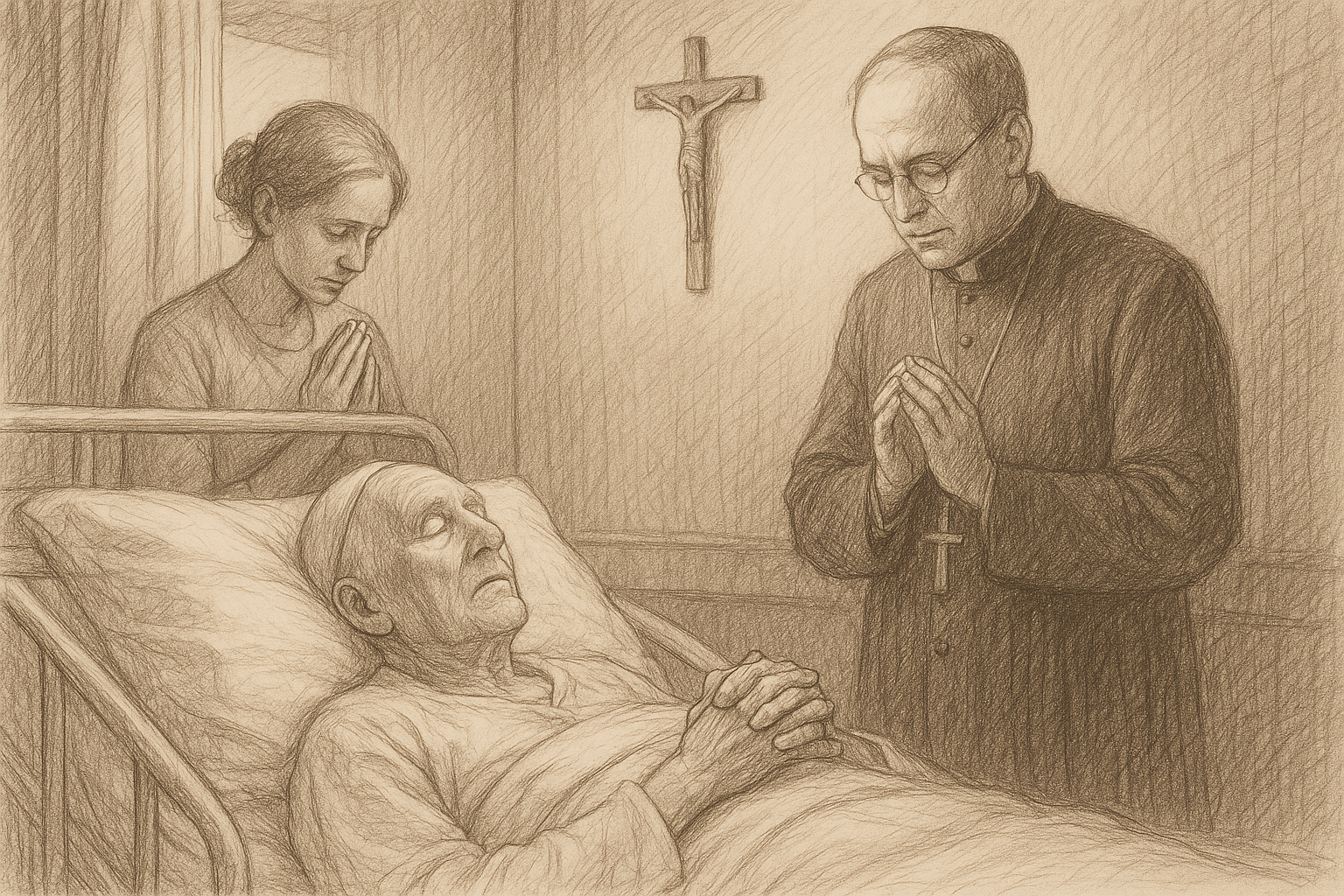
The Catholic response begins with presence. To sit with the dying, to ease symptoms, to listen without panic, to pray when words fail, and to make the person comfortable are acts of love. The Church's moral rejection of euthanasia is not a rejection of mercy. It is a defense of a deeper mercy, one that stays near the person who suffers rather than ending the person who suffers.
Here it helps to remember that Christ entered human suffering from within. He did not look on pain from a distance. He accepted humiliation, abandonment, and death itself. That does not mean every suffering is good in itself. It means that suffering is not a sign that a life has become worthless. In the light of the Cross, the dying person is never abandoned by God, even when the Church cannot remove every pain.
Ordinary care, extraordinary care, and moral discernment
Families sometimes worry that rejecting euthanasia means demanding aggressive treatment at all costs. That is not what the Church teaches. Catholic moral reasoning distinguishes between ordinary care, which should generally be provided, and extraordinary or disproportionate care, which may be refused when it offers little hope or causes excessive burden.
Basic care such as food, water, hygiene, warmth, and companionship normally belongs to the dignity owed to every person, though specific medical situations can complicate how those needs are met. A person may also decline heroic procedures that are gravely burdensome, painful, or disproportionate to expected benefit. A ventilator, surgery, or chemotherapy may be morally optional in a given case if it no longer serves the patient's good in a reasonable way.
This discernment is not about giving up. It is about recognizing that death is not always the enemy to be defeated at every turn. Sometimes the faithful choice is to let death come in its natural time while continuing to care, comfort, and accompany. Hospice care often reflects this spirit well by focusing on pain relief, emotional support, and dignity rather than on futile attempts to prolong life at any cost.
We do not show love by hastening death. We show love by remaining faithful to the person who is dying.
Pastoral concerns for patients and families
Many Catholics who encounter this issue are not looking for arguments first. They are looking for reassurance that God has not left them alone. A family member may fear being trapped in severe pain. Another may fear becoming dependent. Someone else may worry about the financial burden of care. These concerns are real, and they should be met with patience rather than quick moral slogans.
Pastoral care begins by naming the fear honestly. It also means helping people seek good medical advice, palliative care, spiritual support, and the sacraments when possible. Confession, Anointing of the Sick, Holy Communion, and prayer with the family can become a great source of peace. In the face of death, the Church does not merely instruct. She accompanies.
There is also a particular sorrow when a person feels trapped between unbearable suffering and the fear of burdening others. Catholics should respond by making sure the vulnerable are not isolated. A person who feels valued is less likely to believe that death is his or her only path to dignity. Sometimes what is needed is not a new moral argument but a phone call, a meal, a night of respite, or a family willing to sit through the hard hours.
How Catholics can speak with truth and tenderness
Because the topic is emotionally charged, Catholics should speak carefully. It is possible to defend the Church's teaching while still sounding cold or dismissive, and that does no one any good. The goal is not to win a debate. It is to witness to the truth in a way that preserves trust and opens space for grace.
A few habits can help:
- Listen before responding, especially to the fears beneath someone's words.
- Avoid shaming people who are exhausted, grieving, or under pressure.
- Distinguish clearly between euthanasia and refusing disproportionate treatment.
- Encourage hospice, palliative care, and spiritual support when appropriate.
- Remind families that dignity does not depend on independence or physical strength.
When Catholics speak this way, they make the teaching easier to hear because they show that doctrine and compassion belong together. Truth without mercy can become harsh. Mercy without truth can become confusion. The Church asks for both.
Hope does not vanish at the bedside
One of the deepest lies behind euthanasia is the idea that when cure is impossible, hope is gone. Catholic faith says otherwise. Hope changes when healing is no longer expected, but it does not disappear. The hope of a Christian at the bedside is not only for recovery, though we may pray for that. It is also for peace, forgiveness, reconciliation, courage, and eternal life.
This is why the dying should never be treated as if they have been reduced to a medical problem. They remain sons and daughters of God, capable of prayer, love, and grace. Even when weakness grows, a person can still offer patience, receive love, and be united to Christ in a profound way. Families, too, can discover unexpected holiness in the care they give.
In the end, euthanasia Catholic teaching is not a narrow rule against one act. It is a broad affirmation that no person is disposable, no suffering person is alone, and no one is measured by efficiency or ease. The Church asks us to protect life, relieve pain, refuse needless burdens, and remain faithful when life enters its final season. That fidelity can be costly, but it is never empty. It is one way love keeps watch at the edge of eternity.
Keep Reading on Lets Read The Bible
Frequently Asked Questions
Does the Catholic Church allow pain medicine if it may shorten life?
Yes, if the intention is to relieve pain and not to cause death. Catholic teaching permits proportionate pain relief even when there is a possible unintended side effect of shortening life.
Is refusing a very burdensome treatment the same as euthanasia?
No. Refusing disproportionate or excessively burdensome treatment is not euthanasia when the intention is to allow natural death, not to cause death.
How should Catholics care for someone who is dying?
With prayer, presence, practical help, hospice or palliative care when appropriate, and the sacraments when possible. The goal is to comfort and accompany the person with dignity and love.