Family and Vocation
Fatherhood Formed by Grace: A Quiet Vocation of Love and Responsibility
In the Catholic life, fatherhood is not measured by volume or control, but by faithful presence, sacrificial love, and steady spiritual leadership.
Site Admin | November 17, 2025 | 98 views
Fatherhood is often discussed in practical terms: providing for a family, making decisions, protecting children, and being present when life is demanding. These responsibilities are real, but the Church sees fatherhood as more than a role of management or support. In the fatherhood Catholic perspective, a father is called to image God the Father in a limited but meaningful way through mercy, steadiness, truth, and sacrificial love.
That calling can feel weighty. Many fathers carry pressure to be strong, successful, and emotionally composed at all times. Others feel the ache of past failure, inconsistency, or distance from their own children. Catholic faith does not ignore those burdens. It places them before the Lord, who strengthens human weakness and makes ordinary family life a place of grace.
Fatherhood begins with gift, not ownership
In Scripture, children are not presented as possessions. They are entrusted gifts. Psalm 127 says, children are a heritage from the Lord Psalm 127:3. That truth changes the way fatherhood is understood. A father is not the master of his family, but a steward. He receives his children from God and is accountable to God for how he loves them.
This stewardship matters because modern culture can reduce fatherhood to either authority without tenderness or tenderness without authority. Catholic teaching rejects both extremes. A father is called to protect, guide, and provide, but always as one who answers to the Lord. His authority is real, yet it must serve the good of the child and the peace of the household.
St. Paul describes this balance in a striking way. He tells fathers, Do not provoke your children to anger, but bring them up in the discipline and instruction of the Lord Ephesians 6:4. Discipline in the Christian sense is not harshness. It is formation. It is the patient work of helping a child learn truth, virtue, responsibility, and trust in God.
The fatherhood Catholic perspective and the example of St. Joseph
No figure in the Christian tradition shows quiet fatherhood more clearly than St. Joseph. He does not speak a word in the Gospels, yet his actions reveal obedience, courage, and tenderness. He protects Mary, receives the child Jesus into his care, and responds promptly to the will of God. In him, fatherhood appears as faithful presence rather than self-display.
Joseph reminds fathers that spiritual leadership is often hidden. It is found in waking early to work, in listening without defensiveness, in praying before a difficult conversation, in staying when retreat would be easier, and in making space for the needs of others. A father may never be praised for these acts, but heaven sees them.
In that sense, Joseph is especially consoling to fathers who feel inadequate. He was not chosen because he was impressive by worldly standards. He was chosen because he was righteous and ready to obey. Catholic fatherhood is not built on perfection. It is built on fidelity.
Scripture places fatherhood inside a covenant of love
In the Bible, fathers are often judged not by status, but by whether they help their households remain faithful to God. Abraham, despite his failures and uncertainties, becomes a father in faith because he trusts God enough to go where he is sent. His story shows that fatherhood is connected to blessing, promise, and responsibility.
Deuteronomy gives a simple but demanding command: These words which I command you this day shall be upon your heart; and you shall teach them diligently to your children Deuteronomy 6:6. A father is not only a provider of material goods. He is a witness to the faith. He teaches by words, but even more by habit, tone, and the priorities that shape family life.
That teaching does not require theological brilliance. It requires consistency. A child learns the faith when prayer is normal, when Sunday Mass is protected, when forgiveness is practiced at home, and when a father speaks of God as someone real and near. In Catholic life, the home becomes a small school of discipleship.
What fatherhood asks in ordinary daily life
For many men, the hardest part of fatherhood is not a dramatic trial but the repetition of ordinary duty. The same bills return. The same dishes pile up. The same child asks the same question again. Work is tiring. Sleep is short. Patience can wear thin. These are not small things. They are the place where love is tested.
Fatherhood often asks a man to do quiet things well:
- to be emotionally available without making himself the center
- to correct with fairness instead of irritation
- to provide what is needed without treating work as an excuse for absence
- to pray even when prayer feels dry
- to apologize when he is wrong
- to remain steady when a child is afraid, confused, or angry
These acts may seem ordinary, but they are deeply spiritual. They train a father in humility. They also teach children that love is not merely a feeling. Love is faithful action for another person's good.
The Cross gives this truth its deepest meaning. Christ does not save by spectacle, but by self-gift. A father who serves his family in hidden ways participates, however imperfectly, in that pattern of love. He learns that strength is not the same as domination and that authority is ordered toward life.
Common struggles fathers face
Many fathers carry a private sense of failure. Some grew up without a stable father figure and fear repeating what they have received. Others struggle with work and finances and feel they are never doing enough. Some find it difficult to speak affectionately or to express emotion. Some feel caught between the demands of employment and the needs of home.
The Church does not ask fathers to deny these struggles. It asks them to bring the struggles into the light. Sin and fear thrive in secrecy, but grace works through truth. A father who admits weakness is not becoming less of a father. He is becoming more truthful, and truth is a friend of holiness.
There is also the struggle of discouragement. A father may wonder whether his efforts matter. He may preach patience while seeing impatience in his own heart. He may teach generosity while feeling the pressure of scarcity. He may try to lead in prayer and face indifference. In such moments, it helps to remember that fruit often appears slowly. God works through patience, repetition, and perseverance.
Catholic faith also speaks honestly about wounded fatherhood. Some men have had painful experiences with their own fathers. Others may be fathers by adoption, foster care, or in blended families, where love requires additional wisdom and gentleness. The vocation remains real, but it must be lived with prudence and mercy. God is able to heal what is broken and to build good fatherhood in unexpected places.
Grace makes room for conversion
The sacraments matter profoundly in family life because fatherhood cannot be sustained by willpower alone. A father needs grace to become patient, disciplined, and gentle. He needs grace to forgive his children and to receive forgiveness from them. He needs grace to resist resentment and to stay faithful when life feels heavy.
Confession is especially important. A father who confesses his sins regularly learns humility, and humility protects love from becoming controlling or prideful. The Eucharist also strengthens fatherhood by uniting a man to Christ's self-offering. A father who receives the Lord well can begin to give himself more fully at home.
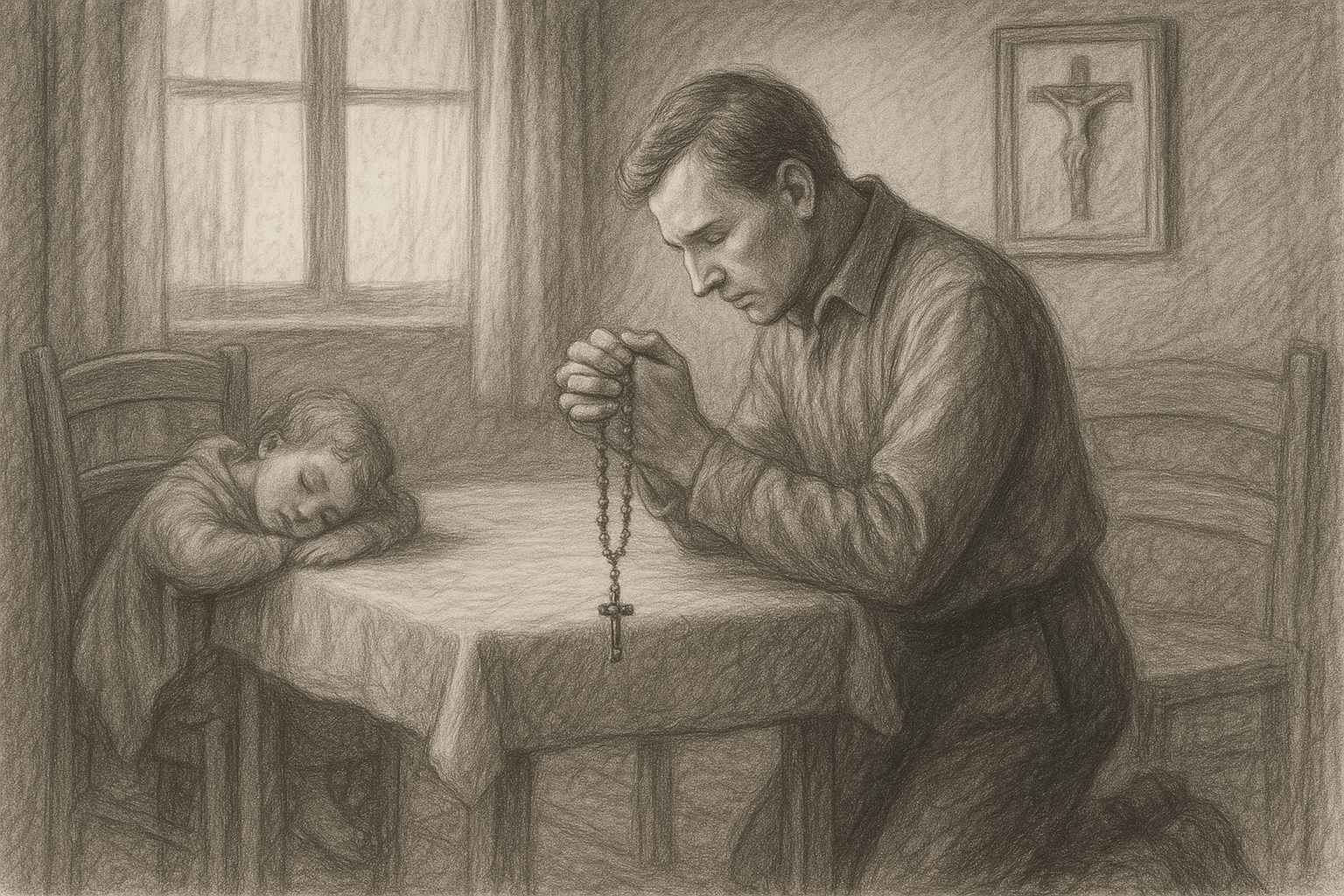
Prayer, too, is indispensable. Even a brief prayer before work, before meals, or before a hard conversation can reshape the atmosphere of a home. Fathers do not need elaborate formulas to begin. They need honesty before God. A simple prayer such as,
Keep Reading on Lets Read The Bible
Frequently Asked Questions
What does the Catholic Church mean by fatherhood as a vocation?
The Church teaches that fatherhood is more than a social role. It is a vocation of service, protection, formation, and sacrificial love in which a father helps lead his family toward God.
How can a father live the fatherhood Catholic perspective if he feels inadequate?
By starting with fidelity rather than perfection. Prayer, the sacraments, honest repentance, and small daily acts of love can slowly form a man into a more steady and Christlike father.
Why is St. Joseph important for fathers?
St. Joseph shows that true fatherhood is often quiet, obedient, and protective. He cared for Jesus and Mary with courage and humility, making him a lasting model for Catholic fathers.