Family and Vocation
St. Joseph and the Patience of Fatherhood
A reflection on quiet authority, entrusted love, and the kind of fatherhood that learns to listen before it leads.
Site Admin | October 31, 2025 | 85 views
St. Joseph stands before the Church as a man of remarkable silence and real authority. Scripture records no spoken word from him, yet his presence shapes the earliest years of Jesus' earthly life in a way that still speaks to fathers, mothers, and anyone discerning a vocation of service. The fatherhood of St. Joseph reflection begins here: not with self-assertion, but with receptivity to God, and then with action. Joseph listens, rises, and obeys.
The Gospels present him as a just man, one who belongs wholly to God without drawing attention to himself. When he learns that Mary is with child, he does not react with cruelty or self-protection. Instead, he receives a message from God in a dream and takes Mary into his home Matthew 1:20. That moment reveals something essential about fatherhood in the Catholic imagination. A father is not first a manager of appearances. He is a guardian of life entrusted to him by God.
Joseph's Fatherhood Begins in Obedience
Joseph's role in salvation history is often described as hidden, but hidden does not mean small. In fact, the hiddenness of his life may be part of its greatness. He is asked to receive what he did not plan, protect what he did not create, and serve a mystery larger than himself. This is true fatherhood in a fallen world: not ownership, but stewardship.
In the infancy narratives, Joseph repeatedly acts when God asks. He takes Mary as his wife Matthew 1:24. He names the child Jesus, which in biblical terms is a sign of legal and paternal responsibility Matthew 1:25. He rises at night to flee into Egypt when Herod's violence threatens the Child Matthew 2:13. He returns when it is safe Matthew 2:19-20. Each step is simple, but each one is costly. Joseph does not wait for perfect conditions before he obeys.
Many fathers know the temptation to believe that leadership means always having the right words or a complete plan. Joseph suggests another path. He leads by fidelity. He does what needs to be done. He makes room for God's plan to unfold in his home. That is not passive fatherhood. It is disciplined courage.
The Strength of a Father Who Protects
One of the most moving features of Joseph's life is his protection of Mary and Jesus. He is entrusted with a family marked by mystery, vulnerability, and danger. The Child he cares for is the promised Messiah, yet He arrives in poverty and grows under ordinary dependence. Joseph's work, then, is not ornamental. It is protective love in action.
In Catholic life, fatherhood is never only biological. It includes the duty to shelter, provide, and guard what is fragile. This is true in the home, but also in spiritual life. A father protects by keeping watch over the tone of a household, by choosing integrity when compromise would be easier, and by refusing to let fear become the loudest voice in the room. Joseph does all of this quietly. He is strong without domination.
That strength matters because the world often misunderstands gentleness. Joseph is not weak because he is silent, and he is not timid because he trusts God. He shows that a man can be firm without being harsh. He can be tender without being sentimental. He can be decisive without being controlling. These are not contradictions. They are marks of sanctified masculinity.
Joseph's life teaches that love is measured not by visibility, but by faithfulness.
Fatherhood as Presence in Ordinary Time
Most of Joseph's life is hidden from us. We are not given a long biography, heroic speeches, or family stories. We are given enough to understand the pattern: he remained present. That presence is not trivial. In a home, children do not only need instructions. They need a father who is there, who pays attention, who makes steady sacrifices, and who is not absent in body or heart.
Catholics can find in Joseph a model for the ordinary seasons of family life, when love is expressed in errands, repairs, meals, patient conversations, and quiet endurance. Such acts can seem small, but they form the daily texture of a home. The holiness of Joseph reminds us that vocation is not only lived in dramatic moments. It is lived in repeated yeses.
This is where the fatherhood of St. Joseph reflection becomes especially practical. A father may never face an angel in a dream, but he does face decisions that require trust. He may not be called to flee into Egypt, but he is called to choose what protects his family spiritually and morally. He may not be remembered by the world, but he can still become the steady center of a home. Joseph dignifies these hidden labors.
Joseph and the Language of Trust
Joseph's trust in God is not abstract. It is embodied in movement, work, and surrender. He does not cling to control when God redirects his path. He trusts the Lord with his family, his future, and his reputation. That trust is difficult because fatherhood naturally awakens a desire to secure outcomes. Yet the Gospel shows that the deepest security does not come from control. It comes from belonging to God.
The Church has long honored St. Joseph as protector of the Church and patron of fathers, workers, and families. This devotion is not sentimental decoration. It recognizes that Joseph's life reveals how God's providence often works through hidden men and women who perform their duties faithfully. In Joseph, believers see that trust is not the opposite of responsibility. Trust is what makes responsibility bear fruit.
For fathers today, this can mean praying before reacting. It can mean listening before correcting. It can mean remembering that children are not projects to complete but persons to accompany. Joseph never appears as one who competes with God's fatherhood. Instead, he cooperates with it. That is why he is so useful as a guide for Christian fathers. He shows how a man can exercise authority without claiming the place that belongs to the Father in heaven.
Three habits Joseph encourages in daily life
- Pray before you decide. A brief prayer can slow impulse and open the heart to God's will.
- Protect what is entrusted to you. This includes not only material needs, but also the moral and spiritual atmosphere of the home.
- Stay present in the small things. Ordinary faithfulness often shapes a family more deeply than rare grand gestures.
What Joseph Teaches About Work and Responsibility
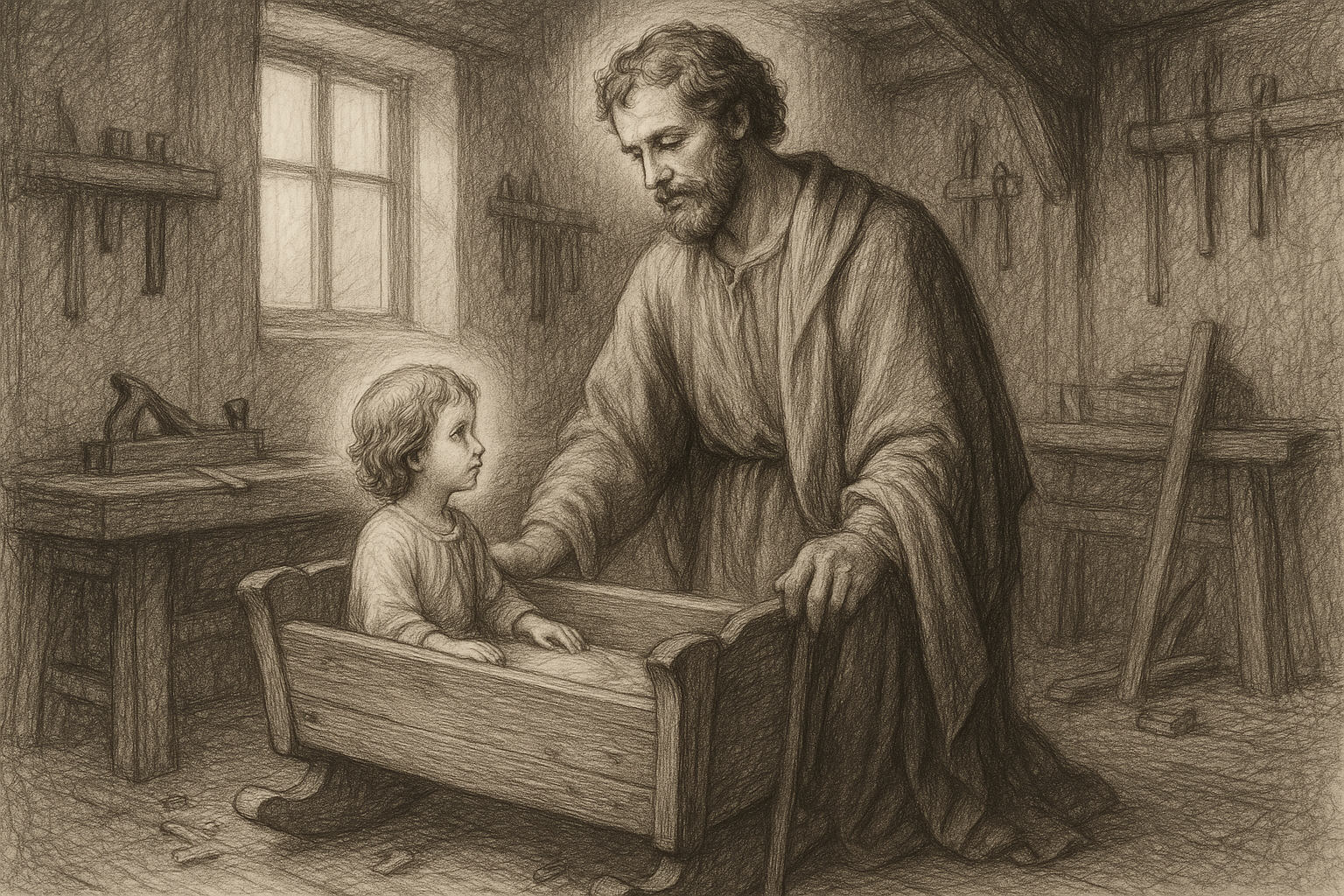
Joseph is remembered as a carpenter, or more broadly as a working man who supported his household through honest labor. His work matters because Catholic faith does not separate holiness from ordinary human effort. Work can become a place of sanctification when it is offered to God in love.
For many believers, labor is tied to fatigue, pressure, and the fear of not doing enough. Joseph speaks directly to that anxiety. He shows that work is not only about achievement. It is also about service. The value of labor lies not merely in what it produces, but in whom it serves. Joseph's hands built, repaired, and provided, all within the hidden rhythm of a holy family.
There is a sober beauty in that image. A father may be exhausted at the end of the day and still have done something deeply sacred by showing up, earning honestly, and giving himself for others. Joseph sanctifies that kind of hidden offering. He reminds the Church that a man's work can become a form of love when it is joined to obedience and prayer.
Learning to Receive Fatherhood from God
Not every reader will be a father in the natural sense. Some are single, some are consecrated, some are widowed, and some carry wounds from broken family relationships. Yet Joseph remains relevant to all, because his fatherhood is first a gift received from God. He did not invent his mission. He accepted it.
That makes Joseph a companion for anyone who must care for another person or accept responsibility beyond what was expected. He is a friend to foster parents, adoptive parents, spiritual fathers, godparents, teachers, and mentors. He is also a consoling presence for those who feel they have failed in family life. Joseph's holiness does not erase human uncertainty. It reveals that God can work through humble surrender.
When Christians ask for Joseph's intercession, they are not escaping the demands of discipleship. They are asking for help to live it more fully. His example invites believers to become dependable, prayerful, and ready to receive God's word even when it comes in darkness. The man who rose in the night to save the Child is still teaching the Church how to answer grace promptly.
To honor St. Joseph is to honor the kind of fatherhood that makes room for God, and then keeps showing up.
In a culture that often confuses authority with self-display, Joseph offers another vision. He teaches that a father can be strongest when he is most surrendered to God. He teaches that love can be quiet and still change history. And he teaches that the hidden life, if lived in faith, is never hidden from the Father who sees in secret.
For anyone trying to live the fatherhood of St. Joseph reflection in an ordinary home, the invitation is simple and demanding: listen, trust, protect, and remain. These are not small things. They are the shape of love when it is given to God.
Keep Reading on Lets Read The Bible
Frequently Asked Questions
Why is St. Joseph considered a model for fathers?
St. Joseph is a model for fathers because he protected Mary and Jesus, obeyed God's direction, and carried out his responsibilities with quiet fidelity. His fatherhood shows that true leadership is rooted in service, trust, and sacrifice.
What can ordinary Christians learn from St. Joseph if they are not fathers?
Even those who are not fathers can learn from Joseph's obedience, humility, and steadiness. He is a model for anyone who must care for others, accept responsibility, or discern God's will in daily life.
How can Catholics imitate St. Joseph in family life?
Catholics can imitate St. Joseph by praying before making decisions, protecting the moral life of the home, remaining present in ordinary duties, and trusting God when family life feels uncertain or demanding.