Family and Vocation
St. Joseph and the Quiet Strength of Fatherhood
What the foster father of Jesus reveals about authority, tenderness, sacrifice, and grace in family life
Site Admin | October 30, 2025 | 77 views
St. Joseph and the Shape of a Father's Heart
When Catholics think about fatherhood, St. Joseph often stands apart from every human expectation. He speaks no recorded words in the Gospels, yet his silence is not emptiness. It is the silence of a man who listens, acts, protects, and remains. In the fatherhood of St. Joseph Catholic perspective, that hidden life becomes a steady light for families that wonder what faithful fatherhood really looks like.
Joseph is called a righteous man in Scripture, and that small phrase carries great weight. In Matthew's Gospel, he learns that Mary is with child, and before he can fully understand the mystery before him, he receives God's word in a dream: do not be afraid to take Mary into your home, for the child conceived in her is from the Holy Spirit Matthew 1:20. Joseph rises, obeys, and enters a vocation larger than anything he could have planned.
That is one of the first lessons Joseph gives the Church. Fatherhood is not merely biological authority or social responsibility. It is a vocation of self-gift. It means receiving life as a trust, not a possession. It means guarding what is not one's own, yet loving it as if it were the center of one's whole heart.
Fatherhood as Protection, Presence, and Obedience
Joseph's fatherhood is revealed not in speeches but in decisions. He takes Mary as his wife. He leads the Holy Family to Bethlehem. He shelters the child Jesus from Herod's violence. He brings the family to Egypt. He returns when the danger passes. Again and again, Joseph answers God's call through concrete, ordinary action.
This matters because many fathers feel pressure to measure success by visibility. They are told they must be impressive, financially secure, emotionally polished, and always sure of themselves. Yet the Scriptures present Joseph as a man whose greatness is hidden beneath obedience. He does not seek a platform. He seeks the good of his family and the will of God.
That does not make Joseph passive. On the contrary, his quietness is active. He moves when God speaks. He protects when danger comes. He provides by laboring with his hands. He remains when endurance is needed. Christian fatherhood is often like this: not dramatic, but steadfast; not flashy, but faithful.
Fatherhood is not first a performance. It is a daily yes to the protection, guidance, and good of those entrusted to one's care.
In this light, Joseph offers relief to men who feel they must be perfect before they can be good fathers. The Church does not ask fathers to be flawless. She asks them to be faithful. Grace does not erase weakness, but it strengthens fidelity in the middle of weakness.
What Joseph Teaches About Authority
Modern culture can struggle with authority. Some see it as control, and others as something to avoid. Joseph shows a different pattern. His authority is real, but it is ordered to love. He does not dominate Mary and Jesus. He serves them. He does not make himself the center of the home. He places himself at the service of God's plan.
This is deeply Catholic. Authority in the home is never meant to be a mirror of pride. It should resemble Christ, who teaches that the greatest among us must be the servant of all. A father's authority is at its best when it protects peace, encourages virtue, and helps each person in the household flourish according to God's call.
Joseph's authority also rests on trust. He trusts the word of the angel. He trusts the mystery unfolding in Mary. He trusts that God will guide what he cannot fully see. Many fathers know the ache of wanting certainty before taking a step. Joseph teaches that obedience often comes before full understanding.
That is hard for anyone, but especially for fathers who want to provide answers for their children. There will be moments when a father cannot explain everything, cannot remove every fear, and cannot guarantee every outcome. Joseph stands in that space and shows that a man can still lead with integrity by remaining close to God and close to his family.
Joseph, Work, and the Ordinary Life of Holiness
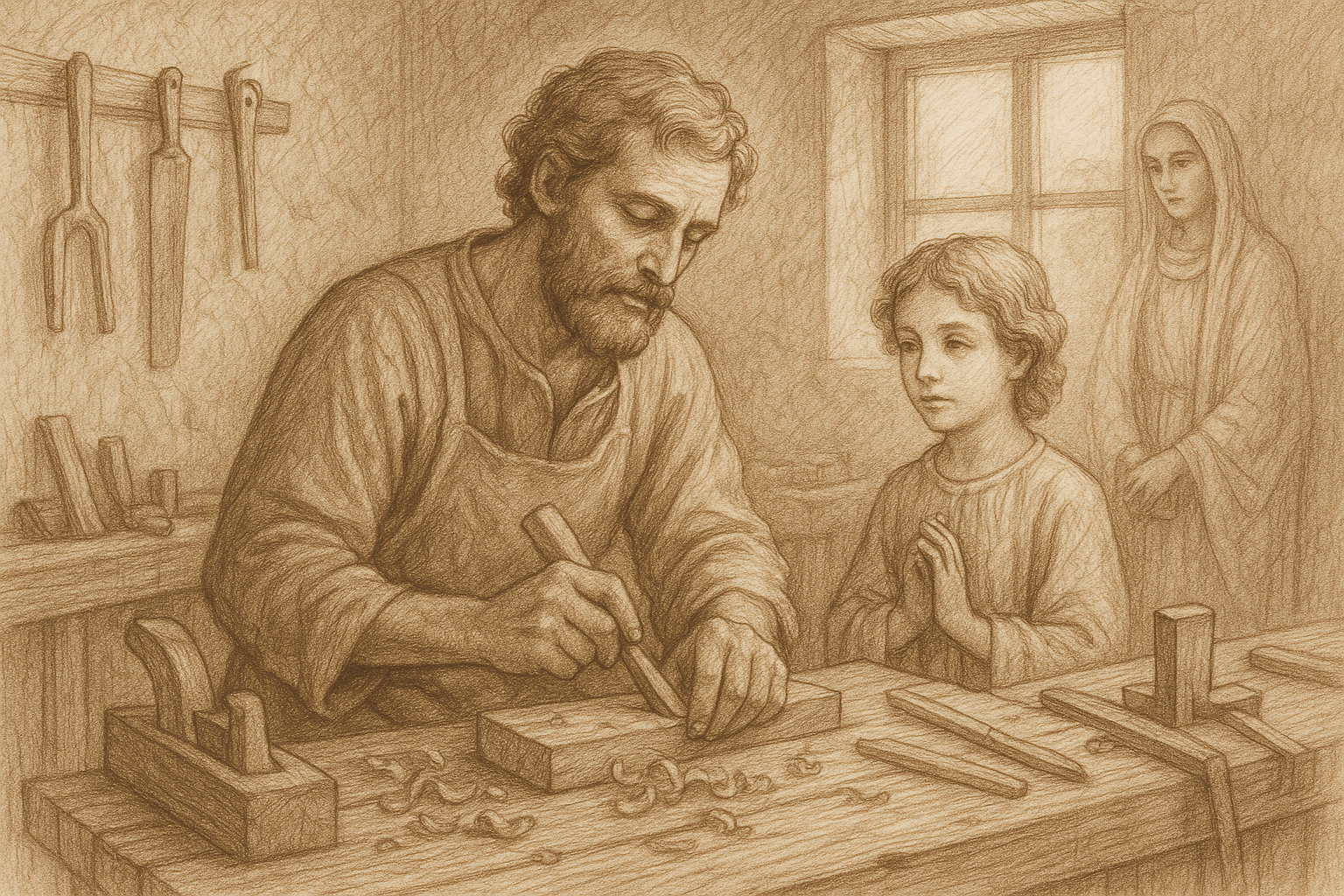
Tradition remembers Joseph as a carpenter, a craftsman who earned the family's daily bread by ordinary labor. The Gospels do not romanticize this work, but Catholic faith honors it. Hidden labor can be holy. Repetition can be holy. Providing for a family through patient work can be holy when it is offered to God with love.
This is one reason so many fathers find Joseph so approachable. He knows the weight of daily responsibility. He knows the ache of tired hands and the pressure of making enough for those who depend on you. He knows what it is to work without applause. He knows what it is to carry duty quietly.
In an age that often rewards image over substance, Joseph reminds us that holiness is not reserved for the spectacular. It can grow in a workshop, in a kitchen, in an unfinished house, in the middle of errands, bills, and long nights. The father who shows up day after day, even when he feels unnoticed, is not living beneath the Gospel. He may be living very near it.
For fathers who struggle with discouragement, Joseph offers a sober and consoling truth: your work is not wasted if it is done in love. When a father provides, repairs, teaches, and endures for the sake of his family, he participates in a hidden pattern of grace. He is not only earning a living. He is forming a home.
The Tenderness of a Strong Father
Some imagine St. Joseph mainly as strong, but not tender. Catholic devotion refuses that split. True strength and true tenderness belong together. A father who is only strong may become harsh. A father who is only gentle may become uncertain. Joseph shows a third way: firm care shaped by reverence.
Consider how he must have watched over Jesus as a child. He would have taught Him to work, to pray, to live within the rhythms of Israel's faith. He would have accompanied Mary and Jesus to the temple and the synagogue. He would have helped create the human environment in which the Son of God grew in wisdom and age and favor before God and man Luke 2:52. The mystery is immense. The Creator entered a family, and Joseph was given a father's role within it.
This offers a beautiful Catholic insight into family life. Children do not only learn through instruction. They learn through the atmosphere of the home. They absorb how adults speak, forgive, labor, and pray. Joseph's fatherhood likely formed Jesus through countless ordinary acts that no one recorded. That hidden influence matters. It tells fathers that presence itself is formative.
It also tells families that tenderness is not weakness. A father who listens well, blesses often, apologizes honestly, and corrects with patience is not less masculine. He is more fully what fatherhood was meant to be.
When Fatherhood Feels Hard
Many men do not encounter fatherhood as an ideal. They encounter it through exhaustion, regret, absence, or fear. Some are trying to be good fathers after never having seen a good father modeled clearly. Some carry guilt over lost time, harsh words, or spiritual indifference. Some long to be fathers and cannot be. Others are raising children in difficult circumstances that test their patience every day.
Joseph speaks to these struggles because his own path was not simple. He faced uncertainty before Jesus' birth. He had to protect his family from violence. He lived with long stretches of hidden labor and likely many unanswered questions. The Holy Family did not live in ease. Yet God was with them in every turn.
This is where Catholic hope becomes practical. Grace does not only console after the fact. It works in the moment. A father who prays before answering, who returns to confession after failure, who blesses his children even when he feels inadequate, is already cooperating with grace. The life of Joseph invites a man to keep going without pretending everything is easy.
There is also comfort here for those who feel the wound of fatherhood from the other side, especially those who have known neglect or absence. Joseph does not replace every human wound, but he reveals what fatherhood ought to mean. In him, the Church can glimpse fatherly care that is protective, just, and faithful. Devotion to St. Joseph can become a healing school for trust in God's own care.
Living Joseph's Fatherhood Today
What does it look like to receive this vision in daily life? It begins with small, concrete habits. Pray before making difficult decisions. Keep your promises. Learn to say
Keep Reading on Lets Read The Bible
Frequently Asked Questions
Why is St. Joseph important for Catholic fatherhood?
St. Joseph is important because he shows that true fatherhood is rooted in faithful presence, protection, obedience to God, and quiet self-gift. He is the foster father of Jesus and a model for how men can serve their families with humility and strength.
What can fathers learn from St. Joseph in everyday life?
Fathers can learn to lead without dominating, to provide without resentment, and to remain steady in difficult circumstances. Joseph teaches that ordinary work, patient listening, and trust in God can become real acts of holiness.
How can someone pray with St. Joseph if fatherhood feels difficult?
A simple prayer asking St. Joseph for patience, courage, and purity of heart is a good place to begin. Many people also pray for the grace to be faithful in small duties, to protect their families well, and to trust God's plan even when it is not fully clear.