Sacraments and Liturgy
From Hosanna to the Empty Tomb: Walking the Sacred Days of Holy Week
The Church enters the saving mystery of Christ through palms, silence, the Cross, and the joy of Easter night.
Site Admin | September 4, 2026 | 72 views
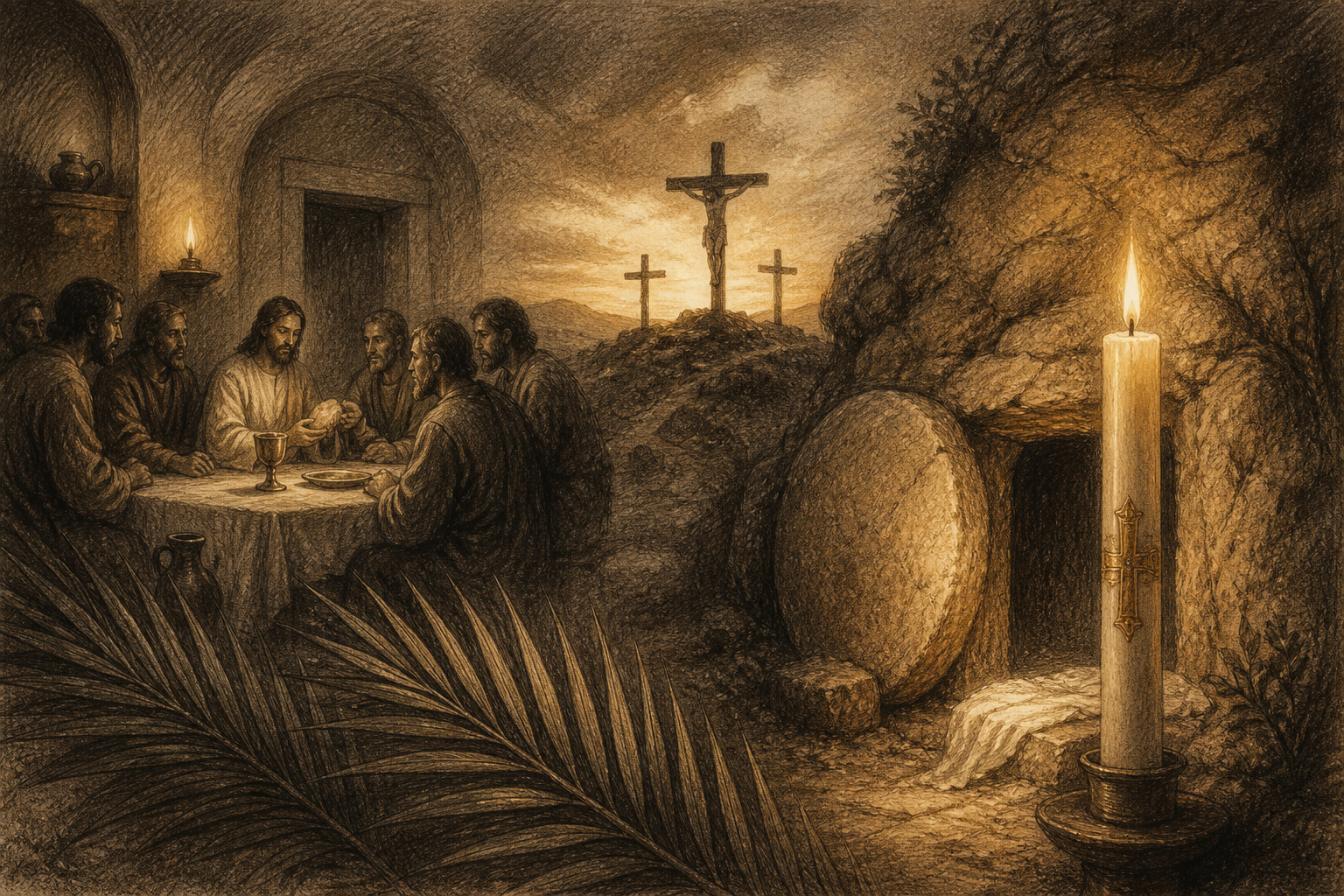
Holy Week is unlike any other week in the Church's year. Its liturgies carry us from the cheering crowds of Jerusalem to the Upper Room, from Gethsemane to Calvary, and finally to the light of the empty tomb. The pace is deliberate. Joy gives way to sorrow, sorrow deepens into silence, and silence opens into Easter praise.
For Catholics, this is not simply an annual review of events from the distant past. In the liturgy, the Church remembers Christ's saving work in a way that makes its grace present to his people. We do not pretend that Jesus is being crucified again, nor do we merely stage a historical reenactment. We enter sacramentally into the one Paschal Mystery of his Passion, Death, and Resurrection.
Holy Week is best explained by participating in it. Even so, understanding the shape of the week can help us pray its liturgies with greater attention and receive their graces more fruitfully.
The shape of the Church's holiest week
Holy Week begins with Palm Sunday of the Passion of the Lord. The first part of the liturgy recalls Christ's entrance into Jerusalem, when the crowd welcomed him with branches and cries of praise. The Gospel tells us that the people acclaimed him as the one who came in the name of the Lord: Matthew 21:9.
The mood changes sharply when the Passion is proclaimed. The King who enters Jerusalem in humility will reign from the Cross. Palm Sunday therefore holds triumph and suffering together. It prevents us from seeking the glory of Easter while avoiding the path by which Christ reached it.
The days that follow lead toward the Sacred Paschal Triduum. The Triduum begins with the Evening Mass of the Lord's Supper on Holy Thursday. It continues through Good Friday and Holy Saturday, reaches its summit in the Easter Vigil, and concludes with Evening Prayer on Easter Sunday. Although these celebrations take place across several calendar days, they form one great liturgical movement.
How these observances developed
Christians have commemorated the Lord's Death and Resurrection from the earliest generations of the Church. Sunday itself became the weekly celebration of the Resurrection, while the annual Christian Passover developed as the central feast of the liturgical year.
By the fourth century, Christians in Jerusalem were observing the final days of Christ's earthly life with processions, Scripture readings, prayer, and worship at places associated with the Gospel accounts. The pilgrim Egeria left an important description of these observances. Over time, local customs developed into the Holy Week rites known throughout the wider Church.
The forms have changed across the centuries, but the center has remained the same: Jesus Christ, the true Paschal Lamb, gives himself for the life of the world. As St. Paul teaches, Christ our Passover has been sacrificed: 1 Corinthians 5:7.
Palm Sunday: receiving the humble King
The blessed palms carried on Palm Sunday are sacramentals. They direct our attention toward Christ and dispose us to receive grace, but they are not charms or objects of superstition. Many Catholics place a blessed palm near a crucifix or sacred image at home. Because it has been blessed, a palm should be treated reverently. Depending on local parish practice, an old palm may be returned to the parish, burned, or buried rather than placed casually in the trash.
The deepest question of Palm Sunday concerns discipleship. It is easy to praise Christ when the crowd is celebrating. It is harder to remain near him when fidelity becomes costly. The Passion invites us to recognize ourselves in the apostles, the frightened bystanders, the repentant thief, and the faithful women who did not abandon the Lord.
Monday through Wednesday: staying close to Christ
The first weekdays of Holy Week can feel quiet compared with the Triduum, but they are not empty. The Mass readings draw the Church more deeply into the events preceding the Passion. They include the anointing at Bethany, Christ's foretelling of betrayal, and Judas's agreement to hand him over.
These days are well suited to a careful examination of conscience. Judas's betrayal did not begin with the exchange of silver. Sin grows through smaller refusals of truth, love, and repentance. Holy Week asks us to bring such refusals into the light of Christ.
Where possible, receiving the Sacrament of Reconciliation before the Triduum can be a fitting preparation for Easter. Parish schedules vary, so Catholics should check confession times in advance rather than assume that the sacrament will be available immediately before a major liturgy.
In many dioceses, the bishop also celebrates the Chrism Mass during Holy Week, though pastoral circumstances sometimes require another nearby date. At this Mass, the sacred oils are blessed or consecrated for sacramental use, and priests renew the promises associated with their ministry. The celebration visibly expresses the unity of the local Church around its bishop.
Holy Thursday: love given as food and service
The Evening Mass of the Lord's Supper commemorates Christ's Last Supper with his apostles. The Church gives particular attention to the institution of the Eucharist, the ministerial priesthood, and the commandment of fraternal charity.
St. Paul preserves the tradition that the Lord took bread, gave thanks, broke it, and identified it with his Body: 1 Corinthians 11:24. Catholics believe that Christ is truly present in the Eucharist, not merely recalled as an absent figure. At every Mass, the one sacrifice of Calvary is made sacramentally present, and the faithful are invited into communion with the Lord who gives himself completely.
The washing of feet, when included, recalls Jesus kneeling before his disciples. He tells them that he has given them an example to follow: John 13:15. Eucharistic devotion cannot be separated from humble love. To receive the Body of Christ while refusing mercy, service, or reconciliation would contradict the gift placed in our hands.
After Communion, the Blessed Sacrament is carried in procession to a place of repose. The faithful may remain in adoration, recalling Christ's prayer in Gethsemane and his request that the disciples keep watch with him: Matthew 26:38. The altar is then stripped, and the church takes on an increasingly stark appearance.
Good Friday: standing beneath the Cross
Good Friday is the one day in the liturgical year when Mass is not celebrated. The Church gathers instead for the Celebration of the Passion of the Lord. Its principal parts are the Liturgy of the Word, the Solemn Intercessions, the Adoration of the Holy Cross, and Holy Communion using hosts consecrated previously.
The liturgy begins in silence. The priest and deacon prostrate themselves, while the people kneel. This gesture expresses grief, humility, and worship before the mystery of redemption. The Passion according to John presents Christ not as a helpless victim of circumstance but as the Lord who freely gives his life. Jesus says that his kingdom is not of this world: John 18:36.
During the veneration of the Cross, Catholics do not worship wood. They honor the instrument upon which the Son of God offered himself for our salvation. A bow, genuflection, touch, or kiss is directed toward Christ and his saving sacrifice.
The Solemn Intercessions widen our prayer beyond personal concerns. The Church prays for her members, Christian unity, the Jewish people, those who do not believe in Christ, civil authorities, and all who suffer. At the Cross, the needs of the whole world are gathered into Christ's self offering.
For Latin Catholics who are able, Good Friday is a required day of fasting and abstinence according to the Church's discipline. Those whose age, health, pregnancy, work, or other serious circumstances affect fasting should follow the Church's provisions with prudence rather than treat bodily harm as a spiritual achievement. The purpose of fasting is conversion, solidarity, and deeper hunger for God.
Holy Saturday and the great Easter Vigil
During the daylight hours of Holy Saturday, the Church remains near the tomb. Mass is not celebrated, and the sacraments are ordinarily not celebrated apart from particular pastoral necessities. This quiet is not despair. Christ has truly died, yet the Church waits in hope.
Holy Saturday can easily become consumed by travel, cooking, decorating, and other preparations. These may be good and necessary, but preserving even a short period of silence helps the day retain its character. Prayer with Mary, who remained faithful through the Passion, is especially fitting.
After nightfall, the Easter Vigil begins. It opens with the blessing of the new fire and the preparation of the Paschal candle. As the candle enters the darkened church, its light spreads from person to person. The symbolism is direct and powerful: the risen Christ scatters the darkness of sin and death. The prologue of John's Gospel declares that the light shines in the darkness and is not overcome: John 1:5.
The Liturgy of the Word unfolds the story of salvation, from creation and the deliverance of Israel to the promises of the prophets and the proclamation of the Resurrection. The Church listens patiently because Easter cannot be separated from everything God has done to prepare a people for Christ.
The baptismal liturgy follows. Catechumens may receive Baptism, Confirmation, and the Eucharist, while the whole assembly renews baptismal promises. The Vigil then reaches its summit in the Eucharist. After the restraint of Lent, the Alleluia returns, and the Church announces that the crucified Lord has risen.
Practical ways to participate more faithfully
No one earns the grace of Holy Week by creating a perfect schedule. Family duties, illness, disability, work, distance, and caregiving can limit attendance. Faithful participation begins by receiving the circumstances of life honestly and offering them to God. Within those circumstances, several practices can help.
- Read the parish schedule early. Holy Week liturgies often begin at unusual times, and the Easter Vigil must begin after nightfall.
- Attend the principal liturgies when possible. Palm Sunday Mass, the Evening Mass of the Lord's Supper, the Good Friday celebration, and the Easter Vigil each reveal a distinct part of the Paschal Mystery.
- Prepare with Scripture. Reading the Passion narratives slowly before the liturgies can make their proclamation more attentive and personal.
- Make room for confession. If you are conscious of grave sin, seek sacramental reconciliation before receiving Holy Communion. Even when grave sin is not present, confession can renew the heart for Easter.
- Reduce unnecessary noise. Limit entertainment, shopping, and digital distraction, especially from Holy Thursday evening through Holy Saturday.
- Practice concrete charity. Forgive an injury, visit someone lonely, give to those in need, or serve quietly at home. The Lord's command to love must take flesh in daily life.
- Arrive with time to settle. Coming early allows the mind and body to become still before the liturgy begins.
- Do not rush away. A few moments of prayer afterward can help the Word, gestures, and silence enter more deeply into the heart.
Those unable to attend can still unite themselves spiritually to the Church through prayer, the daily readings, the Rosary, the Stations of the Cross, or a reverent broadcast of the liturgy. Watching remotely is not the same as being physically present, but it can be a genuine aid to prayer when attendance is impossible.
Letting the liturgy set the pace
Holy Week does not ask us to manufacture intense emotions. It asks us to remain with Christ. At times our prayer may feel fervent; at other times it may seem distracted, tired, or dry. Fidelity is more important than emotional intensity.
The sacred liturgies teach us how to stay: waving palms without mistaking popularity for faith, kneeling at the Eucharist, watching in the garden, venerating the Cross, waiting beside the tomb, and receiving the light of the risen Lord. If we allow the Church to set the pace, Holy Week becomes more than a crowded sequence of services. It becomes a pilgrimage with Jesus, who loved his own to the end: John 13:1.
Keep Reading on Lets Read The Bible
Frequently Asked Questions
When does Holy Week begin and end?
Holy Week begins with Palm Sunday of the Passion of the Lord. The Sacred Paschal Triduum begins on Holy Thursday evening, reaches its high point at the Easter Vigil, and concludes with Evening Prayer on Easter Sunday.
Is the Good Friday service a Mass?
No. Mass is not celebrated on Good Friday. Catholics gather for the Celebration of the Passion of the Lord, which includes the Liturgy of the Word, the Solemn Intercessions, the Adoration of the Holy Cross, and Holy Communion with hosts consecrated previously.
Must Catholics attend every Holy Week liturgy?
The Holy Thursday and Good Friday liturgies are deeply important but are not generally holy days of obligation. Catholics are obliged to participate in Mass on Sundays and holy days according to Church law. The Easter Vigil fulfills the Easter Sunday obligation, but Catholics should not attend both merely from obligation. Those able to participate in the Triduum are strongly encouraged to do so.