Social Teaching
Hands, Hours, and the Image of God
Catholic social teaching begins not with productivity, but with the person who works.
Site Admin | October 4, 2026 | 5 views
Work occupies a large part of human life. It shapes our schedules, supports our families, tests our patience, and gives many people a sense of purpose. It can also become a source of anxiety, exhaustion, injustice, or shame. Some people are overworked. Others are unable to find stable employment. Still others perform necessary labor that is barely noticed because it takes place in a home, a field, a hospital room, or behind a counter.
Catholic teaching approaches these realities with a simple but demanding conviction: work exists for the human person, not the human person for work. A job has economic value, but the worker has a dignity that cannot be priced. This distinction is central to work and the dignity of labor and Catholic life. It changes how employers exercise authority, how employees perform their duties, how families make decisions, and how communities judge economic success.
The worker comes before the work
Human dignity does not begin with employment. It begins with creation. Every person is made in the image and likeness of God, as Scripture declares in Genesis 1:27. That dignity belongs equally to the executive and the apprentice, the farmer and the teacher, the person seeking work and the person whose illness prevents employment.
This is why Catholic social teaching does not measure a human being by wages, credentials, productivity, or social rank. These may describe part of a person's earthly circumstances, but they do not establish personal worth. The elderly man who can no longer work remains fully human. The mother caring for children without a salary performs real and valuable labor. The worker with a disability is not less worthy because a workplace must make accommodations. A person who has lost a job has lost income and security, but not dignity.
Work has dignity because it is performed by a person. It does not grant dignity as though human worth were a benefit included in a contract. This principle protects us from treating workers as replaceable units of production. It also protects us from making our own occupation into an idol.
Work belongs to the human vocation
The Book of Genesis presents human labor as part of our vocation before it presents labor as toil. The human person is placed in the garden to cultivate and care for it in Genesis 2:15. Work, in its proper form, is participation in the wise stewardship of creation.
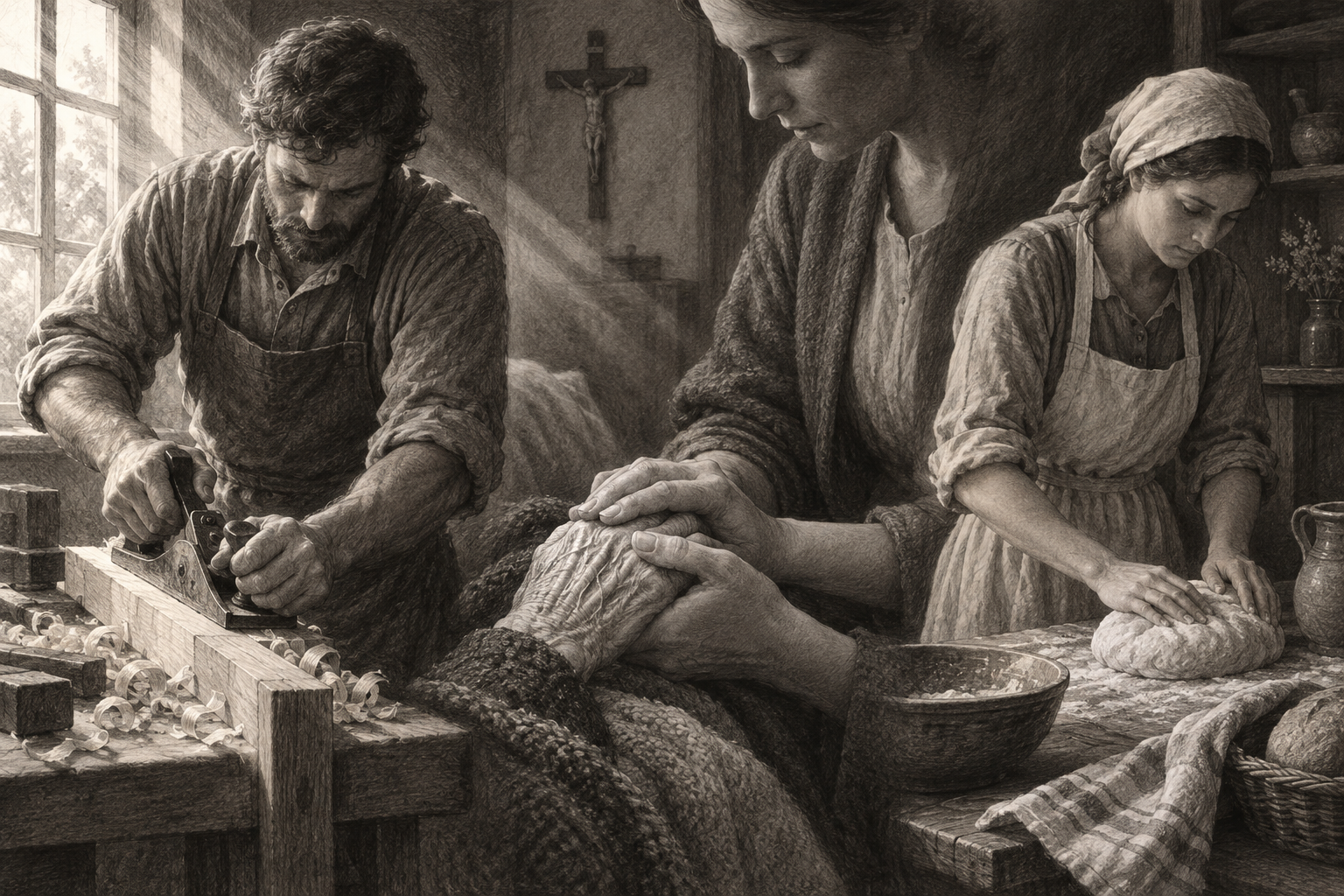
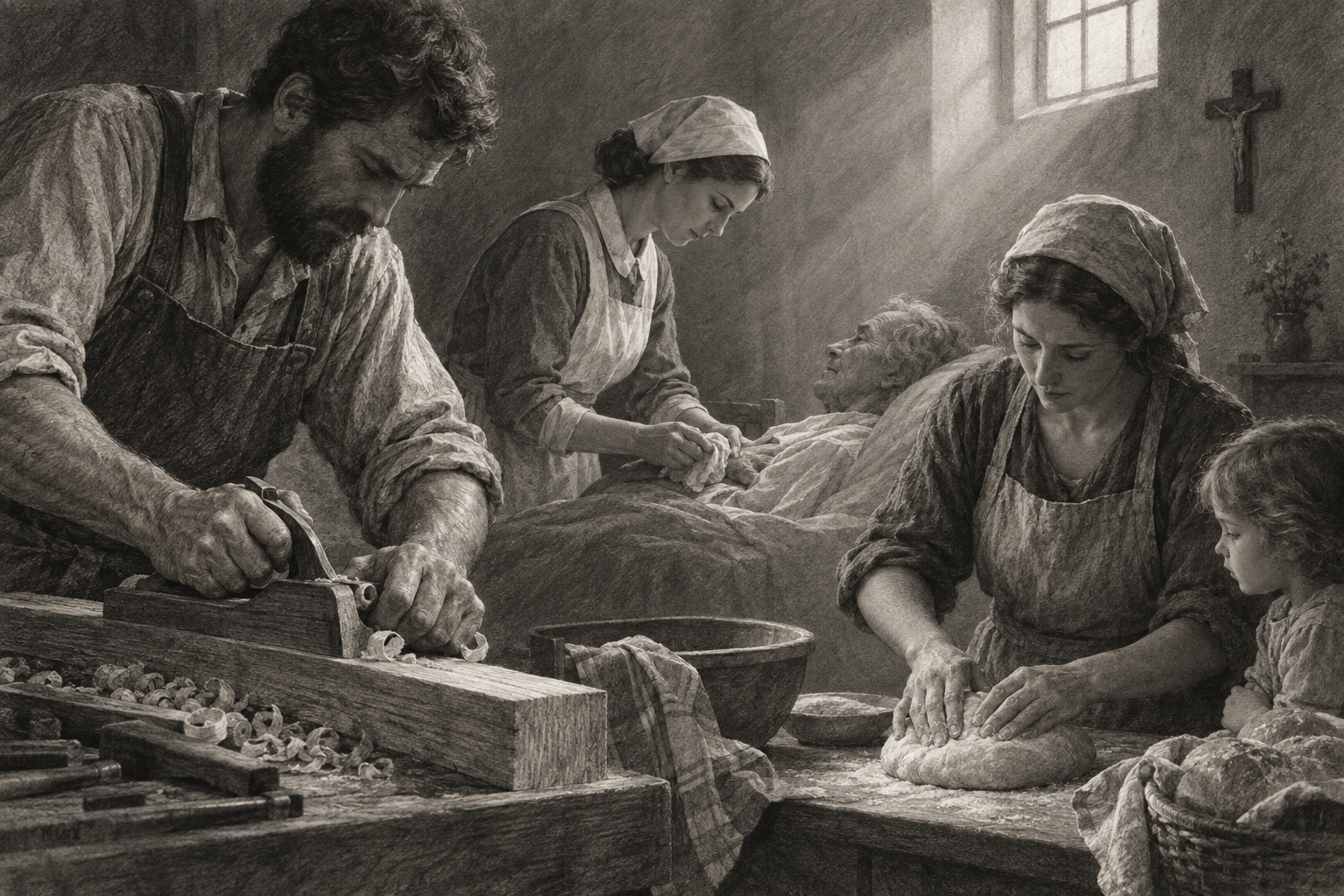
Through work, people develop skills, provide useful goods and services, support dependents, and contribute to the common good. A carpenter shapes materials into shelter. A nurse tends the sick. A sanitation worker protects public health. A bookkeeper brings order to records. A parent prepares a meal and teaches a child. Different forms of labor have different conditions and levels of responsibility, but honest work can become an expression of service.
Work also forms the worker. It can teach perseverance, cooperation, attention, humility, and responsibility. Saint Paul urges Christians to carry out their duties wholeheartedly, as service offered to the Lord, in Colossians 3:23. This does not mean every workplace demand is holy or that an employer may claim unlimited obedience. It means ordinary duties can be offered to God when they are morally good and performed with integrity.
Sin has wounded the experience of labor. Work may involve frustration, rivalry, exploitation, fatigue, or failure. Yet labor itself is not a punishment. Grace does not always remove its difficulty, but it can transform honest effort into an act of love.
Wages are a matter of justice
A wage is not merely the lowest amount an employer can persuade someone to accept. Catholic teaching has long insisted that compensation should be judged in relation to the worker's needs, responsibilities, and participation in the life of society. Economic circumstances are complex, and not every employer controls every condition. Even so, the basic moral question remains: are workers being treated as persons or merely as costs?
Scripture speaks sharply about withheld wages. James describes the unpaid wages of laborers as crying out to God in James 5:4. The language is forceful because wage theft is not a minor bookkeeping problem. It takes from a person who has already given time and effort that cannot be recovered.
Justice at work includes more than a paycheck. It involves reasonable safety, truthful contracts, freedom from harassment, time for worship and family duties, and respect for the worker's health. Catholic social teaching also recognizes the right of workers to associate for the defense of their legitimate interests. Such associations must pursue justice responsibly, but workers should not be isolated when facing powers much greater than their own.
Employers carry serious obligations, yet employees also have duties. A worker should provide the labor that was honestly agreed upon, avoid theft and deception, respect colleagues, and use entrusted resources responsibly. Catholic teaching does not place one class beyond moral accountability. It calls everyone involved in economic life to charity and justice.
Profit is necessary, but not supreme
A business must ordinarily remain financially sound if it is to employ people and serve customers. Profit can indicate that resources are being used effectively. It is not automatically a sign of greed. Problems arise when profit becomes the only measure of success.
A profitable system can still be unjust if it depends on dangerous conditions, fraudulent practices, degrading treatment, or the desperation of people who have no realistic alternative. Efficiency can be good, but it does not excuse cruelty. New technology can relieve drudgery and improve safety, but its effects on workers should be considered rather than dismissed as irrelevant.
Leaders often face decisions without perfect solutions. A struggling business may not be able to preserve every position. A family may have to accept work under difficult conditions. Prudence is necessary, and Catholic moral reflection should not pretend that every economic problem has a simple answer. Still, complexity must not become an excuse for indifference. Decisions should be made with special concern for those who bear the heaviest burdens and possess the least power.
Rest defends the person from being consumed
The dignity of work is inseparable from the dignity of rest. Human beings are not machines designed for uninterrupted output. Jesus teaches that the sabbath was made for man in Mark 2:27. Rest allows time for worship, family, friendship, contemplation, and bodily renewal.
Sunday has a distinctive place in Catholic life because it is the Lord's Day, centered on the Eucharist. Catholics should avoid unnecessary demands that prevent others from worship and appropriate rest. Some essential services must continue, including medical care, public safety, and necessary assistance to vulnerable people. Even there, schedules and expectations should respect workers as far as possible.
A culture of constant availability can quietly deny this truth. Emails, messages, and unpredictable shifts may extend the workplace into nearly every hour. Workers can also place excessive demands on themselves through ambition or fear. Setting reasonable boundaries is not laziness. It can be an acknowledgment that God alone is Lord and that the world does not depend entirely upon our effort.
Unseen labor is still real labor
Much of the work that sustains society is unpaid or poorly recognized. Caring for children, assisting an aging parent, maintaining a household, volunteering in a parish, and accompanying a sick neighbor may not produce a conventional wage. They nevertheless require time, skill, patience, and sacrifice.
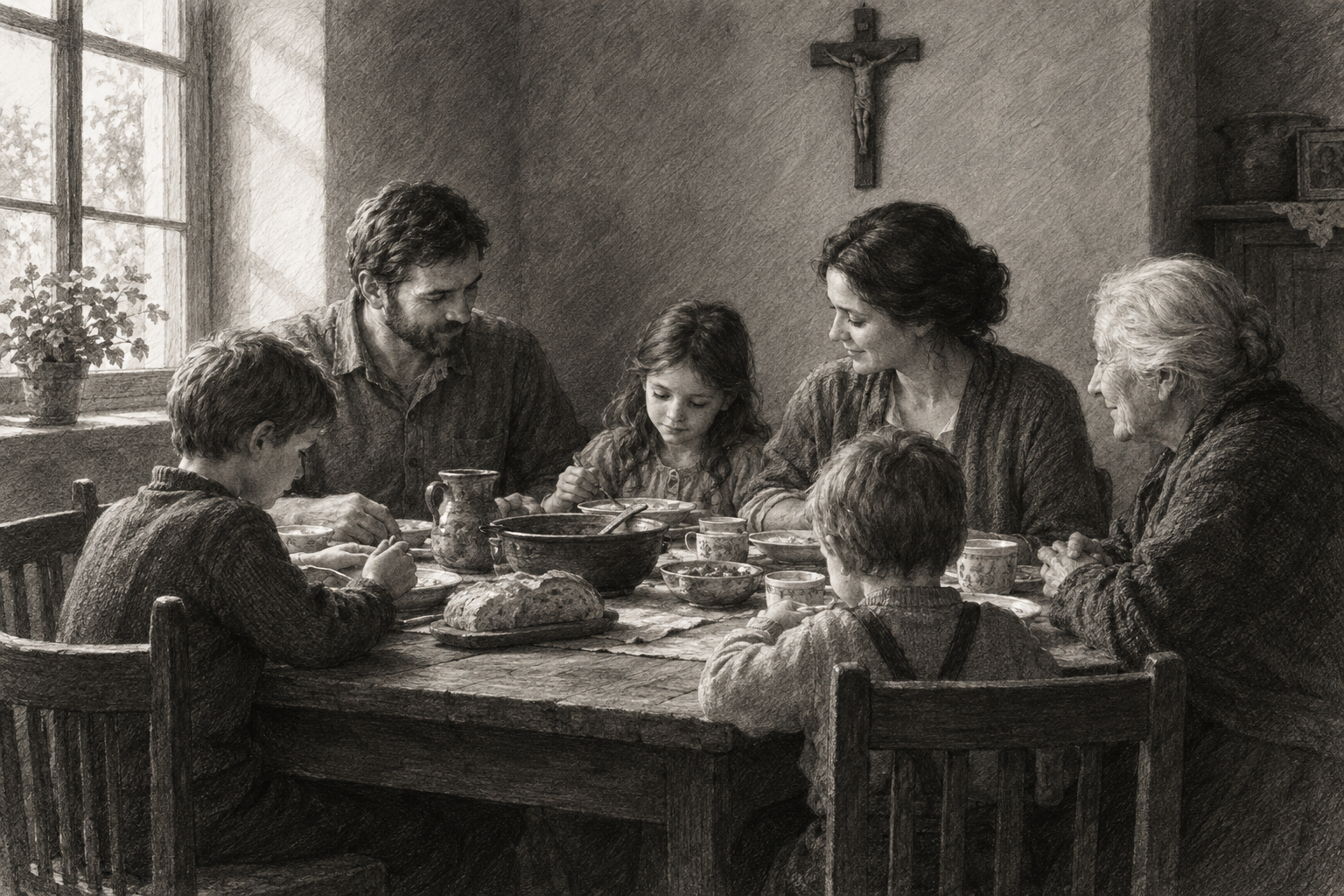
Catholics should be careful not to speak as though paid employment were the only serious contribution a person can make. This is especially important in family life, where invisible tasks can fall heavily upon one person. Gratitude should be expressed, responsibilities should be discussed honestly, and burdens should be shared fairly.
We should also resist contempt for work that society labels menial. Necessary labor does not become undignified because it is physically demanding, repetitive, or performed out of public view. Jesus himself was known among his neighbors as a craftsman, as recorded in Mark 6:3. No honest occupation should be treated as grounds for humiliation.
When work becomes disordered
Not every kind of labor is morally good. A person may not cooperate willingly in fraud, exploitation, pornography, violence against the innocent, or other grave wrongdoing simply because a supervisor requires it. Employment contracts do not erase conscience.
Other situations are less direct and require careful discernment. A worker may discover that a company engages in troubling practices, while the worker's own duties are legitimate and remote from the wrongdoing. Advice from a wise priest, an informed moral theologian, or another competent counselor can help clarify the degree of cooperation and the practical options available.
There are also situations in which work is good in itself but has become disordered through excess. Career ambition may crowd out prayer, marriage, children, health, or works of mercy. The warning signs can be subtle: chronic irritability, neglect of Sunday Mass, dishonesty for advancement, or the inability to receive rest without guilt. Repentance may require more than a change of attitude. It may require a change of schedule, expectations, or employment when that is reasonably possible.
Practicing the Church's teaching at work
The dignity of labor becomes visible through ordinary choices. Catholics do not need control over an entire economy before they can act. They can begin with the people whose work intersects with their own lives.
- Learn names and acknowledge service. Respect should not depend on a person's title or income.
- Pay honestly and promptly. This applies to businesses, household help, contractors, and informal arrangements.
- Refuse humiliating speech. Jokes about low wage workers, immigrants, the unemployed, or people with limited education wound the common good.
- Use authority as service. Managers can communicate clearly, correct fairly, protect confidentiality, and listen before making judgments.
- Work with integrity. Employees can reject gossip, deception, deliberate waste, and the quiet transfer of their responsibilities to others.
- Protect time for God and family. Reasonable boundaries help keep employment in its proper place.
- Attend to those without secure work. Practical help may include job leads, transportation, child care, food, professional mentoring, or patient encouragement.
- Examine purchasing habits. Price matters, but Catholics can also consider whether their consumption supports abusive or grossly irresponsible practices.
Charity is essential, but charity does not replace justice. A generous donation cannot excuse the mistreatment of employees. In the same way, justice should not become cold or abstract. Policies concern real people, each with a face, a family, and a history known fully by God.
Offering our labor to God
For most Catholics, holiness will involve many ordinary hours of labor. Some will carry heavy responsibilities. Some will endure periods of unemployment or underemployment. Some will spend years doing work that receives little recognition. The Christian promise is not that every job will become satisfying. It is that no honest act of service offered in love is hidden from God.
At the same time, faith prevents us from confusing God's approval with professional success. Advancement may be a blessing, but it is not a verdict on the soul. Failure may be painful, but it is not proof of abandonment. Jesus warns against gaining the whole world while losing one's life in Mark 8:36.
Our work can be brought into prayer: gratitude for what is good, repentance for what was dishonest, intercession for colleagues, and petition for those seeking employment. At Mass, the gifts of bread and wine, described as the work of human hands, are offered to God and transformed by his grace. That pattern gives Catholic labor its deepest orientation. We receive creation, apply our gifts, serve our neighbor, and return our efforts to the Lord, trusting that our worth rests not in what we produce but in the love of the God whose image we bear.
Keep Reading on Lets Read The Bible
Frequently Asked Questions
Does Catholic teaching say that every person has a right to a job?
Catholic social teaching affirms the importance of access to work and the duty of society to foster conditions in which people can find suitable employment. This does not mean any particular employer must provide every applicant with a position. It means economic life should be ordered toward participation, family support, and the common good rather than treating widespread unemployment as morally unimportant.
Is earning a profit contrary to the dignity of labor?
No. Profit can help a business remain stable, invest, and continue employing people. It becomes morally disordered when it is pursued through fraud, exploitation, unsafe conditions, unjust wages, or disregard for the human and spiritual needs of workers.
How should Catholics respond to an unjust workplace?
The response depends on the seriousness of the injustice and the worker's circumstances. Possible steps include documenting concerns, using appropriate reporting channels, seeking support from trustworthy colleagues or worker associations, obtaining legal or professional advice, and consulting a priest or informed moral adviser. A Catholic should not willingly perform intrinsically immoral acts, even under workplace pressure.