Social Teaching
The Measure of a Day's Work
Labor has economic value, but Catholic social teaching begins with the greater value of the person who performs it.
Site Admin | October 3, 2026 | 3 views
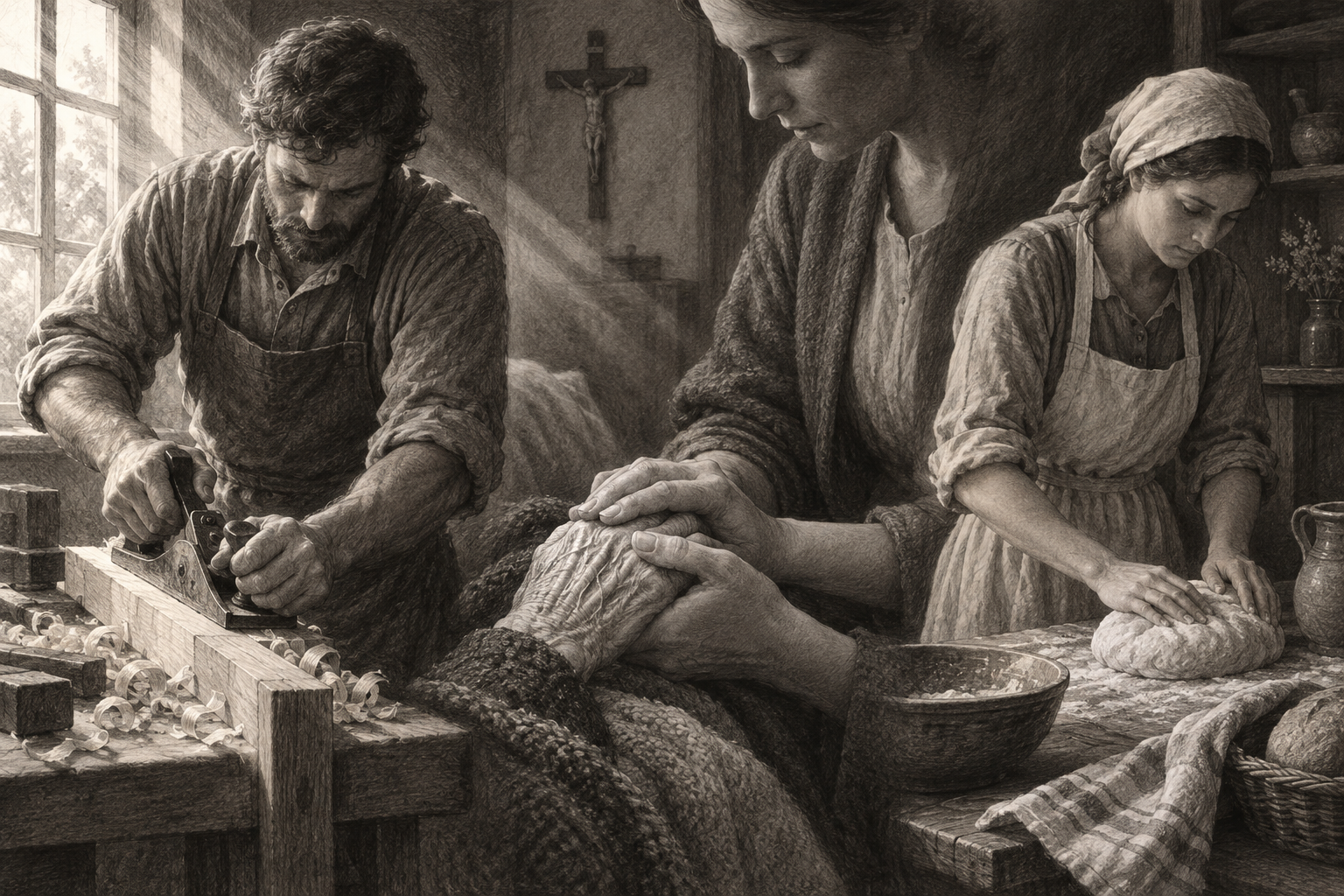
Work occupies a remarkable portion of human life. It can be a source of satisfaction, service, fatigue, friendship, frustration, and hope, sometimes within the same day. Paid employment supports households and communities, but work is not limited to what appears on a payroll. Parents care for children, relatives tend the sick, volunteers serve neighbors, students prepare for future responsibilities, and religious communities sustain lives of prayer and service. All of this belongs within a Christian reflection on labor.
When the Church speaks about work, she does not begin with productivity charts or political slogans. She begins with the human person, created in the image of God. That starting point gives Catholic teaching both its warmth and its moral seriousness. Work matters because people matter. Markets, institutions, technologies, and policies must therefore be judged partly by how they affect the dignity of those who labor and those who depend upon the fruits of labor.
Work begins with creation, not punishment
The opening chapters of Genesis present human beings as entrusted with the care of creation. Adam is placed in the garden to cultivate and keep it: Genesis 2:15. Work is therefore present before the fall. It belongs to humanity's original vocation, not merely to the consequences of sin.
Sin does, however, wound the experience of work. The ground becomes difficult, toil becomes painful, and human relationships are marked by domination and conflict. Scripture captures what workers in every age have known: labor can be meaningful, yet it can also become exhausting, unjust, or alienating.
The Christian response is not to treat work as an evil from which only the fortunate escape. Nor is it to glorify every form of busyness. Work is good when it serves genuine human flourishing and the common good. Its hardships are real, but they do not erase its place within God's purposes.
Jesus himself entered an ordinary working household and was known in his community as a craftsman: Mark 6:3. The Son of God did not regard manual labor or an obscure life as beneath him. His hidden years at Nazareth quietly honor faithful work that receives little public recognition.
The worker is always more important than the product
A central principle of work and the dignity of labor Catholic teaching is that work exists for the human person, not the human person for work. Saint John Paul II developed this principle in Laborem Exercens, emphasizing that the dignity of labor comes first from the person performing it. A task may produce something useful, but its deepest human significance lies in the worker who freely and responsibly carries it out.
This principle challenges the temptation to evaluate people solely by output, salary, job title, or economic usefulness. A highly paid executive and a seasonal farmworker possess the same fundamental human dignity. So do a person seeking employment, a worker with a disability, an elderly person no longer in the workforce, and a parent whose labor in the home is unpaid.
Economic systems need efficiency, skill, planning, and accountability. Catholic teaching does not deny these realities. It insists, however, that efficiency is a tool rather than the highest good. A workplace may be profitable and still be unjust if it treats employees as disposable instruments, exposes them carelessly to danger, withholds rightful wages, or makes normal family life nearly impossible.
The value of work cannot be separated from the value of the person who works.
This conviction also shapes the use of technology. Tools can remove dangerous burdens, improve health, and increase access to goods. Yet technological change should be directed toward human service. Workers should not be regarded as inconvenient costs simply because a machine or software system can perform part of a task. Wise change considers training, transition, family stability, and the good of the wider community.
Rights and responsibilities belong together
From Rerum Novarum onward, modern Catholic social teaching has repeatedly defended the rights of workers while also recognizing their duties. These rights do not arise from hostility between social classes. They follow from the dignity of the person and the requirements of justice.
Among the concerns consistently present in Catholic social teaching are:
- A wage sufficient to support a worker and family in dignity.
- Reasonable security against unsafe or degrading conditions.
- Time for worship, rest, family responsibilities, and community life.
- The right of workers to form associations and pursue their legitimate interests together.
- Protection against discrimination, coercion, and exploitation.
- Special care for workers who are poor, vulnerable, migrant, young, or otherwise at risk of abuse.
The biblical demand is direct: a laborer's wages must not be withheld. James condemns those whose unpaid workers cry out for justice: James 5:4. Deuteronomy likewise commands prompt payment to a poor laborer: Deuteronomy 24:15. These passages concern more than private generosity. They identify payment for honest work as a matter of justice.
Workers also have genuine responsibilities. They should perform their duties honestly, respect coworkers, care for property, avoid fraud, and contribute to the legitimate mission of their workplace. Saint Paul counsels Christians to do their work wholeheartedly, as service offered to the Lord: Colossians 3:23. This does not excuse exploitation or demand silent acceptance of abuse. It calls the Christian worker to integrity even when no supervisor is watching.
Employers, managers, and owners bear responsibilities corresponding to their influence. They must consider the real lives behind financial decisions. Leadership includes setting fair expectations, listening seriously to concerns, providing safe conditions, and recognizing that employees have obligations beyond the workplace. Profit can sustain a business and preserve employment, but profit alone cannot settle every moral question.
A just wage is more than a market price
A wage has an economic dimension, but Catholic thought does not treat it as nothing more than the price established by supply and demand. Human labor is not an ordinary commodity because it cannot be separated from the person who gives time, strength, intelligence, and skill.
A just wage should allow workers to meet ordinary needs and support family life with dignity. Determining the precise amount can involve complex questions about local conditions, the health of an enterprise, the nature of the work, and the wider economy. Catholic social teaching does not reduce this discernment to a single universal calculation. It does establish a moral standard: the needs and dignity of workers must be taken seriously rather than dismissed whenever they conflict with convenience or maximum return.
This concern is closely connected to the universal destination of goods. The Church recognizes private property, entrepreneurship, and responsible ownership. At the same time, created goods are ultimately intended by God for the benefit of all. Ownership carries a social responsibility. Wealth and productive property should be used in ways that contribute to the common good, especially when the basic needs of workers and families are at stake.
Solidarity does not erase subsidiarity
Catholic social teaching holds solidarity and subsidiarity together. Solidarity recognizes that human beings are responsible for one another. The hardship of a dismissed employee, an injured laborer, or a family trapped in poverty is not merely someone else's private problem. A healthy society seeks structures that permit participation and protect the vulnerable.
Subsidiarity teaches that decisions should ordinarily be made at the most local competent level. Families, worker associations, businesses, parishes, professional groups, and local communities all have proper roles. Larger institutions should support these smaller communities when necessary, not absorb every responsibility that rightly belongs to them.
Together, these principles resist two errors. One error leaves isolated individuals to face powerful institutions without meaningful support. The other assumes that distant authorities should control every detail of economic life. Catholic social teaching instead encourages participation, shared responsibility, and institutions ordered toward the common good.
The Church's defense of workers' associations belongs here. Workers may act together to protect legitimate interests and seek just conditions. This right does not mean that every demand or tactic is automatically wise. Like employers and public authorities, worker organizations remain accountable to truth, justice, and the common good.
Rest protects the soul of work
The biblical rhythm of labor includes rest. The Sabbath command limits the claim that production can make upon human life. It creates space for worship, family, mercy, and the recognition that the world depends finally upon God rather than upon uninterrupted human effort.
Jesus teaches that the Sabbath was made for the human person: Mark 2:27. For Catholics, Sunday is above all the day of the Lord's Resurrection and participation in the Eucharist. It should also include appropriate rest from work that hinders worship, joy, mercy, and renewal.
This teaching is not a condemnation of necessary Sunday labor. Hospitals, emergency services, caregiving, public safety, and other essential forms of service do not simply cease. Yet a culture that expects constant availability can weaken families and reduce persons to producers and consumers. Employers and workers alike should resist unnecessary demands that make genuine rest impossible.
Rest also corrects spiritual pride. A person is loved by God before accomplishing a task. Human worth does not disappear during unemployment, illness, disability, retirement, or sleep. Christian rest receives life as a gift and places work within its proper limits.
Daily choices can honor the people behind the work
Most Catholics do not set national economic policy or manage large institutions, but all can help build a culture that respects labor. The first step may be simple attention. Every service has a person behind it, often someone whose pressures remain unseen.
Practical habits include:
- Performing one's own work with honesty, competence, and concern for others.
- Learning the names of coworkers and service workers, and treating them with patience.
- Paying employees, contractors, and household workers promptly and fairly.
- Listening carefully when workers describe unsafe or unjust conditions.
- Supporting family life through reasonable schedules and humane expectations.
- Considering labor practices when making purchases, while recognizing that consumers may have limited information and limited means.
- Helping people who are unemployed without treating unemployment as a personal failure.
- Giving unpaid caregiving and domestic labor the gratitude and practical support it deserves.
Parishes can also be places of solidarity. They can pray for those seeking work, connect parishioners with trustworthy assistance, respect their own employees, and remain attentive to families under economic strain. Charity may meet an immediate need, while justice asks why the need persists and what responsible action might address it.
Work will remain marked by effort and imperfection, but it can also become an offering of love. In an office, kitchen, field, classroom, workshop, hospital, or home, Christians can serve neighbors and participate in God's care for creation. The ordinary dignity of labor becomes visible whenever a person is treated not as a cost, a tool, or a statistic, but as someone made in the image of God.
Keep Reading on Lets Read The Bible
Frequently Asked Questions
What does the Catholic Church teach about the dignity of work?
The Church teaches that work participates in God's creative care and can serve both the worker and the common good. Its dignity comes primarily from the human person who performs it, not from salary, status, or productivity. Work must therefore be organized in ways that respect human life, family responsibilities, worship, rest, safety, and justice.
Does Catholic social teaching support the rights of workers?
Yes. Catholic social teaching supports rights such as just compensation, safe conditions, reasonable rest, freedom from exploitation, and the ability to form worker associations. It also teaches that workers have duties, including honesty, diligence, respect for others, and responsible care for property.
Is unpaid work included in the Church's understanding of labor?
Yes. Human work is broader than formal employment. Caring for children, tending sick or elderly relatives, maintaining a household, studying, volunteering, and serving a religious community can all be genuine forms of work. Their lack of a wage does not remove their human or social value.