Marian Devotion
Mary at Calvary: The Silence, the Sorrow, and the Faith That Remained
A reverent Catholic meditation on Mary beside the Cross, rooted in Scripture and the Church's living memory.
Site Admin | March 30, 2026 | 100 views
Mary at the Cross in the Gospel
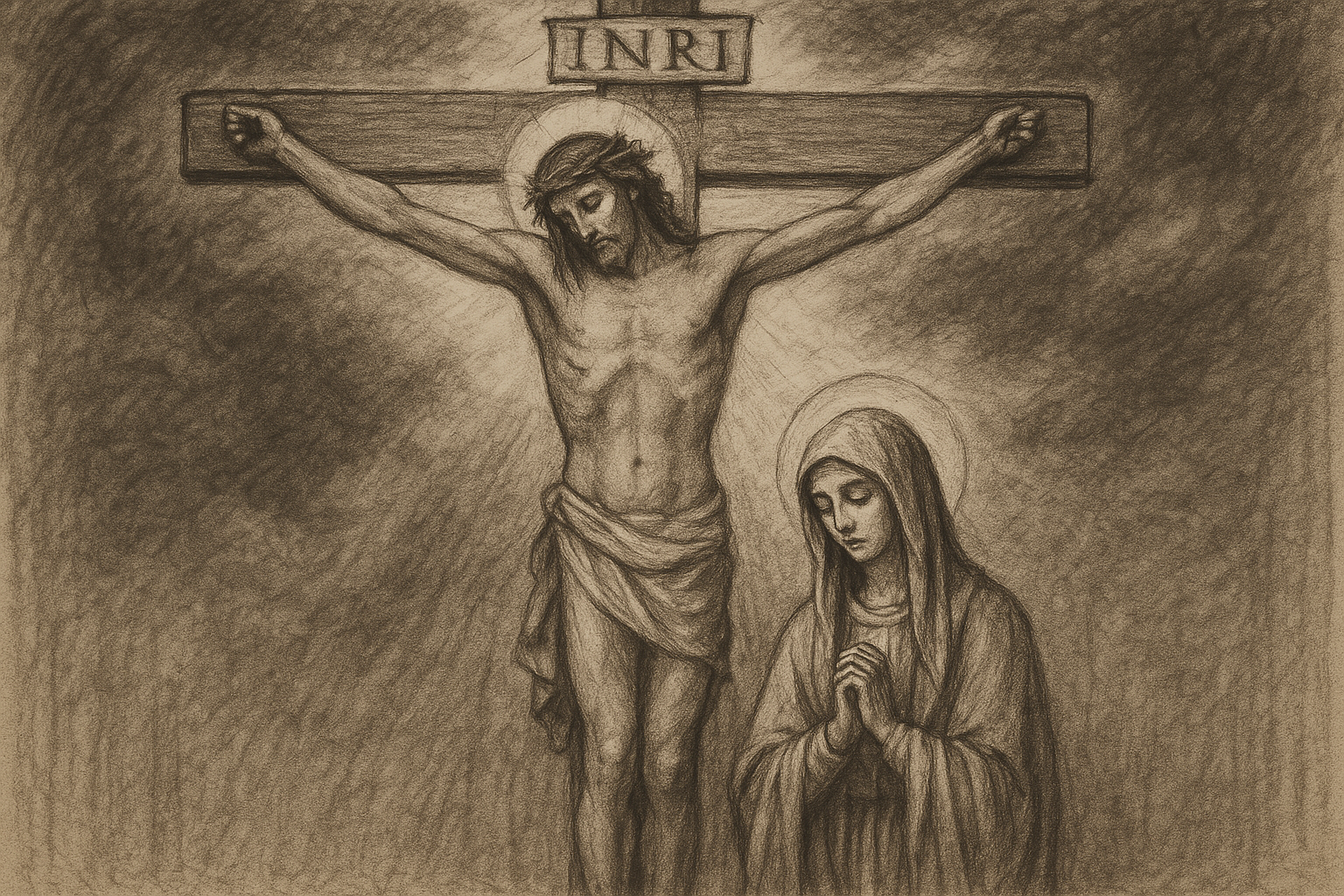
The Gospel gives us only a few words about Mary at Calvary, but those words are enough to linger over for a lifetime. Saint John writes, "standing by the cross of Jesus were his mother" standing by the cross of Jesus were his mother. That simple line carries immense weight. Mary is not described as speaking, protesting, or fleeing. She is standing there. She remains present to her Son in the hour of His Passion.
For Catholics, this scene is not a decorative detail in the Passion narrative. It is a revelation of the Mother who has always said yes to God. At the Annunciation, she gave her consent to the Word becoming flesh. At Calvary, that consent reaches its hardest earthly testing. She does not understand every detail of the mystery, but she does not abandon Jesus. Her presence reveals a faith that does not depend on comfort.
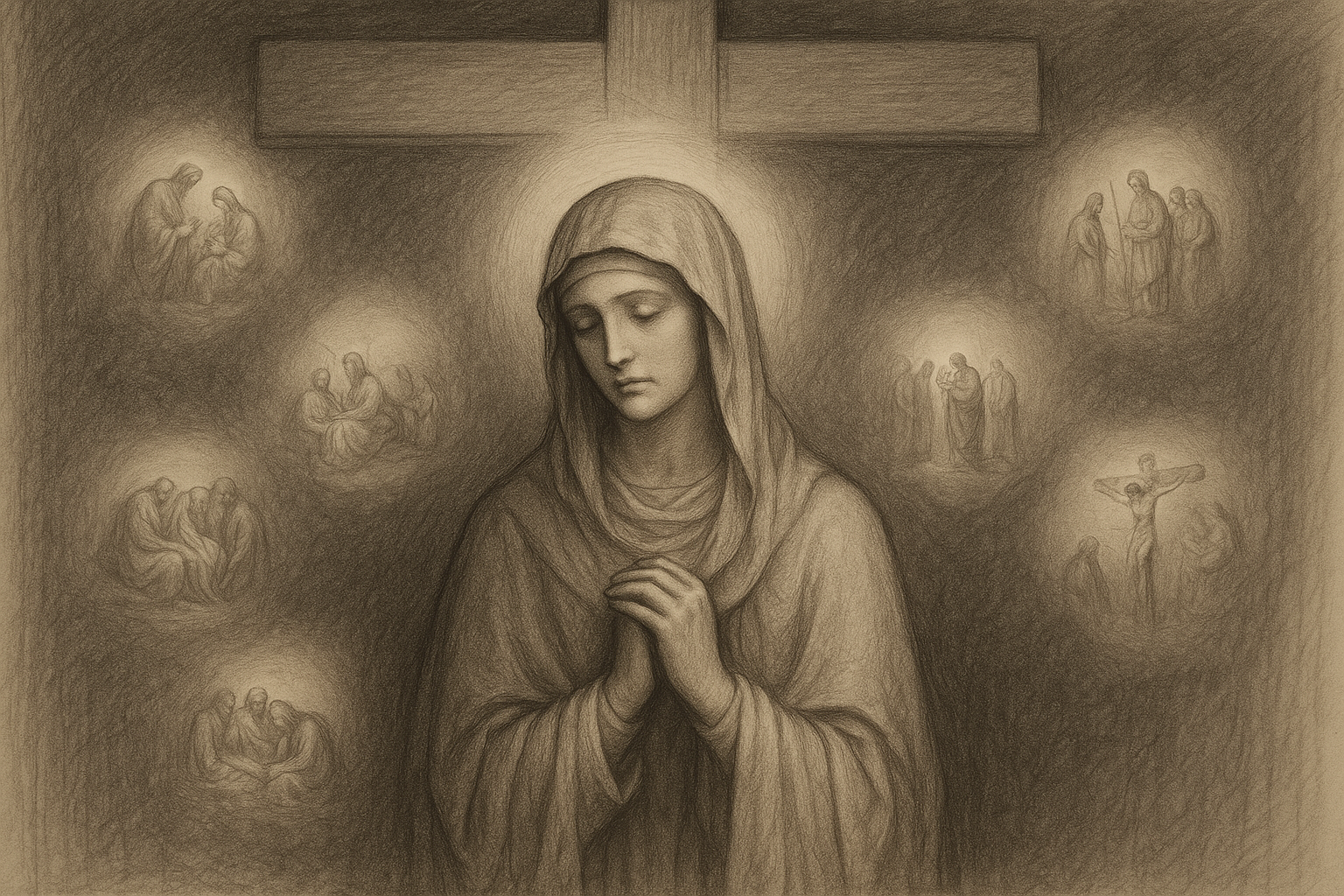
Saint Luke had already prepared us for this. When Simeon spoke in the temple, he told Mary, "and a sword will pierce through your own soul also" a sword will pierce through your own soul also. Calvary is the hour when that prophecy comes to fulfillment. The sorrow is real, and the sword is deep. Yet Mary remains united to the saving work of her Son.
What the Church Sees in Mary's Suffering
The Church has long taught that Mary is uniquely joined to Christ because of her role as His Mother and because of her flawless cooperation with grace. This does not mean she is equal to Christ or that her suffering redeems by itself. Only Jesus, the true Lamb of God, saves the world by His sacrifice. But Mary is inseparably near to that sacrifice in a maternal and spiritual way.
At Calvary, Mary does not stand as a spectator. She participates by loving, by consenting, and by suffering as a mother suffers when her innocent child is unjustly condemned. Catholic devotion has often spoken of her as the Sorrowful Mother, not to sentimentalize her pain, but to honor its truth. Her sorrow is purified by faith. She is not crushed into despair, because she knows the God who first called her is still faithful.
The Catechism teaches that Mary advanced in her pilgrimage of faith and remained united to her Son, even at the Cross. That is a profound point for prayer. Faith is not only for moments of clarity. Sometimes faith looks like standing where love has placed you, even when nothing seems explained. Mary at Calvary shows us that obedience can be silent and that trust can coexist with grief.
Mary's suffering at Calvary is not an ornament added to the Cross. It is the sorrow of a mother who remains with Jesus when the cost of fidelity becomes visible.
Mary at Calvary explained in light of Scripture
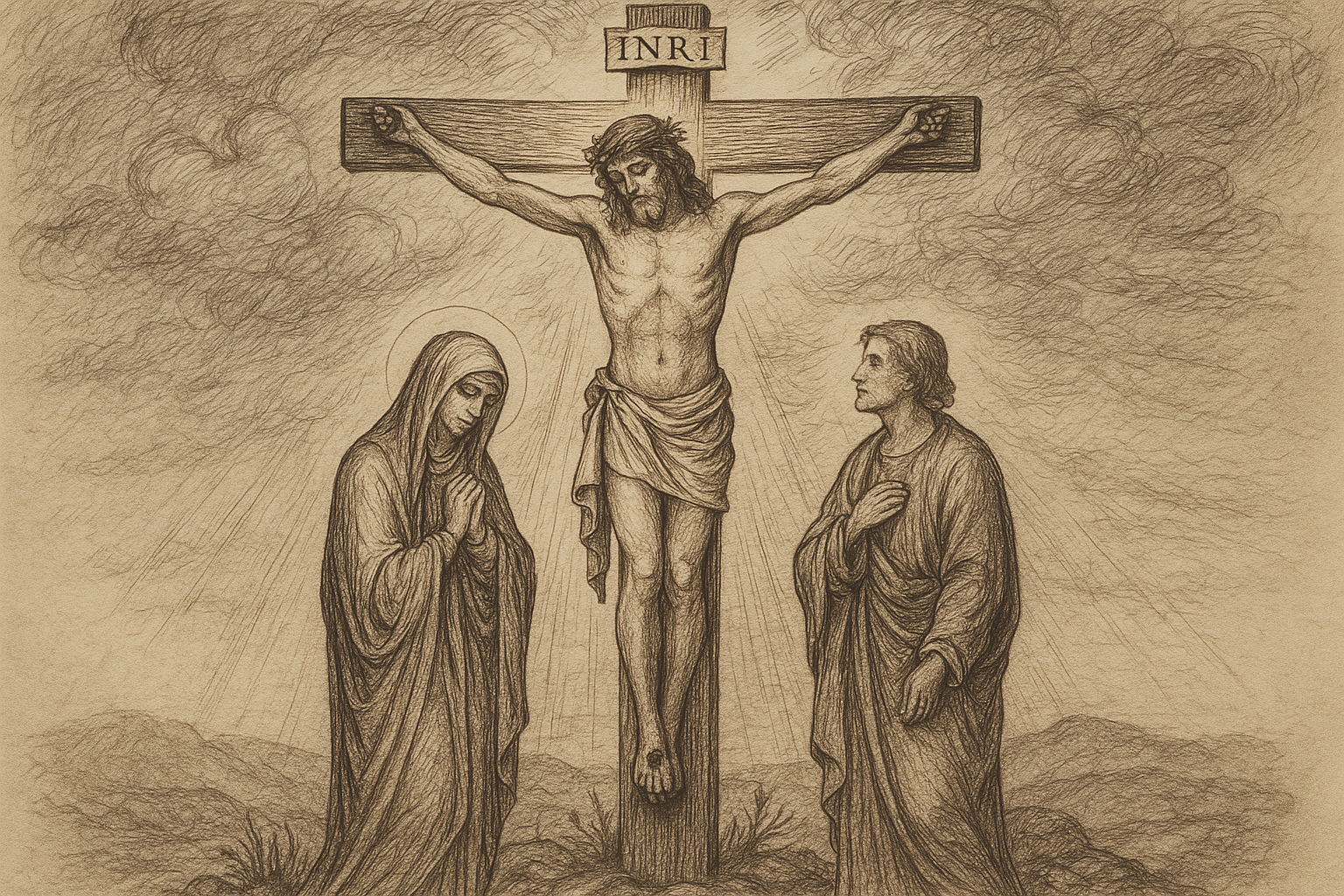
Several Gospel details help us understand the scene more deeply. In John 19, Mary stands with the beloved disciple and the other women near the Cross standing by the cross of Jesus were his mother. Jesus, seeing His mother and the disciple whom He loved, says, "Woman, behold, your son!" and to the disciple, "Behold, your mother!" Woman behold your son. Behold your mother.
These words are tender, but they are also solemn. On one level, Jesus entrusts Mary to the disciple's care. On another, He gives Mary to the Church represented by that disciple. Catholics have always heard here a maternal gift that extends beyond one household. Mary becomes mother in a new order of grace, at the very moment Christ is opening the gates of salvation through His Blood.
The prophecy of Simeon, the presence of Mary at the Cross, and the entrustment of Mary and John all belong together. The Lord does not leave His Mother isolated in sorrow. He places her within the life of the Church. At the same time, He reveals that her motherhood is now spiritual and universal. This is one reason Catholics feel at home bringing Mary into our prayer. She does not replace Jesus. She leads us more deeply toward Him.
It is also important to notice the contrast between Mary's steadiness and the flight of many disciples. Human weakness is on full display at Calvary. Fear scatters, confusion deepens, and the apparent defeat of Jesus seems to close the story. Mary remains. Her faithful presence is a quiet rebuke to our own tendency to withdraw when discipleship becomes costly.
The devotional meaning of Mary's presence
Devotion to Mary at Calvary is not about dwelling morbidly on sorrow. It is about learning how to remain with Christ in suffering. Many Catholics know from experience that pain can make prayer feel sparse and words impossible. Mary teaches another way. Sometimes prayer is simply standing before God, heart open, unable to fix anything, yet refusing to turn away.
There is deep comfort in knowing that the Mother of Jesus has known anguish. She understands the wrenching helplessness of watching suffering unfold. Her compassion is not abstract. She has stood where human love is tested to the limit. That is why so many Catholics naturally turn to her in times of loss, illness, family distress, and grief. She is not distant from human sorrow. She has entered it with her Son.
At the same time, Mary's presence at Calvary keeps us from imagining that Christian hope means emotional numbness. The Cross is not painless. Love costs. Yet the Cross is also the place where love is victorious. Mary teaches us to endure without bitterness, to suffer without ceasing to trust, and to believe that God is still at work when the surface of life looks broken.
What Mary's silence teaches
One of the most striking things about Mary at Calvary is her silence. Scripture records no speech from her there. That silence should not be mistaken for passivity. In biblical terms, silence can be a form of assent, reverence, and interior strength. Mary does not need to explain the mystery. She receives it.
In prayer, many Catholics discover that silence becomes necessary when grief is too heavy for words. Mary's silence gives dignity to that experience. It reminds us that we do not need polished language to remain near to God. We need fidelity. We need to stay. Mary shows us how to do that.
How Catholics can pray with Mary at Calvary
Praying with Mary at Calvary can become a fruitful part of a Catholic's Lenten life, a daily meditation on the Passion, or a prayer in times of personal suffering. The goal is not merely to feel sad. The goal is to stand spiritually with Mary and Jesus so that our hearts are conformed more closely to the Cross.
Here are a few simple ways to pray this mystery:
- Read John 19:25 to 27 slowly and imagine the scene.
- Ask for the grace to remain faithful when life is painful or unclear.
- Pray one Hail Mary with special attention to the words "pray for us sinners, now and at the hour of our death".
- Offer a real sorrow, fear, or loss to Jesus through Mary's maternal intercession.
- Spend a few moments in silence, remembering that Mary herself stood silently before the Cross.
Some Catholics find it helpful to pray the Stations of the Cross or the Sorrowful Mysteries of the Rosary with Mary in mind. In the Fifth Sorrowful Mystery, Mary is not only emotionally near Jesus. She is also spiritually joined to His self-offering. This does not blur the difference between Creator and creature. Rather, it shows how perfectly grace can unite a human heart to the work of Christ.
When we pray this way, we begin to see that Mary is not a distraction from the Cross. She is one of the Church's great helps for understanding it. Her presence leads us to reverence, humility, and trust. She does not ask us to admire her for her own sake. She teaches us to adore her Son.
Mary and the Christian life of suffering
Every Christian eventually encounters some form of Calvary, whether through illness, bereavement, family fracture, or the hidden griefs that accompany a life of conscience and sacrifice. Mary at Calvary explained in Catholic terms becomes a guide for these moments. She shows that suffering does not have to destroy communion with God. It can become, by grace, a place of deeper union.
That does not mean Christians seek pain or pretend it is good in itself. The Church never calls evil good. But in Christ, suffering can be offered, joined to love, and transformed from within. Mary is the first and most faithful witness to this truth after Jesus Himself. She does not remove the Cross, but she teaches us how to stand near it without surrendering hope.
For families, caregivers, and those who accompany the dying, Mary's presence at Calvary has special meaning. She reminds us that love often means staying when there is no easy remedy. It means keeping watch, praying, and trusting God's hidden mercy. A Christian at the bedside, in the cemetery, or in the quiet after bad news can learn from Mary's fidelity.
And when we think of our own sins, Mary at Calvary also helps us see the seriousness of redemption. The Cross was necessary because sin is real. Yet the Cross is also the place where mercy overflows. Mary stands there as a witness to both truths: the gravity of sin and the greater power of divine love.
So when Catholics honor Mary at Calvary, we are not placing her beside Jesus as though she were another savior. We are recognizing that no human creature has ever been more closely shaped by the Cross of Christ. She is the Mother who suffered with faith, the disciple who never stopped believing, and the woman who stood when standing was all love could do.
To ask for her prayers is to ask for the grace of steadfast love. To contemplate her at Calvary is to learn that fidelity does not always look triumphant. Sometimes it looks like a mother standing at the foot of a Cross, keeping her heart open to God even in the hour of sorrow.
Keep Reading on Lets Read The Bible
Frequently Asked Questions
Why is Mary present at Calvary in Catholic devotion?
Catholics honor Mary's presence at Calvary because Scripture shows her standing near the Cross in union with her Son's suffering. Her presence reveals maternal faith, deep sorrow, and a unique participation in the mystery of redemption, always dependent on Christ and never replacing Him.
Does Mary share in the saving work of the Cross?
Mary does not redeem the world. Only Jesus Christ saves. But Catholic teaching recognizes that Mary, by grace, cooperates uniquely with her Son through faith, obedience, and suffering. At Calvary, her role is real and profound, but always subordinate to Christ's one sacrifice.
How can Catholics pray with Mary at Calvary in daily life?
Catholics can pray with Mary at Calvary by reading John 19:25 to 27, praying the Sorrowful Mysteries, keeping silence before God, and bringing personal suffering to Jesus through Mary's intercession. The aim is to remain faithful to Christ in sorrow, as Mary did.