Marian Devotion
Mary at the Foot of the Cross: A Catholic Reading of Calvary
At Calvary, Mary is not a bystander but a mother who remains with her Son, sharing in the sorrow of redemption with quiet faith.
Site Admin | March 29, 2026 | 99 views
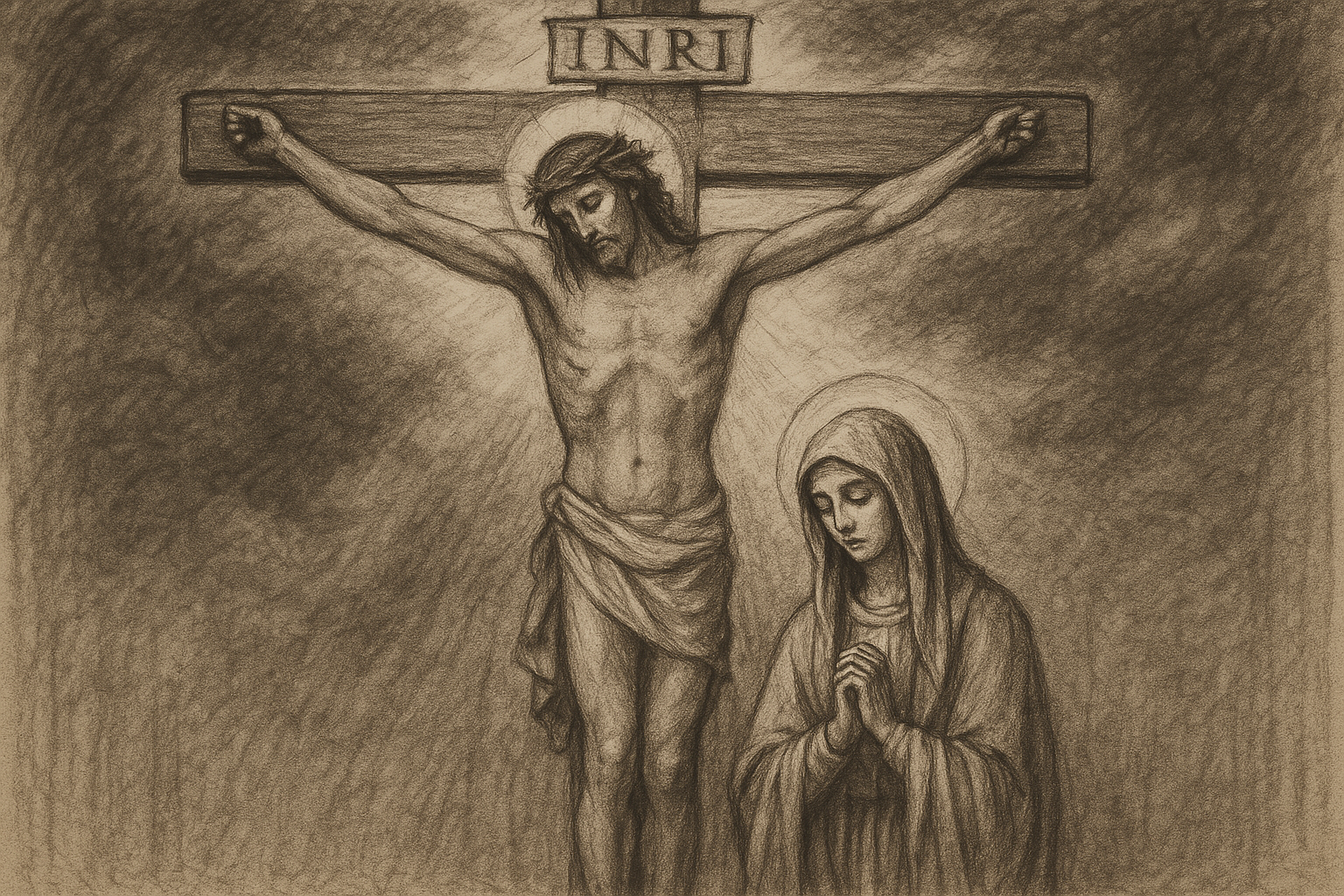
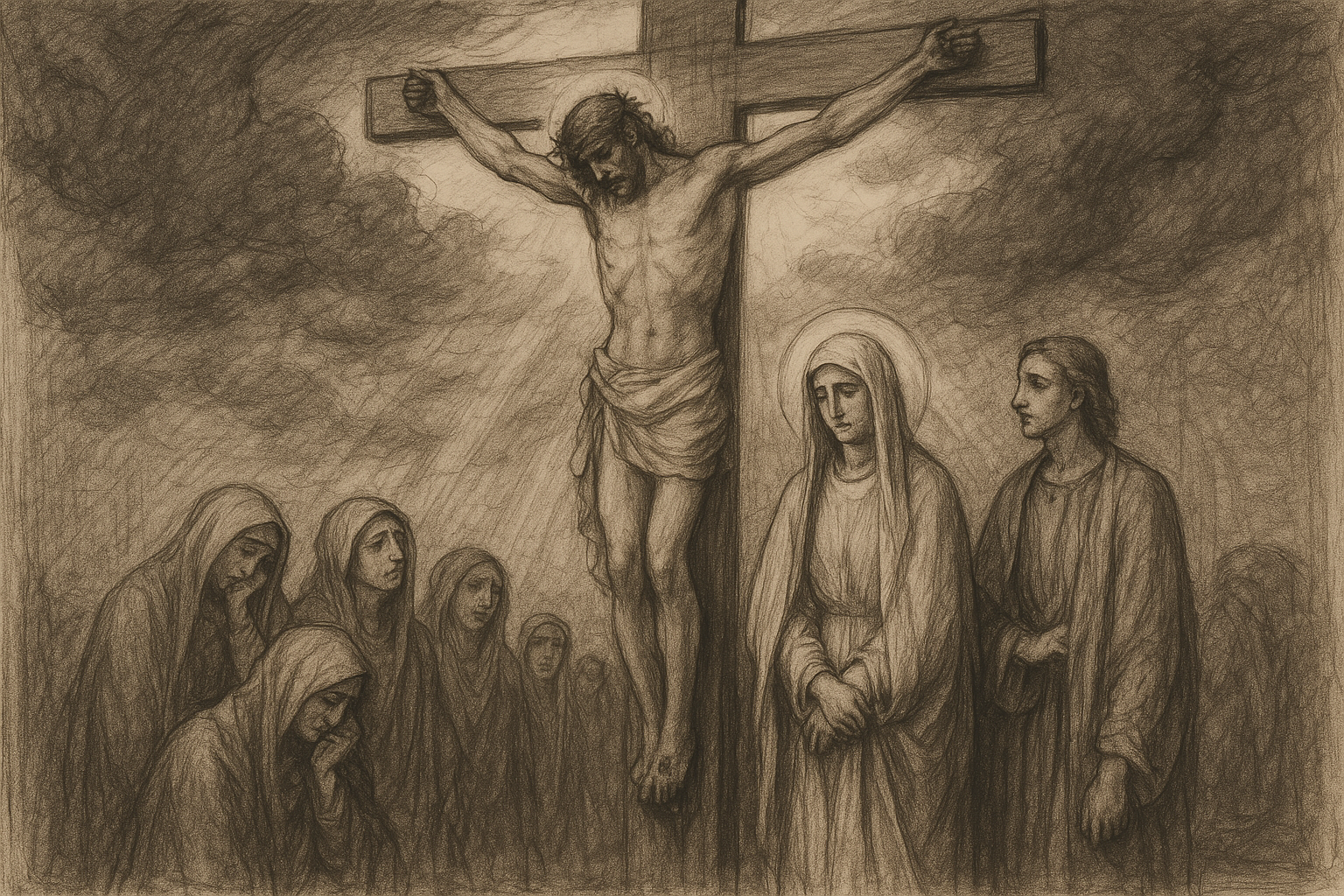
Among the most moving scenes in the Gospels is the moment when Jesus hangs upon the Cross and Mary stands near him. Saint John records it with solemn simplicity: "standing by the cross of Jesus were his mother" and the disciple whom Jesus loved. The Church has always lingered over that scene because it reveals something precious about both Christ and his Mother. Mary is not placed at the center in place of Jesus. She is there because she belongs to him, and because the mystery of redemption reaches even into the sorrow of a mother who watches her Son suffer.
The Gospel scene at Calvary
The basic biblical text is found in John's Gospel. As Jesus offers his life, Mary stands near the Cross, together with other women and the beloved disciple. Jesus speaks to her, then to the disciple: "Woman, behold, your son" and "Behold, your mother" [[VERSE|john|19|26-27|John 19:26-27]]. This is one of the most tender and dense moments in the New Testament. The words are brief, but the meaning is rich.
In a purely human sense, the scene is heartbreaking. A mother sees her innocent Son unjustly condemned, mocked, wounded, and lifted up in death. Yet John presents Mary not as overwhelmed by despair, but as present. She remains. Catholic tradition has often seen in this steadfast presence the fruit of Mary's lifelong faith. At Nazareth, at Bethlehem, in the hidden years of Jesus' growth, and now at Calvary, she does not understand everything in advance, but she continues to trust God.
The Gospels do not give us Mary's spoken words at the Cross. Her silence is itself eloquent. It is the silence of reverence, sorrow, and obedient love. In that silence, the Church recognizes a disciple who does not flee when the cost of redemption becomes visible.
What the Church sees in Mary at Calvary
Catholic teaching does not treat Mary as a rival to Christ. Her place at Calvary is meaningful precisely because it is subordinate to him. Jesus alone redeems. He alone is the Savior. Yet God chose to draw Mary into the mystery of the Incarnation in a unique way, and that same choice is not set aside at the Cross. The Mother who consented to the angel's message at the beginning of the Gospel story remains near the fulfillment of that message at the end.
Traditional Catholic language often speaks of Mary's compassion, a word that means suffering with another. She does not add to the power of Christ's sacrifice, but she is spiritually united to it. Her suffering is real, and her love is real. At Calvary, she stands where human love meets divine self-offering.
The Church also sees in this scene the revelation of Mary's motherhood. When Jesus entrusts the beloved disciple to her, Catholics hear more than a private act of care. The disciple represents all who belong to Christ by faith. In giving Mary to the disciple and the disciple to Mary, Jesus manifests a maternal relationship that extends within the communion of believers. Her motherhood is not merely biological or historical. It has a spiritual dimension within the Church.
This is why Marian devotion remains Christ-centered when it is healthy and rightly ordered. To honor Mary at Calvary is to honor the work of God in her, and to contemplate more deeply the price of our salvation.
Why John's Gospel matters so much
John's account of the Passion is especially important for understanding the Mary at Calvary Catholic meaning. John is careful with symbols, but he is never vague about history. He tells us where Mary stands and what Jesus says. He also places the scene within the larger movement of Jesus' glorification. In John's Gospel, the Cross is not only humiliation; it is also the hour of glory, the moment when divine love is displayed in its fullest measure John 19:30.
That matters for Mary. She does not stand at Calvary merely as a grieving mother in a tragic story. She stands at the place where God is accomplishing salvation. Her sorrow is inseparable from faith in the one who is dying. The darkness of the hour does not cancel the promise of God. It presses faith to its deepest expression.
The Church's reading of this scene also fits with the rest of John's Gospel. Earlier, at Cana, Mary directs attention toward Jesus: "Do whatever he tells you" John 2:5. At Calvary, that same orientation is fulfilled in the most costly way possible. The signs and words of the Gospel move toward the Cross, and Mary remains where the work of salvation is being completed.
Mary's presence and the mystery of discipleship
Mary at Calvary is not only a Marian subject. She is also a pattern of Christian discipleship. The disciple of Jesus does not seek comfort above truth, nor does love stop when suffering begins. Mary shows that faith can remain steady in the presence of sorrow. She does not need to explain the Cross in order to remain faithful at the Cross.
That is important for Catholics who pray with Mary. Devotion to her is not sentimental attachment. It is a school of receptivity and fidelity. She teaches believers to stand near Jesus, especially when the path of the Gospel becomes costly or difficult. Her presence at Calvary says that love does not abandon Christ when he is rejected, and that hope can remain present even when visible signs seem to fail.
There is also a lesson about union with suffering. Catholics do not believe that suffering is good in itself, but they do believe that suffering united to Christ can be borne with grace and offered in love. Mary does not replace Christ's sacrifice, but she shows how a human heart can be joined to it. In that sense, her presence at Calvary deepens devotion to Jesus because it helps the believer understand that his Cross is not an abstraction. It is a real act of love into which he draws others.
The tradition of Mary's sorrow
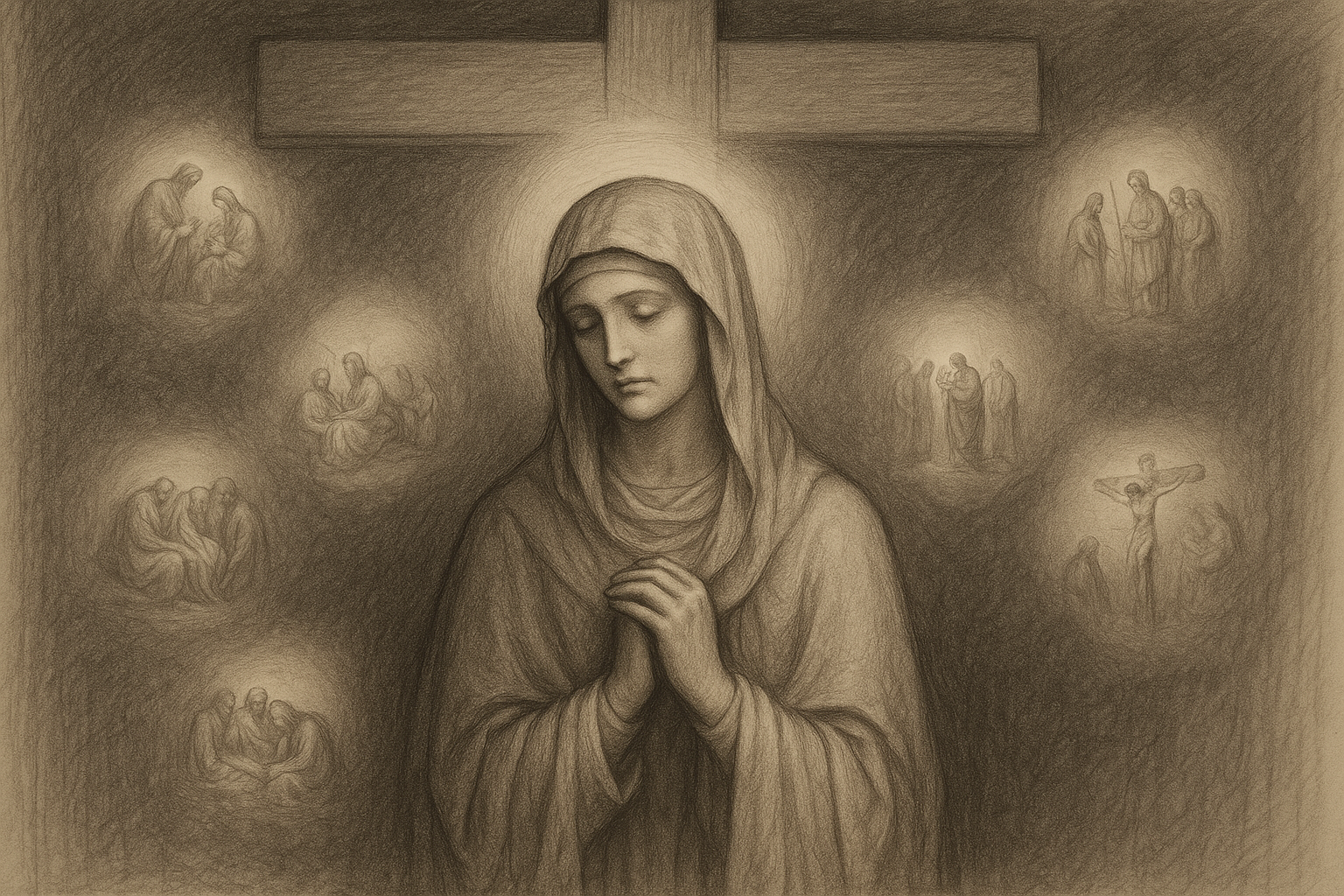
Over time, the Church has reflected deeply on Mary's sorrow at the Passion. This is one reason Catholic spirituality so often contemplates the Seven Sorrows of Mary. The devotion is not meant to isolate Mary from Jesus, but to meditate on the wounds of Christ through the heart of the woman who knew him most intimately.
At Calvary, her sorrow is not hopeless. Christian sorrow, when rooted in faith, is different from despair. Mary mourns, but she mourns before the mystery of God's saving will. Her grief is touched by trust, even when the future is hidden. She does not receive every answer on the spot, but she remains within the reach of the promise already spoken over her life.
In Catholic contemplation, Mary's sorrow leads us not away from the Cross, but more deeply into it, because she stands where love and sacrifice meet.
This is one reason so many saints have loved to pray with Mary beneath the Cross. They do not ask her to compete with Christ. They ask her to lead them to him. Her maternal closeness helps believers keep their eyes on the Crucified Lord, where mercy and justice meet.
What Mary's presence teaches about the Church
Mary at Calvary also has an ecclesial meaning. The Church is born from Christ's sacrifice, and Mary stands at that birth in a maternal role. The water and blood that flow from Christ's side have long been understood by Christian tradition as signs of sacramental life. Mary, standing near the pierced side of her Son, is often seen as the mother who remains near the source of the Church's life.
Her presence helps Catholics remember that the Church is not merely an institution, but a family gathered around the Crucified and Risen Christ. The faithful are not saved by private effort. They are drawn into communion. Mary's motherhood at the Cross points to that communion and encourages believers to receive one another as gifts from Christ.
At the same time, her presence guards against a shallow view of discipleship. To belong to Jesus is to accept the Cross in some form. Mary does not promise an easy path. She shows a faithful one. Her witness reminds the Church that sorrow, when united to Christ, can become a place of grace.
How Catholics can pray with Mary at Calvary
To pray with Mary at Calvary is to practice reverent attention. It begins with looking at Jesus. Every authentic Marian devotion should do that. If a prayer to Mary does not lead the heart toward the Lord, it has lost its center. But when Mary is contemplated in relation to the Cross, she becomes a help to prayer.
Catholics may pray with her in several simple ways:
- by reading the Passion accounts slowly and asking for the grace to stand near Jesus with faith
- by meditating on Mary's silence and asking for a more obedient heart
- by offering personal sorrows in union with the suffering of Christ
- by asking Mary to teach a steadfast love that does not flee when faith is tested
These are not complicated practices. They are ways of remaining close to the mystery the Gospel presents. The point is not to sentimentalize pain, but to let the Cross shape the believer's love.
Mary at Calvary also invites examination of conscience. Do I remain with Christ when his teaching is difficult? Do I follow him only when faith is consoling, or also when it demands sacrifice? Do I trust that God's promises endure even when my understanding is limited? Mary's presence asks these questions without harshness, because her own fidelity is quiet and patient.
Why this scene deepens devotion to Jesus
Some people fear that Marian devotion takes attention away from Christ. Calvary shows the opposite. Mary is most beautiful in the place where Jesus is most glorified by self-giving love. She is not the light; she reflects the light. She is not the sacrifice; she stands beside the Sacrifice. Her greatness is entirely derivative, but that does not make it unimportant.
To love Mary rightly is to learn how to love Jesus more fully. Her yes at the Annunciation and her presence at Calvary form a single line of faith. She receives the Word, bears the Son, and remains near the Cross. In her, the believer sees what total trust looks like when it passes through suffering and stays faithful.
That is the enduring Catholic meaning of Mary at Calvary. She is the mother who stands close to Jesus when the world rejects him. She is the disciple who does not turn away. And she is the gift Christ gives to his Church as he completes the work of salvation. In her sorrow and fidelity, Catholics learn to look more steadily at the Crucified Lord and to trust that his love is stronger than death.
Keep Reading on Lets Read The Bible
Frequently Asked Questions
Did Mary suffer at Calvary in the same way Jesus did?
No. Jesus alone suffered and died as the Redeemer. Mary did not share in his saving death, but she did truly suffer as his mother, remaining united to him in faith and sorrow.
Why does Jesus call Mary
In John's Gospel, Jesus says, "Woman, behold, your son" to Mary and then gives her to the beloved disciple. Catholics understand this as a sign of Mary's spiritual motherhood within the Church, not a denial of her natural motherhood.
Is devotion to Mary at Calvary meant to take focus away from Jesus?
No. Healthy Marian devotion leads to Jesus. Mary at Calvary is honored because she stands closest to the mystery of the Cross and helps believers contemplate the love of Christ more deeply.