Marian Devotion
At the Edge of Bethlehem: Mary and the First Christmas Quiet
Scripture shows Mary not as a distant symbol, but as a believing mother who enters the poverty, wonder, and silence of Christ's birth.
Site Admin | March 26, 2026 | 83 views
Mary in the first Christmas scene
When Catholics speak of Mary at the Nativity explained through Scripture and the Church's faith, we are not trying to add emotion to a manger scene. We are trying to look carefully at what God has actually revealed. The Gospels do not give us a crowded, romantic Christmas tableau. They give us a poor place, a young mother, a newborn Child, and the steady nearness of God who comes in humility.
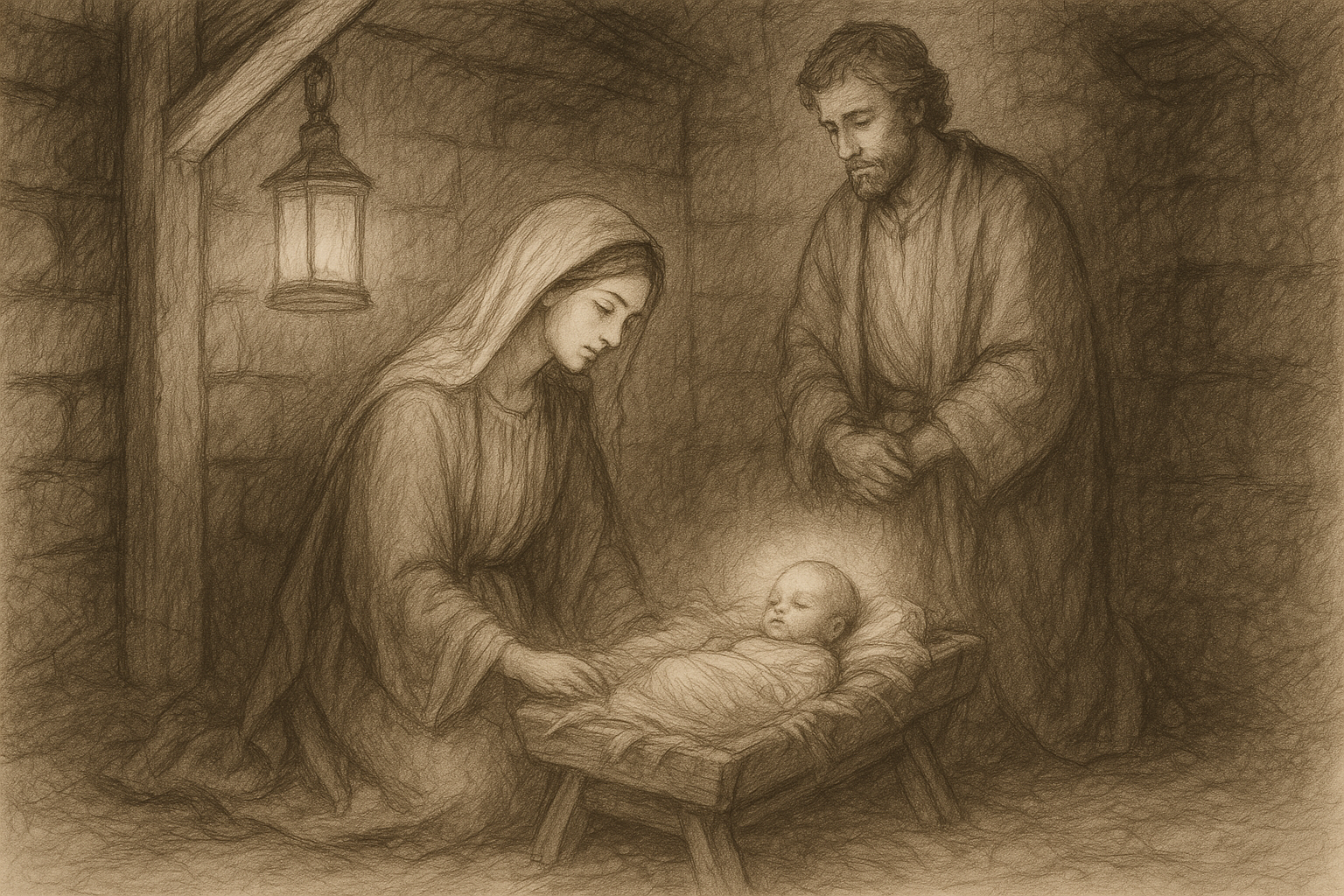
Luke tells us that Mary brought forth her firstborn son, wrapped him in swaddling cloths, and laid him in a manger because there was no place for them in the inn Luke 2:7. That verse is spare, but it is rich. Mary is not presented as a spectator. She is the Mother who gives birth, cares, protects, and receives the Child whom the angel had already named Jesus. She is at the center of the earthly beginning of the Incarnation, even though she says almost nothing.
This silence is not absence. In Catholic devotion, Mary's quiet is full of meaning. She is attentive, faithful, and present in the concrete needs of the moment. Bethlehem is not only the place where Christ is born. It is also the place where Mary's faith becomes visible in action.
The Gospel details matter
Luke's account does not linger on external detail for its own sake. The wrapped Child, the manger, the lack of room, the shepherds arriving in haste, all point to the identity of Jesus and the kind of kingship he brings. Mary stands within that revelation. Her motherhood is real, bodily, and historical. She does not simply bear a message. She bears the Word made flesh John 1:14.
This matters greatly for Catholic belief. The Church confesses Mary as the Mother of God, not because she is greater than God, but because the One she bore is truly divine and truly human. At Bethlehem, that doctrine is not abstract. It is lived in vulnerability. The Son who is adored by angels is also the infant held by his mother. The Child who is David's Lord lies in a manger and is fed, cleaned, and kept warm by a human mother who has said yes to God.
That is why the Nativity is never only about sentiment. It is about the mystery of the Incarnation entering ordinary human life. Mary's presence reminds us that God saves not by bypassing human weakness, but by entering it. He comes through a family, through labor, through waiting, through the ordinary care of a mother.
Mary's faith at Bethlehem
Luke also gives us a second, quieter clue about Mary. After the shepherds come and tell what they have heard concerning this Child, we read that Mary kept all these things, pondering them in her heart Luke 2:19. The same is repeated after Jesus is found in the temple Luke 2:51. This is one of the most precious Marian details in Scripture. Mary does not rush to explain the mystery. She receives it.
At the Nativity, this interior disposition matters as much as the outward scene. She has already consented at the Annunciation. Now she endures the demanding reality of that consent. The promise has become flesh, but in a form too small for easy understanding. The Savior is an infant. The Messiah is hidden. The glory of God is present in weakness. Mary stands where faith is required.
Catholic tradition often describes Mary as the one who believed most perfectly because she trusted God before she fully understood. Bethlehem reveals that same pattern. She does not control the event. She contemplates it. She receives what God is doing and keeps it in her heart, like a lamp sheltered against the wind.
What her presence teaches the Church
Mary at the Nativity is not only a beautiful image for private devotion. She teaches the whole Church how to be near Christ. Her example offers several simple lessons.
- Receive Christ with reverence. Mary does not possess Jesus as an idea. She receives him as Lord and Son. Catholics are invited to approach the Eucharist and prayer with that same reverence.
- Love through service. The manger scene implies care, not spectacle. Mary's motherhood is practical. She serves the life entrusted to her.
- Welcome mystery. Not every grace is immediately clear. Mary shows that faith can remain peaceful even when understanding is partial.
- Keep silence before God. Her pondering heart teaches us to resist noise and hurry, especially at Christmas.
These lessons are especially helpful during a season that can become crowded with preparation and distraction. The Church does not ask us to abandon joy. She asks us to let joy be purified. Bethlehem reminds us that the deepest Christmas joy is not produced by abundance. It is born from the presence of Christ.
Mary and the humility of God
It is worth pausing over the humility of the scene itself. The eternal Son of the Father enters the world through Mary, in poverty, without earthly power, without visible triumph. This is not accidental. It reveals God's way. As St. Paul writes, Christ Jesus emptied himself, taking the form of a servant Philippians 2:7.
Mary is present in that self-emptying from the beginning. She accepts a place that is hidden from public honor. She is not the main attraction, yet she is indispensable. Her obedience does not compete with Christ's glory. It makes his coming possible in history. In this sense, Marian devotion is always Christ-centered when it is rightly ordered. To honor Mary is to admire the grace of God at work in her and through her.
Some people worry that devotion to Mary distracts from Jesus. The Nativity corrects that fear. No one loved Jesus more simply than his Mother. No one was closer to the mystery of the Incarnation than the woman who gave him human life. To honor her is to accept the way God chose to come among us. She is never the endpoint. She is the path by which the Savior enters the world.
Reading the Nativity with the saints
The saints often saw Bethlehem as a school of humility and adoration. They recognized that the manger speaks to every age. Christians do not merely recall a past event at Christmas. We enter again into the contemplation of God's nearness. Mary's role helps us do that with a steady heart.
In prayer, it can help to imagine the scene without embellishment. There is the cold air, the poor shelter, the fragile body of the newborn Christ, and the watchful care of his Mother. There is also the quiet joy that heaven has touched earth. Angels praise God, shepherds hasten, and Mary remains near the Child she has given to the world. The scene is simple, but it is not small.
For Catholic readers, this simplicity is often the right place to begin. It allows the heart to move from curiosity to worship. Mary does not invite us to admire her for her own sake. She leads us to Jesus. Her greatness is inseparable from her nearness to him.
The manger is a place of poverty, yet it becomes a throne because Christ is there, and Mary is the first to cradle that mystery in human hands.
Praying with Mary at Christmas
If you want to pray with Mary at the Nativity, keep the prayer plain. Begin with Scripture. Read Luke 2 slowly. Pause at the words wrapped him, laid him, pondered them in her heart. Ask for the grace to receive Christ without haste. Ask Mary to teach you how to remain near Jesus when circumstances are uncertain or unadorned.
You might also pray for a more contemplative Christmas. Not every family gathering is peaceful. Not every season feels abundant. Bethlehem itself was not comfortable. Yet Christ came there, and Mary remained faithful there. That is an encouragement for anyone whose Christmas is marked by grief, strain, travel, or weariness. The Mother of Jesus knows what it is to receive grace in a hard place.
Some practical ways to keep this devotion alive are simple:
- Set aside a few quiet minutes before the Nativity scene or Christmas creche.
- Read Luke 2 out loud and pause after each sentence.
- Ask Mary to help you adore her Son with peace and gratitude.
- Offer one hidden act of charity in honor of her humility.
These are small acts, but they can shape the heart. Marian devotion does not require elaborate language. It asks for attentiveness, trust, and a willing heart. That is exactly what Mary offers at Bethlehem.
Christmas seen through Mary's eyes
To look at Christmas through Mary is to see that the great joy of the feast is inseparable from surrender. She gives the world Christ, yet she also receives him anew in faith. She is mother, disciple, and contemplative. At the Nativity, all of these are joined together.
When Catholics ask for Mary at the Nativity explained in a faithful way, the answer is not complicated. She is there because God chose her. She is there because the Son of God took flesh in her womb and entered the world through her care. She is there because her heart knew how to hold mystery without breaking it apart. And she is there because the Church, in every Christmas season, still needs her quiet example.
The manger remains a place of worship. The Child remains the Savior. And Mary remains near him, showing us how to receive the Word made flesh with reverence, trust, and love.
Keep Reading on Lets Read The Bible
Frequently Asked Questions
What does Mary at the Nativity teach Catholics about Christmas prayer?
It teaches us to pray with reverence and silence. Mary does not rush the mystery of Christ's birth. She receives it, keeps it in her heart, and remains near Jesus. Her example invites Catholics to make Christmas prayer more contemplative and less hurried.
Why is Mary important in the Nativity if the focus is on Jesus?
Mary is important because God chose to come into the world through her. She is the Mother of Jesus, and in Catholic belief, the Mother of God. Her presence at Bethlehem shows the humility of the Incarnation and the real human care surrounding the birth of Christ.
What Scripture passages are most important when reflecting on Mary at the Nativity?
The key passages are Luke 2:7, which describes the birth and the manger, and Luke 2:19 and 2:51, which say that Mary kept these things and pondered them in her heart. John 1:14 and Philippians 2:7 also help explain the mystery of the Word made flesh and Christ's humility.