Prayer and Devotion
Nightfall and the Quiet Work of Examining the Heart
A daily habit that helps Catholics notice grace, name sin honestly, and return to God with a freer conscience.
Site Admin | December 11, 2025 | 87 views
A daily examination of conscience is one of the most ordinary and most useful habits in Catholic spiritual life. It asks for very little time, but it can open the heart in a way that makes prayer more honest and repentance more concrete. At the end of the day, a Catholic pauses before God, looks back over the hours just lived, gives thanks for grace received, asks pardon for sin, and asks for light to live better tomorrow. The practice is simple, but it is not shallow. It reaches into the hidden places where motives, desires, and habits take shape.
Many people know they should examine their conscience before Confession. Fewer realize that a brief daily examination can prepare the soul far more gently and steadily than waiting until the sacrament is near. When done with faith, it becomes less a courtroom than a conversation with the Lord. It helps a person see life truthfully in God's presence. That honesty matters because Christian conversion is not only about big moral decisions. It is also about the small movements of the heart that either turn toward God or drift away from him.
What the daily examination of conscience is really for
The Church teaches that conscience is the interior judgment by which a person recognizes the moral quality of an act and applies the moral law to concrete choices. A daily examination of conscience is a deliberate time set aside to listen to that interior witness. It is not self-criticism for its own sake, and it is not an invitation to anxiety. It is a prayerful review of the day in the presence of God, who already knows the truth and still loves the sinner.
Scripture gives a strong pattern for this kind of self-scrutiny. The Psalms often ask God to search the heart: Search me, O God, and know my heart. Saint Paul also urges believers to examine themselves before receiving the Lord's gift: Let a person examine himself. These are not verses meant to burden the faithful with fear. They are invitations to clearer sight. We do not examine ourselves because God is ignorant. We do it because we are often distracted, defensive, or forgetful.
In Catholic life, the daily examination serves several purposes at once. It forms conscience, because repeated reflection helps a person recognize patterns of sin and grace. It deepens gratitude, because the day becomes legible as a series of gifts rather than a blur of tasks. It strengthens humility, because one sees how often God's help was needed and how often it was given. And it prepares the soul for Confession, because sins named regularly are easier to confess honestly and to fight with practical resolve.
Why this quiet practice changes spiritual life
Spiritual growth usually happens in small acts of fidelity. A daily examination of conscience teaches that the interior life is worth caring for every day, not only when something has gone wrong. Over time, that habit can make prayer more attentive and moral decisions more deliberate. It creates a pause between action and reaction. Instead of carrying the whole day forward in forgetfulness, the believer returns it to God.
There is also a healing effect in naming things plainly. A person may feel vague guilt for days without being able to identify why. The examination of conscience brings shape to that unease. It can reveal that the real struggle is impatience, vanity, resentment, gossip, lust, negligence in prayer, or indifference to the needs of others. Once a sin is named, it can be brought into mercy. What remains hidden often grows larger; what is brought into the light can be surrendered.
This practice also strengthens hope. A sincere examination does not end with failure. It ends with God. The point is not to tally faults and leave in discouragement. The point is to notice where grace was present, where resistance arose, and where new help is needed. The Christian does not examine the conscience alone. He examines it before the Father, through the Son, in the Holy Spirit. That changes everything, because mercy is not an afterthought in the Catholic life. It is the atmosphere in which conversion takes place.
How to begin in a simple and realistic way
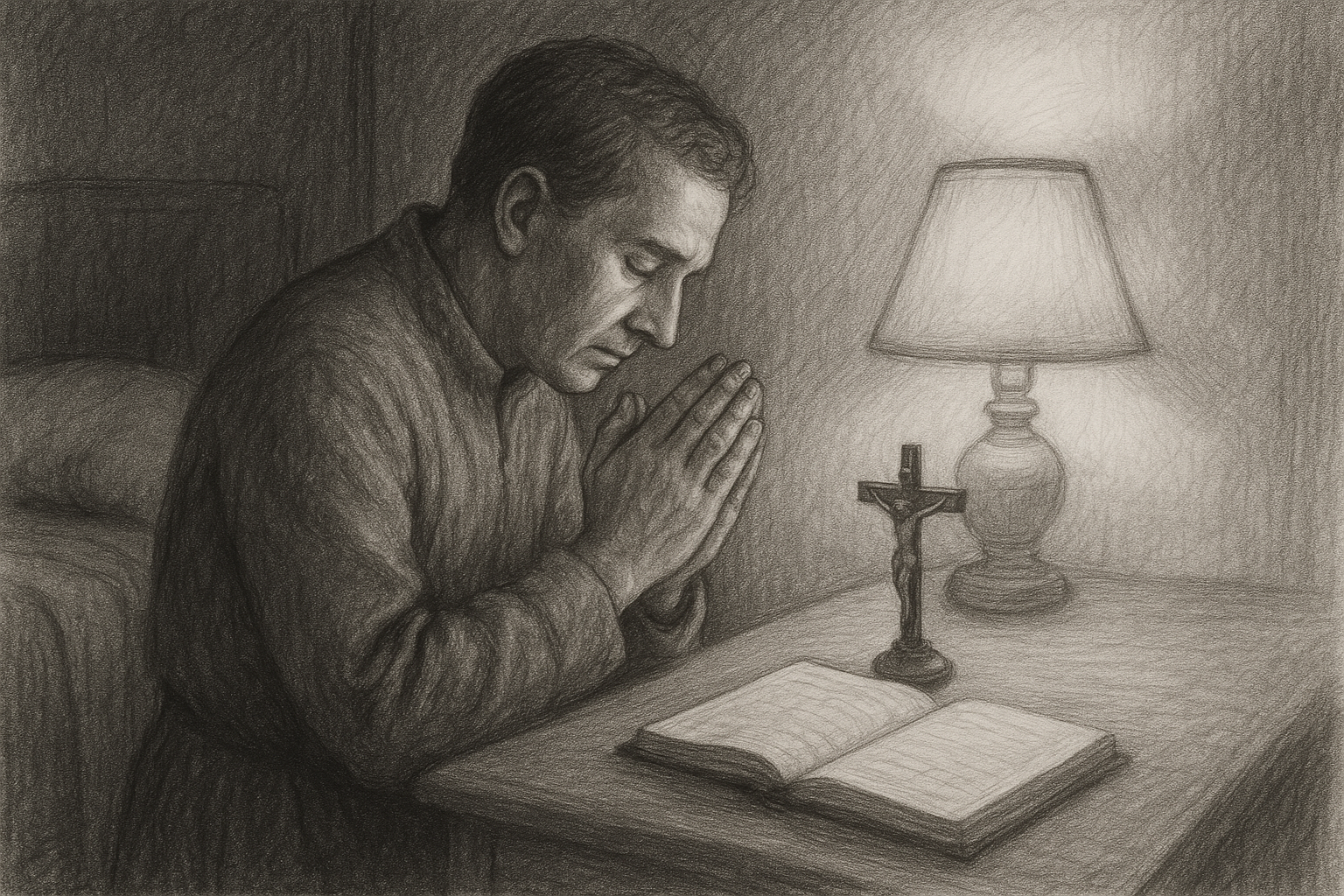
A daily examination does not need to be long to be fruitful. For many people, five to ten minutes is enough. The important thing is steadiness. Choose a time that is likely to be protected, often in the evening before bed. Some people pray it kneeling by the bedside, others in a chair with a crucifix or Scripture nearby. The setting matters less than the sincerity.
One helpful pattern is to follow a few clear movements:
- Place yourself in God's presence and ask for light.
- Give thanks for the graces and gifts of the day.
- Review the day from morning to night.
- Name the sins, failures, and omissions you recognize.
- Express sorrow and ask for mercy.
- Resolve, with God's help, to make one concrete change tomorrow.
This structure is simple enough for beginners, but it is also deep enough for lifelong use. The first step matters more than many people realize. Asking for light reminds the soul that this is prayer, not mere introspection. The examination is not a solo performance of moral seriousness. It is a response to grace. Without grace, a person may see only weakness. With grace, the same person can see both weakness and the gentle action of God throughout the day.
When reviewing the day, it often helps to move through ordinary events rather than to hunt for dramatic failures. Begin with waking, work, conversation, family life, media use, prayer, meals, and moments of temptation or frustration. Ask simple questions: Where was I impatient? Did I speak with charity? Did I waste time? Did I omit prayer? Did I notice a chance to serve someone and pass it by? Did I give thanks? Such questions are practical because holiness is lived in ordinary time.
A short prayer for the examination
Many Catholics use a brief prayer before beginning. It can be as simple as this: Lord, help me to see my day as you see it. Show me where I responded to your grace and where I resisted it. Give me sorrow for my sins, gratitude for your goodness, and courage to begin again.
That kind of prayer keeps the heart from turning harsh. It reminds us that the purpose of the examination is not to condemn but to convert. Even sorrow should be lived in trust. The one who searches the conscience is the one who can also heal it.
How to keep the practice from becoming scrupulous
Some Catholics hesitate to adopt a daily examination because they fear becoming scrupulous. That concern is worth taking seriously. A healthy examination of conscience is marked by peace, truth, and proportion. Scrupulosity, by contrast, turns every slip into an emergency and often leaves the soul unable to trust God's mercy. The answer is not to avoid self-examination, but to carry it out with discipline and simplicity.
One safeguard is to focus on patterns rather than obsessing over every passing thought. A passing distraction in prayer is not the same as deliberate irreverence. A momentary irritation is not the same as settled hatred. The examination should help a person identify real moral failures, not inflate every weakness. Another safeguard is to keep the examination brief. Long, anxious self-interrogation can feed uncertainty. A short, faithful review done each day is usually healthier than an irregular and overwhelming search.
It is also wise to let the sacrament of Confession do what it is meant to do. If a person is unsure whether a matter is serious, a confessor can help. A daily examination does not replace spiritual guidance. In fact, it often reveals the need for it. A trustworthy confessor can help distinguish serious sin from ordinary imperfection and can offer steady direction when a person is caught between laxity and scrupulosity.
Above all, remember that conscience is meant to be informed by truth and formed by charity. The goal is not to become inwardly preoccupied. The goal is to become freer for love of God and neighbor.
What to ask when the day has been especially difficult
Some days are more demanding than others. There are days of conflict, fatigue, disappointment, or sin that seems obvious and heavy. On such days, the examination of conscience can feel painful. Yet those are often the days when the practice is most needed. The Christian does not examine the conscience only when the day has gone well. He brings the whole day, including its confusion, into the light of Christ.
When the day has been difficult, it can help to ask a few focused questions. Where did I refuse grace? What wound or fear was at work beneath my words or actions? Did I respond to stress with anger, escape, or self-pity? Did I fail to trust God in a moment that called for patience? Did I hurt anyone by omission, silence, or indifference? These questions are not meant to overwhelm, but to reveal the deeper spiritual landscape.
After naming failure, do not linger there. Move quickly to sorrow and hope. The Lord does not ask for theatrical regret. He asks for truth. A simple act of contrition, said slowly and sincerely, can be enough to place the day back into God's hands. Then make one practical resolution. If you were sharp with a family member, resolve to speak more gently tomorrow. If you wasted time online, choose a concrete limit. If you missed prayer, set a fixed time and keep it. Grace usually works through such small, realistic promises.
The examination and the sacramental life
A daily examination of conscience belongs naturally to the sacramental life of the Church. It prepares the soul for Confession, making confession less vague and more fruitful. Instead of arriving with only a general sense of guilt, the penitent can speak clearly about habits, occasions, and failures. That honesty helps the confessor give better counsel and helps the penitent receive mercy with greater faith.
It also deepens Eucharistic devotion. Saint Paul warns the faithful to examine themselves before receiving the Lord's Body and Blood: Let a person examine himself. This is not because the Eucharist is withheld from the weak. It is because the Eucharist is holy, and the heart should approach with reverence. A daily examination encourages that reverence by teaching a person to live in a state of readiness, not anxiety, before God.
Over time, this practice can reshape a whole Catholic life. Evening review becomes morning intention. Confession becomes more honest. Communion becomes more grateful. Daily prayer becomes less mechanical. The heart begins to notice the difference between what merely feels urgent and what is truly important. That is one of the quiet gifts of conscience properly formed.
For anyone seeking a steady way forward, the path is not complicated. Begin tonight. Give thanks, review the day, name what needs repentance, and ask for mercy. If the practice feels awkward at first, keep going gently. The conscience becomes clearer by being used in the light of God, and the light of God never diminishes the soul it reveals.
Keep Reading on Lets Read The Bible
Frequently Asked Questions
How long should a daily examination of conscience take?
It can be as short as five minutes or as long as ten, especially at the beginning. The key is regularity and sincerity, not length.
Is a daily examination of conscience only for people preparing for Confession?
No. It is useful for every Catholic who wants to grow in self-knowledge, gratitude, and repentance. It also helps prepare for Confession when the sacrament comes.
What if my examination of conscience makes me anxious?
Keep it brief, focus on real patterns rather than every small fault, and bring concerns to a confessor or spiritual director. The practice should lead toward peace and honesty in God's mercy, not fear.