Sacraments and Liturgy
A Quiet Saturday with Mary: Entering the First Saturday Devotion with Faith
A clear Catholic guide to the First Saturday devotion, its roots in the Fatima message, and the simple spiritual discipline it invites.
Site Admin | September 23, 2025 | 95 views
The First Saturday devotion is simple on the surface, yet it reaches deep into Catholic life. It gathers familiar prayers and practices, confession, Communion, the Rosary, and meditation, and places them within a single act of love offered to God with Mary. For many Catholics, it becomes a monthly rhythm of repentance and peace. For others, it is a devotion they have heard of but never quite understood. First Saturday devotion explained means more than listing the required prayers. It means seeing why the Church has long encouraged Marian devotion as a path that leads to Christ.
The devotion is associated with the apparitions of Our Lady of Fatima in 1917 and the call she gave to reparation for sins and conversion of heart. In that message, Mary asked the faithful to make amends for offenses against her Immaculate Heart, not because she stands apart from Christ, but because she always draws souls toward him. The First Saturday devotion reflects that movement very clearly: it is Marian, but it is never merely sentimental. It is penitential, Eucharistic, and centered on grace.
Where the devotion comes from
The First Saturday devotion developed in response to the Fatima message, especially the later request commonly associated with the apparitions at Pontevedra in 1925. The devotion asks the faithful to practice a set of acts on five consecutive first Saturdays of the month in reparation for sins committed against the Immaculate Heart of Mary. The Church does not treat this devotion as a new sacrament or as something required of all Catholics. Rather, it stands within the rich tradition of approved private devotion, helping the faithful live the Gospel more intentionally.
What makes the devotion striking is its balance. It is tender toward Mary, but it never loses sight of Christ. It is personal, but not private in the shallow sense. It forms the believer in habits that are deeply ecclesial: sacramental confession, Eucharistic Communion, the Rosary, and meditation. These are not isolated spiritual techniques. They are ways of entering the life of the Church, which is itself Christ's body.
The heart of the devotion
The First Saturday devotion asks the faithful to offer four acts on five consecutive first Saturdays:
- Go to sacramental confession.
- Receive Holy Communion.
- Pray five decades of the Rosary.
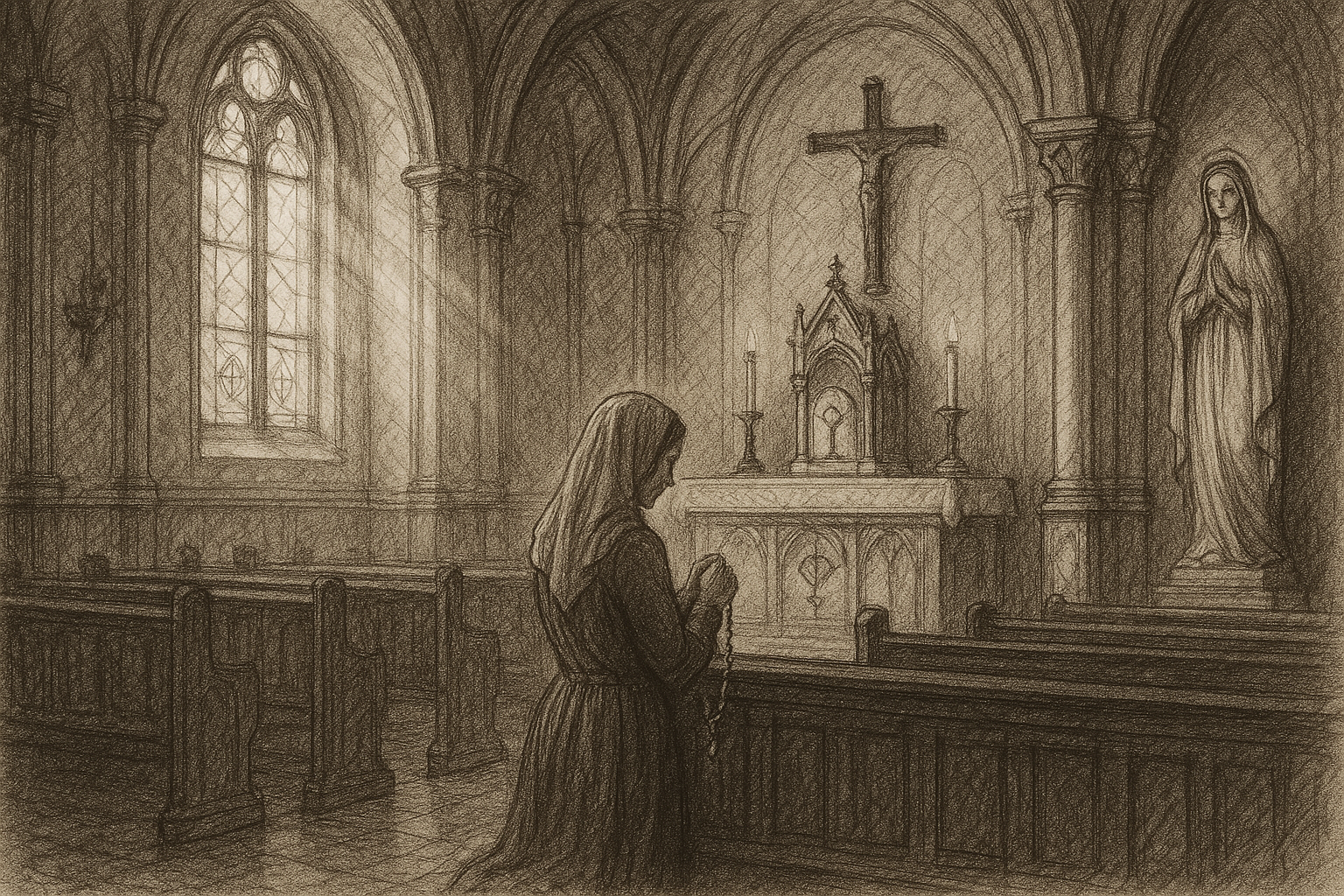
- Keep Mary company for 15 minutes while meditating on one or more mysteries of the Rosary.
These acts are often remembered as a checklist, but their spiritual meaning is richer than that. Confession opens the soul to mercy. Communion unites the believer to Christ in the Eucharist. The Rosary keeps the mind in the school of the Gospel. Meditation asks for quiet attention, a willingness to sit with the mysteries of Christ rather than merely speak about them. Together, they form a monthly pattern of repentance and contemplation.
The number five is part of the devotion as commonly practiced, and the Church has received it as such in the Fatima tradition. Yet the point is not arithmetic. The point is fidelity. Five Saturdays become a school of perseverance. The soul learns that devotion is not only a feeling in one moment, but a repeated yes to grace.
Why reparation matters
Some Catholics first encounter this devotion and wonder why reparation should be needed at all. Scripture and the life of the Church give the answer. Sin wounds communion, not only between individuals but also within the whole Mystical Body. We are not saved as isolated believers, but as members of a people. When love is rejected, love can also be offered in return. The logic of reparation is not strange to Catholic faith. It flows from the cross, where Christ himself makes satisfaction for sin once and for all.
I rejoice in my sufferings for your sake
St. Paul does not mean that Christ's sacrifice was incomplete. Rather, he shows how Christian suffering can be united to Christ for the good of the Church. Marian reparation stands in that same pattern. It is not a competing sacrifice, but a participation in the love of Christ, offered with the compassion of his Mother. In this way, the First Saturday devotion is a school of consolation and mercy.
The devotion also helps Catholics remember that devotion to Mary is never rivalrous. Mary does not absorb honor that belongs to Christ. She reflects it. Her Immaculate Heart is precious because it is wholly ordered to the Son. Any authentic Marian devotion finally enlarges faith in Jesus, deepens repentance, and strengthens trust in divine mercy.
How to observe First Saturday faithfully
For someone beginning the devotion, the practical steps can seem easier than expected. The Church's pastoral guidance is not meant to burden the faithful, but to help them enter the devotion with sincerity.
- Go to confession. This should be done within a reasonable time before or after the first Saturday, according to pastoral judgment and the state of grace needed for Communion. The essential point is contrition and sacramental reconciliation.
- Receive Holy Communion. Attend Mass and receive the Eucharist reverently, with the intention of making reparation.
- Pray five decades of the Rosary. You may pray them in church, at home, or in another suitable setting, as long as you pray them devoutly.
- Meditate for 15 minutes on the mysteries of the Rosary. This can be done by considering one mystery deeply, or by reflecting quietly on several. The goal is loving attention, not complexity.
It is helpful to set aside the day with intention rather than rushing through the prayers. If possible, arrange your confession ahead of time. Prepare for Mass by reading the readings or making an act of contrition. After Communion, remain in thanksgiving. When praying the Rosary, do not hurry the words. Let the mysteries lead the heart.
Many Catholics find it useful to choose a stable plan for the 15 minutes of meditation. For example, one month might focus on the Annunciation, another on the Crucifixion, another on the Resurrection. The specific method matters less than the fidelity with which it is done. The devotion asks for presence, not performance.
What the devotion forms in the soul
First Saturday devotion has a quiet way of teaching the Christian life. It forms habits that are easy to state but hard to sustain without grace. Confession forms humility. Communion forms hunger for Christ. The Rosary forms memory, helping the believer keep the life of Jesus before the eyes of faith. Meditation forms silence, and silence is often where surrender begins.
There is also a profoundly Marian shape to the devotion. Mary is not a distant symbol in it. She is a mother who gathers her children around the mysteries of her Son. To pray on First Saturday is to stand, however briefly, in her company. This does not replace the Mass or the sacraments. It disposes the heart to receive them more fully.
That is why the devotion is especially suited to ordinary Catholic life. It can be practiced by the busy, the young, the elderly, the spiritually seasoned, and the spiritually beginning. It does not require unusual eloquence. It asks for constancy. In that sense, it mirrors the quiet faithfulness of Mary herself, who received the word of God and kept it in her heart.
Common misunderstandings
One common misunderstanding is that the devotion is magical, as though the external actions alone guarantee holiness. That is not Catholic faith. The value of the devotion lies in the disposition of the heart and the grace of the sacraments. Another misunderstanding is that only those who can fulfill every detail perfectly should begin. In practice, Catholics should do their best with sincerity and seek guidance from a priest when needed. The devotion is meant to lead souls toward Christ, not to trap them in scrupulosity.
Another concern is whether devotion to Mary distracts from Jesus. In healthy Catholic life, the opposite is usually true. Marian devotion, when properly ordered, brings believers closer to the mysteries of Christ. The Rosary itself is a Christ-centered prayer. The First Saturday devotion simply places that prayer within a framework of sacramental communion and reparation.
It can also be helpful to remember that devotions do not replace the obligations of the Christian life. Sunday Mass, the commandments, charity, forgiveness, and daily prayer remain essential. First Saturday is not a substitute for those duties. It is a support for them, a monthly act of renewal that strengthens everything else.
Living the devotion as a habit of love
The most fruitful way to keep First Saturday is to treat it as an offering rather than a task. A task can be completed and forgotten. An offering remains alive because it is given to Someone. On the first Saturday of the month, the Catholic who prays this devotion is saying, in effect, that mercy is real, sin is real, the Eucharist is real, and Mary is a true mother in the order of grace.
That is a strong claim, but it is also a tender one. The devotion invites the faithful to place their ordinary lives inside the mercy of God. It asks for repentance without despair, reverence without fear, and love without reserve. When lived well, it becomes less like an added obligation and more like a monthly return home.
And perhaps that is the deepest gift of First Saturday devotion: it teaches the heart to keep company with Mary long enough to hear again what she always says, namely that Christ is worth everything, and that his mercy is still open to those who come with faith.
Keep Reading on Lets Read The Bible
Frequently Asked Questions
Is the First Saturday devotion required of all Catholics?
No. It is an approved private devotion, not a universal obligation. Catholics are free to practice it and may find it spiritually fruitful, but it is not required in the way Sunday Mass is required.
Do confession and Communion have to happen on the exact first Saturday?
The intention is to observe the devotion on first Saturday, but practical pastoral guidance allows confession to be made within a reasonable time before or after, provided the person is properly disposed. Communion should be received on the first Saturday itself as part of the devotion.
What should I meditate on during the 15 minutes?
You may meditate on one or more mysteries of the Rosary. Many Catholics choose a mystery and quietly contemplate its place in the life of Christ and Mary. The important thing is prayerful attention, not a complicated method.