Social Teaching
Speaking the Truth Without Losing the Neighbor
Catholic discipleship asks more of us than being right. It asks us to love well when we disagree.
Site Admin | October 22, 2025 | 90 views
Public disagreement is now part of ordinary life. It happens in parish meetings, family conversations, school board debates, comment sections, and workplaces where people must share space even when they do not share convictions. For Catholics, the challenge is not simply to avoid rudeness. The deeper question is how to remain faithful to Christ when truth and tension arrive together.
The Church does not ask the faithful to pretend that disagreement is unimportant. Many matters are serious. Human life, marriage, justice, religious liberty, the poor, and the moral order are not small questions. But Catholic teaching also insists that truth must be joined to charity. The believer is never free to treat another person as a problem to be crushed. Every person is made in the image of God, and that changes the way we speak, listen, and argue.
Truth is not the enemy of charity
Some people imagine that charity means softness, silence, or avoiding hard questions. In Catholic life, charity is much stronger than that. It is love ordered toward the good of the other. That means charity may include correction, disagreement, and witness. It may mean saying plainly that something is wrong. Yet it must never become contempt.
Scripture holds these truths together. Saint Paul teaches,
speaking the truth in loveand also warns that even strong gifts are empty without love:
If I speak in human and angelic tongues but do not have love, I am a resounding gongThe Church receives both lessons. Truth without love hardens. Love without truth drifts. Christian speech must resist both errors.
This is especially important in public disagreement, where emotions rise quickly and audiences reward sharpness. A person can be technically correct and still act in a way that damages witness to Christ. On the other hand, a person may avoid conflict so completely that he fails in justice or silence becomes complicity. Catholic teaching asks for a better path: clarity without cruelty, conviction without vanity, and firmness without disdain.
The dignity of the person comes first
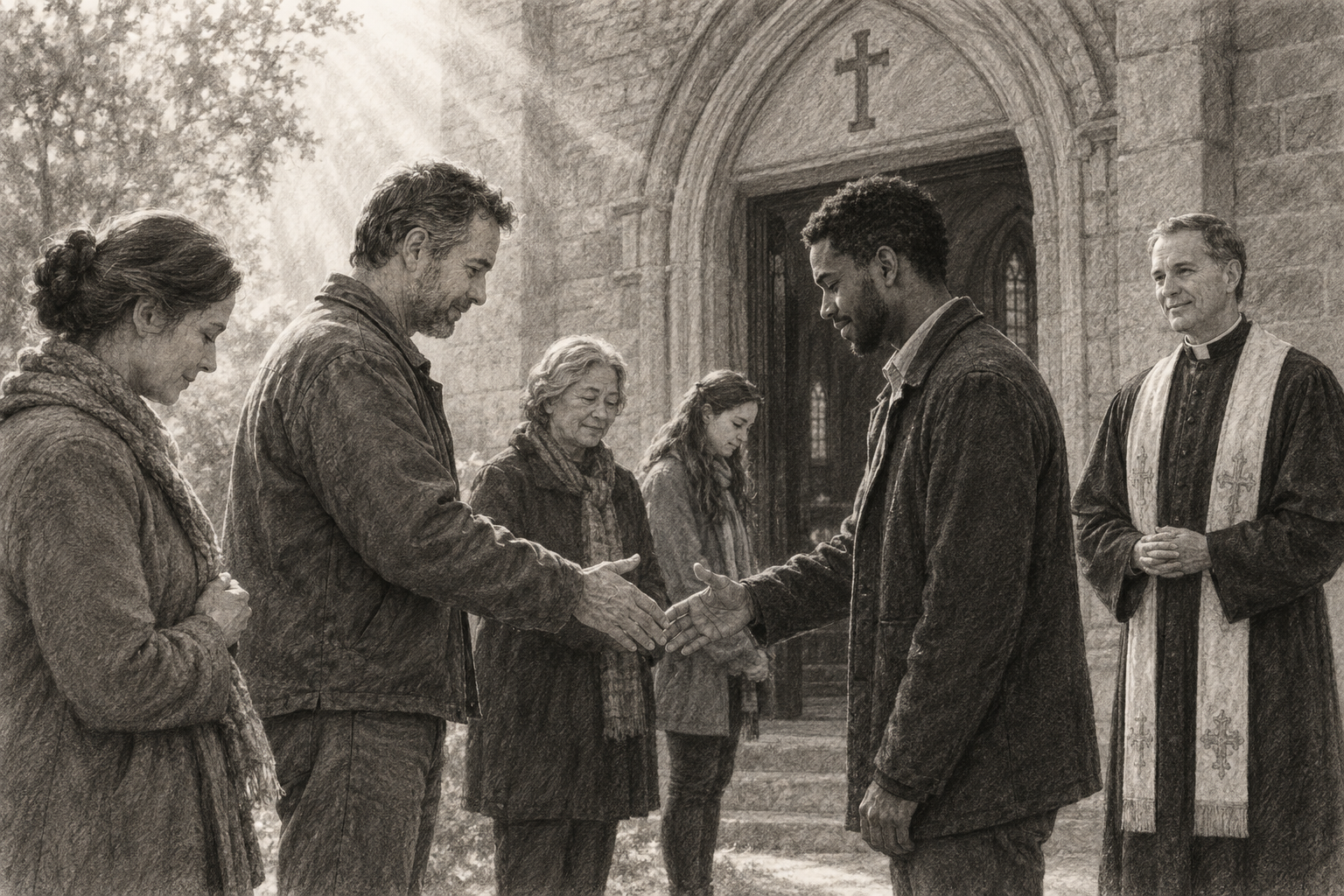
Before Catholics disagree with a position, we must remember the person who holds it. The Church teaches that every human being possesses dignity because every person is created by God. That dignity does not disappear when someone is mistaken, angry, inconsistent, or even hostile. In public life, this is often the first truth to be forgotten.
When we reduce another person to a label, we have already lost something essential. The person before us is not merely an opponent, a voter, a colleague, or a stranger on a screen. He or she is someone for whom Christ died. That does not make every opinion equal, but it does make every person worthy of respect.
This respect is not sentimentality. It is an act of justice. Catholic social teaching has long defended the principle that human dignity stands at the center of social life. If that is true, then mockery, slander, and dehumanizing language can never be excused as mere style. They are moral failures, even when used in defense of a good cause.
Jesus Himself gives the pattern. He speaks with truth and authority, but He also looks at people, listens to them, and calls them to conversion without discarding them. He rebukes sin and still eats with sinners. He reveals the Father and still bends low to wash feet. His way is never careless with truth, but it is always personal.
Public speech reveals the heart
Catholic morality does not treat words as harmless. Words shape communities, form habits, and reveal interior life. That is why Scripture repeatedly warns against idle speech, rash judgment, and anger. In public disagreement, what comes out of the mouth often shows whether a person is seeking the good or seeking victory.
Anger can be understandable. There are real injustices that should trouble a Christian conscience. But anger becomes dangerous when it turns into spite, or when it seeks humiliation instead of repentance. The goal of a Christian conversation is not to win applause from allies. It is to serve truth in a way that leaves room for conversion, friendship, and peace.
Saint James is blunt about the power of speech:
With it we bless the Lord and Father, and with it we curse men who are made in the likeness of GodThat warning applies directly to public debate. It is possible to defend a cause while sinning with the tongue. It is possible to share a true statement and do so in a way that wounds charity.
For that reason, Catholics should be cautious about irony that depends on humiliation, outrage that trades in exaggeration, and language that turns opponents into caricatures. Such habits may feel effective, but they often distort the soul. Over time, they train us to enjoy division. A Christian should not become addicted to the pleasure of contempt.
Catholic social teaching gives practical guardrails
Charity in public disagreement is not vague idealism. Catholic social teaching offers concrete habits that can be practiced in ordinary life.
- Begin with the good of the person in view. Ask what would actually help the other person, not just what would score points.
- Distinguish persons from positions. A bad argument does not make someone worthless, and a strong disagreement does not erase shared humanity.
- Refuse the temptation to exaggerate. Catholics should not misrepresent an opponent in order to make an argument easier to defeat.
- Speak with proportion. Not every issue requires the same tone, but no issue justifies cruelty.
- Be willing to listen. Listening does not mean surrendering conviction. It means recognizing that truth is served by attention as well as by assertion.
- Leave room for conscience. People often come to their views through fear, formation, experience, or pain. Patient speech can uncover what hostility obscures.
These habits matter because public disagreement often becomes impersonal. The more distance there is, the easier it becomes to forget that the other side includes real families, real wounds, and real fears. Catholic social teaching repeatedly reminds us that social questions are not abstractions. They touch lives.
At the same time, charity does not require agreement. A Catholic may firmly reject a policy, protest an injustice, or defend the moral law without compromise. Indeed, there are times when silence would be a failure of love. The point is not to dilute conviction. The point is to express conviction in a manner worthy of the Gospel.
When correction is needed, humility matters
Sometimes public disagreement becomes personal because someone must be corrected. This can happen in family life, parish life, or civic life. Correction is sometimes necessary, but humility changes its shape. A humble person knows that he, too, is capable of error. That awareness softens pride and keeps correction from becoming a performance.
The Lord's teaching in the Sermon on the Mount is a serious warning against self-righteousness:
Why do you notice the splinter in your brother's eye, but do not perceive the wooden beam in your own eyeCatholics do not read this as a call to moral indifference. Rather, it is a call to examine oneself before judging others. The person who knows his own need for mercy will usually speak with more care.
Humility also helps us choose the right moment. Not every disagreement needs to be handled publicly. Some issues require a private conversation, some require a measured public statement, and some require silence until emotions cool. Prudence is part of charity. It asks not only what is true, but how, when, and to whom it should be said.
There is also a place for apology. If a Catholic has spoken harshly, spread incomplete information, or treated another person unfairly, charity requires repentance. Apology is not weakness. It is a sign that truth matters enough to correct oneself. A person who can admit error is often more credible than one who never admits fault.
Peacemaking is not the same as compromise
Some disagreements cannot be resolved by splitting the difference. Catholics should be careful not to confuse peace with vagueness. Peace in the Christian sense is the tranquility that comes from right order, not the mere absence of conflict. Sometimes truth disturbs false peace, and that disturbance is necessary.
Still, peacemaking remains a beatitude. Jesus says,
Blessed are the peacemakers, for they will be called children of GodPeacemaking does not mean avoiding all tension. It means working so that disagreement does not become hatred. It means refusing to make enemies out of people whom God calls us to love.
This is one reason Catholics should resist the habit of treating every disagreement as a battle between good and evil in which the other side is wholly corrupt. Real moral evil exists, and some ideas are gravely wrong. But public life is more faithful to Christ when it keeps moral seriousness together with spiritual sobriety. Not every adversary is a monster. Not every argument is a war. Not every silence is cowardice, and not every loud voice is courage.
There will always be moments when Catholics must stand apart from the dominant opinion. The Church has done so across the ages, often at great cost. Yet the manner of that witness matters. The world notices not only what Christians say, but how they say it. An argument made with patience and dignity can open a door that a harsh tone would shut.
Charity in the digital age requires discipline
Online communication intensifies every weakness of public disagreement. Words are stripped of tone, context disappears, and speed outruns reflection. It is easier to react than to discern. It is easier to forward a sharp line than to check whether it is true. It is easier to perform righteousness than to practice charity.
For Catholics, digital habits deserve moral examination. Before posting or replying, it helps to ask a few simple questions: Is this true? Is it necessary? Is it kind? Is it fair? Will it help anyone grow in understanding? These questions are not a form of censorship. They are a form of discipline.
Discipline matters because the internet rewards escalation. The Christian response must be different. A Catholic need not surrender to the culture of outrage. He can choose a slower, steadier, more honest way. He can correct without sneering, disagree without humiliating, and remain peaceful without becoming passive.
That kind of witness is often unnoticed. It may not draw attention. It may even seem ineffective in a moment when attention is the currency of public life. Yet hidden fidelity has always mattered in the Church. The quiet virtue of a restrained tongue can be as important as a public defense of doctrine. In the end, charity in public disagreement is not an accessory to Catholic life. It is one of the places where discipleship becomes visible.
Christ calls His followers to love their enemies, pray for those who oppose them, and keep their hearts free from revenge. That command does not cancel the duty to speak truth. It gives truth its proper form. When Catholics remember that, public disagreement can become less poisonous and more humane, and even hard conversations can leave room for grace.
Keep Reading on Lets Read The Bible
Frequently Asked Questions
Does Catholic teaching require me to stay quiet in public disagreements?
No. Catholics can and should speak when truth or justice is at stake. The duty is to speak with charity, prudence, and respect for the dignity of the person, not to remain silent at all costs.
Can a Catholic strongly oppose an idea without being uncharitable?
Yes. Strong disagreement is not the same as contempt. A Catholic may reject an argument firmly while still avoiding insults, exaggeration, and dehumanizing language.
What is the best habit for staying charitable in heated debates?
Pause before responding, ask whether your words are true and necessary, and remember the person you are speaking to is made in the image of God. That simple act can change the tone of an entire conversation.