Jesus and the Gospels
When Christ Multiplies the Little We Bring
The feeding of the five thousand reveals both the tenderness and the authority of Jesus, and it still speaks clearly to Catholic life today.
Site Admin | February 3, 2026 | 67 views
The crowd, the hillside, and the mercy of Christ
The feeding of the five thousand is one of the most familiar miracles in the Gospels, yet its familiarity can hide its depth. A tired crowd has followed Jesus into a remote place. The hour grows late. The disciples see a practical problem: there is little food, and the people need to eat. Christ sees something else first. He sees their need, and He receives it with compassion.
In the Gospel of Matthew, Jesus looks on the crowds with pity and heals their sick before the meal is ever served. Then, when the disciples urge Him to send the people away, He gives a reply that still stands at the center of the scene: You give them something to eat. He does not say this to shame them. He says it to draw them into His work.
The miracle begins with a pastoral problem, but it becomes a revelation. The Lord does not merely solve a shortage. He shows what divine generosity looks like when it enters human poverty. That is part of the feeding of the five thousand Catholic meaning: Christ is not distant from ordinary need. He is moved by it, enters it, and transforms it.
Five loaves, two fish, and the Lord who asks for what is available
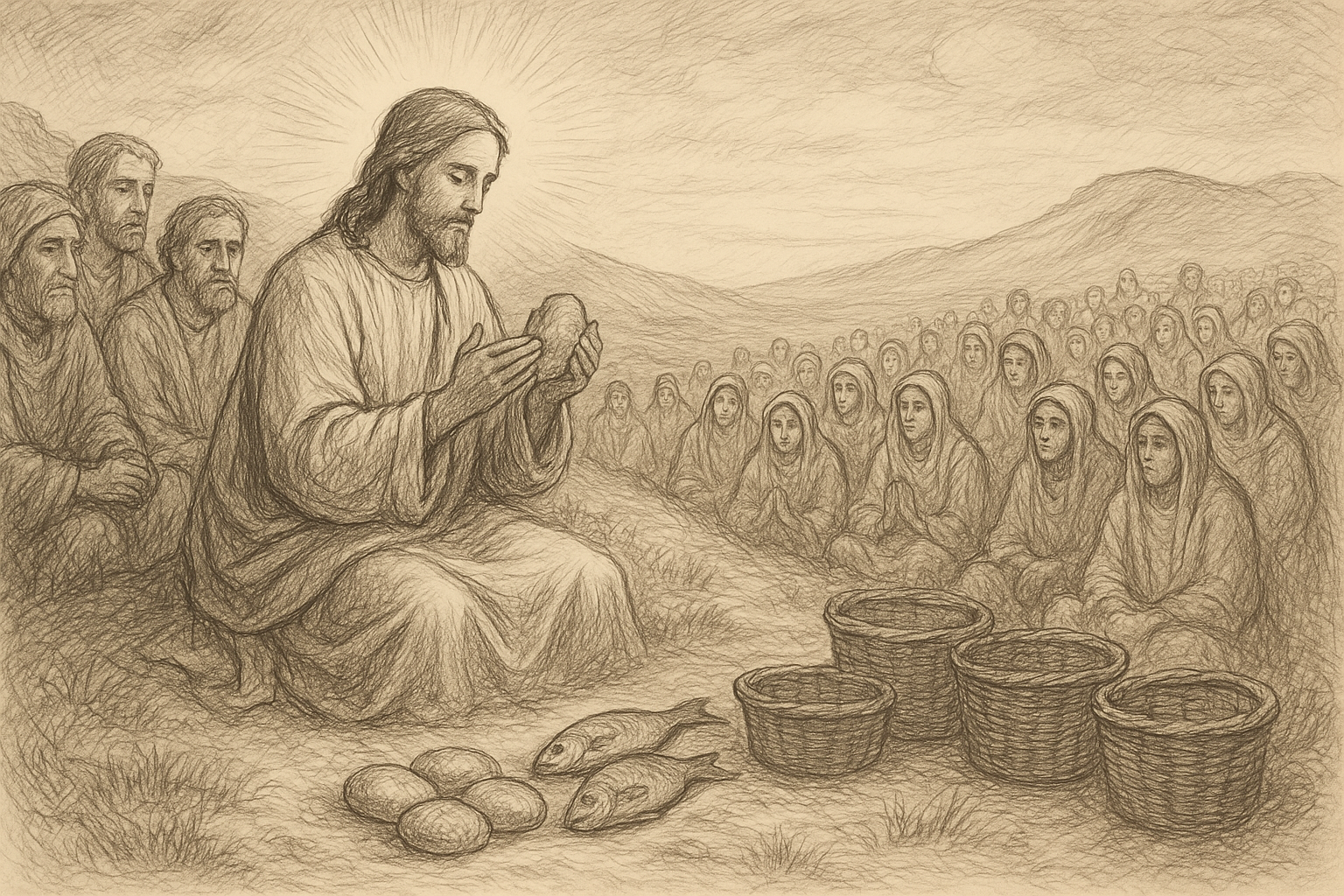
The detail of the loaves and fish matters because it keeps the miracle from becoming abstract. The disciples do not hand Jesus a treasury. They bring a meager offering. In St. John's account, a boy has five barley loaves and two fish, and even that is described as a small and insufficient beginning. The point is not the greatness of the gift. The point is the greatness of the One who receives it.
Jesus takes the bread, looks toward heaven, blesses it, breaks it, and gives it. That pattern is not accidental. It echoes the language and movement Catholics hear in the Eucharist. The Church has long seen in this miracle a sign that points beyond itself. The feeding in the desert is real food for real people, but it also gestures toward a deeper feeding that Christ will give in His Body and Blood.
Even before the Last Supper, Jesus is already acting as the true shepherd who feeds His flock. He does not wait for abundance before beginning. He begins with what is at hand. In Catholic life, that is often how grace works. The Lord asks for the little we have, not because He lacks power, but because He loves to make His power visible in our surrender.
A sign of the Eucharist, not a replacement for it
Catholics often notice the Eucharistic shape of this miracle, and rightly so. The Gospel verbs are familiar: Jesus takes, blesses, breaks, and gives. The setting includes a crowd gathered around Christ in need of sustenance. The result is not only enough food but abundance, with twelve baskets left over. These details matter because they help the Church read the event as a sign.
Still, it is important not to flatten the miracle into a simple symbol. Jesus truly feeds the people. This is a historical act of mercy, not merely a lesson with bread imagery. Yet its history opens into mystery. The same Lord who multiplied loaves will later give Himself sacramentally in the Eucharist, where He remains truly present and offers not only earthly nourishment but communion with His own life.
In that sense, the feeding of the five thousand Catholic meaning reaches in two directions at once. It reveals the compassion of Jesus in the Gospel story, and it prefigures the sacramental life of the Church. The desert becomes a place of divine provision. The table of loaves becomes a glimpse of the altar. The hungry crowd becomes a sign of humanity's deeper hunger for God.
The miracle says something simple and searching: when Christ is near, scarcity is no longer the final word.
What the disciples learn when they feel their limits
The disciples are not side characters in this scene. They are caught in the tension between human inability and divine command. They count the people, estimate the cost, and see the problem clearly. Their instincts are understandable. Many of us respond the same way when faced with too much need and too few resources.
Yet Jesus involves them anyway. He tells them to bring what they have. He has the crowd sit down. He gives them the loaves to distribute. The disciples become ministers of the miracle before they fully understand it. This is one of the quiet lessons of the passage: Christ often feeds others through hands that first have to learn trust.
That is why the story speaks so directly to discipleship. Catholics are not called to wait until they feel sufficient. We are called to obey the Lord with what we have. A family may have limited time, a parish may have limited energy, and a believer may feel spiritually poor. None of that prevents God from working. He asks for fidelity, and He supplies the fruit.
There is also a warning here against spiritual self-reliance. The disciples can organize the crowd only so far. They can count loaves, but they cannot create bread from nothing. In the life of faith, it is easy to confuse planning with providence. Christ teaches another order: first mercy, then blessing, then distribution, then abundance. Human effort remains real, but it is never the source of grace.
Abundance that is never wasteful
At the end of the miracle, the people are satisfied, and twelve baskets remain. Scripture does not present this as careless excess. It is a sign of divine fullness. Christ gives more than enough because His generosity is not stingy, and His providence is not fragile.
The twelve baskets also invite reflection. In the biblical imagination, twelve often calls to mind the tribes of Israel and the apostolic foundation of the Church. The leftovers are not merely scraps. They suggest that what Jesus provides is meant to be gathered and shared, not squandered. Grace is to be received with reverence.
This detail has practical weight for Catholics. The Lord who feeds the crowd also teaches us to gather what remains. In the spiritual life, there are graces that can be overlooked if we rush past the gift. A consoling word, a difficult lesson, a moment of prayer, a sacramental encounter, all of these can be like baskets left over after a feast. They should be held with gratitude.
Desert hunger and the hunger of the human heart
The place of the miracle matters as well. Jesus leads the crowd away from ordinary centers of supply. He brings them into a lonely place. That setting recalls the biblical desert, where God fed His people with manna. The evangelists are not merely reporting geography. They are revealing a pattern in salvation history. God feeds His people where they cannot feed themselves.
Catholics know that this pattern is not only ancient. It describes the heart. We are often more starved than we realize. We hunger for meaning, peace, belonging, and holiness. We try to satisfy that hunger with many things, but the need remains. The feeding of the five thousand Catholic meaning includes this clear lesson: earthly goods can be real and still insufficient. Only Christ meets the deepest hunger.
That does not make ordinary needs unimportant. Jesus is attentive to bodies, not only souls. He feeds the hungry because He loves the whole person. This is one reason the miracle speaks so powerfully to Catholic social concern. Acts of mercy toward the poor are never separate from the Gospel. They belong to it. When the Church feeds the hungry, she is not performing a secondary task. She is imitating her Lord.
How Catholics can live this miracle now
The feeding of the five thousand invites more than admiration. It asks for response. Catholics can receive its grace in concrete ways.
- Bring the little you have to Christ. Time, energy, prayer, patience, and material resources may feel small. Offer them anyway.
- Trust the Lord before you can see the outcome. The disciples distributed bread before they understood the abundance.
- Receive the Eucharist with wonder. The miracle points toward the sacrament, where Christ gives Himself as true food.
- Practice mercy toward the hungry. The Gospel does not let us separate worship from works of charity.
- Gather the leftovers. Notice and preserve the graces God provides in ordinary, overlooked ways.
These are simple movements, but they are not small. They train the heart to live by gift. They also protect us from the illusion that holiness depends on possessing enough resources, enough answers, or enough strength. The Lord who fed the crowd is still able to work through poverty offered in faith.
The miracle still points beyond itself
The feeding of the five thousand remains compelling because it is both concrete and luminous. It answers a real need in a real place, but it also opens onto the shape of Christian life. Christ feeds, the disciples distribute, the people receive, and abundance remains. That is not only a memory from the Gospel. It is a pattern for the Church.
When Catholics hear this story, they are invited to see more than multiplication. They are invited to recognize the heart of Jesus. He is attentive to the crowd, patient with His disciples, generous with His gifts, and faithful in providing what He commands us to share. The miracle is not merely that bread grows. It is that Christ Himself is enough.
And so the scene on the hillside still reaches us. We bring our shortage. He offers His blessing. We place the fragments in His hands. Then, in a way only grace can explain, there is more than we expected, and the people are fed.
Keep Reading on Lets Read The Bible
Frequently Asked Questions
Why do Catholics connect the feeding of the five thousand with the Eucharist?
Because Jesus uses the familiar pattern of taking, blessing, breaking, and giving bread. The miracle is a real historical event, but it also points forward to the Eucharist, where Christ gives Himself sacramentally as true food for the Church.
What does the twelve baskets left over mean?
The twelve baskets suggest the fullness and generosity of God's provision. Many Catholic readers also see a link to the twelve tribes of Israel and the twelve apostles, showing that Christ's gift is meant for the whole people of God.
How can this Gospel passage help in daily Catholic life?
It encourages Catholics to bring small offerings to Christ with trust, to receive the Eucharist with greater reverence, and to practice works of mercy toward those in need. The story teaches that God can multiply what we place in His hands.