Jesus and the Gospels
When the Bridegroom Delays: Reading the Wise and Foolish Virgins with Catholic Eyes
Christ's parable of the ten virgins is a sober call to watchfulness, ready faith, and persevering love.
Site Admin | March 6, 2026 | 60 views
Among the parables of Jesus, few are as brief or as searching as the story of the wise and foolish virgins. It appears in the Gospel according to Matthew, set within the Lord's final teaching before His Passion. The scene is simple: ten virgins wait for a bridegroom, lamps in hand, for the arrival of the wedding feast. Yet the parable opens onto a much larger horizon. It is about vigilance, judgment, grace, and the mystery of Christ's return.
For Catholics, the the Wise and Foolish Virgins explanation is not merely a lesson in common sense. It is a call to live in readiness before God. The parable asks whether our faith is alive, whether our charity is sustained, and whether we are prepared to meet the Lord when He comes, at the end of time and at the hour of our death.
The biblical setting of the parable
Matthew places this parable in Jesus' final discourse before the Passion, a section of teaching often called the Mount of Olives discourse. In that setting, the Lord speaks plainly about the coming of the Son of Man, the need for watchfulness, and the uncertainty of the hour. The parable of the ten virgins appears in Matthew 25:1-13, just before the parable of the talents and the judgment of the nations.
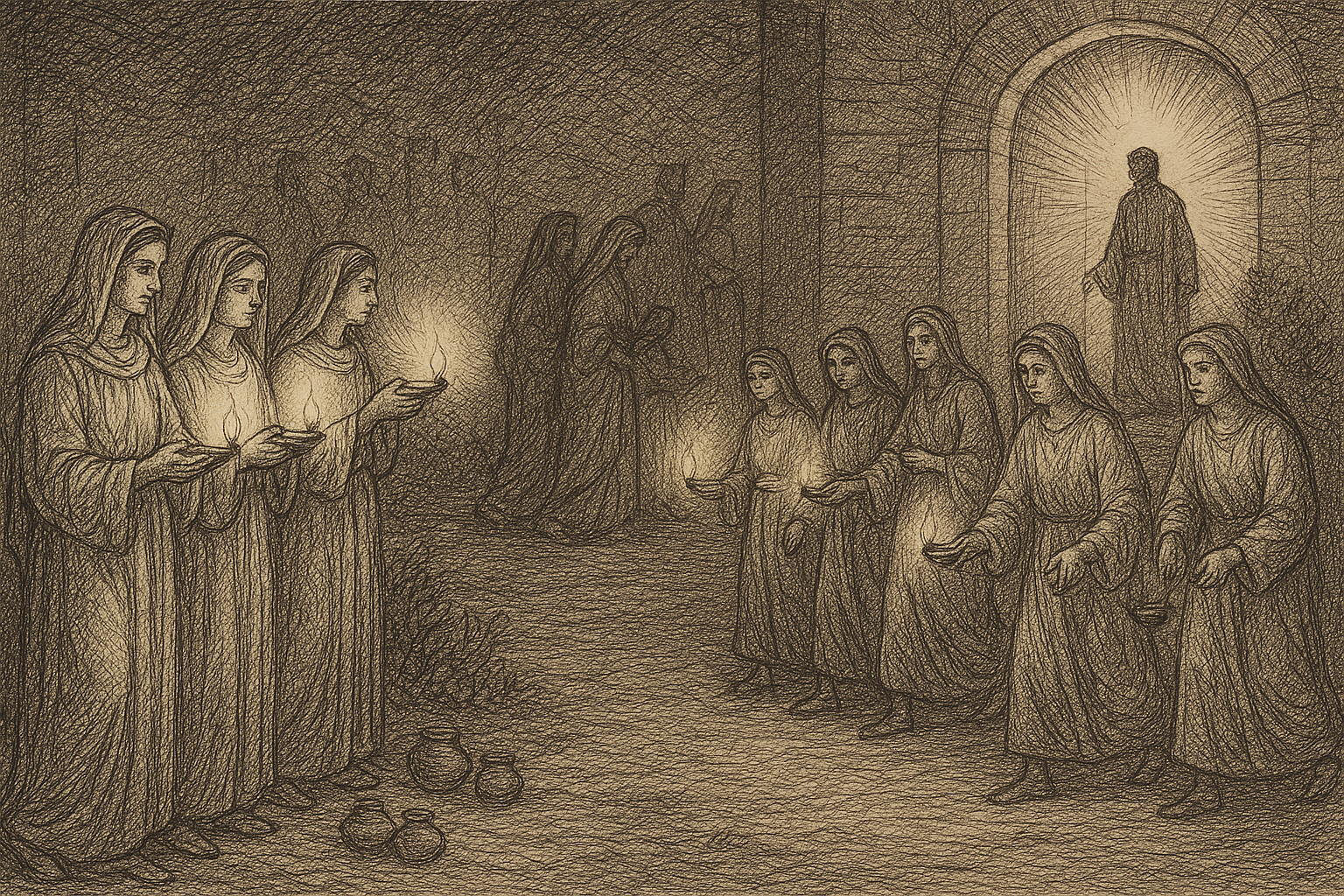
The imagery would have been familiar to Jesus' first hearers. A wedding procession in the ancient world was a communal event. The bridesmaids or virgins waited with lamps to greet the bridegroom and accompany him to the feast. In the story, all ten are waiting, and at first glance they all seem alike. The difference comes not in their expectation but in their preparation.
Five are wise because they bring extra oil. Five are foolish because they bring only their lamps. When the bridegroom is delayed and all become drowsy, the cry finally goes up: Behold, the bridegroom! Come out to meet him Behold, the bridegroom! Come out to meet him. The foolish virgins discover too late that their lamps are failing. While they go off to buy oil, the bridegroom arrives, the wise enter with him, and the door is shut.
Watch therefore, for you know neither the day nor the hour Watch therefore, for you know neither the day nor the hour.
What Jesus is teaching through the image of oil
The parable is not about a literal supply list for a wedding. Jesus is using the image of oil to point to an interior reality. The wise virgins possess something that cannot be borrowed at the last moment. They have a readiness rooted in prior fidelity. Their lamps are not enough by themselves. They need the oil that keeps the flame alive.
Catholic tradition has often read this oil as a figure of grace, charity, and persevering holiness. The exact symbol can be held with care, since parables often contain several layers of meaning. But the central point is clear: outward belonging is not enough. It is not enough to be near the Bridegroom, to carry a lamp, or to be counted among those waiting. One must actually be prepared.
This is why the wise and foolish are both within the group of the waiting. The Lord is not contrasting believers and unbelievers in a crude sense. He is warning those who expect Him. The danger is spiritual negligence within the sphere of discipleship. A lamp without oil is a visible sign of a hidden lack.
That hidden lack matters because the coming of the Lord is not something to schedule or control. The parable belongs to the Church's sober faith in the Lord's return, the Parousia. Christ will come again in glory to judge the living and the dead. The Gospel does not invite fear alone, but it does reject spiritual laziness. The Lord's delay is not indifference. It is mercy, giving time for repentance, growth, and perseverance.
Why the delay matters
One of the striking features of the parable is the delay of the bridegroom. The waiting becomes long enough for drowsiness to overtake all ten virgins. This detail speaks deeply to Christian life. Many believers begin with zeal, but time tests the soul. The interval between conversion and fulfillment is where faith is either deepened or neglected.
In Catholic life, the delay of the bridegroom can be felt in ordinary ways. We pray, but answers do not come at once. We seek holiness, but progress can be slow. We believe in Christ's promises, yet history continues with suffering, confusion, and apparent silence. The parable reminds us that waiting is not wasted time. It is the place where readiness is formed.
The foolish virgins are not condemned for sleeping, since all ten sleep. Their failure lies earlier, in not bringing enough oil. In other words, the problem is not ordinary human weakness but unpreparedness. A Christian can grow tired, but he must not live carelessly. He can stumble, but he must not cease to tend the flame.
The Catholic moral lesson: readiness is a habit
For Catholics, vigilance is not a dramatic pose. It is a habit of life. The Church asks the faithful to live in a state of grace, to repent when they fall, to receive the sacraments worthily, and to cultivate the virtues that make endurance possible. These are not decorative extras. They are the oil that keeps the lamp burning.
The parable invites examination of conscience. Do I assume that tomorrow will always be available? Do I postpone conversion because mercy seems infinite and time seems abundant? Do I rely on the faith of my family, my parish, or my past devotion, while neglecting prayer and repentance now?
Jesus' warning is sharp because love is at stake. The bridegroom is not a stranger. He is the one for whom the virgins wait. In the broader Gospel, Christ reveals Himself as the Lord who comes to gather His people into communion. Read that way, the shut door is a tragic image of self-chosen exclusion. The foolish virgins are not kept out because the feast is petty, but because they were not ready for communion when communion finally arrived.
That seriousness should not make Catholics anxious in a sterile way. Rather, it should encourage a steady, hopeful discipline. Holiness is built in small acts: attentive prayer, faithful Sunday worship, honest confession, mercy toward others, and perseverance in daily duty. The Lord often prepares souls not by sudden spectacle but by the repeated grace of ordinary fidelity.
Readiness in the sacramental life
The Church's sacramental life gives concrete shape to the watchfulness Christ asks of His disciples. In Baptism, we receive new life. In Confirmation, we are strengthened by the Holy Spirit. In the Eucharist, we are fed with the Body and Blood of the Lord. In Penance, we are restored when our lamps have gone dim. These are not symbolic gestures detached from the parable. They are ways Christ keeps His people ready.
It is especially fitting to think of the Eucharist in this context. The Mass trains the heart for the Bridegroom's coming. Every liturgy is a foretaste of the wedding feast, a participation in the Church's longing for the Lord. When the faithful say, in the liturgy, that they await His coming, they are not reciting a distant idea. They are standing in the posture of the wise virgins: waiting with lamps that need oil, but with hope rooted in the promise of Christ.
Confession also belongs here. The foolish virgins discover too late that oil cannot be borrowed at the last minute. In the same way, no one can live indefinitely on the borrowed fervor of another person. Each soul must respond personally to grace. Yet when sin has depleted the lamp, the mercy of God in the sacrament of Reconciliation restores what has been lost. The Church does not preach readiness as self-reliance. She preaches it as cooperation with grace.
How the parable speaks to daily Catholic life
The beauty of the parable is that it applies to ordinary life without losing its eschatological force. Vigilance is not reserved for extraordinary saints or monks in cloistered cells. It belongs to parents, students, workers, retirees, and all who bear the name of Christ.
- In prayer: A daily habit of prayer keeps the soul attentive to God, even when feelings fade.
- In charity: Love for neighbor is not an optional decoration but a sign that grace is active.
- In repentance: Regular confession guards against the slow hardening that comes from delayed conversion.
- In suffering: Trials can purify the soul and make hope more steadfast.
- In hope: Christians do not wait for a vague future, but for the living Christ who has already conquered death.
The parable also corrects a temptation common to every age: the idea that spiritual life can be handled later. Later is the language of the foolish virgins. They plan to adjust at the last moment, as if readiness could be assembled on demand. But grace is usually received in advance, through hidden obedience over time.
When the Lord delays, He is not absent. He is teaching His people how to wait with love. Waiting becomes an act of faith when it is filled with prayer, watchfulness, and trust. In that sense, the Christian life is not a passive interval before the real event. It is already part of the wedding procession.
The parable and the hope of judgment
Modern ears can hear the shutting of the door as harsh. Yet Catholic faith sees judgment as part of divine mercy and truth. The Bridegroom does not force the feast upon unwilling or unprepared hearts. He honors the reality of our choices. The final coming of Christ will reveal what we have become.
That is why the parable is both consoling and severe. It consoles those who strive to remain ready, because their effort is not forgotten. It warns those who drift, because time is not endless. The wise virgins are not praised for brilliance but for prudent perseverance. They kept what they had received and were able to enter when the hour came.
The Church hears this parable as a call to hope in the Lord's return without presumption. We are not to predict the day or build our lives as if history were self-contained. We are to live in a way that makes sense only if Christ is truly coming again. That is the shape of Christian realism.
In the end, the wise and foolish virgins explain one another by contrast. The wise reveal that readiness is possible. The foolish reveal that proximity to holy things is not the same as possession of living faith. Between the two stands every disciple, invited to keep watch, tend the flame, and wait for the Bridegroom with a heart made steady by grace.
Keep Reading on Lets Read The Bible
Frequently Asked Questions
What does the oil in the parable of the wise and foolish virgins mean?
Catholic readers often understand the oil as a sign of grace, charity, and persevering holiness. The main point is that readiness before God cannot be improvised at the last moment.
Why did Jesus say the bridegroom was delayed?
The delay highlights the long waiting of Christian life before Christ's return. It teaches patience, perseverance, and the need to remain faithful over time.
How can Catholics live the message of this parable today?
By remaining in a state of grace, praying regularly, receiving the sacraments faithfully, practicing charity, and avoiding spiritual procrastination.