Sacraments and Liturgy
Ashes, Bread, and the Discipline of Desire
Lent invites Catholics into prayer, fasting, and almsgiving so that the heart can become more free for Christ.
Site Admin | September 13, 2025 | 70 views
Lent begins with a serious and hopeful invitation
For many Catholics, Lent arrives with familiar signs: ashes on the forehead, the call to prayer, and the question of what to give up. Yet Lent and fasting explained well are more than a list of religious habits. Lent is the Church's annual call to conversion, a time to turn back to God with greater honesty, humility, and trust.
The season prepares us for Easter by leading us through prayer, fasting, and almsgiving. These practices are not meant to impress anyone. They are meant to free the heart. In the language of the Gospel, they help us store up treasure in heaven rather than become attached to what passes away Matthew 6:19, Matthew 6:21.
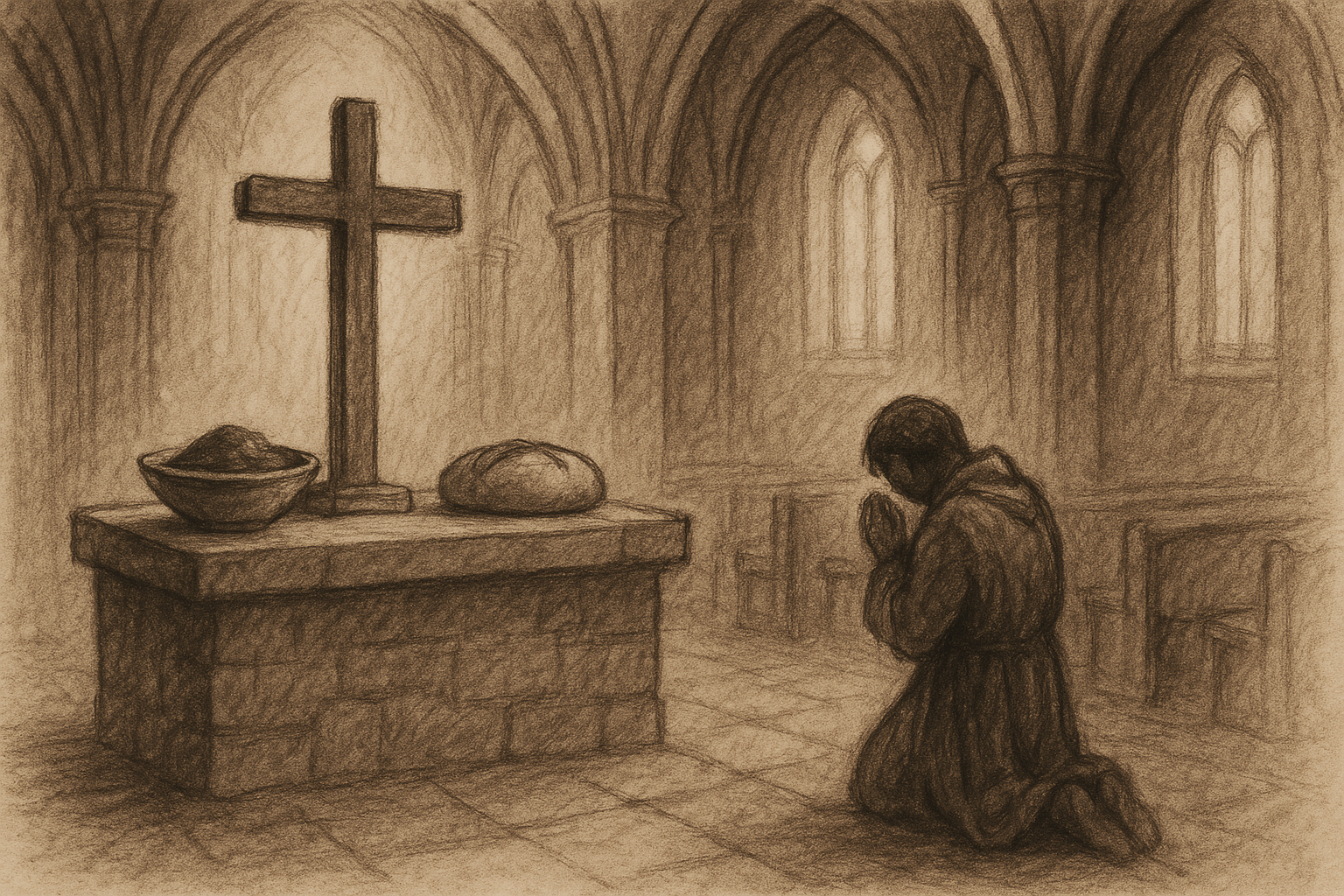
Lent is also deeply Catholic because it is bodily. We do not seek God with the mind alone. We kneel, we keep silence, we abstain, we give, we confess, and we come to the Eucharist. The body learns what the soul needs to remember: we are made for communion with God.
Where Lent came from and why the Church keeps it
The Church did not invent Lent in a single moment. Its roots reach back to the earliest Christian centuries, when catechumens prepared for Baptism and the whole Church joined them in prayer and penance. Over time, the season took shape as a forty day fast in imitation of Christ, who fasted in the desert before beginning his public ministry Matthew 4:1.
The number forty appears often in Scripture as a time of trial, purification, and preparation. Moses spent forty days on the mountain with the Lord. Elijah journeyed forty days to Horeb. Israel wandered forty years in the desert. In Lent, the Church enters that biblical rhythm again, trusting that God forms his people in the wilderness.
The discipline of Lent also reflects a simple Christian conviction: love must be trained. We do not become ready for Easter by accident. We need a season that slows us down, exposes our habits, and makes room for grace. Fasting is one of the Church's ordinary means for that work.
What fasting is meant to do
Fasting is often misunderstood as a diet with a religious label. Catholic fasting is not primarily about food control, though it does involve food. It is about desire. By freely setting aside something good, we learn that even good things are not our ultimate good.
Scripture links fasting with repentance and prayer. Jesus does not tell his disciples if they fast, but when they fast, and he warns them not to perform it for show Matthew 6:16. He also teaches that some spiritual struggles require prayer and fasting together Mark 9:29.
In Catholic life, fasting has several purposes:
- It unites us to Christ's own self-emptying.
- It awakens us to our dependence on God.
- It helps us resist disordered habits and comforts.
- It makes space for prayer, silence, and charity.
- It reminds us that the body and soul belong together in worship.
The aim is not sadness for its own sake. The aim is freedom. A person who fasts well begins to notice how quickly the heart clings to comfort, distraction, and control. That awareness is valuable, because it opens a way for repentance and grace.
How the Church asks Catholics to fast
The Church's laws of fasting are intentionally modest. They are not meant to replace personal effort, but to give all the faithful a common starting point. On Ash Wednesday and Good Friday, Catholics who are able are called to fast. On those days, those between ages 18 and 59 are ordinarily bound to one full meal and two smaller meals that together do not equal a full meal, while also abstaining from meat. Catholics age 14 and older are ordinarily bound to abstain from meat on Ash Wednesday, Good Friday, and the Fridays of Lent.
These obligations are important, but they are only the beginning. A Catholic can keep the minimum and still miss the spirit of the season. The Church gives a floor, not a ceiling. Many faithful Catholics voluntarily take on additional fasting, simplified meals, or other forms of restraint during Lent, according to health and circumstance.
Prudence matters. Those who are pregnant, ill, elderly, underweight, recovering from an eating disorder, or otherwise unable to fast should not force themselves into harmful practices. The Church never asks anyone to damage their health in the name of piety. A humble and honest offering, made within one's limits, is more pleasing to God than an imprudent sacrifice.
Prayer, fasting, and almsgiving belong together
Jesus places fasting within a larger pattern of hidden discipleship. In the Sermon on the Mount, he speaks of almsgiving, prayer, and fasting as practices done before the Father who sees in secret Matthew 6:1, Matthew 6:6, Matthew 6:18. These three works hold Lent together.
Prayer turns the heart toward God. Fasting loosens our grip on created things. Almsgiving turns the emptied hand toward the neighbor in need. If fasting becomes isolated from mercy, it can become self centered. If almsgiving is disconnected from prayer, it can become mere philanthropy. But when they belong together, the soul is reoriented in a profound way.
This is one reason Lent is so fitting before Easter. We are preparing not just to remember an event, but to enter more deeply into the Paschal Mystery. Christ dies, rises, and draws us with him. Lent helps us say yes to that movement with our whole lives.
How to participate more faithfully this Lent
For many Catholics, the hardest part of Lent is not knowing where to begin. The good news is that the Church's wisdom is concrete. A faithful Lent does not require complicated plans. It requires clarity, consistency, and sincerity.
1. Keep the Church's fasting and abstinence rules carefully
Start with what the Church actually asks. Mark Ash Wednesday, Good Friday, and the Fridays of Lent on your calendar. Make a simple plan for meals and remind yourself ahead of time so the day does not pass in confusion.
If you are able, treat these days as sacred interruptions. Eat more simply. Avoid grazing. Let hunger become a prompt for prayer rather than irritation. Even a small inconvenience, freely accepted, can become an act of love when joined to Christ.
2. Choose one additional sacrifice that is realistic
Many people try to change too much at once and then lose heart. A better approach is to choose one clear sacrifice and keep it. You might reduce snacking, give up sweets, simplify entertainment, or limit a habit of online scrolling. The point is not to become impressive. The point is to become attentive.
A wise Lenten sacrifice should be concrete, measurable, and spiritually useful. If it does not help you pray, repent, or love better, it may only be a temporary inconvenience. Ask whether the practice exposes a real attachment in your life.
3. Add a daily prayer you can keep
Fasting without prayer can become frustration. Pair your sacrifice with a prayer that is short enough to remain faithful. You might pray the Rosary, read the daily Gospel, spend ten quiet minutes before bed, or pray Psalm 51, the great psalm of repentance: Create in me a clean heart, O God Psalm 51:10.
Keep the prayer modest if needed. Fidelity matters more than ambition. A small prayer offered every day can do more for the soul than an elaborate plan abandoned after a week.
4. Go to Confession if you can
Lent is a privileged time for the sacrament of Reconciliation. Fasting can sharpen our awareness of sin, but only grace heals sin. Confession brings the mercy of Christ into the places we most want to hide. It is one of the clearest ways to prepare for Easter with a clean heart.
Many Catholics put off Confession because they fear shame or do not know where to begin. Yet the sacrament is not a courtroom for the self-righteous. It is medicine for sinners. The priest is there in the person of Christ, not as a spectator of failure but as a minister of mercy.
5. Let your fasting become charity
If your Lenten fasting saves time or money, do something concrete with that gift. Give to your parish, support a food pantry, make an intentional gift to someone in need, or serve quietly where you can. Lent should open the hand as well as quiet the appetite.
This is one of the most beautiful habits a Catholic can learn: when I consume less, I can love more. Fasting without generosity can curdle into pride. Fasting joined to almsgiving becomes a witness that God is enough, and that our neighbors are not interruptions but fellow children of the Father.
What to expect when Lent is lived seriously
A sincere Lent often begins with discomfort. That is normal. When habits are interrupted, we notice how dependent we have become on convenience, food, noise, or routine. At first, the disturbance may feel like failure. In truth, it can be the first grace.
As Lent continues, many Catholics find that prayer becomes more focused, gratitude becomes more practical, and the liturgy speaks with greater force. The Alleluia is set aside for a time, not because joy is denied, but because joy is being prepared more deeply. The Church walks through repentance so that Easter can be received as gift, not taken for granted.
There is also a quiet dignity in knowing that millions of Catholics are walking this same path with you. Lent is personal, but it is never private. The whole Church fasts, repents, and hopes together. The one who begins with a small offering may find, by Easter, that God has done far more than expected.
So start where you are. Keep the fast the Church asks. Pray simply. Give generously. Come to Confession. Let hunger become a reminder that man does not live by bread alone, but by every word that comes from the mouth of God Matthew 4:4.
Keep Reading on Lets Read The Bible
- Listening at Mass: The Liturgy of the Word and the Church's Living Voice
- Entering the Mystery: The Introductory Rites of Mass and the Art of Beginning Well
- At the Table of the Word: Meeting Christ in the Scriptures at Mass
- At the Heart of the Mass: Living the Liturgy of the Eucharist with Attention and Faith
Frequently Asked Questions
What is the main purpose of fasting during Lent?
The main purpose is conversion. Fasting helps Catholics detach from comfort, make room for prayer, and unite themselves more closely to Christ. It is meant to free the heart for God, not to function as a spiritual diet.
Do Catholics have to fast every day of Lent?
No. The Church requires fasting on Ash Wednesday and Good Friday for those who are bound by the law, and abstinence from meat on Ash Wednesday, Good Friday, and the Fridays of Lent for those 14 and older. Many Catholics also choose additional voluntary fasting.
What if I cannot fast because of health reasons?
If fasting would be harmful because of illness, pregnancy, age, recovery, or another serious reason, you should not force it. Catholic fasting should be done prudently and with peace. You can still join Lent through prayer, almsgiving, and another suitable sacrifice.