Sacraments and Liturgy
At the Heart of the Mass: Living the Liturgy of the Eucharist with Attention and Faith
A Catholic look at the Church's sacred center, from the preparation of the gifts to Holy Communion.
Site Admin | September 7, 2025 | 77 views
The Mass is one act of worship, but the Church names its movements with care because each one has its own grace. The Liturgy of the Word opens our ears to God speaking. The Liturgy of the Eucharist brings us to the altar, where Christ gives himself to the Father and to the Church under the signs of bread and wine. If the first part of Mass forms our minds and hearts, the second brings us to the center of Catholic life.
When people ask for the Liturgy of the Eucharist explained, they are usually asking more than for a list of actions. They want to know what is really happening, why the Church does these things, and how to enter them with faith. The answer is both simple and profound. At the altar, the Church remembers Christ's sacrifice in the biblical sense of remembrance, not as mere mental recall, but as a living making-present of the one saving sacrifice of Jesus Christ. The same Lord who offered himself once for all on Calvary makes his gift sacramentally present so that the faithful may unite themselves to him.
The shape of the Eucharistic heart of Mass
The Liturgy of the Eucharist normally unfolds in several movements: the preparation of the gifts, the Eucharistic Prayer, the Communion rite, and the reception of Holy Communion. Each movement flows into the next. Nothing is accidental. Even the small gestures teach us how to approach God with reverence and trust.
The altar is prepared with bread and wine, the priest prays over the offerings, and then the great Eucharistic Prayer begins. In that prayer, the Church praises the Father, recalls the saving work of Christ, invokes the Holy Spirit, and offers the sacrifice of praise. The heart of the prayer is the consecration, when the priest speaks the words of Jesus at the Last Supper: "This is my body" and "This is the chalice of my blood". Catholics believe that by the power of Christ and the Holy Spirit, the bread and wine become the Body and Blood of the Lord, even though the appearances of bread and wine remain.
This is why the Church treats the Eucharist with such care. The sacrament is not a symbol in the ordinary sense of a reminder or religious sign. It is the living sacramental presence of Christ himself, whom the Church adores, receives, and carries in procession with joy. All of the surrounding rites serve that mystery.
The preparation of the gifts and the offering of ourselves
The first part of the Liturgy of the Eucharist is often quiet and gentle. Gifts of bread and wine are brought forward, and the priest receives them at the altar. In many parishes this seems like a simple practical action, but the Church asks us to see more. The bread and wine are signs of the world God has made, of human labor, and of the work of our hands. They also represent our own lives.
At this moment, the faithful should place themselves spiritually on the paten and in the chalice, so to speak. Our joys, fatigue, family responsibilities, hidden sufferings, and daily duties are not separate from the sacrifice of Christ. They are meant to be offered with him. This is one reason the Church values active participation, not as constant talking or movement, but as interior union with the sacrifice being made present.
The prayers over the offerings are simple and beautiful. They remind us that what we bring to God is always received as gift. We offer bread and wine, and God gives back his own Son. We offer our weak efforts, and he gives grace. We offer our lives, and he makes them fruitful.
The Eucharistic Prayer and the Church's memory
The Eucharistic Prayer is the central prayer of the entire Mass. It is long because it is doing more than asking for blessings. It is an act of praise, thanksgiving, remembrance, petition, and self-offering. The Church's oldest prayers have always recognized this structure. The very word Eucharist means thanksgiving.
Within the prayer, the Church remembers the whole saving work of Christ: his Incarnation, Passion, Resurrection, Ascension, and promised return. The prayer gathers the Church on earth with the saints in heaven and with the souls who await the full vision of God. At the same altar, in one act of worship, the Church prays with heaven and for the world.
For Catholics, this is one of the most important things to understand. The Mass is not only a meal, though it is truly a sacred banquet. It is not only a memorial, though it truly recalls Christ's saving death and Resurrection. It is also sacrifice, because Christ's self-offering to the Father is made present sacramentally and the Church is drawn into that one offering. The language of the Mass keeps all of these truths together.
"Do this in memory of me" Do this in memory of me
That command from Christ at the Last Supper is the Church's doorway into the Eucharist. The Lord did not simply ask his apostles to remember him privately. He entrusted to them a sacramental act that would continue in the Church until the end of time. The Mass is the Church obeying that command with love.
The meaning of the consecration
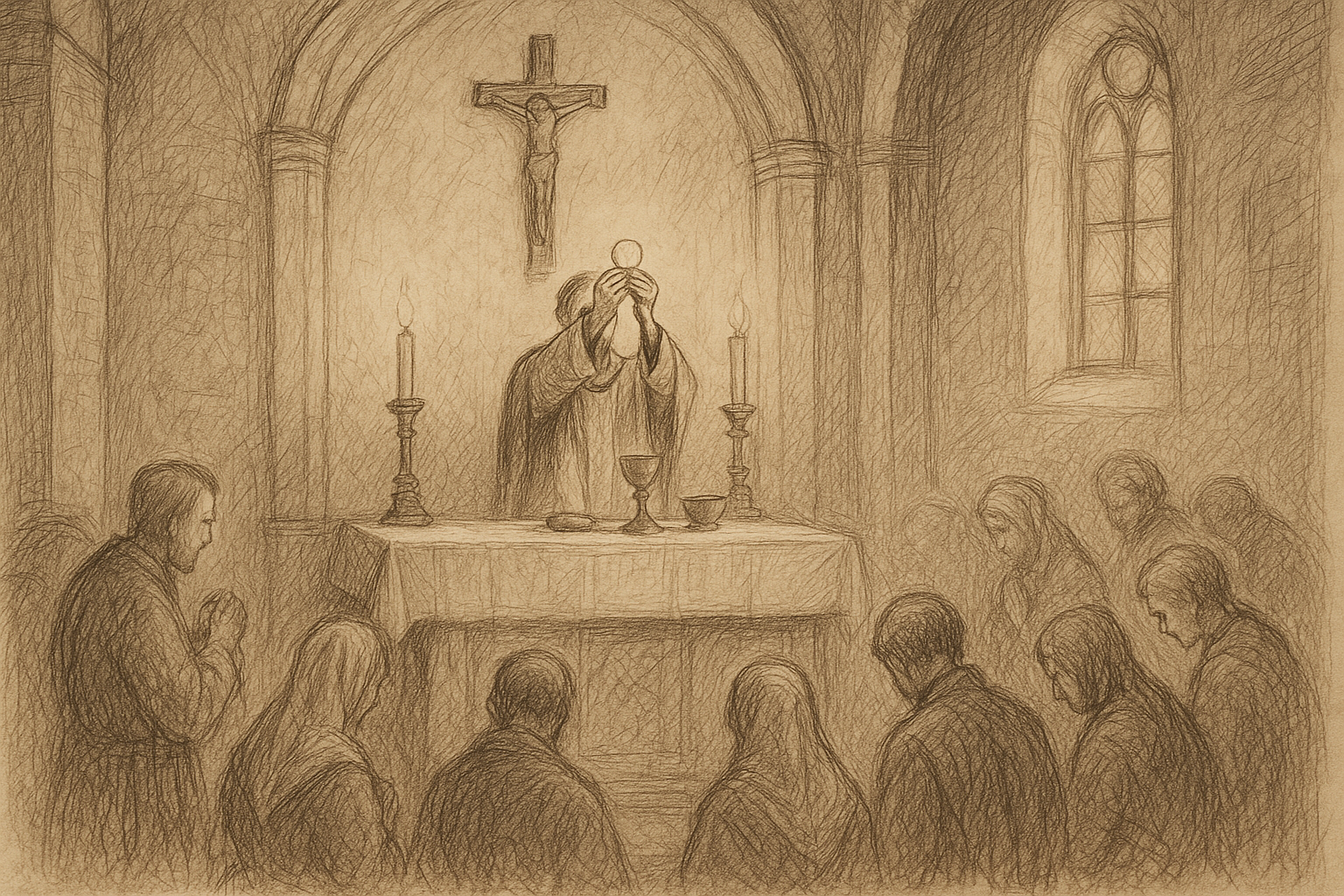
At the consecration, Catholics kneel or bow in reverence because the Church believes that the Lord is truly present. The priest does not act in his own name alone. He acts in the person of Christ the Head, within the prayer of the whole Church. The words of institution are not a dramatic quotation. They are efficacious words, words that accomplish what they say because Christ is acting through his Church.
This is the moment when faith and worship meet. We do not stand apart as spectators. We are drawn into mystery. The bells, if they are rung, the silence that follows, and the elevation of the Host and chalice all direct our attention to Christ who is present and given for us. Adoration belongs here because the Eucharist is the Lord himself.
The priest then continues the prayer, asking the Father to send the Holy Spirit upon the Church, upon those who receive Communion, and upon the whole world. The Eucharist is never a private possession. It builds the Church. It sends grace outward. It forms the people who receive it into one body in Christ.
The Communion rite and the gift of being fed
After the Eucharistic Prayer, the Church prepares to receive what she has just offered. The Communion rite includes the Lord's Prayer, the sign of peace, the fraction of the Host, the commingling, and the invitation to Communion. These rites are brief, but they help us understand what is happening.
The Lord's Prayer reminds us that we come to the altar as children who need daily bread and mercy. The sign of peace is not a social break. It is a sign that Communion with Christ includes reconciliation and communion with one another. The fraction of the Host recalls the breaking of bread in the early Church and points to the one Bread made available to many. The invitation, "Behold the Lamb of God," places before us the humility of Christ, who comes as both sacrifice and feast.
To receive Holy Communion worthily, Catholics must be properly disposed, which ordinarily includes being in the state of grace and having observed the Eucharistic fast. The Church's discipline is not meant to burden the faithful. It is meant to protect the holy reality they are approaching. When the Church asks us to prepare, she is teaching us that this gift is too great for casual reception.
Those who cannot receive Communion at a given Mass are not excluded from Christ's mercy. They are invited to a deeper longing, a spiritual communion, and a patient walk toward reconciliation. Reverence sometimes means waiting, and the Church knows that waiting can itself become an act of love.
What history tells us about the rite
The structure of the Eucharist did not appear suddenly. It grows from the Last Supper, the breaking of bread in the Acts of the Apostles, and the worship of the earliest Christian communities. Saint Paul already speaks of the Eucharist in a way that shows its seriousness and its holiness. He warns the Corinthians that the bread and cup are not ordinary food and drink, and he calls the Church to discern the Body of the Lord 23-29.
Over the centuries, the Church shaped the liturgy with solemn prayers, consistent gestures, and careful language so that the mystery would be guarded and handed on. Different rites and liturgical traditions developed, but the heart remained the same. The Church gathered, praised God, remembered Christ's saving act, called down the Holy Spirit, and received the Lord in Communion.
Many Catholic prayers and gestures that seem ancient are in fact the fruit of this long fidelity. Kneeling, bowing, incense, chant, candles, sacred vessels, and silence all serve to confess that the Eucharist is holy. The Church does not decorate the Mass to make it impressive. She surrounds the mystery with signs of reverence because the Lord is among his people.
How to participate more faithfully
Many Catholics want to attend Mass more faithfully but are unsure where to begin. The answer is often less complicated than expected. Participation starts before Mass does. A few quiet minutes of prayer before the liturgy can make a real difference. Reading the Scriptures in advance, if possible, can help the Word and the Eucharist belong together in your mind and heart.
During the Mass itself, try to remain attentive to the sequence of gifts, prayer, and communion. When the gifts are brought forward, offer your own intentions. During the Eucharistic Prayer, unite yourself to Christ's sacrifice in silence. At the elevations, adore him. Before Communion, ask for a clean heart and a living faith. After Communion, remain prayerful and grateful instead of rushing inwardly toward the next thing.
It can also help to learn the texts of the Mass. Familiarity is not the enemy of reverence. In the liturgy, familiarity can become love. The more we know the words, the more we notice the meaning. The more we notice the meaning, the more our responses become sincere.
- Arrive a few minutes early and recollect your heart.
- Read the Sunday readings ahead of time when you can.
- Offer one specific intention during the preparation of the gifts.
- Bow or kneel with deliberate reverence at the consecration.
- Receive Communion with gratitude and without haste.
- Stay for a moment after Mass to thank the Lord quietly.
These practices are small, but the liturgy is made up of small faithful acts. The Church is formed not only by rare dramatic moments but by repeated reverent attention. In the long life of the soul, attention is often the beginning of love.
The Eucharist and the shape of daily life
The Liturgy of the Eucharist does not end when Mass ends. What we receive at the altar is meant to shape the way we live at home, at work, and in hidden places where no one applauds. The One who is broken for us teaches us to become a people who are given for others. The One who feeds us teaches us to feed the poor, forgive injuries, and carry burdens patiently.
Here the Mass becomes personal in the deepest sense. If Christ has truly given himself to us, then our time, our speech, our habits, and our priorities cannot remain untouched. The Eucharist calls us to conversion, gratitude, and mission. It teaches us that real communion with Christ always sends us outward in charity.
That is why the Liturgy of the Eucharist is not simply the climax of the Mass. It is the center from which Catholic life receives its form. When the Church stands at the altar, she is not performing a ritual that ends at the church door. She is entering the gift that will continue to shape her every day, until the Lord who comes in sacrament comes again in glory.
Keep Reading on Lets Read The Bible
Frequently Asked Questions
What happens during the Liturgy of the Eucharist at Mass?
The gifts of bread and wine are brought forward, the priest prays the Eucharistic Prayer, the bread and wine are consecrated, and the faithful are invited to receive Holy Communion. These rites make present Christ's sacrifice and feed the Church with his Body and Blood.
Why is the Eucharistic Prayer so important?
The Eucharistic Prayer is the center of the Mass because it is the Church's great prayer of thanksgiving and sacrifice. It remembers Christ's saving work, calls upon the Holy Spirit, and leads to the consecration and Communion.
How can I participate more reverently in the Liturgy of the Eucharist?
Prepare before Mass with prayer, follow the prayers carefully, make an interior offering of your life, adore Christ at the consecration, and receive Communion with faith and gratitude. Staying briefly after Mass to pray also helps deepen participation.