Jesus and the Gospels
At Calvary, John Stayed Close: The Beloved Disciple and the Meaning of Presence
The Gospel scene at the Cross reveals more than sorrow. It shows the quiet fidelity of a disciple who remained when others fled, and the grace that flows from standing near Jesus.
Site Admin | January 25, 2026 | 94 views
The scene is brief, but it stays with the Church because it is so stark and so tender. While many disciples were absent, the Gospel of John shows one figure near the Cross: the beloved disciple, traditionally identified as St. John. He stands beside the Mother of Jesus as the Lord suffers and dies, and in that hour Jesus entrusts Mary to him and him to Mary. The moment is full of sorrow, but it is also full of gift. At Calvary, love does not speak loudly. It remains.
The Gospels do not tell us everything we might want to know about the emotional state of St. John that day. They do not record his private fears or the details of how he arrived there. But they do tell us enough to see the meaning of his presence. He stayed close to Jesus at the hour when closeness was costly. That fact alone gives the scene spiritual weight. In the Gospel, faith is not only a matter of understanding. It is also a matter of staying.
The Gospel scene at the Cross
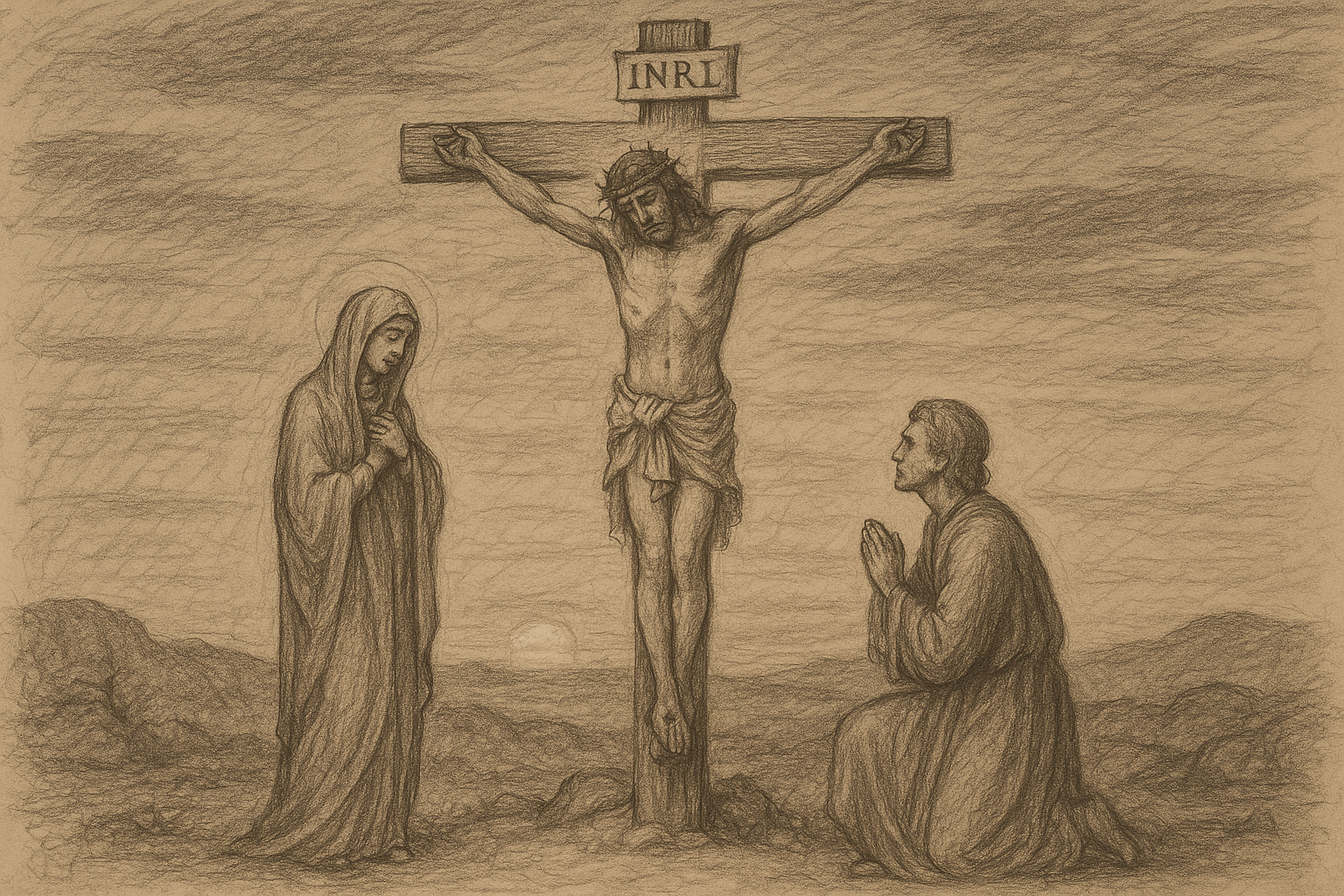
St. John is mentioned at the foot of the Cross in the Fourth Gospel. There, near the Crucified Lord, are Mary His Mother, Mary Magdalene, Mary of Clopas, and the beloved disciple. The text is solemn and simple, and its restraint makes it even more powerful. Jesus sees His mother and the disciple whom He loved, and He says, Woman, behold your son. Then to the disciple He says, Behold your mother. From that hour, the disciple takes Mary into his own home.
This is not a decorative detail. It is a revelation. The disciple is not merely a bystander. He is drawn into the mystery of Christ's final gift. In the hour of apparent defeat, Jesus is still Lord. He is still giving. He is still gathering a family. Even as He hangs on the Cross, He speaks words of communion and trust.
The Fourth Gospel alone explicitly places the beloved disciple beside Mary at Calvary. That silence in the other Gospels does not weaken the scene. Instead, it shows how the evangelist wants us to read the moment: as a deeply personal and theological encounter. The Cross is not only the place of suffering. It is the place where Christ forms relationships of grace. At the center of redemption stands a Son, a Mother, and a disciple who learns how to receive.
Who was the beloved disciple?
Catholic tradition has long identified the beloved disciple with St. John the Apostle, son of Zebedee and brother of James. The Gospel itself never names the beloved disciple directly, but the Church has consistently read the figure in connection with John, whose witness is linked with the Fourth Gospel. Whether one approaches the text with scholarly caution or traditional confidence, the theological point remains the same: the disciple at the Cross represents intimate, faithful attachment to Christ.
That intimacy matters. The beloved disciple is not defined first by public achievement, but by closeness to Jesus. He leans on the Lord at the Last Supper, he is near the Cross, and later he is among the first to believe in the Resurrection. His pattern of discipleship is quiet but steady. He does not seek attention. He seeks the Lord.
In that sense, John becomes a model of contemplative fidelity. He is not the apostle most associated with dramatic words or bold speeches. Peter often speaks first. John often seems to be the one who sees, listens, and remains. The Gospel invites us to notice that this too is holiness. Not every disciple leads from the front. Some keep watch when the hour grows dark.
Why John's presence matters at Calvary
To stand near the Cross is to accept that love may demand more than comfort. John could have gone elsewhere. He could have hidden. He could have protected himself from association with the condemned Jesus. But he remained. His presence suggests a courage that is not loud but real. It is the courage of reverence, loyalty, and endurance.
In a Catholic reading, this matters because discipleship is not only about knowing truths about Christ. It is about consenting to be near Him in every season, including suffering. The Cross changes our expectations. We may hope to follow Jesus in consolation, but the Gospel also calls us to follow Him in desolation, uncertainty, and grief. John does not preach a sermon from Calvary. He witnesses. That witness is itself a form of love.
His presence also shows that Christian love is not abstract. The dying Christ does not entrust His mother to a general idea of the Church. He entrusts her to a particular disciple. The relationship is personal, concrete, and embodied. Catholic faith has always resisted turning grace into theory alone. At the Cross, grace becomes family. Christ gives Mary to John, and in that gift the Church sees a sign of spiritual motherhood and discipleship lived in communion.
Mary and John: a family formed beneath the Cross
The exchange between Jesus, Mary, and John is one of the most beloved passages in the Gospel because it reveals how redemption creates belonging. Jesus says, Woman, behold your son, and then, Behold your mother. The disciple takes Mary into his own home. In the Catholic tradition, this scene is often read not only as a tender personal provision, but also as a sign of Mary's maternal role in the life of believers.
John receives Mary at the very moment when he is learning the cost of love. That timing is important. Mary does not come to him after the Cross has passed. She is given to him at the Cross itself. In other words, the relationship between Mary and the disciple is born in suffering, not in ease. The Church recognizes in this a pattern for the spiritual life. We do not wait to receive the gifts of Christ only after life becomes manageable. Often, they are given in the very place where trust is most demanded.
For Christians, this scene also suggests that the family of God is not limited by bloodline or social category. John becomes son in a spiritual sense, and Mary becomes mother in a spiritual sense, because Christ wills it so. The Gospel offers not isolation, but communion. At Calvary, the Lord does not leave believers orphaned.
What St. John teaches about prayer
John's silence at the Cross can teach us a great deal about prayer. He does not need to explain everything. He is there. Many people struggle with prayer because they think it must always be filled with words, insights, or strong feelings. But the beloved disciple reminds us that prayer can begin with faithful presence. To be near Jesus, even when we do not understand, is already a prayer of love.
That is especially important when we are facing suffering. There are moments when the soul cannot easily produce many words. Grief, fear, and exhaustion can make prayer feel sparse. In those moments, John offers a Gospel shape for interior life: stay with the Lord. Stand at the Cross. Do not rush away from the place where Christ is suffering. The Church has always known that silent adoration, patient endurance, and loving attentiveness can be deeply prayerful.
John also teaches us to receive. At the Cross he receives Mary, and through her he receives a deeper share in the life Christ is giving. Prayer is not only our offering. It is also our openness to what God gives. Sometimes the soul prays most truly not by speaking first, but by consenting to be entrusted with a gift.
What St. John teaches about discipleship
Discipleship in the Gospels is often tested by pressure. It is easy to follow Jesus when crowds are gathered and miracles are visible. It is harder when the path leads to misunderstanding, loss, and the Cross. John's witness says that the disciple is called to remain faithful when love is no longer rewarded by visible success. The Christian life includes such hours.
John also teaches that discipleship includes watchfulness. To be at the Cross is to refuse spiritual distraction. The beloved disciple does not turn away from the mystery of Christ's suffering. He faces it. In our own lives, this can mean learning not to flee from every hard truth. Sometimes fidelity requires that we stay awake to what is painful, whether that is another person's suffering, our own weakness, or the demands of conversion.
Finally, John teaches humility. The beloved disciple never seems to draw attention to himself. He points to Jesus. He receives from Jesus. He remains where Jesus places him. That is a mature form of discipleship. It does not need to be impressive. It needs to be faithful.
Practical lessons for Catholics today
The image of St. John at the foot of the Cross can shape ordinary Christian life in several practical ways:
- Practice reverent presence. When prayer feels dry, remain before Christ anyway. Silence can be a form of fidelity.
- Do not separate love from suffering. The Gospel does not promise a life without the Cross. It promises Christ with us in it.
- Receive Mary as mother. The disciple takes her into his home, and Catholics are invited to welcome her into the home of the heart through devotion and trust.
- Stay near the suffering. Like John, Christians are called to be present to the afflicted, especially when there is little to say.
- Let the Cross form your relationships. Christ creates communion. He draws believers into a family that is stronger than fear.
These lessons are not dramatic, but they are durable. Much of Christian maturity is built in exactly this way, through the repeated choice to remain close to Jesus and open to what He entrusts.
The witness that reaches the Resurrection
John's faith at Calvary does not end in sorrow. The same disciple who stands near the Cross will later testify to the empty tomb and encounter the risen Lord's peace. The Gospel shows continuity between the Cross and the Resurrection. The disciple who remained close in suffering is also the disciple who is prepared to recognize glory when it comes.
That is an encouraging pattern for believers. We often want Easter without Good Friday, but the Gospels do not separate them. The one who learns to stay with Christ in the dark is better able to receive the light when it arrives. John at the Cross is not a separate story from John at the tomb. It is the same disciple, being shaped by the same Lord.
So the image endures because it speaks quietly to the conscience. There is Christ, lifted up. There is Mary, steady in sorrow. There is John, faithful enough to stay. And there is the Church, learning from them how to love when love is costly, how to pray when words are few, and how to remain near the Savior who gives Himself even at the hour of death.
Keep Reading on Lets Read The Bible
Frequently Asked Questions
Why is St. John traditionally called the beloved disciple at the foot of the Cross?
Catholic tradition identifies the beloved disciple with St. John the Apostle because the Fourth Gospel presents this disciple in a particularly intimate relationship with Jesus, including at the Last Supper, the Cross, and the empty tomb.
What does Jesus mean when He says to John, Behold your mother?
In the Catholic reading, Jesus is entrusting Mary to John and John to Mary. The Church also sees in this scene a sign of Mary's spiritual motherhood and of the Church as a family formed by Christ.
How can Catholics pray with the scene of John at Calvary?
They can pray by staying quietly with Christ in suffering, asking for fidelity in hard moments, and welcoming Mary into daily devotion as John did when he took her into his home.