Sacraments and Liturgy
At the Door of Christmas: Learning the Church's Advent Pace
How the liturgy teaches watchfulness, repentance, and joyful hope during the weeks before the Nativity
Site Admin | September 2, 2026 | 64 views
Advent arrives when the surrounding culture is often already celebrating Christmas. Lights appear, music begins, calendars fill, and the pressure to create a perfect holiday can become exhausting. The Church moves at a different pace. She does not ignore the joy of Christmas, but she asks us to approach it through expectation, repentance, prayer, and hope.
For anyone seeking Advent preparation explained in a faithful Catholic way, the first thing to understand is that Advent is not merely a seasonal devotion. It is a liturgical season. Through the prayers of the Mass, the readings of Scripture, sacred music, and a more restrained atmosphere, the Church forms our desire for Christ. She teaches us to remember his first coming in humility and to await his return in glory.
Advent begins a new liturgical year
The First Sunday of Advent begins a new liturgical year in the Roman Rite. The season includes the four Sundays before Christmas and ends before the celebration of the Nativity begins on Christmas Eve. Its name comes from a Latin word referring to an arrival or coming.
The historical shape of Advent developed gradually. Early Christian communities did not everywhere observe the season in precisely the same manner. In various places, Christians practiced periods of prayer, fasting, and preparation before celebrations associated with the Lord's birth and manifestation. Over time, the Roman liturgy received the four-Sunday form familiar to Catholics today.
This history helps explain why Advent contains both sobriety and joy. It is not simply a shorter Lent, although repentance belongs within it. Nor is it Christmas celebrated early. Advent has its own spiritual character: alertness before a promised arrival.
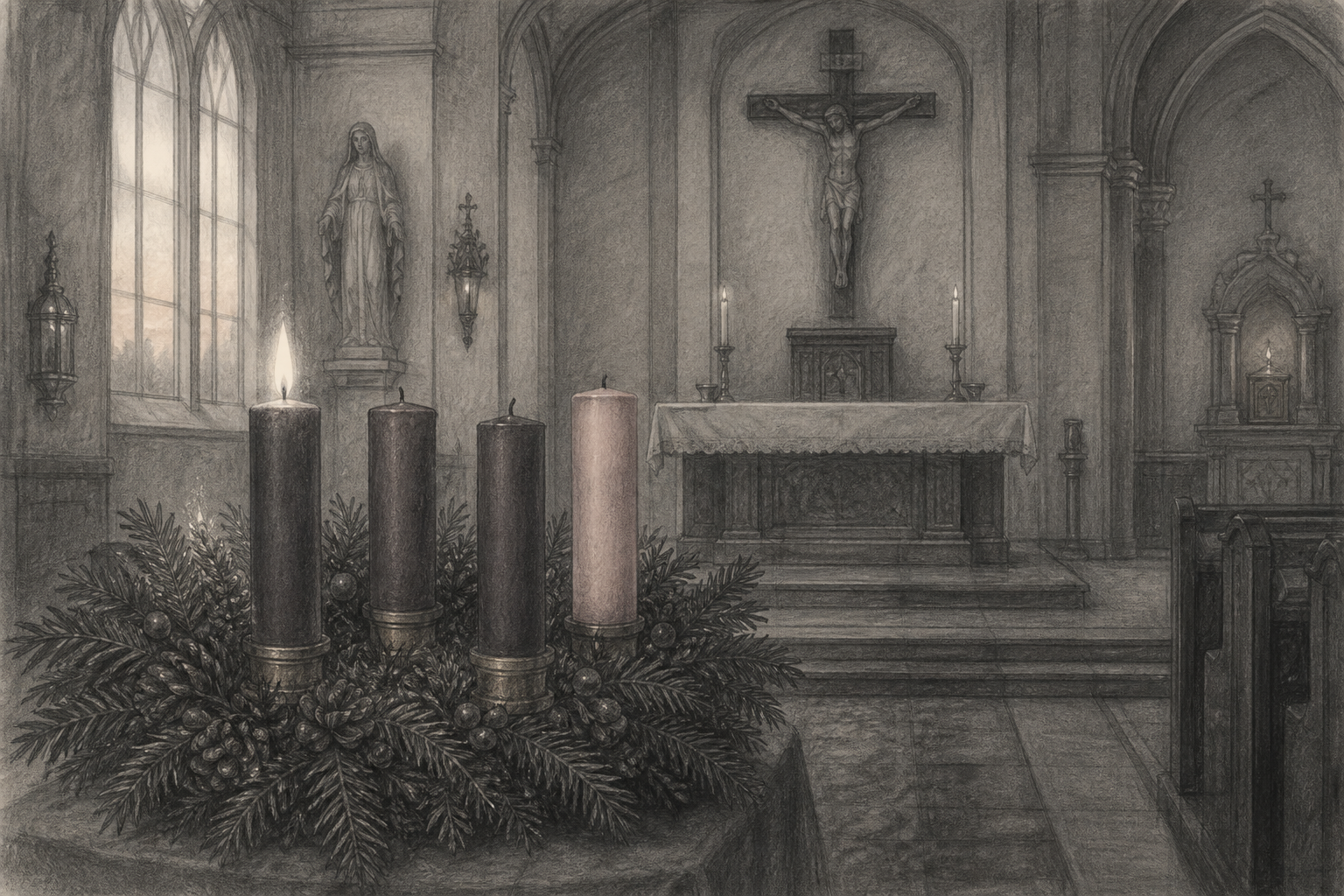
At Mass, violet vestments ordinarily express the season's restrained and penitential quality. The Gloria is generally not sung or recited on Advent Sundays, allowing it to return with particular joy at Christmas. Yet the Alleluia remains. On the Third Sunday of Advent, called Gaudete Sunday, rose vestments may be used. This visible brightening expresses the nearness of the feast and the Church's joy in the Lord.
The season looks toward two comings of Christ
Advent holds together two mysteries. First, Catholics prepare to celebrate the birth of Jesus Christ in Bethlehem. The eternal Son of God truly entered human history, taking flesh from the Virgin Mary and coming among us in poverty. This is not a comforting legend but the mystery of the Incarnation.
Second, the Church awaits Christ's return in glory. The earlier part of Advent places special emphasis on this future coming. The readings call Christians to remain awake, faithful, and ready. Jesus warns his disciples, "Be watchful! Be alert!" Mark 13:33 Advent therefore directs the heart beyond holiday plans toward the fulfillment of God's kingdom.
These two comings are inseparable. The Child laid in the manger is the Lord who will come again. We can approach his birth with real joy because his death and Resurrection have opened the way to eternal life. At the same time, the expectation of his return gives moral seriousness to the present. Our choices matter. Grace invites a response.
Christ also comes to his people now, especially through the sacraments, the proclamation of his word, and the life of charity. Advent trains us to recognize him. The season's watchfulness is not anxious speculation about dates or signs. It is the attentive faith of a disciple who wishes to be found loving God and neighbor.
Israel's hope becomes the Church's prayer
The Advent liturgy draws deeply from the prophets, especially Isaiah. These readings speak of light, peace, justice, consolation, and the promised king. They arise from the real history and hope of Israel, and the Church receives them as testimony to God's saving plan fulfilled in Christ.
Isaiah's cry, "Prepare the way of the Lord!" Isaiah 40:3 is taken up in the preaching of John the Baptist. John stands near the center of Advent because he refuses to let expectation remain vague. He calls for repentance and points away from himself toward the One who is coming.
The Blessed Virgin Mary reveals another essential form of preparation. Her response to the angel is trusting, humble, and obedient: "May it be done to me according to your word." Luke 1:38 Mary does not control the mystery entrusted to her. She receives God's word and offers herself to his will.
Isaiah, John the Baptist, and Mary teach complementary Advent dispositions. The prophets teach longing. John teaches conversion. Mary teaches receptive faith. Together, they show that preparing for Christ involves the whole person: memory, desire, conscience, and action.
Let the liturgy set the pace
The surest foundation for Advent is faithful participation in Sunday Mass. Each week unfolds part of the season's movement. Early readings emphasize vigilance and the Lord's return. John the Baptist then calls for a straight path. As Christmas approaches, the Gospel turns more directly toward the events surrounding Christ's birth.
Listening carefully to the Collect, Preface, antiphons, and readings can reveal themes that are easy to miss. Arriving early, silencing the phone, reading the Sunday Gospel beforehand, and remaining briefly after Mass can make participation more attentive. These are small acts, but they create room for the liturgy to shape the heart.
Daily Mass, when one's duties and circumstances permit, can be especially fruitful. The weekday readings provide a steady scriptural journey toward Christmas. Still, Advent should not become a project measured by how many religious activities can fit into an already crowded calendar. A parent caring for children, a person working long hours, or someone carrying illness may prepare faithfully through brief, consistent prayer offered with love.
Make room for repentance and confession
Because Advent directs us toward an encounter with Christ, it naturally invites an examination of conscience. We can ask where impatience, resentment, dishonesty, distraction, or neglect of prayer has narrowed our welcome for the Lord. The purpose is not self-absorption. It is conversion through grace.
The Sacrament of Penance is one of the most fitting ways to prepare for Christmas. In confession, Catholics name their sins honestly, express contrition, receive absolution, and undertake the assigned penance. The sacrament is not merely an emotional reset. Christ acts through the ministry of the priest to forgive sins and reconcile the penitent with God and the Church.
It is wise to check parish confession times early rather than waiting until the final days before Christmas. A careful examination of conscience, sincere prayer for contrition, and a clear confession can become a decisive moment in the season. Those returning after a long absence may simply tell the priest that they need guidance.
Build a simple Advent rule of life
A practical plan should be concrete enough to follow and modest enough to endure. Instead of making an ambitious list, choose a few practices that address prayer, repentance, and charity.
- Keep a daily time of silence. Begin with five or ten minutes. Read the day's Gospel, sit quietly before God, and ask for the grace to receive Christ more fully.
- Attend Sunday Mass with preparation. Read the Gospel in advance and bring one intention to the altar. If possible, arrive before Mass begins.
- Go to confession. Choose a date early and place it on the calendar. Preparation becomes more real when it has a time and place.
- Practice one form of restraint. This might mean reducing entertainment, unnecessary shopping, alcohol, sweets, or habitual phone use. The goal is freedom for prayer and love, not discomfort for its own sake.
- Perform a deliberate work of mercy. Visit someone lonely, give quietly to those in need, reconcile with a family member, or offer practical help without seeking recognition.
- Protect part of Christmas for Christmas. Not every celebration can be moved, but Catholics can preserve a sense of arrival by saving certain music, foods, decorations, or family customs for the feast itself.
Household customs can support this rule of life. An Advent wreath marks the passing weeks with increasing light. A Nativity scene can be assembled gradually, with the figure of the Christ Child placed in the manger at Christmas. Families may read a brief passage of Scripture before lighting the wreath or pray one decade of the Rosary together.
These practices should point beyond themselves. An Advent wreath is not a sacrament, and no home custom replaces Mass or confession. Devotions are fruitful when they extend the prayer of the Church into daily life and keep the household attentive to Christ.
Resist both hurry and perfectionism
Advent often exposes the gap between our ideals and our actual lives. Plans are interrupted. Family tensions reappear. Grief may become sharper. Financial pressures can make the season burdensome. Some people approach Christmas without the loved ones who once filled it with warmth.
The Church's hope does not depend upon producing a cheerful mood. Christian hope rests in God's faithfulness. The light shines in darkness, and the darkness has not overcome it John 1:5. A sorrowful Advent can still be holy. Lament, quiet prayer, and accepting help from others may be forms of faithful preparation.
Perfectionism is another temptation. Missing a day of prayer or failing to maintain a custom does not ruin the season. Begin again. Advent is about receiving a Savior, not proving that we can save ourselves through flawless observance.
Carry Advent into Christmas
The discipline of Advent makes the celebration of Christmas deeper. Catholic tradition does not treat December 25 as the end of Christmas but as the beginning of a liturgical season. After weeks of restraint, the Church celebrates the mystery of the Word made flesh with sustained joy.
A faithful Advent will not necessarily feel dramatic. Its fruit may be a more honest confession, a calmer approach to Mass, a restored relationship, or a renewed desire for prayer. The deepest preparation is the work of grace received through willing hearts. As Christmas draws near, the Church invites us to become quiet enough to hear the promise, free enough to repent, and humble enough to welcome the Lord who comes to dwell among his people.
Keep Reading on Lets Read The Bible
Frequently Asked Questions
When does Advent begin and end?
In the Roman Rite, Advent begins with the First Sunday of Advent and ends before the liturgical celebration of Christmas begins on Christmas Eve. It contains four Sundays and opens a new liturgical year.
Is Advent a penitential season like Lent?
Advent has a restrained and penitential character, and repentance and confession are appropriate. However, it is not identical to Lent. Advent is marked especially by watchful hope, joyful expectation, and preparation for Christ's birth and return.
What is the best way for a Catholic to prepare during Advent?
Begin with faithful Sunday Mass, regular prayer with Scripture, an honest examination of conscience, and the Sacrament of Penance. Add a modest act of self-denial and a concrete work of mercy. Simple practices followed consistently are usually more fruitful than an overloaded plan.