Sacraments and Liturgy
Make Straight the Way: Living Advent With Watchful Hope
A practical path through prayer, repentance, the liturgy, and works of mercy as the Church prepares for the coming of Christ.
Site Admin | September 1, 2026 | 71 views
Advent arrives at a time when many people are already tired. Calendars fill, stores grow crowded, and preparations for Christmas can become a source of pressure. The Church does not ask us to pretend that these demands are absent. Instead, she gives us a season that can reorder them.
Advent is a time of expectant preparation for the coming of Jesus Christ. It looks back to his birth in Bethlehem, awakens us to his presence now, and directs our hope toward his return in glory. These are not three unrelated themes. The Child born of Mary is the risen Lord who comes to his people in grace and will come again to judge the living and the dead.
Any Advent preparation Catholic guide is useful only if it helps us meet Christ rather than merely complete seasonal tasks. The goal is not to produce a flawless December. It is to become watchful, repentant, generous, and ready to receive the Lord.
A Season Formed by the Church's Worship
The word Advent comes from the Latin adventus, meaning coming or arrival. The season developed over centuries in the life of the Western Church. Its customs and length were not identical everywhere at first, but the Roman liturgy eventually took the four-Sunday form familiar to Catholics today.
Advent begins a new liturgical year. This is significant. The Church does not begin her year with a list of accomplishments or resolutions. She begins by waiting for someone. Christian life starts and starts again with God's initiative. The Lord comes toward us before we can make our way toward him.
The liturgy gives Advent a restrained but hopeful character. Violet vestments express preparation and a spirit of penance. Rose vestments may be used on the Third Sunday of Advent, called Gaudete Sunday, as a sign of rejoicing that the Lord is near. The Gloria is ordinarily omitted at Mass during Advent, while the Alleluia remains. This distinguishes Advent from Lent and preserves the season's particular note of expectation.
Advent does have a penitential dimension, but it is not simply a shorter Lent. Its sobriety is filled with hope. We clear away sin and distraction because a beloved guest is approaching. We make room because the One who comes is worthy of our attention.
The Three Horizons of Advent
Remembering Bethlehem
The most familiar purpose of Advent is preparation for the celebration of Christ's Nativity. The Gospel accounts do not offer a sentimental scene. Mary entrusts herself to God's word. Joseph obeys amid uncertainty. Jesus is born in poverty and laid in a manger because there is no proper place for him.
The angel tells Mary, "You will conceive in your womb and bear a son, and you shall name him Jesus" Luke 1:31. Advent invites us to receive this mystery again: the eternal Son of God truly entered human history. He did not save humanity from a distance. He assumed our nature, shared our weakness without sin, and came among the poor.
Receiving Christ in the Present
Advent also trains us to recognize how Christ comes to his people now. He speaks in Scripture, acts in the sacraments, gathers the Church at Mass, and meets us in those who need mercy. His presence is not a substitute for his historical birth or future return. It is the way the risen Lord sustains his people as they wait.
This is why Catholic Advent preparation is deeply sacramental. We do not prepare only through private thoughts or seasonal feelings. We approach the altar, listen to the Word of God, confess our sins, and receive grace through the life of the Church.
Waiting for the Lord's Return
Early Advent readings emphasize watchfulness because history is moving toward Christ. Jesus tells his disciples, "Watch, therefore; you do not know when the lord of the house is coming" Mark 13:35. This watchfulness is not fearful speculation about dates. Christ explicitly calls for faithful readiness.
Remembering the Second Coming protects Advent from becoming nostalgic. Christians are not trying to recreate an idealized Bethlehem. We are preparing to celebrate the Nativity while looking toward the fulfillment of God's promises. The newborn King is also the Lord before whom every human life will be revealed.
The Voices That Teach Us to Prepare
Advent has its own spiritual teachers. The prophets give language to Israel's longing and proclaim God's fidelity. Isaiah announces, "The people who walked in darkness have seen a great light" Isaiah 9:1. The Church hears these prophecies in the light of Christ, in whom God's saving promise reaches its fullness.
John the Baptist calls for repentance. He is not interested in vague seasonal improvement. He urges people to turn from sin and prepare a straight way for the Lord. His ministry fulfills the cry, "Prepare the way of the Lord, make straight his paths" Mark 1:3. Advent repentance is concrete because love must become concrete.
Mary shows the deepest form of readiness. She listens, asks an honest question, gives her consent, and remains faithful. Her response, "May it be done to me according to your word" Luke 1:38, is not passive resignation. It is courageous cooperation with grace.
Joseph also prepares us for Christmas. He receives God's direction and acts upon it, taking Mary into his home as commanded Matthew 1:24. His quiet obedience reminds us that Advent is not measured by how much religious emotion we feel. Fidelity often consists in doing the next good thing God has placed before us.
A Realistic Advent Rule of Life
A good Advent plan should be simple enough to keep and serious enough to make a difference. Trying to begin many devotions at once can lead to frustration. It is usually better to choose a few practices that support prayer, repentance, and charity.
- Let Sunday Mass anchor the week. Prepare for Mass by reading the Sunday readings in advance. Arrive early when possible, silence the phone, and ask for one grace you especially need. Listen for the themes of promise, watchfulness, repentance, and joy. If a holy day of obligation falls during Advent in your region, make practical arrangements to participate in Mass.
- Set aside a small daily time for prayer. Ten attentive minutes can be more fruitful than an ambitious routine abandoned after three days. Begin with silence, read a short passage from the day's Mass readings or an infancy narrative, and speak honestly to Christ. End with an Our Father, Hail Mary, or a simple prayer such as, "Come, Lord Jesus."
- Receive the Sacrament of Penance. Advent is an appropriate time for Confession, especially if serious sin has separated a person from the reception of Holy Communion. Make a careful examination of conscience, confess sins honestly, receive absolution with gratitude, and complete the assigned penance. The sacrament is not spiritual housekeeping performed to impress God. It is an encounter with the mercy Christ entrusted to his Church.
- Choose one form of voluntary self-denial. Advent does not carry the universal fasting discipline associated with Lent, but a modest personal sacrifice can create interior space. Consider limiting unnecessary purchases, entertainment, alcohol, sweets, or habitual phone use. The purpose is not self-punishment. It is freedom for prayer and love.
- Turn sacrifice into mercy. Give the money saved through restraint to someone in need or to a trustworthy charitable work. Visit a lonely relative, prepare food for a struggling household, write to someone who is grieving, or offer practical help without waiting to be noticed. Jesus identifies himself with those who are hungry, thirsty, sick, and in need Matthew 25:40.
- Guard some silence. Not every empty moment needs music, news, or conversation. A silent commute, a quiet first few minutes after waking, or a pause before the Advent wreath can help the heart become attentive. Silence is not an achievement. It is hospitality toward God's word.
Let Household Customs Serve the Mystery
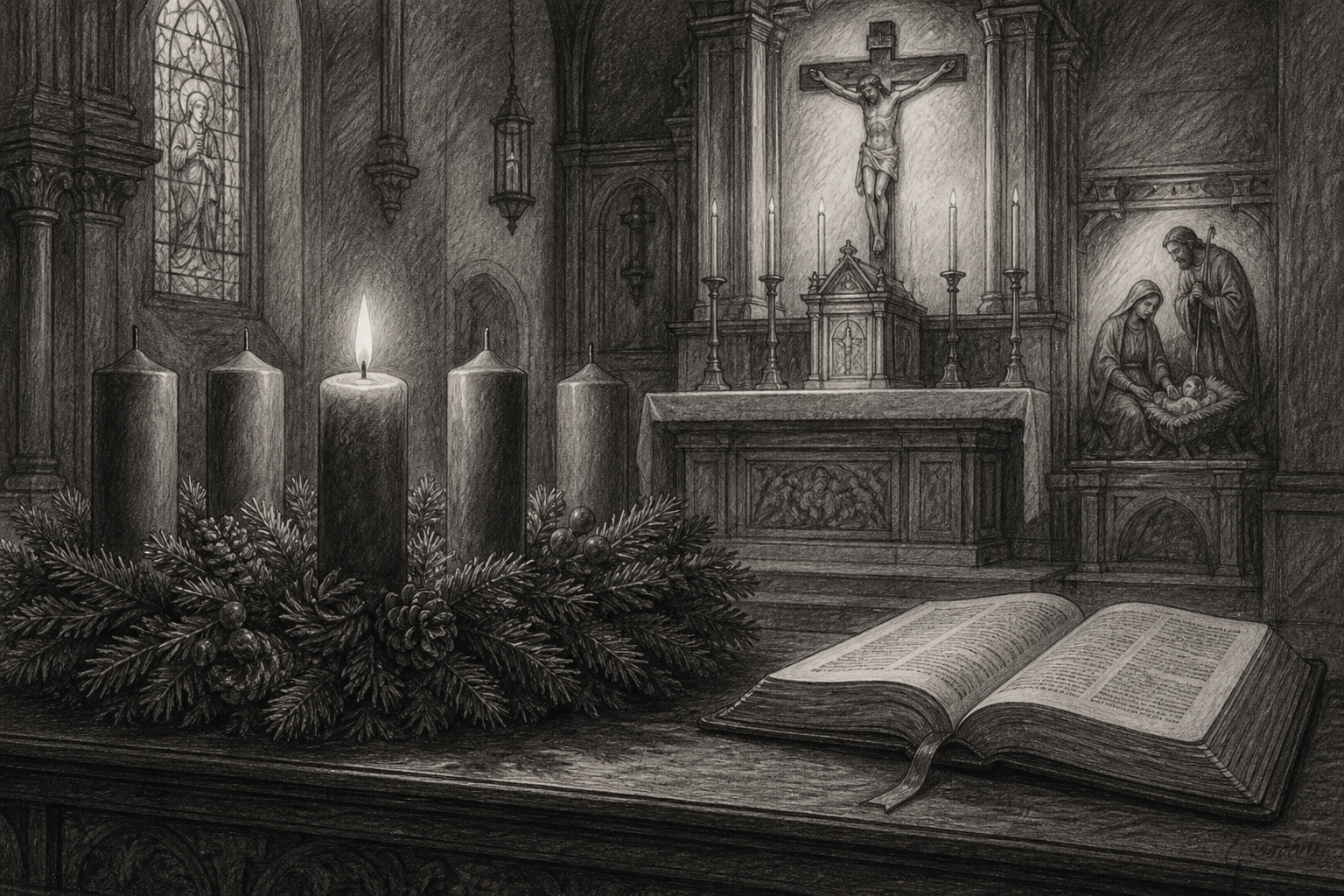
Advent customs can teach the faith when they remain connected to prayer. An Advent wreath marks the passage of the four Sundays with increasing light. Its candles are not sacraments, and the custom should not become a source of anxiety about colors or elaborate arrangements. Its value lies in gathering people to hear Scripture and ask for the coming of Christ.
A Nativity scene can also unfold gradually. The stable may be prepared early while the figure of the Christ Child is placed there at Christmas. Children can be encouraged to offer small acts of love as a way of preparing for Jesus. A Jesse Tree, built around biblical figures and events in salvation history, can show how patiently God prepared his people for the Messiah.
Household prayer need not be long. A family might light the wreath, read a few verses from the coming Sunday's Gospel, name particular intentions, and pray together. A person living alone can follow the same pattern. The domestic church is not defined by the size of a household. Any home can become a place where Christ is awaited.
It is also wise to decide which customs can be set aside. If a tradition consistently produces resentment, exhaustion, or debt, it may need to be simplified. Catholic celebration is not proven by excess. Gifts, meals, decorations, and gatherings are good when they express love, but they should not obscure the feast they are meant to honor.
When Advent Does Not Feel Peaceful
For some people, Advent brings grief, financial worry, family tension, infertility, illness, or painful memories. The Church's call to rejoice does not require anyone to deny these burdens. Christian hope is not forced cheerfulness. It rests on the fidelity of God within real sorrow.
The first Advent was not comfortable. Mary and Joseph faced uncertainty, displacement, and poverty. Israel's longing arose within oppression and disappointment. The light of Christ is proclaimed precisely because darkness is real.
"Rejoice in the Lord always. I shall say it again: rejoice!" Philippians 4:4
This joy is possible because the Lord is near, not because every circumstance has already been repaired. Someone carrying sorrow through Advent may prepare faithfully by attending Mass, asking others for prayer, receiving the sacraments, and making one small act of trust each day.
Entering the Final Days With Mary
As Christmas approaches, the liturgy turns more directly toward the events surrounding Christ's birth. This is a good time to reduce unnecessary noise rather than accelerate it. Read the Annunciation, the Visitation, Joseph's dream, and the journey to Bethlehem. Pray with Mary's Magnificat, in which she praises the God who remembers his mercy Luke 1:54.
If the season has not gone as planned, do not declare it a failure. Begin again with the day that remains. Go to Confession if needed. Attend Mass attentively. Forgive someone. Put down the phone and pray. Make room at the table or in the budget for another person. Advent is about grace arriving among people who are not finished.
The Church waits because God keeps his promises. In the quiet of prayer, the honesty of repentance, the worship of the Mass, and the mercy shown to a neighbor, the road is made straighter. Then Christmas can be received not merely as a date on the calendar, but as the joyful proclamation that the Lord has come near and has not abandoned his people.
Keep Reading on Lets Read The Bible
Frequently Asked Questions
Is Advent a penitential season like Lent?
Advent has a real penitential and preparatory character, but it is not simply a shorter Lent. Its dominant tone is watchful hope as the Church prepares to celebrate Christ's birth and awaits his return. Voluntary sacrifice and Confession are appropriate, but the Church does not impose a universal Advent fast.
Should Catholics go to Confession during Advent?
Yes, Advent is an especially fitting time to receive the Sacrament of Penance. Confession helps Catholics turn away from sin and prepare to receive Christ with a reconciled heart. Those conscious of mortal sin should receive sacramental absolution before receiving Holy Communion.
What is a simple daily Advent practice for a busy Catholic?
Set aside ten quiet minutes each day. Read a short passage from the day's Mass readings, speak honestly to Christ about your needs and sins, and finish with an Our Father or the prayer, "Come, Lord Jesus." Pairing this prayer with one weekly act of mercy can give the season a practical rhythm.