Sacraments and Liturgy
Before the Risen Christ: A Faithful Way into Divine Mercy
The history, prayer, sacramental setting, and everyday practice of a devotion centered on trust in Jesus.
Site Admin | September 6, 2026 | 64 views
The Divine Mercy devotion explained only as a set of prayers can seem like one Catholic practice among many. In reality, its prayers, image, feast, and message all point toward the center of the Christian faith: Jesus Christ, crucified and risen, who seeks sinners and restores them to communion with God.
This devotion does not introduce a new kind of mercy. It draws attention to the mercy already revealed throughout Scripture and given to the Church in Christ. God is described as rich in mercy in [[VERSE|ephesians|2|4-5|Ephesians 2:4-5]], and Jesus teaches that heaven rejoices when a sinner repents in Luke 15:7. After the Resurrection, Christ entrusts the ministry of forgiveness to his apostles in [[VERSE|john|20|22-23|John 20:22-23]].
Divine Mercy therefore belongs within the wider life of Catholic faith. It leads toward repentance, Confession, the Eucharist, trust in God, and works of mercy. When practiced well, it does not compete with the liturgy or the sacraments. It helps the faithful approach them with greater confidence and gratitude.
Mercy is the heart of the message
Christian mercy is more than kindness, tolerance, or relief from uncomfortable feelings. It is God's loving response to human misery, especially the misery caused by sin. Mercy does not pretend that sin is harmless. It confronts sin with a love powerful enough to forgive, heal, and call the sinner into a new life.
The Cross reveals the cost and depth of that mercy. Christ does not save humanity from a distance. He enters suffering, bears sin, and offers himself to the Father for the salvation of the world. His Resurrection shows that sin and death do not have the final word.
For this reason, trust is central to the Divine Mercy devotion. Trust does not mean assuming that God will approve every decision we make. It means placing ourselves honestly before Christ, repenting of sin, receiving the help he offers, and believing that no sincere return to him is pointless.
Jesus, I trust in You.
This brief prayer, inscribed on the Divine Mercy image, can be prayed in peace, fear, temptation, grief, or gratitude. It is not a formula for controlling an outcome. It is an act of surrender to the person of Jesus.
How the devotion entered the life of the Church
The modern form of the Divine Mercy devotion is closely associated with St. Maria Faustina Kowalska. Born in Poland in 1905, she entered the Congregation of the Sisters of Our Lady of Mercy. During the 1930s, she reported a series of private revelations in which Christ called for renewed confidence in his mercy and compassion toward others.
At the direction of her confessors and superiors, Faustina recorded her spiritual experiences. These writings were later published as Diary: Divine Mercy in My Soul. Her spiritual director, Father Michael Sopocko, also played an important role in evaluating and promoting the message entrusted to her.
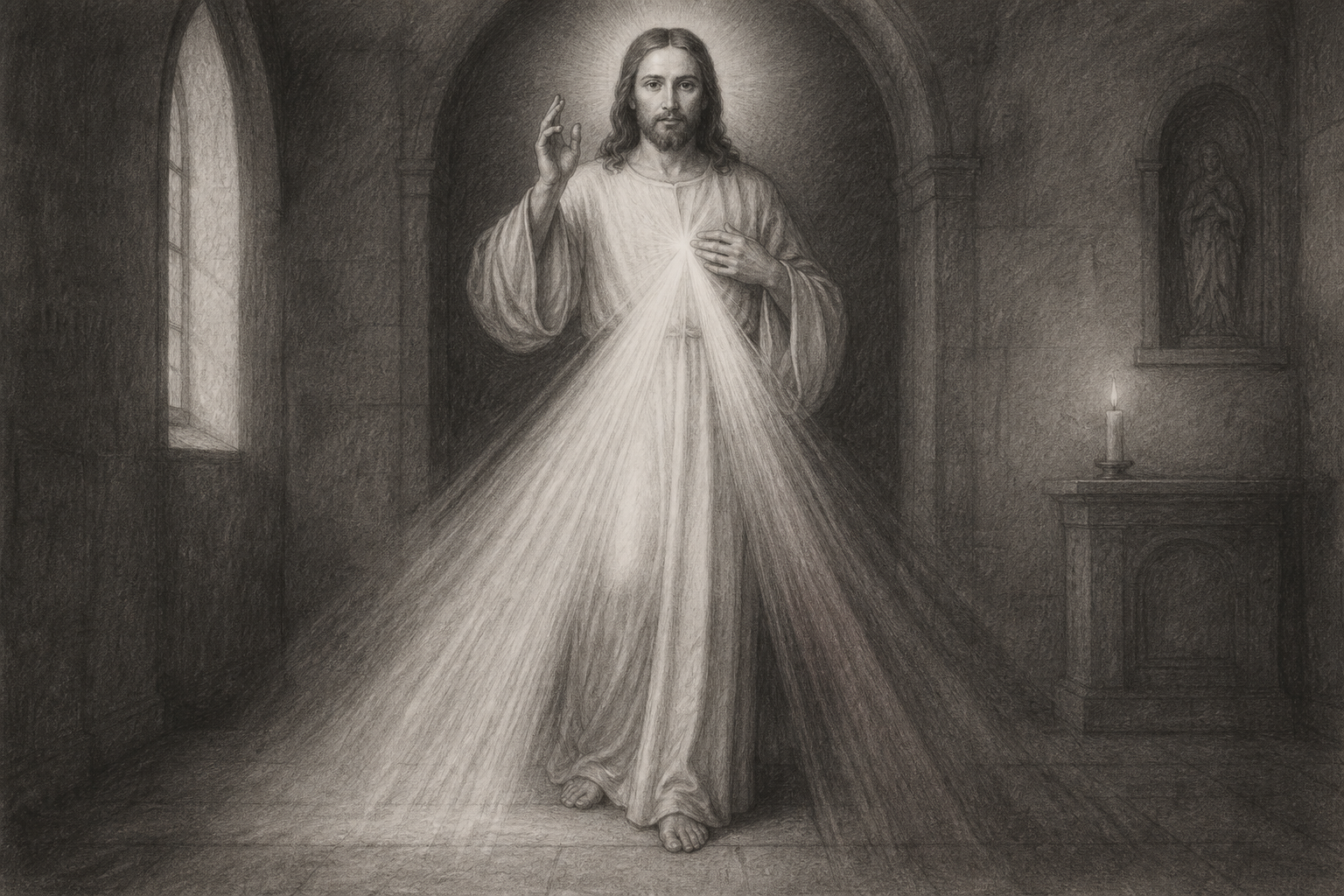
Faustina reported that Christ asked for an image showing him with one hand raised in blessing and the other touching his garment near his heart. Two rays emerge from that area, one pale and one red. The first Divine Mercy image was painted by Eugene Kazimirowski under Faustina's direction and was publicly displayed in Vilnius in 1935.
The rays are commonly understood, in light of Faustina's account, to recall the blood and water that flowed from the side of Christ in John 19:34. They direct attention to the saving death of Jesus and to the life of grace given to the Church.
St. John Paul II had a deep devotion to Divine Mercy. He canonized Faustina in 2000 and established the liturgical designation of the Second Sunday of Easter as Divine Mercy Sunday throughout the universal Church. Her canonization did not place every detail of her private revelation on the same level as Scripture. Rather, the Church judged that her life and message could safely assist the faithful in living the Gospel.
Private revelation serves the Gospel
Catholic teaching distinguishes public revelation from private revelation. Public revelation is the saving truth God has given in Christ and handed on through Scripture and Sacred Tradition. It was completed with the apostolic age and belongs to the deposit of faith.
Approved private revelations do not add new doctrines or complete something missing from the Gospel. They may emphasize a truth that the Church needs to hear with renewed attention in a particular time. Catholics are not required to give a private revelation the same assent owed to the Word of God.
This distinction protects the Divine Mercy devotion from exaggeration. Its value does not depend on treating it as secret knowledge or a shortcut around ordinary Catholic life. Its message is fruitful precisely because it turns believers back toward Christ, repentance, sacramental grace, prayer, and love of neighbor.
The principal practices of Divine Mercy
The Divine Mercy image
The image presents the risen Christ approaching the viewer in blessing. It is intended to foster prayerful trust, not superstition. A blessed copy may be placed in a church, chapel, or home, but the physical object should never be treated as a charm.
To pray before the image, a person might slowly repeat the inscription, bring a particular fear or sin before Christ, and ask for the grace to trust him. The image should direct the heart beyond itself to Jesus.
The Chaplet of Divine Mercy
The chaplet is usually prayed on ordinary rosary beads. It is brief enough for daily prayer and can be offered for the living, the dead, those near death, or any person in need of God's mercy.
- Begin with the Sign of the Cross.
- Pray the Our Father, the Hail Mary, and the Apostles' Creed.
- On each large bead, pray: Eternal Father, I offer You the Body and Blood, Soul and Divinity of Your dearly beloved Son, Our Lord Jesus Christ, in atonement for our sins and those of the whole world.
- On each of the ten smaller beads, pray: For the sake of His sorrowful Passion, have mercy on us and on the whole world.
- Repeat this pattern for all five decades.
- Conclude by praying three times: Holy God, Holy Mighty One, Holy Immortal One, have mercy on us and on the whole world.
The chaplet is not the same as the Mass, nor does it replace the Rosary or the Liturgy of the Hours. It is a private devotion focused particularly on Christ's Passion and the Father's mercy toward the whole world.
The Hour of Mercy
Many devotees pause at 3:00 in the afternoon to remember the death of Jesus. The Gospels associate Christ's death with the ninth hour, approximately 3:00 p.m., as seen in [[VERSE|mark|15|34-37|Mark 15:34-37]]. A person may pray the chaplet at this time, meditate on the Passion, make the Stations of the Cross, or simply pray a brief act of trust.
There is no requirement to pray the full chaplet at exactly 3:00 p.m. The hour is an invitation to remember Christ's sacrifice, not a magical window in which God becomes more willing to listen.
The Divine Mercy novena
A novena is nine days of prayer. The Divine Mercy novena is commonly begun on Good Friday and completed before Divine Mercy Sunday. Some use the intentions recorded by Faustina, while others pray the chaplet each day for particular people and needs.
This novena is optional. The solemn liturgies of Holy Week and the Easter Octave take precedence. A healthy devotion supports participation in those liturgies rather than drawing attention away from them.
Divine Mercy Sunday and the sacraments
Divine Mercy Sunday is celebrated on the Second Sunday of Easter, the final day of the Easter Octave. The Gospel traditionally proclaimed at Mass recounts the risen Christ appearing to the disciples, giving them peace, and entrusting the forgiveness of sins to the apostles. It also recounts the movement of Thomas from doubt to faith in [[VERSE|john|20|27-29|John 20:27-29]].
The liturgical setting matters. Divine Mercy Sunday is not an isolated celebration added after Easter. It stands within Easter itself. The mercy being celebrated is the fruit of Christ's Paschal Mystery, his death and Resurrection.
Some Catholics become anxious about promises associated with Divine Mercy Sunday. These should always be understood within the Church's sacramental teaching. Attendance at a devotion does not remove the need for repentance, and private prayer does not substitute for sacramental Confession when a person is conscious of mortal sin.
The Church also provides a plenary indulgence connected with Divine Mercy Sunday under the established conditions. An indulgence is the remission before God of temporal punishment due to sins whose guilt has already been forgiven. It is not permission to sin, and it is not forgiveness apart from repentance.
The usual conditions include sacramental Confession, reception of Holy Communion, prayer for the intentions of the Pope, and freedom from attachment to sin, even venial sin. The faithful should approach these conditions peacefully and sincerely rather than with scrupulous fear.
A simple way to begin faithfully
A newcomer does not need to adopt every practice at once. It is better to begin modestly and let the devotion deepen one's sacramental and moral life.
- Pray one act of trust each morning. Offer the day to Christ with the words, Jesus, I trust in You.
- Learn the chaplet gradually. Pray it once a week before attempting a daily commitment.
- Return to Confession. If it has been a long time, prepare with a calm examination of conscience and speak honestly to the priest.
- Participate fully in Sunday Mass. The Eucharist is the source and summit of Christian life. No private devotion replaces it.
- Read a Gospel passage about mercy. The parable of the prodigal son in [[VERSE|luke|15|20-24|Luke 15:20-24]] is a fitting place to begin.
- Perform a work of mercy. Forgive an offense, visit someone lonely, feed someone in need, pray for the dead, or speak patiently to a difficult person.
Mercy received must become mercy offered. Jesus teaches that the merciful are blessed in Matthew 5:7. This does not mean ignoring injustice or abandoning prudent boundaries. It means refusing hatred, seeking another person's true good, and remembering our own dependence on grace.
A devotion of confidence, not presumption
The Divine Mercy devotion can be misunderstood when trust is separated from conversion. Presumption says that sin does not matter because God is merciful. Christian trust says that sin matters so deeply that Christ gave his life to free us from it.
The devotion can also be distorted by fear, as if missing a prayer at a certain hour caused the loss of God's favor. Catholic devotions are aids to love, not traps for the conscience. Someone who forgets the chaplet, cannot complete a novena, or is prevented from attending a special service has not offended God merely by that limitation.
True devotion bears recognizable fruit: greater honesty in Confession, deeper reverence at Mass, patience with others, concern for the suffering, and hope in moments of personal failure. It teaches the believer to look at the wounds of the risen Christ and recognize not rejection, but an open invitation to return.
When guilt, grief, or fear makes prayer difficult, even a single sincere sentence may be enough to begin again: Jesus, I trust in You. Spoken with repentance and hope, those words place the heart before the One whose mercy is stronger than sin and whose risen life remains the Church's joy.
Keep Reading on Lets Read The Bible
Frequently Asked Questions
Is the Divine Mercy devotion required for Catholics?
No. The Divine Mercy devotion is an approved private devotion, not an obligation equal to Sunday Mass or the sacraments. Catholics may embrace it as a trustworthy aid to prayer, repentance, and works of mercy, but they are not required to practice every element.
Can I pray the Divine Mercy Chaplet at a time other than 3:00 p.m.?
Yes. The chaplet may be prayed at any time. Praying at 3:00 p.m. is a customary way to remember the hour of Christ's death, but it is not a requirement and should not be treated superstitiously.
Do I need to go to Confession on Divine Mercy Sunday itself?
Confession does not ordinarily have to occur on the Sunday itself. A person seeking the indulgence should fulfill the Church's established conditions within the permitted period. Anyone conscious of mortal sin must receive sacramental absolution before receiving Holy Communion.