Prayer and Devotion
Beginning the Day Before the Noise Takes Over
A steady Catholic practice that hands the first moments of the day to God
Site Admin | November 25, 2025 | 80 views
Morning prayer begins with the first gift of the day
A Catholic morning prayer habit does not begin with productivity or self-improvement. It begins with grace. Before a person checks messages, plans the schedule, or rushes into responsibilities, there is a quiet moment to remember that life itself is given by God. The Church has always taught that prayer is not mainly about performing well. It is about turning the heart toward the One who made us, saves us, and accompanies us in ordinary time.
Morning prayer is the small but decisive act of saying, in effect, Lord, this day belongs to You before it belongs to me. That offering may be as brief as the Sign of the Cross and a few words of praise, or as extended as a psalm, Scripture reading, and silent meditation. What matters is the direction of the heart. The day begins not with anxiety, but with adoration.
Scripture gives this instinct a clear shape. The psalmist prays, In the morning, Lord, You hear my voice, and again, Fill us at dawn with Your mercy. These lines are not decorative. They reveal a deeply human truth: the soul needs to orient itself before the world starts asking for everything at once.
Why the Church treasures prayer at the start of the day
There is a spiritual wisdom in praying early. Morning is a threshold, and thresholds matter. The first movements of the day often shape the rest of it. If we begin with haste, our minds can become scattered. If we begin with resentment, the heart may stay guarded. If we begin with silence, thanksgiving, and surrender, we are more likely to carry peace into work, family life, study, and suffering.
This is not because morning prayer magically removes all difficulty. It does something more realistic and more important: it places difficulty inside communion with God. The Catholic life is not a promise that every morning will feel inspiring. It is the commitment to return to God even when the heart feels dry, distracted, or tired. That faithfulness itself is a form of love.
Morning prayer also reminds us that the day is not our private project. Catholics are called to live every moment before God. At Mass, in the Liturgy of the Hours, in the Rosary, and in simple personal prayer, the Church teaches us to sanctify time. Morning prayer is one of the most accessible ways to do that. It makes the home, the kitchen, the car, and the workplace into places where the soul remembers its Lord.
There is another reason the practice matters. We wake each morning carrying our own intentions, fears, and unfinished business. Prayer brings those hidden things into the light. The habit forms us to ask not only, What must I do today? but also, Who do I belong to today? That is a different question, and it changes the shape of the day.
What morning prayer can include
A morning prayer Catholic guide should never imply that there is only one proper formula. The Church offers many paths, and the best one is often the one a person can actually keep with humility and consistency. Still, a simple pattern can help.
Many Catholics begin with thanksgiving. Before asking for anything, they thank God for life, breath, a new day, and the protection that has carried them through the night. Gratitude is not sentimental. It is truthful. Everything we have is received.
Next comes offering. The day can be placed in God's hands with a simple intention: family concerns, work, study, appointments, temptations, joys, and sufferings. Some people unite the day to the Eucharistic sacrifice by offering their prayers, works, joys, and sufferings. Others place the day under the Blessed Virgin Mary, asking her to teach them how to say yes to God with trust.
Then there is petition. Morning prayer is a fitting time to ask for the grace needed for the hours ahead: patience, chastity, perseverance, honesty, generosity, purity of speech, and peace. Catholics do not pray because God is unaware of our needs. We pray because our dependence on Him is real, and prayer opens us to receive His help.
Scripture can also be part of the morning. Even one short passage can steady the heart. Consider Do not worry about tomorrow, His mercies are new every morning, or Present your requests to God. A few verses read slowly can become a spiritual anchor for the whole day.
Some Catholics use a fixed prayer, such as the Our Father, the Hail Mary, the Glory Be, or the Morning Offering. Others pray in their own words. Both are good. The point is not to impress oneself with originality, but to speak honestly to God and to listen in silence.
How to begin when the habit is not yet there
Many people admire morning prayer without having a stable routine. They imagine that a faithful practice requires a long block of time, a perfectly quiet room, and a disciplined mind. In reality, the beginning is usually much smaller.
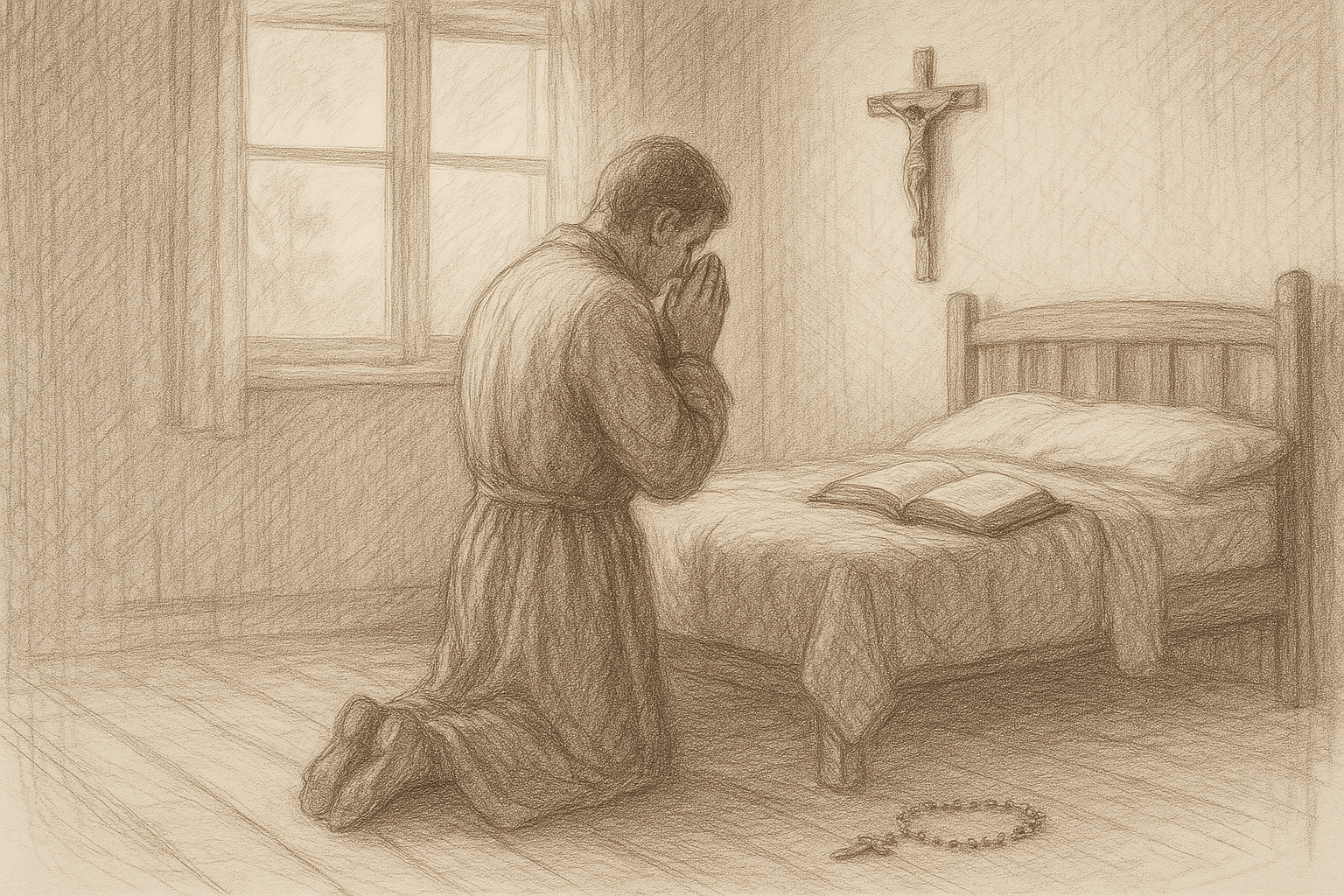
Start with two minutes. Stand beside the bed, make the Sign of the Cross, and offer the day to God. If that is all you can manage, begin there. If you can add a psalm, do so. If you can pray for your family and enemies by name, do so. If you can sit in silence for a minute without reaching for your phone, that too is a real act of devotion.
It can help to prepare the night before. Set a prayer book nearby. Keep the Bible open to a morning passage. Leave a holy image or crucifix where you will see it first. These small arrangements matter because they gently train the body to remember what the soul intends. Catholic spirituality is never purely abstract. We pray as embodied people.
It is also wise to choose a realistic time. Some pray immediately upon waking. Others pray after washing up or after the first cup of coffee. The best time is the time you can keep faithfully. A humble, repeatable practice will bear more fruit than an ambitious plan that collapses after a week.
And when a morning is missed, begin again without drama. Guilt can be useful when it leads to repentance, but it becomes harmful when it turns prayer into a performance test. The Lord is not waiting to shame the faltering heart. He invites us back.
When prayer feels dry or distracted
One of the most common obstacles is the feeling that prayer is not doing much. The mind wanders. The heart feels flat. The words seem thin. This is not unusual. In fact, it is deeply ordinary. The value of morning prayer is not measured by emotional intensity. It is measured by fidelity and faith.
Sometimes the most fruitful prayer is very plain. A person rises, offers the day, reads a brief passage, and sits quietly for a moment. Nothing dramatic happens. Yet the heart has turned toward God. That turning is real, even if it feels small.
Distracted prayer can also become a place of humility. We discover how restless we are. Instead of seeing that as failure, we can bring the distraction itself to God. Lord, my mind keeps running. Stay with me. Such a prayer is honest and childlike. It may be more pleasing to God than polished speech.
The saints remind us that perseverance matters. Some holy men and women lived with fervent prayer, but many also lived with dryness, fatigue, and routine. The important thing was not constant feeling but steady return. Morning prayer is a school of return.
For those who struggle with distraction, it can help to pray aloud. Hearing the words slows the pace. Another useful practice is to use a short verse as a refrain. Let me hear Your mercy in the morning can be repeated slowly until it settles the heart. A short prayer prayed attentively is often better than a long one rushed through.
How morning prayer shapes the rest of the day
A Catholic morning prayer habit slowly changes the person who keeps it. Not all at once, and not in a way that can be measured neatly, but truly. Prayer teaches dependence, and dependence weakens the illusion that we are self-sufficient. Prayer teaches gratitude, and gratitude softens complaint. Prayer teaches memory, and memory keeps God near during ordinary tasks.
It also strengthens moral readiness. A person who begins the day in God's presence is better prepared to meet temptation honestly. That does not mean temptation disappears. It means there is already a door open to grace. The soul that has already said yes to God in the morning is more likely to remember that yes when pressure comes.
Morning prayer can also transform family life. A parent who prays before the household wakes is not only seeking private peace. That prayer can spill into the atmosphere of the home. A spouse, child, or roommate may never hear the words, but they may feel the difference. Grace is often quiet before it is visible.
At work, the habit can become a hidden offering. Meetings, deadlines, errands, and interruptions become part of a day that was already placed in God's hands. Even suffering can be received differently when the day begins with trust. The Cross does not vanish, but it is no longer carried alone.
A simple pattern to keep nearby
If you want a practical structure, this one is simple enough to remember and rich enough to sustain:
- Wake and make the Sign of the Cross.
- Thank God for the gift of a new day.
- Offer the day with its work, joys, and burdens.
- Read a short Scripture passage and pause over one line.
- Ask for grace for the challenges ahead.
- Entrust yourself to Mary and the saints.
- End with silence or the Our Father.
This pattern is not a law. It is a path. The goal is not to create pressure, but to create space for God. Over time, the heart learns to wake more quickly to His presence.
For some, the most helpful image is not a schedule but an act of surrender. Morning prayer says that the first thoughts of the day do not need to belong to fear. They can belong to the Father. As This is the day the Lord has made reminds us, the day is already a gift before it becomes a task.
Morning prayer does not demand a perfect personality or a dramatic spiritual experience. It asks only for willingness. Begin small, stay faithful, and let the Lord meet you in the quiet before the noise starts to speak. If you return to Him there each day, the habit will slowly become less like an obligation and more like home.
Keep Reading on Lets Read The Bible
Frequently Asked Questions
What is a simple Catholic morning prayer to start with?
Begin with the Sign of the Cross, thank God for the new day, offer your work and intentions to Him, and ask for grace to live faithfully. The Our Father or a short psalm can be added if you have time.
How long should morning prayer be?
There is no fixed length. Two to five minutes is a good beginning if that is what you can keep consistently. A shorter prayer prayed daily is better than an ideal plan that is never maintained.
What if I miss morning prayer?
Do not be discouraged. Simply begin again the next morning. Catholic prayer is a habit of return, and God is always ready to receive a sincere heart.