Catholic Living
Contraception and the Moral Life: A Catholic Path of Truth, Mercy, and Growth
A clear look at why the Church speaks firmly, yet with hope, about fertility, marriage, and the call to holiness.
Site Admin | August 8, 2025 | 69 views
Why this teaching reaches beyond a private decision
Few moral questions in Catholic life feel as intimate as contraception. It touches marriage, family planning, health, finances, and the emotional burdens many couples carry in ordinary life. For that reason, the Church has always approached the matter with seriousness and pastoral care. She does not speak about fertility as though it were an inconvenience to be managed. She speaks of it as a gift that belongs to the meaning of married love itself.
That is why contraception and Catholic life cannot be separated from the wider call to holiness. Catholic moral teaching is not simply a list of permitted and forbidden acts. It is a vision of what human love is for, how the body speaks, and how spouses are meant to receive one another in truth. When the Church warns against contraception, she is not trying to reduce joy. She is trying to protect the language of self gift that marriage is meant to embody.
Scripture presents fertility as part of God's blessing and human stewardship. From the beginning, the Lord tells man and woman to be fruitful and multiply Be fruitful and multiply. Later, the Psalms speak of children as a gift from the Lord Children are a gift from the Lord. These passages do not settle every medical or pastoral question by themselves, but they do help us see that life is received, not manufactured, and that love is not measured only by comfort or control.
What the Church means when she says no
Catholic teaching holds that each marital act should remain open to the gift of life. That phrase can sound abstract until we slow down and ask what it means. It means that spouses are called to unite bodily in a way that preserves the full truth of their exchange. The marital act is meant to say, in the body, I give myself to you completely. To block the procreative meaning of that act is to alter the language of the gift.
The Church's objection is not that couples should have as many children as possible without discernment. Nor is it that every serious reason for spacing births is wrong. The moral issue is the chosen act itself. Catholic teaching allows spouses to cooperate with the rhythms of fertility through natural family planning when there are proportionate reasons, because that approach works with the body rather than against its meaning. What is not allowed is the deliberate frustration of the act's procreative power through contraception.
This distinction matters because morality is not only about results. It is also about the kind of person we become through our choices. A married couple may intend kindness, financial stability, or peace of mind. Those are understandable goods. Yet if the means chosen train the heart to resist the language of life, the moral cost is not small. The Church sees this not as a matter of mere rule keeping but as part of the formation of virtue.
The human heart and the temptation to control
Many Catholics struggle with this teaching because modern culture trains us to think of control as freedom. We plan our education, our careers, our schedules, our retirement, and even our emotional boundaries. In such a world, fertility can feel like one more area to manage. The problem is not planning itself. Prudence is a virtue. The problem is the deeper temptation to treat life as something to be accepted only on our terms.
Contraception and Catholic life intersect here because the issue is not only sexual ethics but also trust. Married love asks a couple to cooperate with God in a bodily way. That can feel risky. It can require sacrifice, discipline, patience, and discernment. Yet those are the very conditions in which virtue grows. A marriage that never has to practice trust will be poorer for it.
Saint Paul teaches that the body matters in salvation history. He reminds the Corinthians that the body is not for immorality but for the Lord The body is for the Lord. Later he insists that our bodies are temples of the Holy Spirit Your body is a temple of the Holy Spirit. Catholic teaching on contraception belongs to that same vision. The body is not an accessory to the soul. It is part of the person, and what we do with it shapes the whole person.
Marriage is a school of self gift
To speak of self gift is not to romanticize marriage. Married life is full of bills, interruptions, fatigue, illness, and long seasons when affection must be expressed in patience more than sentiment. But marriage is still a school of charity. Spouses learn to give, receive, forgive, and begin again. Children, whether many or few, are not the only fruit of that school. Fidelity itself becomes fruitful.
In this light, the Church's teaching on contraception is not merely about childbearing. It concerns the meaning of spouses' love. Marriage is called to mirror God's faithful love, a love that is generous and life giving. When spouses reject the inner structure of that gift, they risk reducing one another to emotional comfort or personal satisfaction. When they receive the full truth of marriage, they learn that love is more than desire and more than control.
This is also why the Church speaks with caution about separating the unitive and procreative meanings of sex. These meanings belong together. To love a spouse is not only to seek closeness, but also to honor the body's openness to life. That openness does not mean every act must result in conception. It means the act itself must remain oriented toward the truth of life. In Catholic moral reasoning, form matters, not just outcome.
Mercy for those who have already struggled
Many Catholics carry this topic with pain. Some used contraception for years before they knew the Church's teaching. Others knew the teaching and still struggled because of fear, pressure from a spouse, medical uncertainty, depression, or the demands of a difficult season. Some have felt ashamed, confused, or alone. The Church does not ask such people to pretend their burdens were light. She asks them to bring their real lives into the light of Christ.
Mercy is not denial. It does not call evil good. But mercy also refuses to reduce a person to a single sin or pattern. If you have used contraception and now see the matter differently, the first step is not self hatred. The first step is truth before God. Bring the matter to confession. Tell the priest plainly what happened, when possible, and what fears or pressures were involved. Receive absolution with humility. Grace is given for real conversion, not for self punishment.
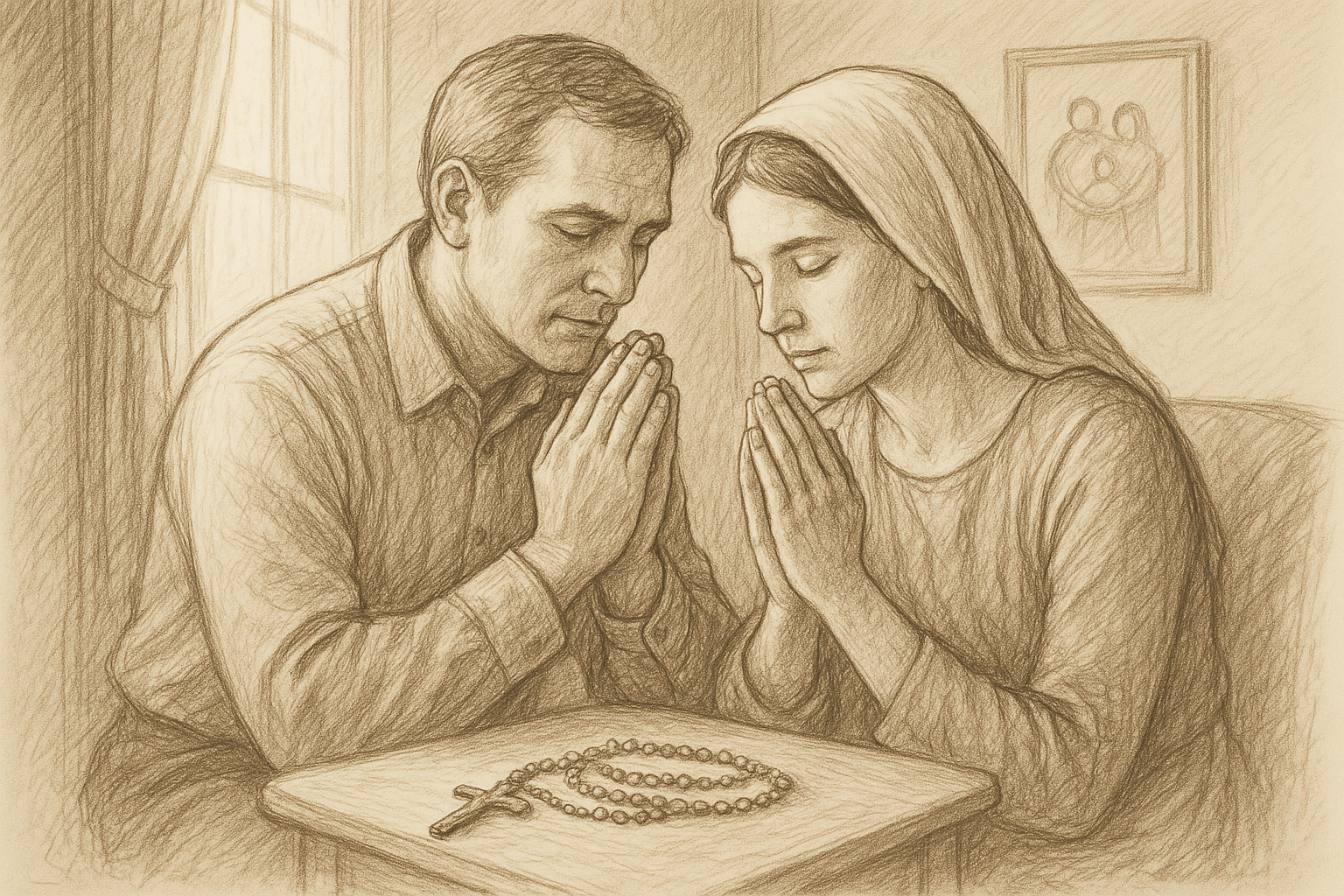
If both spouses need healing, they should pray together if possible. If one spouse is hesitant, the other can still live faithfully, speak gently, and ask God for patience. Healing in marriage often begins with quiet honesty rather than dramatic speeches. A soft, steady recommitment to the Lord can open the door to deeper trust.
Christ does not wait for a perfect marriage before offering grace. He enters the marriage as it is and begins to heal what is disordered.
Practical steps toward repentance and growth
For couples who want to respond faithfully, it helps to move in small, realistic steps. Good intentions matter, but habits are changed by practice. The following steps are simple, but they are not superficial.
- Make a sincere examination of conscience. Ask whether fear, convenience, pressure, or resentment has shaped your choices more than trust in God.
- Go to confession. Name the sin honestly and receive the sacrament as a source of mercy, not embarrassment.
- Learn the Church's teaching in full. Read a trustworthy Catholic explanation of marriage, fertility, and chastity so that your conscience can be formed well.
- Pray together as spouses. Even a few minutes each day can change the tone of a household.
- Consider natural family planning with proper guidance. If serious reasons exist to postpone pregnancy, learn a method that respects the body and the moral law.
- Ask for support. A priest, Catholic counselor, or faithful mentor can help when emotions, health concerns, or marital tension make discernment difficult.
Growth in virtue is rarely dramatic. Usually it looks like repeated fidelity. A couple may begin with one honest conversation, one confession, one act of patience, one renewed attempt to pray. Over time, these choices reshape the heart. The goal is not to win an argument about fertility. The goal is to become more free, more truthful, and more open to God's will.
What if obedience feels too costly?
This is the question many never say out loud. What if trust in God's plan feels unsafe? What if another pregnancy seems impossible? What if a medical condition complicates everything? These are serious questions, and they deserve serious pastoral attention. Catholic teaching does not dismiss them. It asks couples to discern with conscience formed by the Church, not against it.
Sometimes the struggle is not a lack of belief but exhaustion. In that case, the path forward may require slower pacing, medical consultation, better communication, and practical help from the parish community. It may also require accepting that chastity within marriage includes more than the sexual act. It includes tenderness, restraint, and mutual understanding. When spouses learn to honor one another's limits, they often discover deeper communion than they expected.
There is also a spiritual dimension to sacrifice. The Lord does not ask for a love that costs nothing. He asks for hearts willing to be purified. In marriage, that purification can happen in ordinary ways: by embracing children as gifts, by accepting temporary abstinence when needed, by trusting Providence when plans change, and by refusing to let fear have the final word.
Forming conscience without fear
A well formed conscience is not a private opinion. It is the faculty by which a person recognizes moral truth and chooses the good. Catholics should not treat conscience as a permission slip to do whatever feels manageable. At the same time, conscience formation takes patience. Someone raised with little teaching may need time to understand why the Church says what she says.
That formation begins with Scripture, the sacraments, and patient instruction. It continues in marriage through daily choices. It is strengthened by humility, because humility allows us to admit that modern habits may not have the final word. It is also strengthened by hope. The Church does not ask couples to carry this teaching by willpower alone. She offers grace.
When Catholics live this teaching well, they testify that love is richer than impulse and more durable than convenience. They show that a child is not a threat to communion but one possible fruit of it. They show that sacrifice does not destroy joy but can deepen it. And they witness to a culture that badly needs signs of trust, fidelity, and reverence for life.
For many readers, the next faithful step will be quiet and practical. It may be a confession scheduled this week, a conversation with a spouse, a search for trustworthy guidance, or a decision to begin learning natural family planning. Whatever the starting point, the Lord meets real people in real homes. He asks for truth, and he gives grace for the road ahead.
Keep Reading on Lets Read The Bible
Frequently Asked Questions
Does the Catholic Church teach that every married couple must have as many children as possible?
No. The Church teaches openness to life, not reckless disregard for prudence. Couples may discern serious reasons to postpone pregnancy and may use moral means, such as natural family planning, while remaining open to God's will.
What should a Catholic do after using contraception?
The first step is repentance. Bring the matter to confession, speak honestly before God, and ask for grace to change. If needed, seek guidance for your marriage and learn the Church's teaching more fully.
Is natural family planning the same thing as contraception?
No. Natural family planning works by observing the natural rhythms of fertility and abstaining during fertile times for serious reasons. Contraception deliberately blocks the procreative meaning of the marital act, which is why the Church distinguishes the two.