Prayer and Devotion
The Discipline of Holy Quiet: Learning to Pray Without Many Words
Silent prayer is not empty time. It is a real meeting with God, where the heart learns to listen, adore, and rest.
Site Admin | December 4, 2025 | 69 views
Many Catholics know the feeling: the day is crowded, the mind is busy, and prayer becomes something we try to squeeze in between obligations. In that setting, silent prayer explained is not a luxury or a spiritual technique reserved for experts. It is one of the oldest and simplest ways of standing before God with a receptive heart.
Silent prayer does not mean that words have no place. The Church treasures vocal prayer, psalms, litanies, and devotions. But there are moments when the soul needs fewer words and more attention. The silence of prayer is not vacant. It is a silence filled by faith, by reverence, and by the presence of the Lord who speaks gently to the heart.
Silence in Scripture is never empty
Scripture often presents silence as a place of encounter. Elijah did not find the Lord in the violent wind, the earthquake, or the fire, but in the sound of a gentle whisper, often rendered as a still small voice 1 Kings 19:12. That moment teaches something lasting about prayer: God is not absent when the noise fades. He is often more easily recognized when the soul grows quiet.
The Psalms repeatedly invite this kind of recollection: Be still, and know that I am God Psalm 46:10. Stillness is not passivity. It is attentive trust. The heart stops trying to manage everything and begins to rest in God's sovereignty.
In the Gospels, Jesus Himself often withdraws to pray in solitude Mark 1:35. He teaches by word and example that prayer is not only speaking to God but being with Him. Even in the midst of intense ministry, He makes room for quiet communion with the Father. If the Lord chose silence for prayer, Catholics should not regard it as strange or unnecessary.
The Church has always valued holy quiet
From the earliest centuries, Christians sought times of interior recollection. The desert fathers and mothers fled distraction not because the world was evil in itself, but because they knew the heart is easily scattered. Their witness remains valuable today. They understood that silence exposes the state of the soul. It reveals our restlessness, our desires, our fears, and our hidden attachments.
Later, the Church's monastic tradition gave silence a disciplined place in daily life. Monks and nuns did not embrace quiet merely to avoid noise. They sought a listening posture before God. The liturgy itself also teaches this lesson. Sacred silence in the Mass is not an awkward pause to be rushed through. It gives room for adoration, reflection, and interior participation. In those moments, the faithful can receive what has been proclaimed and offer it back to the Lord in the heart.
The Catechism speaks of prayer as the raising of the heart and mind to God, and that raising can happen in words or in silence. The point is not method alone. The point is communion. Silent prayer helps make room for that communion when speech would only add more clutter.
What silent prayer is, and what it is not
Silent prayer can be misunderstood. Some assume it means clearing the mind completely. Others think it requires having no thoughts at all. That is not realistic, and it is not the Catholic aim. The purpose of silent prayer is not to empty the person into a blank state. It is to place oneself before God in faith, attention, and love.
In practice, this may include a simple act of recollection, a short scriptural phrase, an act of adoration, or wordless resting in God's presence. Sometimes the heart will be crowded with thoughts. That does not mean prayer has failed. Returning gently to God is part of prayer. Silence is not the absence of struggle. It is often the setting in which struggle becomes honest.
Silent prayer is also not an escape from charity, duty, or the sacraments. It is meant to support them. A person who learns to be still before God is better able to speak with patience, serve with humility, and receive the Eucharist with greater reverence. Quiet prayer orders the soul toward love.
Why silence matters in an age of constant noise
Modern life trains the mind to move quickly from one stimulus to another. Phones, alerts, entertainment, and constant conversation all shape us. Even when none of these things are bad in themselves, the result can be spiritual fragmentation. We begin to lose the ability to remain present. We know many facts but struggle to listen deeply.
Silent prayer helps heal that fragmentation. It reintroduces interior poverty before God. We come without performance. We do not need to impress the Lord with many words. Christ warns against empty babbling in prayer Matthew 6:7, not because He despises vocal prayer, but because the Father already knows our needs. Silence becomes an act of trust. We believe that God knows us better than we know ourselves.
This kind of prayer also guards against spiritual consumerism. It is easy to approach prayer as a search for feelings or results. Silent prayer reminds us that God is the end of prayer, not merely a means to consolation. Sometimes the gift is not an answer we can measure, but a deeper availability to grace.
How silent prayer forms the soul
Silent prayer teaches several spiritual habits at once. It trains attention by asking us to remain with God rather than chase the next distraction. It strengthens humility because we confront our inability to control the interior life. It deepens trust because we learn to stay with God even when prayer feels dry. It also purifies desire. When the soul is quiet, we begin to see what we truly long for.
That is one reason silence can feel uncomfortable at first. It removes the background noise that often hides our inner life. In the stillness, impatience may surface. So may resentment, sorrow, anxiety, or temptation. Yet this is not a reason to avoid silence. It is a reason to enter it with patience. God can work with what He reveals.
There is also a deeper gift. Over time, silent prayer disposes the heart to contemplative openness. Not every person is called to a life of formal contemplation, but every Catholic is called to deeper communion with God. Silent prayer gently fosters that communion by teaching the soul to receive before it speaks.
Simple ways to begin silent prayer at home
The best way to begin is not to wait for perfect conditions. Start small, and be faithful. A few minutes of quiet every day can bear surprising fruit.
- Choose a regular time, even if it is only five or ten minutes.
- Find a quiet place where you are less likely to be interrupted.
- Begin with a short prayer, such as the Sign of the Cross or a brief act of faith.
- Read a verse slowly, then remain with the Lord in silence.
- When distractions come, do not argue with them. Gently return to God's presence.
- End with thanksgiving, even if the time felt dry or scattered.
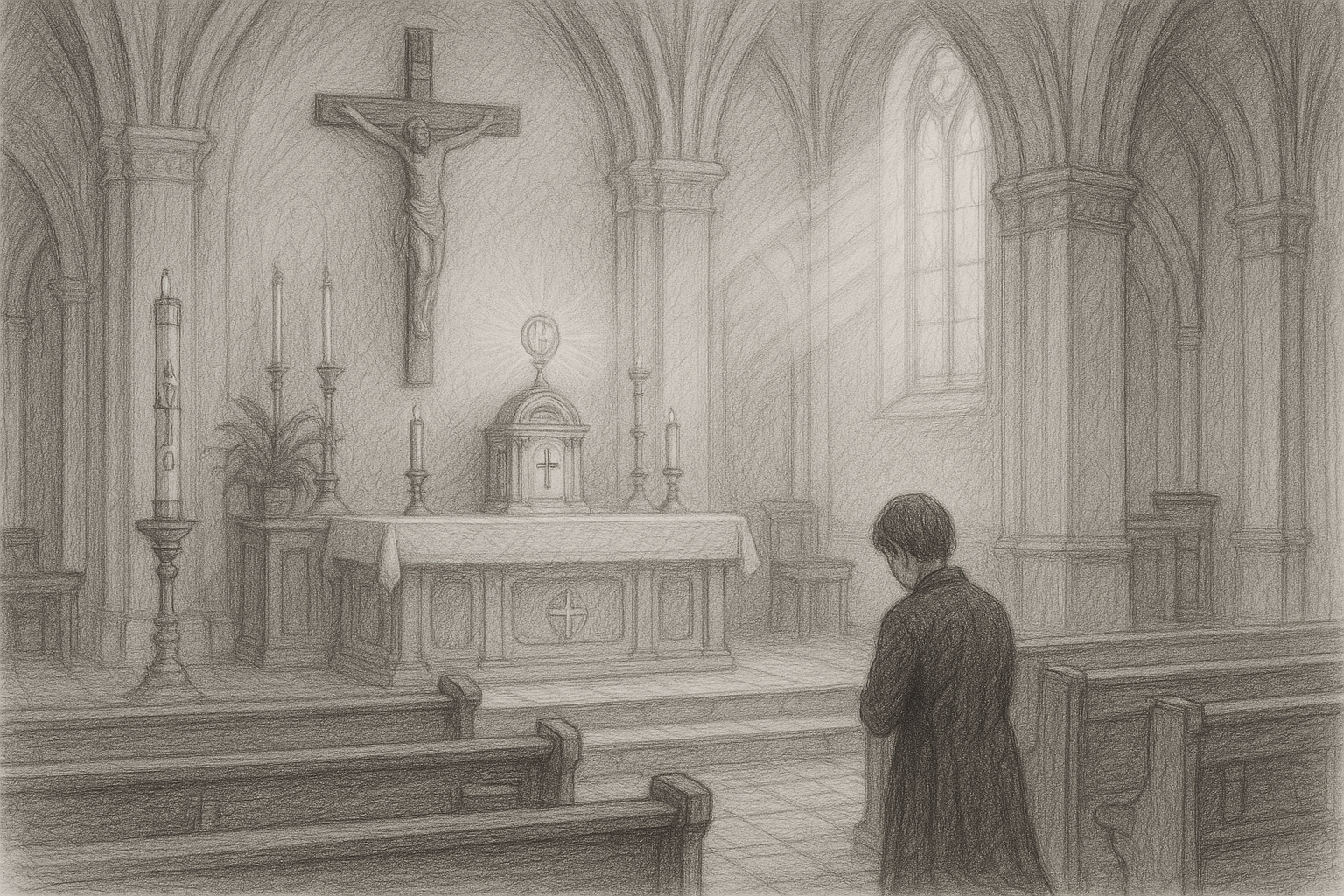
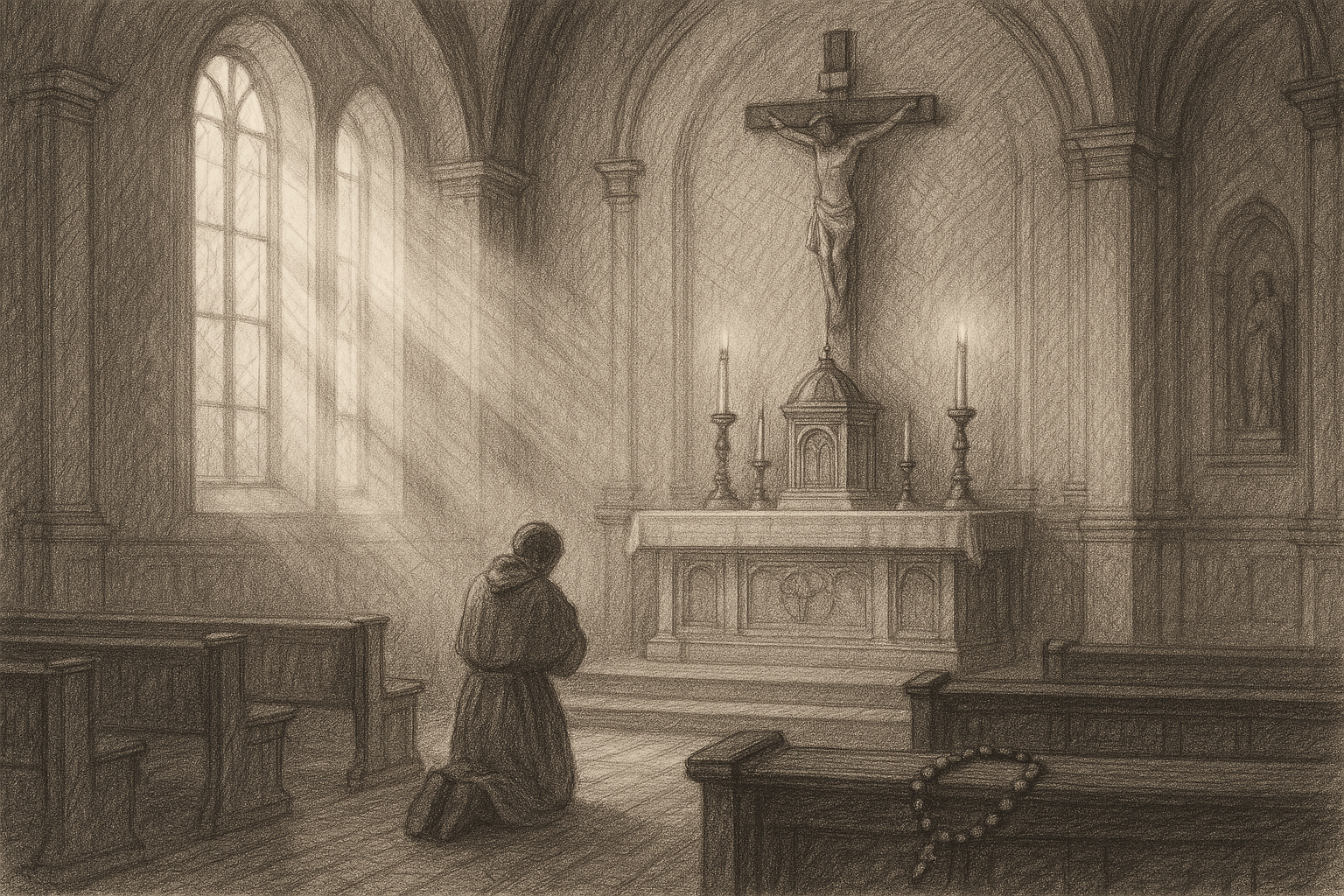
Some people find it helpful to pray before the tabernacle, where reverence naturally deepens. Others pray at home in a chair, in a chapel, or during a quiet walk. The setting matters less than the disposition. The goal is faithful attention.
A useful approach is to let a short passage of Scripture guide the silence. For example, the words of Psalm 23 or the Lord's own invitation to rest can be repeated slowly until they settle into the heart. The point is not to multiply techniques, but to enter into prayer with trust.
Silent prayer and the Sacraments
Silent prayer does not stand apart from Catholic sacramental life. It supports it. Before Mass, silence helps the faithful prepare to receive the liturgy with reverence. After Communion, silence gives space for thanksgiving. In confession, silence before speaking can help us examine our conscience honestly. At home, silent prayer can keep the memory of the sacraments alive through the day.
In this way, silence becomes part of a sacramental rhythm. It reminds us that grace is received, not manufactured. The Lord acts first. We listen, we respond, and we receive. Silent prayer helps the heart understand that order.
It also honors the mystery of God's closeness. We do not come to prayer to create holiness from our own effort. We come because He has already drawn near in Christ. The Incarnation assures us that God is not distant from human life. Silent prayer lets that truth sink in more deeply than hurried speech often can.
When silence feels difficult
Not every attempt at silent prayer will feel peaceful. Some days will seem noisy from beginning to end. That is normal. A distracted prayer, offered in humility, can still be real prayer. The saints were not strangers to dryness. They continued because faith is not measured by comfort.
If silence feels hard, do not abandon it too quickly. Stay simple. Sit before God. Use one word if needed, such as Jesus, Father, or Lord, have mercy. Then return to quiet again. The heart gradually learns that it does not need to fill every space.
It can also help to connect silence with daily duties. A brief pause before work, a moment of quiet before meals, or a short period of prayer after waking can begin to change the tone of a whole day. Silent prayer is not only for retreat houses and chapels. It can be woven into ordinary Catholic life.
A grace worth protecting
Silent prayer remains important because human beings remain the same at their core: made for God, restless until they rest in Him, and in need of a place where the heart can listen. Words are good, and the Church gives us many prayers for a reason. But without silence, words can become hurried and thin. Silence gives them depth.
In the end, silence is not a void. It is a threshold. We step into it with our weakness, our distractions, and our desire, and we discover that the Lord is already there. That is why Catholics keep returning to holy quiet. It teaches the soul how to be present to the One who is always present to us.
If you can begin with a few faithful minutes today, do not despise them. God often shapes the heart slowly, and He is never wasteful with the time we give Him in love.
Keep Reading on Lets Read The Bible
Frequently Asked Questions
What is silent prayer in Catholic life?
Silent prayer is prayer offered with few or no words, where a person rests attentively before God in faith, love, and humility. It can include Scripture, brief invocations, or simple recollection, but its heart is quiet presence before the Lord.
Do I need to stop thinking completely during silent prayer?
No. Silent prayer does not mean having no thoughts at all. Thoughts will come and go. The practice is to notice distractions gently and return to God's presence without discouragement.
How long should silent prayer be each day?
Start with a realistic amount of time, even five to ten minutes. The value of silent prayer comes from fidelity and reverence, not from forcing long periods before you are ready.