Jesus and the Gospels
The Evening Walk That Opened a New Way of Seeing Christ
On the road to Emmaus, sorrow gave way to recognition, and a hidden Lord became known in Scripture and the breaking of the bread.
Site Admin | February 15, 2026 | 75 views
A Gospel scene that begins in disappointment
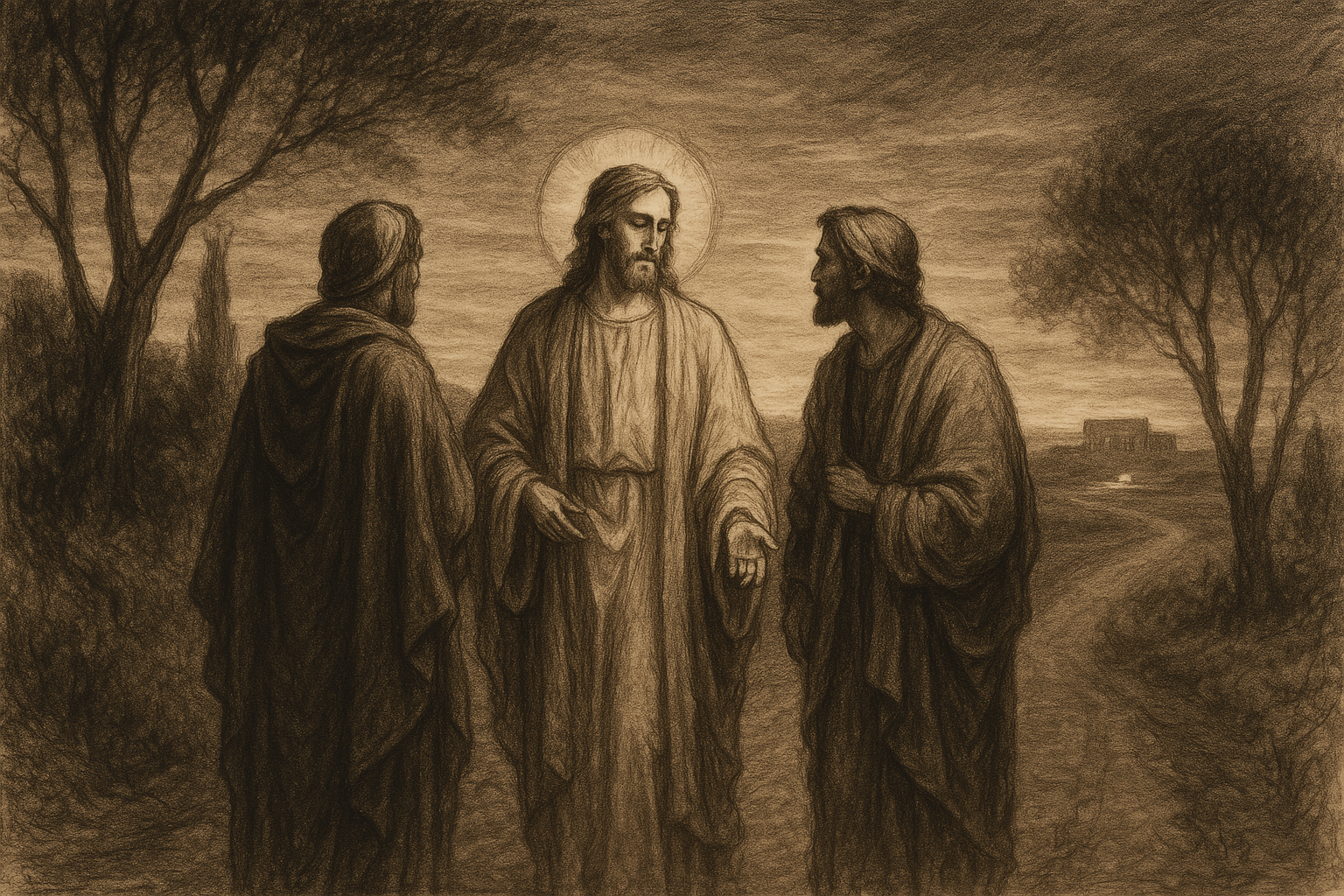
The road to Emmaus appears in Luke 24 as an ordinary walk made heavy by grief. Two disciples are leaving Jerusalem after the Crucifixion, still carrying the shock of what they have seen and heard. They had hoped Jesus would redeem Israel, but from their perspective that hope has collapsed. Into that sadness comes a mysterious companion who asks what they are discussing. Their answer is full of sorrow, confusion, and unfinished faith.
This is one reason the road to Emmaus Catholic meaning is so rich. The scene is not only about a private encounter after Easter. It is about how the risen Christ meets people in disappointment and slowly restores them. He does not begin by scolding. He begins by walking with them, listening, and then opening the Scriptures so that they can understand what has happened in light of God's plan.
Luke tells us that their eyes were kept from recognizing Him their eyes were kept from recognizing Him. That detail matters. Recognition is not immediate because resurrection faith is not mere excitement or wishful thinking. It is a gift that comes through divine initiative, patient teaching, and a heart ready to receive truth.
Christ draws near before the disciples know it
The risen Lord meets the disciples on the road, but He comes in a form they do not expect. This pattern runs through the Gospels. God often works before we understand what He is doing. The disciples can speak honestly about their wounds because Jesus has already joined them. Their sadness does not prevent His presence.
For Catholics, this is deeply consoling. Many believers know what it is to walk through a season when prayer feels dry, plans have failed, or faith seems dim. Emmaus reminds us that Christ is not absent in those moments. He may be nearer than we realize. He may be addressing us through Scripture, through the Church, through a friend, or through the quiet movement of grace that slowly changes the heart.
There is also a gentle irony in the scene. The disciples tell Jesus about Jesus, and they do not know it. They speak of the women who found the tomb empty and of the reports that some angels had appeared. They have fragments of the truth, but not yet the whole picture. The Lord then interprets their own story for them. He shows that the Cross was not a tragic detour but part of the saving plan of God.
Jesus teaches them the meaning of suffering through the Scriptures
Luke says that beginning with Moses and all the prophets, Jesus explained to them what referred to Him in all the Scriptures beginning with Moses and all the prophets. This is a profound image of Christian interpretation. The Old Testament is not discarded after Easter. It is fulfilled in Christ. The promises, covenants, sacrifices, and prophetic hopes all find their center in Him.
Catholic readers can see here a model for lectio divina and for all serious reading of Scripture. We do not open the Bible only to collect moral advice or inspiring phrases. We read it to encounter Christ. The road to Emmaus Catholic meaning includes this conviction: the Scriptures are alive because they bear witness to the living Lord.
The disciples first receive explanation before recognition. That order is important. Their minds are being formed before their eyes are opened. Often our own faith grows in a similar way. We come to understand before we fully feel. We accept the truth before we can say with confidence that we have seen everything clearly. Jesus gives both light and patience.
His interpretation also changes the meaning of suffering. He shows that the Messiah had to suffer before entering His glory. The Cross is not an embarrassment to be hidden. It is the way of divine love. For Catholics, this speaks directly to the shape of Christian discipleship. We are not surprised by sacrifice, loss, or costly obedience. We learn from Christ that love may pass through suffering but is never defeated by it.
The breaking of the bread becomes the moment of recognition
The turning point of the story comes when Jesus sits at table with them. He takes bread, blesses it, breaks it, and gives it to them he took bread, their eyes were opened. Their eyes are opened, and they recognize Him. Then He vanishes from their sight.
Catholics have always heard Eucharistic resonance in this passage. The gestures echo the Last Supper, and the moment of recognition after the breaking of the bread naturally invites Eucharistic reflection. While the text does not reduce the entire scene to a single sacramental point, it clearly shows that Christ makes Himself known in a way that is intimately tied to table fellowship, blessing, breaking, and gift.
This is one of the clearest places where the road to Emmaus Catholic meaning meets Sunday life. The risen Jesus is not only remembered in the Eucharist. He is encountered. He is not a distant symbol of comfort but the living Lord who gives Himself to His people. The disciples know Him when He acts as host and gives them bread. In the Mass, Catholics confess that the same Lord comes near in the fullness of His gift.
Their response is immediate. They say, Were not our hearts burning within us while He spoke to us on the way and opened the Scriptures to us? Were not our hearts burning within us The burning heart is not emotional excitement for its own sake. It is what happens when revelation moves from the mind into the depths of the person. Christ illumines both Scripture and sacrament, and the heart catches fire.
What the Emmaus story teaches about discipleship
The disciples had been walking away from Jerusalem, but after recognizing Jesus they return at once to tell the others. This reversal is part of the story's power. Meeting Christ changes direction. Despair does not have the last word. Fear gives way to witness. Isolation gives way to mission.
That pattern remains relevant for Catholic life today. The Lord still gathers scattered hearts and sends them back into communion. When we encounter Him in Scripture and the Eucharist, we are not meant to stay inward-looking. Grace moves us outward toward the Church, toward service, and toward testimony.
There are several practical lessons hidden in the passage:
- Stay on the road with Christ. Even when you are confused, keep speaking honestly with Him in prayer.
- Let Scripture interpret your life. Ask how your suffering, hopes, and disappointments fit within God's saving story.
- Receive the Eucharist with faith. The risen Lord does not merely inspire. He gives Himself.
- Return to communion. The road to Emmaus ends not in private insight but in fellowship with the brethren.
Each of these lessons has a distinctly Catholic shape. Faith is personal, but never isolated. It is biblical, but never detached from the sacramental life. It is interior, but always ordered to the Church.
The hidden Christ who still walks with His people
One of the most beautiful aspects of Emmaus is the hiddenness of Jesus. The disciples do not recognize Him because God is teaching them to trust beyond appearances. This is not unlike much of Christian life. We often desire immediate clarity, but the Lord usually gives enough light for the next step rather than a full map.
That hiddenness is not a sign of distance. It is a form of mercy. Jesus lets the disciples tell their story, walk their road, and arrive at table. Only then does He reveal Himself. In that way, the passage reveals how Christ respects the human person. He does not overpower faith. He invites it.
The Church has long seen in this story a pattern for every Mass and every act of Christian discipleship. Christ speaks in the Scriptures. Christ is made known in the breaking of bread. Christ sends His disciples back into the world with renewed hearts. The scene is simple, but its meaning is deep. It captures something central to Catholic life: the Lord is known in listening, in worship, and in communion.
For anyone who feels spiritually tired, the road to Emmaus offers hope. The risen Jesus still approaches the discouraged. He still opens the Scriptures. He still gives the bread that reveals His presence. And when the heart is ready, the eyes are opened to see that He had been walking beside us all along.
Keep Reading on Lets Read The Bible
Frequently Asked Questions
Why is the road to Emmaus important for Catholics?
It shows how the risen Christ reveals Himself through Scripture and the breaking of the bread, which Catholics naturally hear as pointing toward the Mass and the Eucharist.
Is the Emmaus story connected to the Eucharist?
Yes. The gestures of taking, blessing, breaking, and giving bread closely echo the Eucharistic life of the Church, and many Catholics see in the passage a strong sacramental meaning.
What should Catholics do with the Emmaus passage in daily life?
Read it prayerfully, ask Christ to open the Scriptures, and bring your own disappointments to Him with trust that He still walks with His people.